You leave treatment with a discharge folder, a few phone numbers, and genuine hope. Then the first unstructured evening arrives. Sleep is poor, meals are irregular, a familiar person texts, and the thought of using appears before you've decided how to respond. Good intentions can't carry the entire burden of that moment. A relapse prevention …

You leave treatment with a discharge folder, a few phone numbers, and genuine hope. Then the first unstructured evening arrives. Sleep is poor, meals are irregular, a familiar person texts, and the thought of using appears before you've decided how to respond. Good intentions can't carry the entire burden of that moment.
A relapse prevention plan template turns recovery goals into instructions you can follow under pressure. It names the warning signs, identifies who to contact, and makes the next safe action visible before a craving narrows your thinking. The plan should be practical, personal, and easy for your support team to understand.
Table of Contents
- Why a Written Relapse Prevention Plan Matters
- Core Components of an Effective Relapse Prevention Plan Template
- Understanding the Three Stages of Relapse
- Structuring Your First 90 Days After Treatment
- Adapting Your Plan for Co-Occurring Needs and Modern Care Settings
- Building a Support Network That Actually Works
Why a Written Relapse Prevention Plan Matters
The first high-risk moment often arrives after treatment ends, when structure disappears faster than confidence. Meals, sleep, medication, appointments, and support may have been organized in residential care. At home, each safeguard becomes a decision you must make while tired, stressed, or exposed to familiar cues.
Relapse prevention begins before substance use returns. A 2015 NIH-indexed review describes relapse as a process involving emotional, mental, and physical stages, with warning signs that may appear weeks or even months before use. Recognizing those signs early creates time to respond. The clinical discussion appears in the NIH-indexed relapse prevention review.
A plan that says “avoid triggers” or “call for help” is too vague for a pressured moment. It should specify who receives the call, what action happens first, where medication information is kept, and what to do if the first contact does not answer. That level of detail matters during the first 30 to 90 days, when routines are still being rebuilt and telehealth, medication-assisted treatment, or changing appointment schedules may require backup arrangements.
Practical rule: If another trusted person cannot understand what to do from your plan, the plan needs more detail.
A widely cited clinical summary places addiction relapse at roughly 40% to 60%, a range discussed alongside chronic conditions such as asthma, hypertension, and diabetes in guidance on aftercare and relapse prevention. The comparison does not make relapse inevitable. It shows why recovery requires continuing management rather than a single promise made at discharge.
A written plan also limits shame-based reactions. If a lapse is treated only as failure, someone may hide it, stop attending care, or delay contacting support. A structured document frames warning signs as information and states the next safe response.
Make it a living document
The first draft will need revision. Returning to work, family responsibilities, a familiar neighborhood, or remote appointments may expose problems that were invisible in treatment. Review the plan with a counselor, prescriber, recovery mentor, or family member, then adjust it after difficult days and routine changes.
Keep one paper copy and another in a private digital location. Share relevant sections with support people, including warning signs, contact preferences, medication instructions, and emergency steps. Use the template during regular check-ins, not merely as a worksheet filed away after discharge.
Core Components of an Effective Relapse Prevention Plan Template
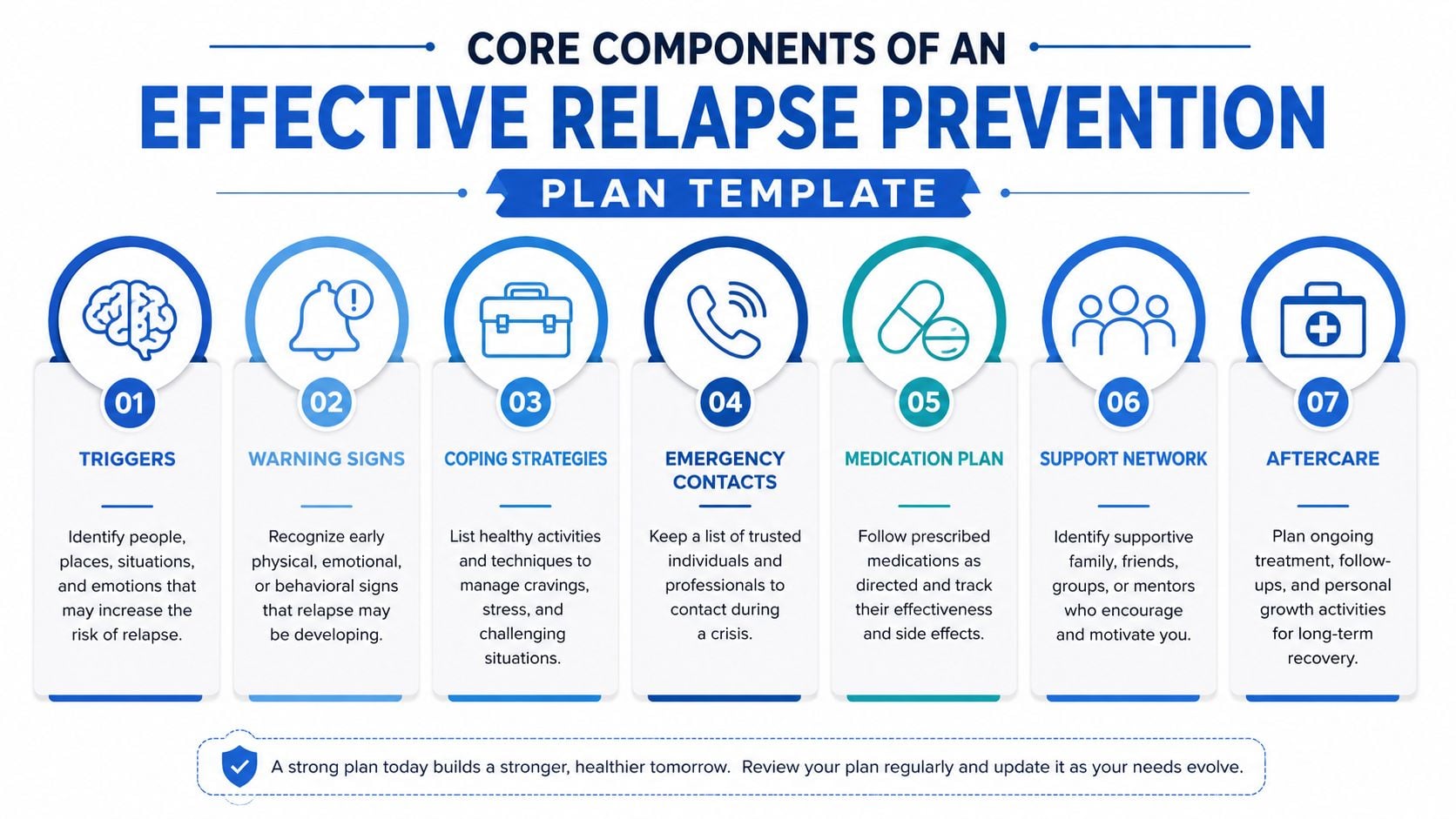
A useful template reads like an executable response protocol, not a collection of broad intentions. Expert guidance recommends including named triggers, early warning signs, coping actions in order, support contacts, daily structure, and instructions for what to do after a lapse in relapse prevention planning guidance.
Start with personal reasons and specific triggers
Write what recovery protects in your life. “I want to be healthy” is less useful than “I want to be present for my daughter and keep my housing.” Your reasons should be visible when motivation drops.
Then name triggers precisely:
- People: “My cousin who still uses,” rather than “certain people.”
- Places: “The parking lot where I used to meet my dealer,” rather than “old places.”
- Emotions: “Feeling rejected after an argument with my partner,” rather than “stress.”
- Body states: “Three nights of poor sleep and skipped meals,” rather than “feeling off.”
Specific wording helps you match each risk to an action. If the trigger is contact from someone who uses, the plan might say, “Don't reply, block the number, leave the room, and call my recovery mentor.”
Record warning signs before cravings peak
Warning signs can be behavioral, emotional, physical, or social. Examples include isolating, skipping appointments, becoming irritable, neglecting meals, romanticizing past use, or telling yourself that support is unnecessary.
Create a personal checklist and mark the signs that tend to appear first. Add an instruction beside each one, such as, “If I miss a session, I contact the provider the same day to reschedule and tell my support person.”
Rank coping actions
Don't list ten coping skills without an order. Put the fastest, simplest response first, then add stronger interventions if the craving continues.
- Immediate action: Leave the triggering location, drink water, and take slow breaths.
- Connection: Call the first available support person and say, “I'm having a strong craving and need you to stay on the phone.”
- Change of setting: Go to a meeting, clinic, trusted home, or other substance-free environment.
- Clinical escalation: Contact the counselor, prescriber, crisis service, or emergency support identified in your care plan.
Add medication, contacts, and aftercare
Your medication section should state the prescribed medication, the prescriber or clinic, the pharmacy, the safe procedure for a missed dose, and who to contact with side effects. Don't change or stop medication based on a craving or a difficult mood without speaking with the prescribing clinician.
List support contacts by role, not just by name. Include a counselor, prescriber, recovery mentor or sponsor, trusted family member, transportation support, and emergency services as appropriate. Finish with aftercare appointments, support meetings, transportation arrangements, daily routines, and a response plan for a lapse.
Understanding the Three Stages of Relapse
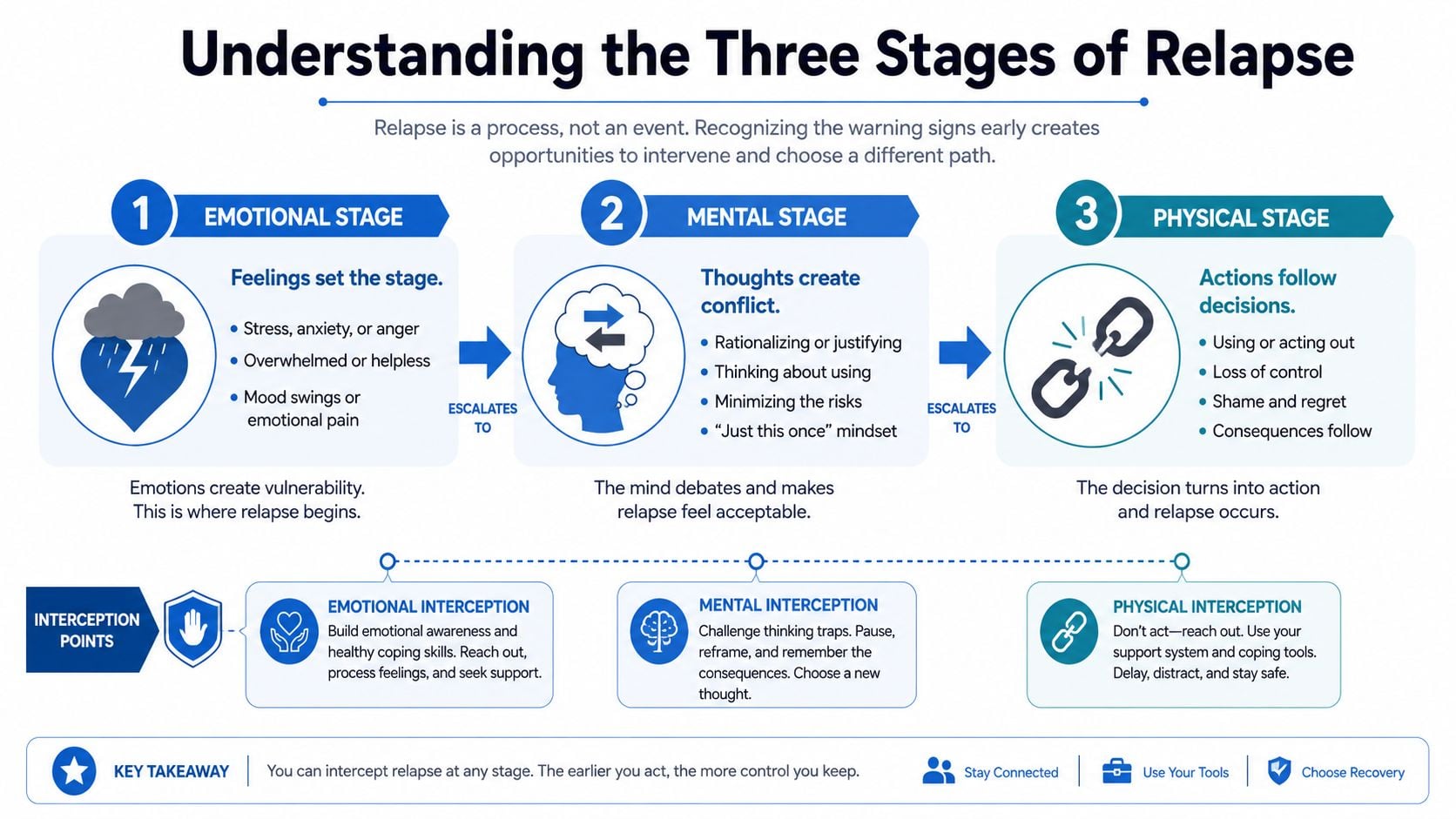
A person can reach the physical return to use after days of poor sleep, isolation, and internal bargaining. The three-stage model gives your plan earlier points for action: emotional relapse, mental relapse, and physical relapse. Use those stages to decide what you will do before a craving becomes an emergency.
Emotional relapse
During emotional relapse, using may not be on your mind. Risk shows up through deteriorating self-care and reduced contact with support. Poor sleep, skipped meals, missed meetings, unanswered messages, resentment, and isolation are practical warning signs.
Write an instruction beside each sign. For example: “If I miss an appointment or stop returning calls, I tell my counselor and support person that my risk is rising.” Track sleep, meals, mood, connection, and cravings in a short daily check-in. This creates a record you and your care team can review during the first weeks after treatment, including telehealth visits.
Mental relapse
Mental relapse involves bargaining. You may recall the pleasurable parts of past use, minimize the consequences, or think, “I could handle it now” or “I only need one.” Those thoughts deserve action, not debate.
Set pre-commitments while you are clear-headed. Read your reasons for recovery, leave the triggering situation, contact a named person, and postpone decisions until you have spoken with support. If medication-assisted treatment is part of your care, keep the prescriber or clinic in that contact chain. Do not change or stop prescribed medication because of a craving or difficult mood without clinical guidance.
Physical relapse
Physical relapse means returning to use. If it occurs, follow a written response rather than hiding it. Move away from substances and unsafe settings, contact a treatment professional or trusted support person, and use the emergency instructions prepared with your care team. Immediate danger, overdose risk, or a medical emergency requires urgent professional help.
Expand your checklist with this guide to warning signs of relapse, then adapt it to your history, medication routine, transportation limits, and available telehealth support. Educational material can identify patterns, but your plan must name who gets contacted and what happens next.
The following video can support a discussion with a counselor or loved one:
Structuring Your First 90 Days After Treatment
A generic template often names triggers but doesn't explain how to live safely while routine is being rebuilt. Early recovery needs a calendar that answers practical questions: When will you sleep, eat, attend care, travel, work, rest, and ask for help?
Research cited in an NIH-indexed review reports roughly 65% to 70% relapse in the first 90 days and more than 85% returning to drug use within one year in some cohorts, supporting the use of early-warning tracking and structured aftercare in this review of relapse timing. These figures describe findings in particular research contexts, not a prediction about you. They do show why the first weeks deserve deliberate planning.
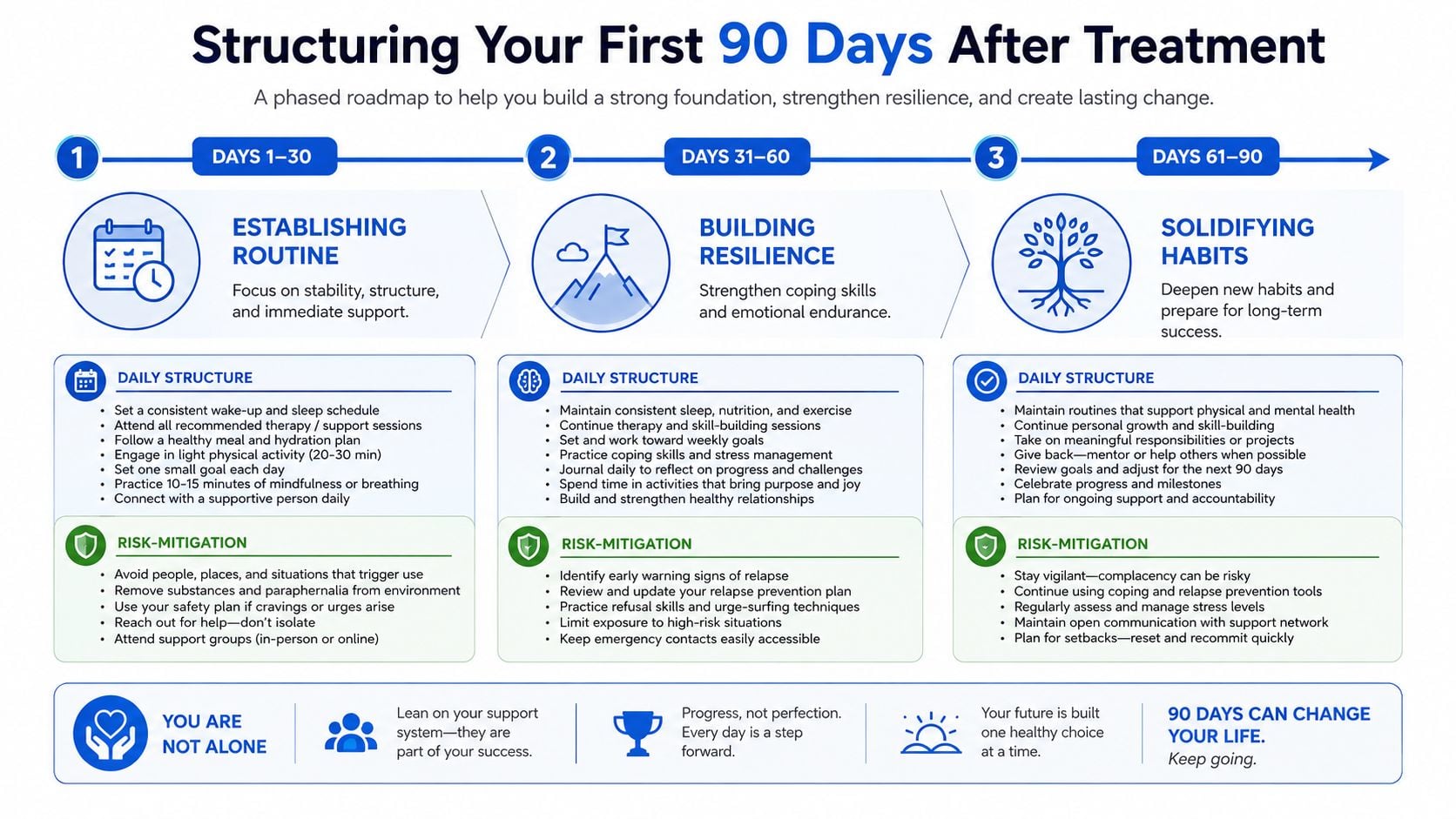
Days 1 through 30
Treat the first phase as stabilization. Put sleep and wake times on the calendar, plan simple meals, confirm transportation, and record every treatment appointment. Keep the day predictable enough that you aren't repeatedly deciding what to do while tired or distressed.
A practical daily entry might include:
- Morning: Wake, eat, take medication as prescribed, and complete a brief mood and craving check.
- Midday: Attend treatment, a recovery meeting, work preparation, or another planned activity.
- Afternoon: Eat again, complete a low-risk task, and check transportation for the next appointment.
- Evening: Contact a support person, avoid high-risk locations, prepare food and medication, and follow the planned bedtime routine.
If a craving spikes, don't improvise. Move through the ranked response in your plan, beginning with leaving the trigger and contacting support. If the first person doesn't answer, call the next person immediately.
Days 31 through 60
Keep the structure while testing resilience. Work re-entry, family conflict, financial pressure, or increased free time can expose gaps in the original plan. Schedule therapy, support meetings, exercise, meals, and downtime rather than allowing unplanned hours to expand.
Review what you've learned. Replace coping strategies that looked good on paper but failed in real situations. Add transportation backups, a plan for canceled appointments, and clear boundaries around people or places connected to past use.
Days 61 through 90
The danger at this stage can be overconfidence. A person may feel stable and decide that regular check-ins are no longer necessary. Keep the routines that protect sleep, treatment engagement, medication adherence, and connection, while working with your care team on appropriate changes.
Use aftercare planning guidance to help organize continuing care. Your plan should state who reviews it, which warning signs require increased contact, and what happens if work, housing, health, or family circumstances shift.
Adapting Your Plan for Co-Occurring Needs and Modern Care Settings
Recovery plans fail when they treat substance cues as the only source of risk. Stress, depression, insomnia, mood destabilization, medication changes, and missed care can all alter judgment and coping capacity. A more nuanced template makes those connections visible, as discussed in guidance on adapting relapse prevention plans.
Add a mental health risk track
Track mood alongside cravings. Write down the changes that usually precede trouble, such as withdrawing from others, sleeping poorly, feeling unusually agitated, or missing psychiatric appointments. Specify who receives the first call and what information they need.
Your plan might say, “If I notice worsening depression and stop answering messages, I contact my therapist and recovery mentor the same day. If I feel unsafe, I use the emergency instructions provided by my treatment team.” Don't diagnose yourself from a checklist. Use it to communicate changes early.
Make MAT instructions concrete
Medication-assisted treatment, or MAT, should have its own section. Record the clinic, prescriber, pharmacy, appointment process, medication storage instructions, and what to do if you miss an appointment or experience side effects. Never change dosage or stop prescribed medication without clinical guidance.
Include practical barriers. Who can help with transportation? What happens if the clinic closes or a telehealth connection fails? Which support person knows how to help you contact the care team?
Design for telehealth and outpatient care
Telehealth offers flexibility, but flexibility can become isolation if the plan doesn't protect privacy and attendance. Identify a private location, headphones, a backup phone number, and a procedure for reconnecting after a dropped session. If you miss an appointment, contact the provider rather than waiting for the next scheduled session.
Outpatient care also requires stronger self-management than a residential setting. Put medication, meals, sleep, transportation, session times, and check-ins into one calendar. Add family roles only with the person's consent, and define what loved ones should do when warning signs appear.
A modern plan should account for care continuity, not just craving intensity.
Building a Support Network That Actually Works
“Call someone if things get bad” is too vague for a crisis. A functioning support network names the person, their role, the preferred contact method, and the action they'll take when you reach out.
A therapist helps process patterns and build skills. A prescriber manages medication questions. A sponsor or recovery mentor can provide immediate peer accountability. A trusted family member may help with transportation, meals, boundaries, or noticing changes in behavior. These roles can overlap, but they shouldn't depend on one person being available at all times.
Build a contact hierarchy
Write contacts in order:
- First call: A person who usually answers and can stay present while the craving passes.
- Second call: A recovery mentor, sponsor, counselor, or another trained support.
- Clinical call: Your treatment provider or prescriber for medication, worsening symptoms, or care changes.
- Emergency response: The emergency or crisis resource specified by your clinicians for immediate danger.
Tell each person what you're asking for. Try: “I'm not asking you to fix this. I need you to stay on the phone while I leave this location and contact my counselor.” If a person doesn't answer, the plan should direct you to the next contact, not back to isolation.
Family members also need boundaries. Explain which information you want shared, what behavior signals concern, and how they should respond without arguing or shaming. The family relapse prevention guidance can help loved ones turn concern into coordinated action.
Review the contact list regularly. Remove unavailable numbers, confirm consent, and tell your support network when your plan changes. A list becomes a safety net only when the people on it understand their part.
Addiction Resource Center LLC offers medically supervised detox with MAT, residential rehabilitation through its partner facility, and IOP care in person or by telehealth, with relapse prevention and individualized aftercare planning included in the care process. Visit Addiction Resource Center LLC to discuss treatment options, arrange a tour, or get guidance for yourself or a loved one.