A typical 30-day inpatient rehab program in the U.S. commonly costs $5,000 to $20,000, while insured patients pay about $1,400 out of pocket on average for a substance-use inpatient admission. The same stay can cost very different amounts depending on your plan design and how long treatment lasts. You may be looking at a facility …

A typical 30-day inpatient rehab program in the U.S. commonly costs $5,000 to $20,000, while insured patients pay about $1,400 out of pocket on average for a substance-use inpatient admission. The same stay can cost very different amounts depending on your plan design and how long treatment lasts.
You may be looking at a facility quote while trying to answer a harder question: “What will our family owe?” The advertised program price is only the beginning. Your deductible, coinsurance, network status, prior authorization, clinical level of care, and number of approved days can change the final bill substantially.
I've walked families through benefit verifications where two patients at the same facility received very different estimates. One had remaining deductible responsibility and out-of-network exposure. Another had already met much of the deductible and stayed within the plan's authorization. The daily rate didn't tell either family what they would pay.
Table of Contents
- What Inpatient Rehab Actually Costs in 2026
- The Five Factors That Drive the Price
- What's Included and What Sneaks In Later
- Inpatient vs IOP vs Outpatient Costs
- Insurance, Medicare, and TRICARE Coverage
- Payment Options and Financial Aid Strategies
- Practical Ways to Lower Your Out-of-Pocket Cost
- Next Steps in Yuba City and Northern California
What Inpatient Rehab Actually Costs in 2026
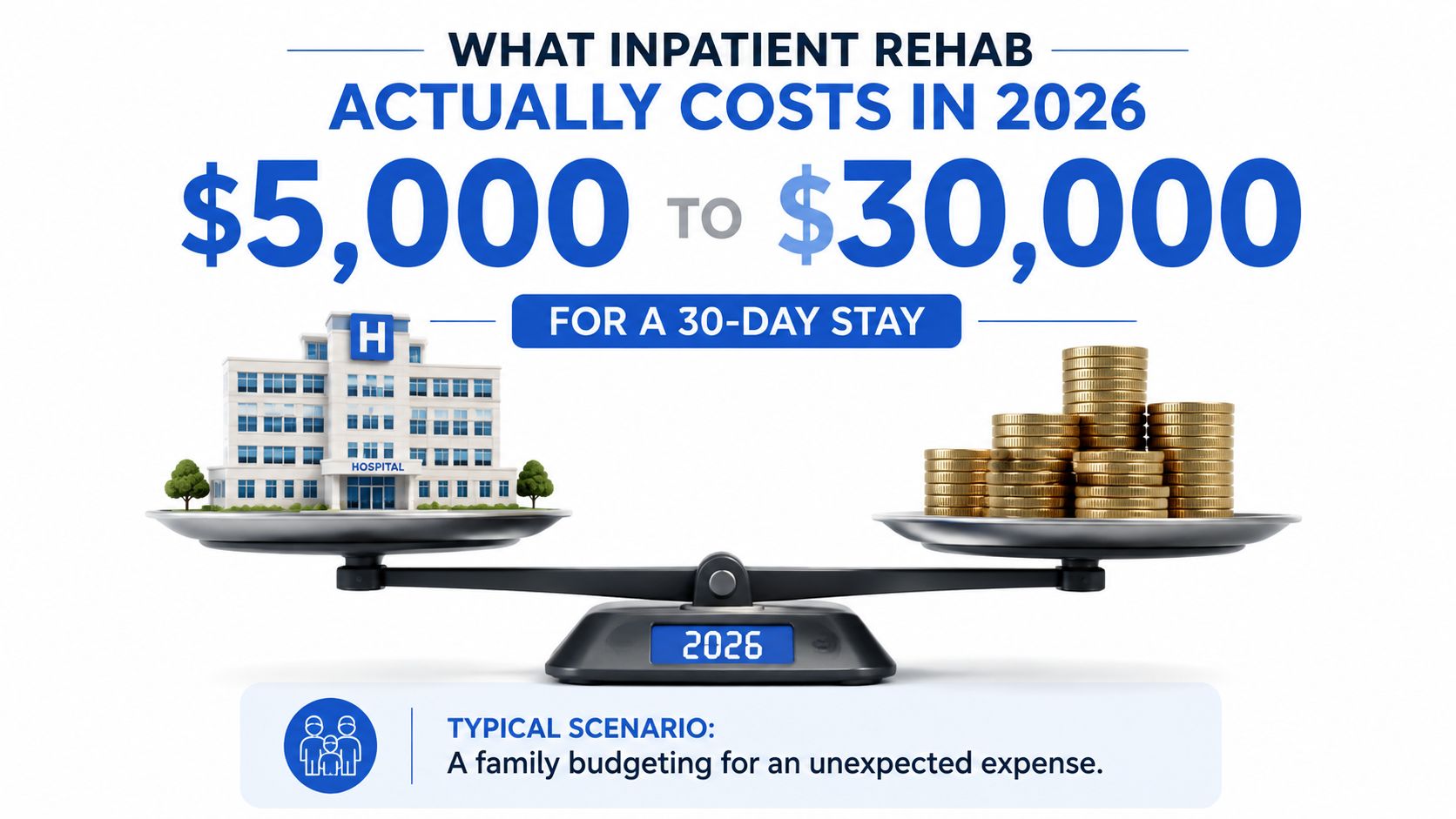
Families usually start with a 30-day residential stay because it's a familiar treatment format and an easy period to budget around. Published cost guides commonly place a standard U.S. inpatient program between $5,000 and $20,000 for 30 days, while a commercial-claims benchmark reports an average total substance-use inpatient admission cost of about $15,500 and average insured out-of-pocket responsibility of about $1,400. These figures come from different pricing perspectives, so they shouldn't be treated as a guaranteed quote. The published range reflects program pricing, while the out-of-pocket figure reflects what insured patients paid on average under varied plans. (Addiction Center's inpatient treatment cost guide, KFF-referenced rehab cost analysis, and 2026 commercial cost discussion)
Why one national price doesn't exist
“Inpatient rehab” can describe several billing arrangements. A hospital-based psychiatric or substance-use admission, medically supervised detox, residential treatment center, and freestanding rehabilitation program may all provide different services and submit different claims. A facility's sticker price therefore matters less than the specific services being billed and how your insurer processes them.
The KFF benchmark found that mental health and substance-use inpatient treatment represented 10% of all commercial inpatient stays in 2023, equal to 32 stays per 10,000 enrollees, with a mean substance-use inpatient admission cost of $15,500. It also found that 25% of substance-use admissions cost $19,200 or more, showing why an average can hide expensive episodes of care. (KFF-referenced cost benchmark)
The number you were quoted is not your final bill
Ask the admissions office to separate four figures:
- The facility's billed or self-pay rate
- The insurer's allowed in-network amount
- What the plan is expected to pay
- Your estimated responsibility, including deductible, copay, coinsurance, and noncovered services
The final answer depends on five things: length of stay, level of care, location, bundled clinical services, and amenities. The first two usually have the strongest effect on patient responsibility. A longer stay creates more billable days, while higher-acuity care can bring additional medical services and stricter authorization reviews.
Practical rule: Never approve admission based only on a daily rate. Ask for a written estimate tied to your exact insurance benefits and the proposed length of stay.
The Five Factors That Drive the Price
A rehab quote moves for identifiable reasons. Before comparing facilities, ask the admissions team to explain each one in plain language.
Length of stay
Time is usually the biggest multiplier. Published guides commonly estimate $1,500 to $5,000 for a seven-day detox, $5,000 to $20,000 for a 30-day program, and $12,000 to $60,000 for 60- to 90-day stays. Luxury or executive programs can exceed $80,000 per month. (Addiction Center's treatment-cost guide)
Those are program-price ranges, not promises about what insurance will allow or what you'll owe. If your plan applies coinsurance after the deductible, every additional authorized day can increase your share.
Level of care
Medically supervised detox and dual-diagnosis psychiatric stabilization generally require more clinical oversight than standard residential programming. That may mean physician involvement, medication management, nursing monitoring, laboratory work, or medication-assisted treatment. Ask whether those services are included in the facility rate or billed separately.
Geography
Location affects staffing, property, and operating expenses. Published cost guidance describes rural and lower-cost regions as generally less expensive than major metropolitan or destination markets. A lower-priced region can reduce the starting bill, but traveling may add transportation, lodging, and family-visit expenses.
Clinical services
A daily rate may bundle individual therapy, group work, medication management, MAT, nursing oversight, and lab testing. Another provider may charge some of those services separately. Compare the clinical package, not just the room price.
Amenities
Private rooms, chef-prepared meals, executive accommodations, equine therapy, and resort-style recreation can raise the cash price. Those upgrades often have little effect on what an insurer considers medically necessary, so confirm whether you'd pay the difference yourself.
| Cost Driver | Lower-End Example | Higher-End Example | Typical Impact |
|---|---|---|---|
| Length of stay | Short detox or brief residential care | Extended 60- to 90-day treatment | Adds or removes entire days of billing |
| Level of care | Standard residential programming | Medical detox or psychiatric stabilization | May add professional and monitoring charges |
| Geography | Rural or lower-cost market | Major coastal or destination market | Changes facility pricing and travel expenses |
| Clinical services | Core therapy and nursing oversight | MAT, psychiatry, labs, and intensive medical services | Can create separate ancillary claims |
| Amenities | Shared room and basic meals | Private room and executive services | Often increases self-pay exposure |
What's Included and What Sneaks In Later
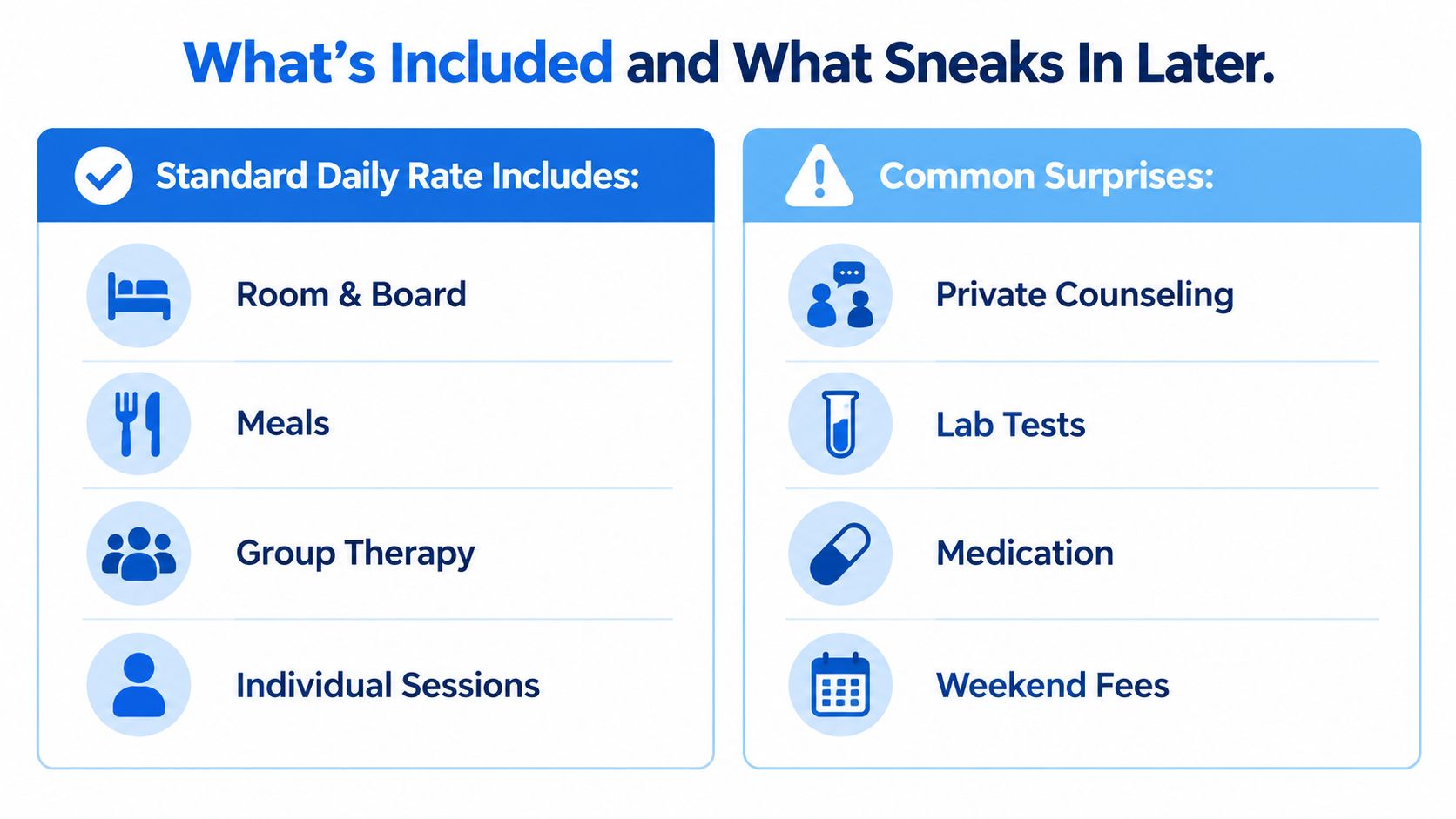
A standard residential rate often covers the essentials: room and board, meals, group therapy, individual counseling, nursing oversight, case management, and discharge planning. The exact package varies, so ask for the facility's written inclusions before comparing it with another provider.
Individual sessions may be limited by the program's schedule. Family therapy, psychiatric appointments, medication management, or specialized services may be available but not included in the base daily rate. The phrase “full-service program” doesn't tell you how the provider bills each service.
Charges families often miss
Request an itemized estimate that addresses:
- Professional fees: Physicians and psychiatrists may bill separately from the facility.
- Laboratory services: Routine labs and toxicology screens may create additional claims.
- Discharge medications: Take-home prescriptions may not be part of the residential invoice.
- Transportation: Travel to detox, residential care, appointments, or the airport may cost extra.
- Family sessions: Counseling beyond the included allowance can be billed separately.
- Step-down care: The program may recommend continuing care or IOP after discharge.
- Amenities: Elective upgrades and recreation fees may be excluded from medical coverage.
The most useful question is simple: “What is the estimated all-in patient responsibility for the planned stay, including likely ancillary services?” Ask the facility to identify what it knows, what depends on clinical need, and what your insurer still must authorize.
A written estimate won't eliminate every claim adjustment, but it gives you something to compare with the explanation of benefits later. Insurance can apply deductibles, copays, and coinsurance to ancillary line items separately, which is where patient responsibility can grow well beyond the original facility estimate.
Inpatient vs IOP vs Outpatient Costs
The cheapest level of care is not automatically the right level of care. A person at risk during withdrawal, unable to remain safe at home, or experiencing serious co-occurring psychiatric symptoms may need inpatient supervision. Sending that person to a lower level solely to reduce the initial bill can create a more expensive crisis later.
Published pricing guides commonly place a 30-day inpatient program at $5,000 to $20,000. Intensive outpatient care is commonly priced around $250 to $500 per day, while standard outpatient counseling costs less than IOP and is often billed per session. (Addiction Center's treatment-cost guide, CareRoute's rehab cost comparison)
| Level of Care | Typical Cost Range | Weekly Time Commitment | Best Fit For |
|---|---|---|---|
| Inpatient or residential | $5,000 to $20,000 for 30 days | Lives at the facility with structured care | People needing a controlled environment or continuous supervision |
| Intensive outpatient | $250 to $500 per day | Frequent scheduled treatment while living at home | People who are stable enough to sleep at home and maintain support |
| Standard outpatient | Lower than IOP and usually session-based | Scheduled appointments around normal responsibilities | People needing ongoing counseling and recovery support |
What changes outside the invoice
IOP lets a person remain at home, preserve employment when feasible, and maintain childcare or family responsibilities. Inpatient care removes the person from immediate triggers and provides a more controlled routine. Those differences affect the household financially even when they don't appear on the provider's bill.
Ask the treatment team for an ASAM level-of-care recommendation before choosing based on price. Then compare the cost, insurance rules, transportation needs, and expected duration for that recommended level. Families can also review this guide to intensive outpatient program costs when comparing residential and IOP options.
If the recommendation is inpatient care, focus on network status and authorization rather than trying to force a lower level. If the recommendation is IOP, ask whether the program offers in-person and telehealth appointments, medication support, relapse-prevention planning, and a clear escalation plan if symptoms worsen.
Insurance, Medicare, and TRICARE Coverage
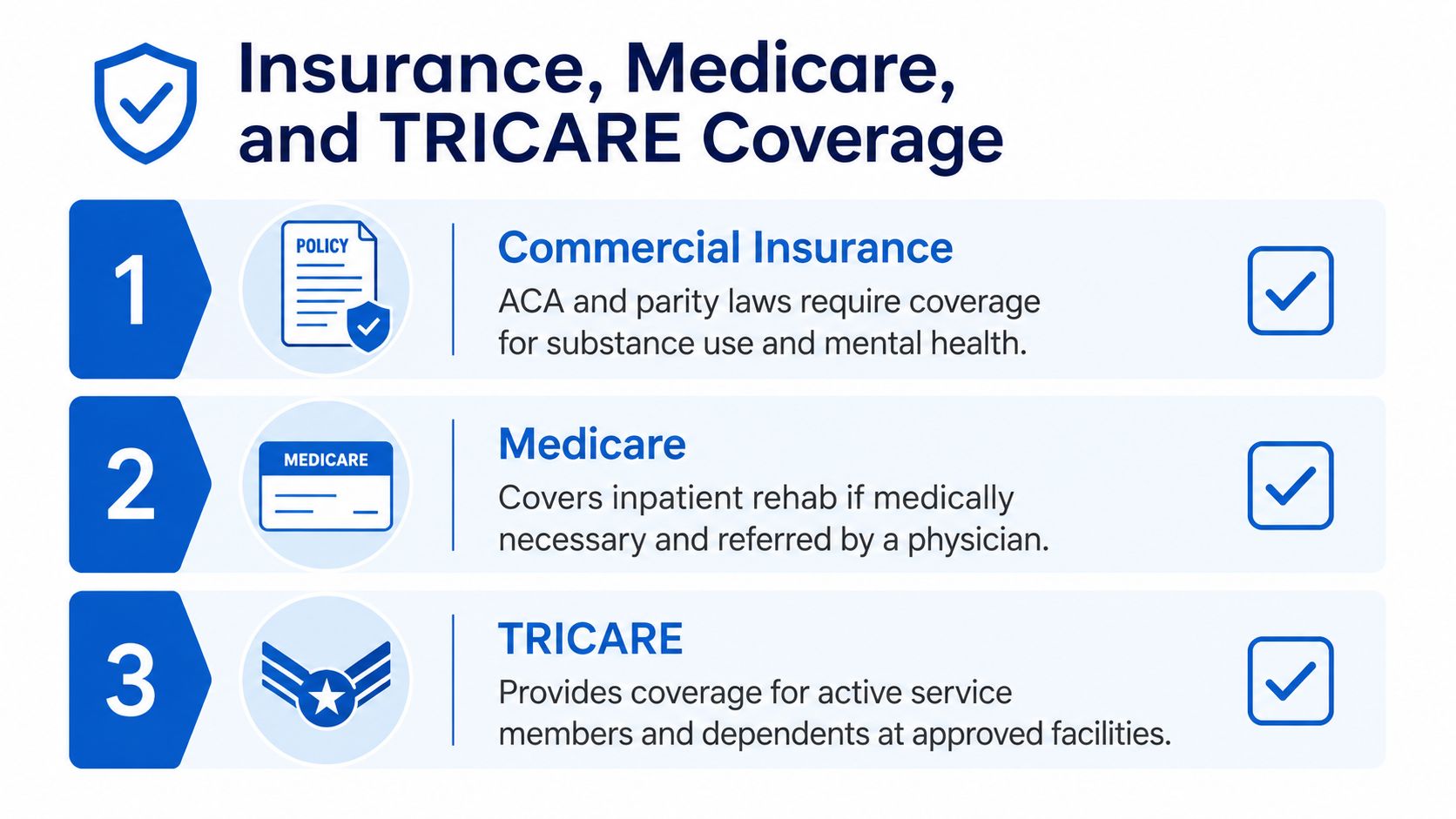
Insurance usually changes the cost of inpatient rehab more than the facility's advertised rate. Most commercial plans must cover mental health and substance-use treatment under the Affordable Care Act and federal parity requirements, but coverage doesn't mean the stay is free. Your deductible, copay structure, coinsurance, network status, authorization rules, and out-of-pocket maximum determine the amount left for you.
Commercial plans
Start by confirming that the facility is in network, not merely that it “accepts” your insurance. Ask whether residential treatment, medical detox, psychiatric stabilization, MAT, laboratory services, and professional fees are covered under separate benefits.
An insurer may authorize an initial stay and then require continued-stay reviews. The facility's clinical team typically submits documentation supporting medical necessity, but you should track the approved dates yourself. A denied extension can leave you responsible for days the plan didn't authorize.
Medicare
Medicare's inpatient rehabilitation coverage rules depend on the type of facility and benefit involved. Medicare guidance states that inpatient rehabilitation care can cost $0 per day after the deductible for days 1 through 60, then $434 per day for days 61 through 90 and $868 per day for days 91 through 150 under the cited 2026 benchmark. (Medicare's inpatient rehabilitation coverage guidance)
Those figures illustrate the core warning for any payer: a stay that looks affordable at the beginning can become much more expensive as it continues. Ask Medicare or the plan administrator to explain whether the proposed substance-use or psychiatric facility falls under the benefit being quoted.
TRICARE
TRICARE beneficiaries should confirm that the provider is TRICARE-authorized and that prior authorization has been completed before admission. Coverage can differ between TRICARE Prime, TRICARE Select, and substance-use treatment arrangements, including residential treatment demonstrations and benefit-year limits.
Families can use this TRICARE rehab coverage guide as a starting point, then verify the answer directly with TRICARE. For military families also comparing behavioral health options, information about using TRICARE for online therapy may help clarify how remote services fit into a broader care plan.
A short benefits call should produce specific answers:
- “Does my plan cover substance-use residential treatment and inpatient psychiatric care?”
- “Which facilities near me are in network?”
- “Do I need prior authorization or a physician referral?”
- “How much of my deductible remains?”
- “What is my copay or coinsurance per day?”
- “What is my out-of-pocket maximum?”
- “Are physician fees, labs, medications, and transportation billed separately?”
- “How many days can be authorized, and how are extensions reviewed?”
Write down the representative's name, the call date, and the reference number. Ask the facility to verify the same benefits and provide its estimate in writing.
A benefits verification video can help families understand which questions to ask before admission.
Payment Options and Financial Aid Strategies
Insurance rarely answers the entire payment question, especially when a deductible remains or the chosen provider is out of network. Ask the facility's financial counselor to review payment options before admission, not after the first bill arrives.
Start with the provider
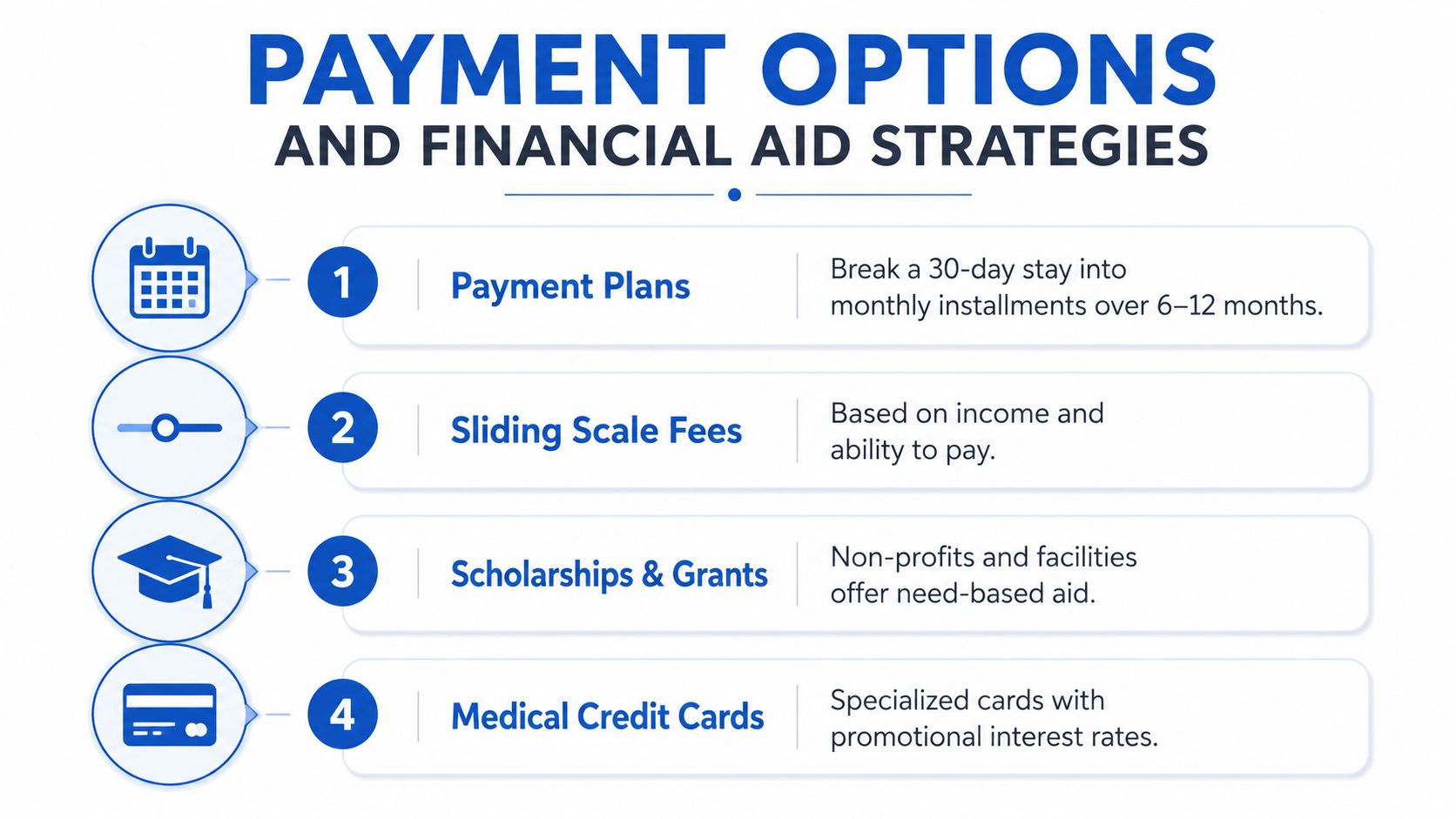
Some facilities offer written payment plans that divide a balance into monthly installments over 6 to 12 months. Nonprofit centers may offer sliding-scale fees based on verified income, and treatment providers or charitable organizations may offer need-based scholarships. The SAMHSA Treatment Locator can help identify programs, while organizations such as 10,000 Beds may provide treatment-access resources.
Medical financing products, including CareCredit and Prosper Healthcare Lending, may offer promotional interest terms to qualifying applicants. Read the agreement carefully. A deferred-interest arrangement can become costly if the balance isn't handled under the stated terms.
Personal loans and 401(k) hardship withdrawals are additional possibilities, but both can affect long-term finances. Ask a tax or financial professional before using retirement funds, especially if another payment route is available.
State-funded treatment slots may be available through county behavioral health departments, and some providers can help families apply. Be direct about income, insurance status, urgency, and clinical need.
Financial warning: A legitimate treatment program should explain its rates and payment terms clearly. Wire-transfer-only or cryptocurrency-only demands are serious fraud warnings, and you shouldn't send money before independently verifying the provider.
Families can also review this guide to paying for rehab for questions to ask about self-pay, financing, and benefits verification.
Practical Ways to Lower Your Out-of-Pocket Cost
The strongest savings usually come from decisions made before admission. Use this checklist with the admissions counselor and insurer.
Before admission
- Choose in-network care: Confirm the exact facility and billing entity are participating providers. “We work with your insurance” isn't enough.
- Get authorization in writing: Ask for the approved level of care, dates, and any conditions for continued coverage.
- Match duration to clinical need: Don't pay for the maximum possible stay if the treatment team recommends a shorter course, but don't leave early solely to avoid a bill.
- Request an all-in estimate: Include facility charges, professional fees, labs, medications, transportation, and likely step-down care.
During treatment
Track the authorized dates and compare them with the facility's daily billing. If the team recommends extending care, ask what clinical documentation supports the request and when the insurer will review it.
Decline elective upgrades that don't change the clinical plan. A private room or premium amenity may improve comfort, but it may also sit outside the insurer's allowed benefit.
After discharge
Review the itemized bill for duplicate room charges, unbundled laboratory services, pharmacy markups, and services you didn't receive. Ask the provider to correct errors before paying the balance.
You can also negotiate a self-pay balance by offering prompt payment or submitting a documented financial-hardship letter. A qualified tax professional can explain whether eligible treatment expenses may fit IRS medical-expense deduction rules for your situation.
Next Steps in Yuba City and Northern California
Families in Yuba and Sutter counties don't need to solve the entire financial puzzle before making the first call. Ask the 24/7 line at Addiction Resource Center to complete a confidential benefits check for commercial insurance, Medi-Cal, Medicare, or TRICARE, and request confirmation of in-network options serving Marysville, Yuba City, and the greater Sacramento referral region.
Bring insurance ID cards, recent medical records, and a current medication list to the assessment. Ask whether an in-person or virtual tour is available, then use it to evaluate clinical fit, family-visiting rules, privacy, transportation, and the practical distance from home.
Addiction Resource Center LLC provides benefits guidance, medically supervised detox with MAT, residential rehabilitation through its partner facility, and IOP services available in person or through telehealth. If care outside the immediate area is recommended, ask about transportation coordination and family lodging.
One phone call can clarify the likely level of care, insurance requirements, and expected patient responsibility. You won't have a perfect final number until the plan and provider verify the claim details, but you can get far closer than a generic online price range.
Addiction Resource Center LLC helps adults and families in Yuba City and Northern California with benefits verification, medically supervised detox, residential rehabilitation referrals, MAT, and in-person or telehealth IOP care. Visit Addiction Resource Center LLC to request a confidential benefits check, schedule an assessment, or discuss the cost of treatment before making a commitment.