At midnight, a family may find the right treatment center, speak with an intake coordinator, and still learn that detox cannot begin until the insurer completes prior authorization. The patient may be clinically ready, the bed may be open, and everyone may agree that waiting is unsafe. Yet the admission can remain conditional on a …

At midnight, a family may find the right treatment center, speak with an intake coordinator, and still learn that detox cannot begin until the insurer completes prior authorization. The patient may be clinically ready, the bed may be open, and everyone may agree that waiting is unsafe. Yet the admission can remain conditional on a payer's approval rather than on the person's willingness to accept help.
That moment feels personal, but it's usually a process problem. The insurer wants clinical information before agreeing to cover a service, while the treatment team is trying to protect a narrow opportunity for the patient to enter care. This guide translates prior authorization requirements into practical steps for substance use treatment, from the first benefits call through continued-stay reviews and appeals.
Table of Contents
- When Insurance Stands Between You and Treatment
- What Prior Authorization Really Means for Addiction Care
- How Authorization Works Across Detox, MAT, Residential, and IOP
- Documentation Insurers Typically Require
- Timelines, Urgent Review, and Federal Deadlines
- How a Treatment Center Helps Move Approval Forward
- Tips to Speed Up Approval and Avoid Costly Delays
When Insurance Stands Between You and Treatment
The call often starts. A parent, spouse, or adult child has spent the evening searching for a detox program, found an available bed, and called with one question: “Can we bring them in tonight?” The admissions coordinator asks about withdrawal symptoms, recent substance use, medications, safety concerns, and insurance. Then comes the answer the family didn't expect: the center must verify benefits and obtain authorization before scheduling covered detox.
The patient may be shaking, frightened, intoxicated, or finally willing to accept help. The family may have spent hours persuading them to stay on the phone. Hearing that an insurer still has to review the admission can feel like another rejection.
Practical rule: Clinical readiness and insurance clearance are related, but they aren't the same decision.
Prior authorization means the payer must review a requested service before it agrees to cover it. The review may result in approval, a request for more information, a partial approval, a lower level of care, or a denial. A center can continue gathering information while the insurer reviews the request, but the family should ask exactly what can happen during that period, including whether an urgent review is being requested and what payment responsibility would apply if coverage isn't confirmed.
Families also deserve a clear explanation of their broader behavioral-health rights. A plain-language resource about mental health parity from Benely can help explain why mental health and substance use benefits generally shouldn't be managed more restrictively than comparable medical benefits without a valid reason. That doesn't eliminate authorization, but it gives families better questions to ask when a plan applies confusing or inconsistent rules.
Before the call ends, request the reference number, the service dates submitted, the level of care requested, the name of the payer department handling the review, and the next follow-up point. A guide to verifying insurance coverage for addiction treatment can help families organize those details instead of trying to remember them while managing a crisis.
What Prior Authorization Really Means for Addiction Care
Prior authorization is a payer's pre-approval process. Before covering certain treatment, medication, or services, an insurer asks the treating provider to submit clinical information. A utilization-management nurse or medical reviewer then compares the request with the plan's rules and the patient's documented needs.
A construction permit is a useful comparison. A contractor may have a complete design and a safe site, but framing can't begin until the permit is issued. In the same way, a treatment team may recommend detox or residential rehabilitation, but the payer may require authorization before it accepts financial responsibility for that setting.
Why addiction services receive close review
Addiction treatment can involve changing levels of care, medication decisions, withdrawal monitoring, psychiatric risk, and uncertain discharge timing. Insurers may therefore ask for detailed evidence that the requested setting matches the patient's current condition. A reviewer may want to know whether withdrawal can be safely managed outside a medical detox setting, whether residential structure remains necessary, or whether outpatient care is clinically sufficient.
The review isn't supposed to replace the treating clinician's judgment. It tests whether the requested service meets the payer's medical-necessity criteria. In practice, that means a diagnosis alone usually isn't enough. The request needs a current description of symptoms, risks, functional impairment, treatment history, and the reason a less intensive option would be unsafe or ineffective.
The rules also differ by program and market. In 2024, Medicare Advantage insurers made nearly 53 million prior authorization determinations, or about 1.7 requests per enrollee, and fully or partially denied 4.1 million requests, 7.7% of the total. 80.7% of appealed denials were overturned. Traditional Medicare had just over 625,000 requests in fiscal year 2024, with a 22.9% denial rate, demonstrating that the scope and outcome of authorization vary substantially by insurance structure. These figures come from KFF's review of Medicare Advantage prior authorization activity, not from addiction treatment alone.
The clinical difference in addiction care
For many medical services, a delay is frustrating. In addiction care, a delay can coincide with withdrawal, renewed substance use, loss of transportation, or a decision to stop pursuing treatment. That's why the level-of-care assessment must communicate urgency in clinical terms, not only state that the patient “needs rehab.” The level-of-care determination process helps frame the requested setting around safety, symptoms, and treatment needs.
How Authorization Works Across Detox, MAT, Residential, and IOP
Prior authorization doesn't look identical across the continuum. The same patient may encounter different review questions when moving from detox to medication-assisted treatment, residential care, or an intensive outpatient program.
| Level of Care | Typical Authorization Window | Common Review Trigger | Reauthorization Frequency |
|---|---|---|---|
| Medical detox | Urgent or expedited review may be requested when withdrawal risk is active | Withdrawal severity, medical instability, overdose risk, or unsafe discharge | Review may occur during the admission if care continues |
| MAT induction and maintenance | Initial review may be routine or expedited depending on medication and risk | Medication necessity, diagnosis, prior treatment, and ongoing response | Periodic reauthorization may apply to continued medication or related services |
| Residential treatment | Often requires detailed initial review and concurrent review | Whether symptoms, relapse risk, co-occurring needs, and functioning require a structured setting | Continued-stay review at intervals set by the payer |
| IOP | Routine review is common unless safety concerns make the request urgent | Attendance capacity, relapse risk, therapy needs, and step-down readiness | Reauthorization may be requested at set intervals, including monthly review under some plans |
Medical detox and MAT
Detox requests often require the team to describe current or anticipated withdrawal risk, recent use, vital-sign concerns, medications, and the consequences of delaying care. A payer may ask whether the patient can safely remain at home or receive a less intensive service. If medication-assisted treatment is started, the initial request may focus on the medication and induction plan, while later reviews examine response, adherence, side effects, and the need for continued services.
A medication request can also involve more than the prescription itself. The plan may review office visits, monitoring, counseling, toxicology, or the setting where induction occurs. Families should ask whether each component has its own authorization requirement.
Residential care and IOP
Residential treatment commonly draws questions about why outpatient care isn't safe or adequate. The clinical team may need to document repeated relapse, an unstable living environment, psychiatric symptoms, inability to manage cravings, or medical and behavioral risks that require continuous structure. A reviewer may approve fewer days than requested, ask for a peer-to-peer conversation, or authorize the admission while reserving continued coverage for a later review.
IOP requests usually center on participation and step-down logic. The payer may want attendance expectations, therapy frequency, recovery goals, medication management, relapse-prevention planning, and the criteria for moving to routine outpatient care. The intensive outpatient program requirements guide can help families understand why an IOP request needs a specific treatment plan rather than a general request for counseling.
Documentation Insurers Typically Require
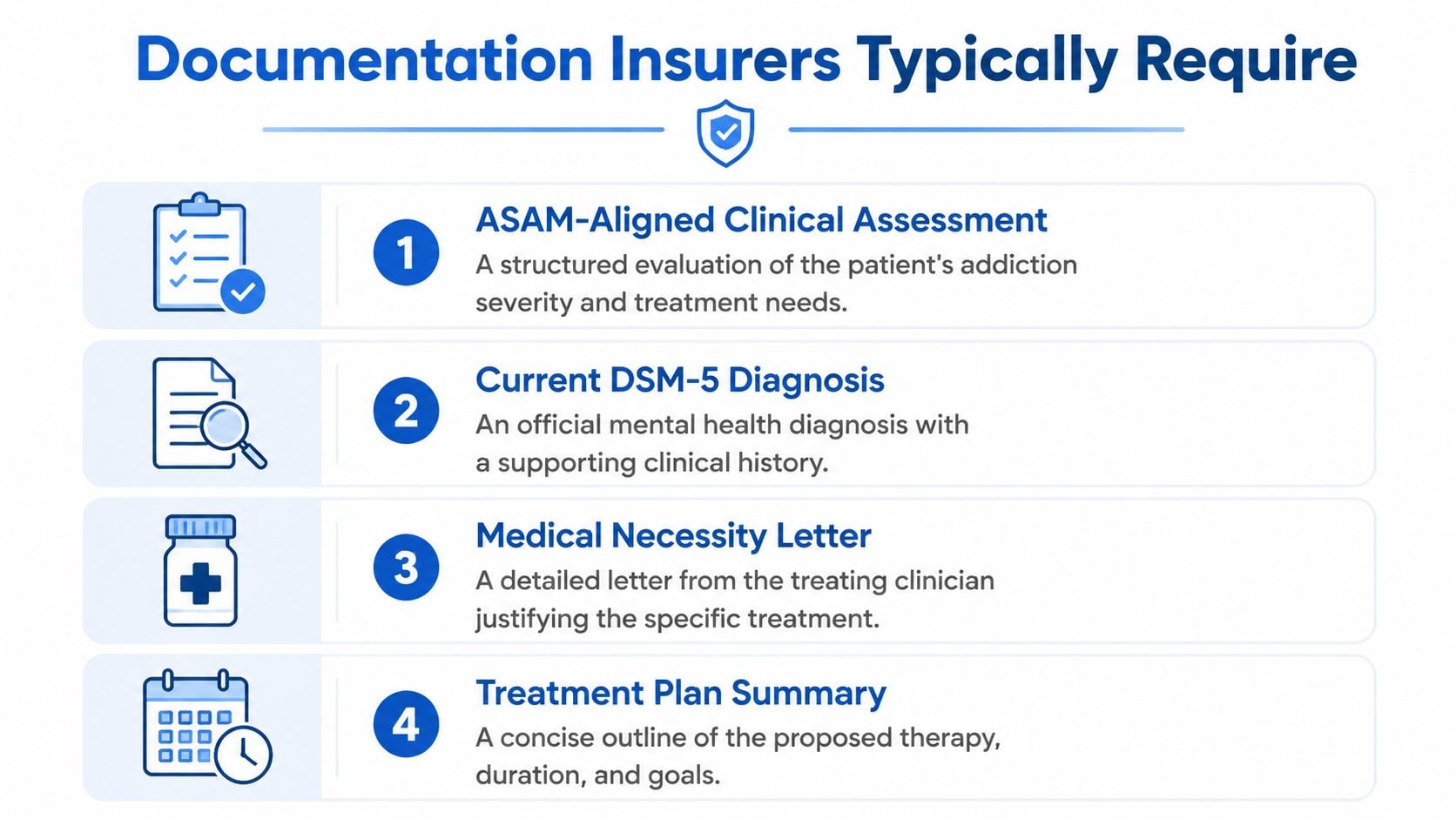
The strongest authorization requests answer four questions in order: What is happening now? What diagnosis explains it? Why is this level of care necessary? What will show that continued care is still needed?
The clinical assessment
An ASAM-aligned assessment should connect substance use with immediate risks and functional problems. It may include recent use, withdrawal symptoms, vital-sign information, toxicology results, medical history, psychiatric symptoms, housing conditions, support systems, and prior treatment. Risk-of-withdrawal scores, when clinically appropriate, give the reviewer a structured way to understand why detox or medical monitoring is being requested.
The diagnosis and supporting history
A current DSM-5 diagnosis should be supported by a concise clinical history. The record should distinguish the substance involved, the pattern of use, symptom severity, prior withdrawal, overdose history, and co-occurring conditions. Psychiatric notes matter when depression, psychosis, trauma symptoms, suicidal thinking, or anxiety affects placement and safety.
The diagnosis should not sit alone on a form. A reviewer needs to see how it affects daily functioning and why the proposed service addresses the documented problem.
The level-of-care justification
A medical-necessity statement should name the requested setting and explain why alternatives are insufficient. “Patient needs residential treatment” is weak without the reasoning behind it. A more useful narrative describes the risks, failed supports, current impairment, co-occurring needs, and specific services the setting can provide.
Prior treatment attempts can be important, but they shouldn't be treated as a universal prerequisite when the current risk requires a higher level of care. If lower-intensity care was attempted, the record should identify what happened, when it happened, and why it didn't meet the patient's needs.
Continued-stay criteria
Extensions require fresh information. The team should document participation, symptoms, medication response, cravings, safety concerns, discharge barriers, family or housing issues, and measurable treatment goals. The request should explain what remains unsafe or incomplete and what clinical change would support step-down.
Missing biopsychosocial summaries, vague medical-necessity language, inconsistent dates, and absent discharge criteria commonly create avoidable questions. Before submission, compare the assessment, diagnosis, treatment plan, and requested dates so the payer receives one coherent clinical story.
Timelines, Urgent Review, and Federal Deadlines
A prior authorization request has two clocks. The first is the insurer's decision window. The second is the patient's willingness and ability to enter care. The second clock can move faster.
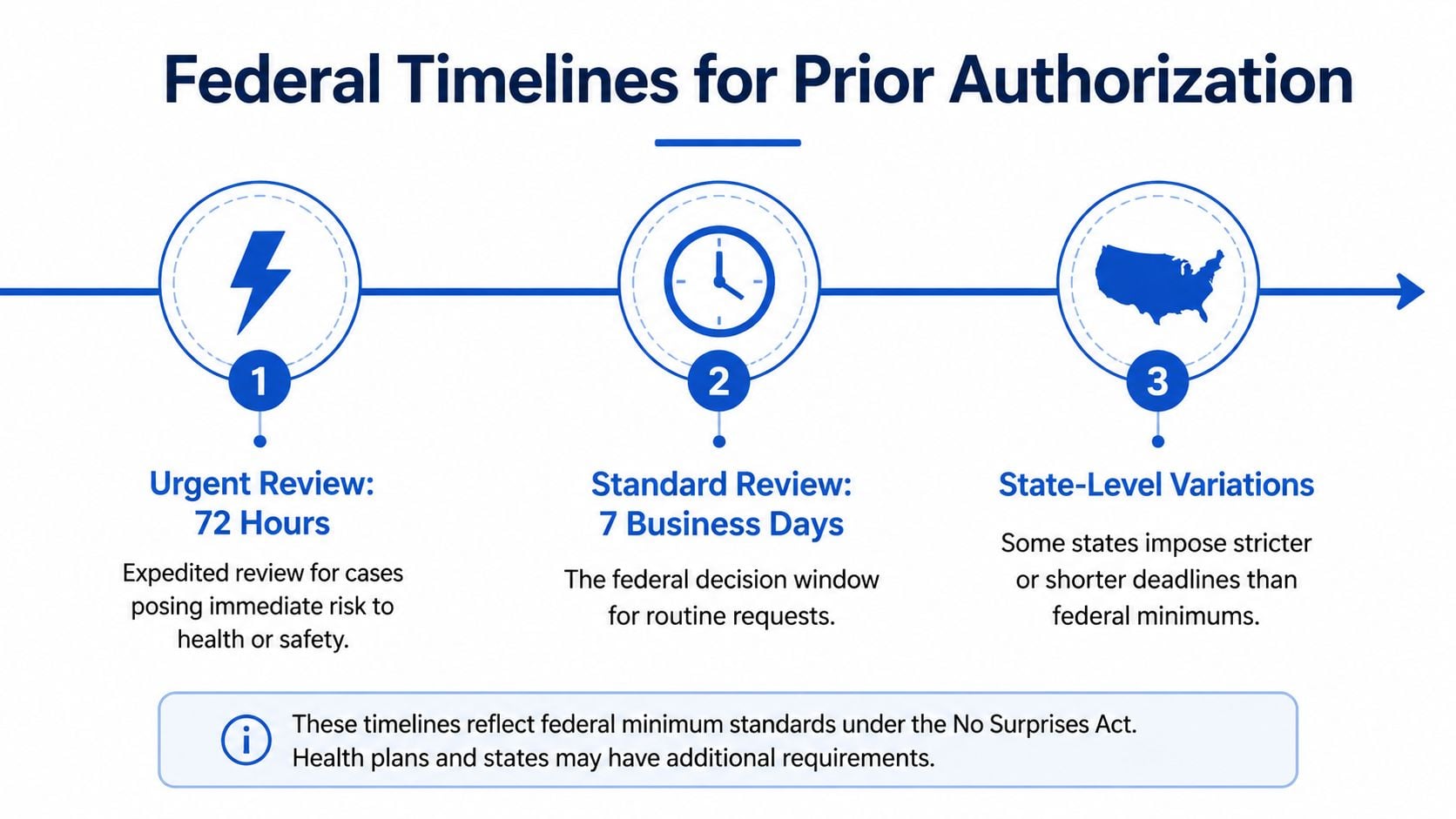
CMS requirements beginning primarily in 2026 require impacted payers to respond within 72 hours for expedited requests and seven calendar days for standard requests, with specific reasons for denials. CMS is also moving toward API-based prior authorization workflows beginning in 2027, as described in its final rule on improving the prior authorization process. These requirements apply to impacted plans and services, so the treatment center still needs to confirm the rules governing the patient's particular policy.
What makes an addiction request urgent
An expedited request should describe an immediate clinical risk, not use the word “urgent.” Active withdrawal risk, a recent overdose, co-occurring suicidal thinking, pregnancy, or an imminent unsafe discharge may support expedited handling when documented by the treating team. A routine IOP request, a planned MAT induction without acute safety concerns, or a residential extension scheduled well in advance may follow the standard process.
State rules and individual plan contracts can impose different or shorter windows. Ask the center which deadline applies, when the request was received, whether the payer marked it expedited, and what information is still missing.
A deadline is useful only if someone tracks the submission time, the payer's receipt, the reviewer's questions, and the decision.
If an insurer misses a required deadline, coverage may be treated as approved under applicable rules. Families still shouldn't assume that this automatically creates an available bed or resolves every billing issue. During withdrawal or a fragile decision to seek help, the patient may not have time to wait for an administrative remedy.
Initial authorization also differs from concurrent review. An initial request asks whether the admission should begin. A concurrent review asks whether continued treatment remains medically necessary after the approved period. The center should request the next review date before the first approval expires.
Use the following video as another plain-language aid while discussing the process with the admissions team.
How a Treatment Center Helps Move Approval Forward
A capable admissions team doesn't treat authorization as a passive waiting period. It runs the clinical intake, benefits verification, documentation, submission, and follow-up tracks at the same time.
The first task is to complete a clinically useful intake before the request goes to the payer. That means collecting the patient's substance-use history, withdrawal concerns, medication list, recent medical and psychiatric records, safety information, and proposed level of care. The utilization team then converts those findings into the insurer's required forms and language without stripping away the clinical detail.
The handoff matters
Admissions may gather the story, clinicians may write the assessment and treatment plan, and billing or utilization staff may submit the request. Weak handoffs create mismatched dates, missing records, and unclear service codes. Strong handoffs give the reviewer one consistent answer to three questions:
- Why now: What makes treatment necessary at this point?
- Why here: Why does the requested setting match the patient's needs?
- Why this duration: What goals and review criteria support the requested period?
Centers with direct payer portals or in-house utilization staff may avoid some of the delays associated with paper-based submissions. Electronic delivery doesn't guarantee approval, but it can make receipt, status, and missing-information requests easier to track.
Peer-to-peer review and escalation
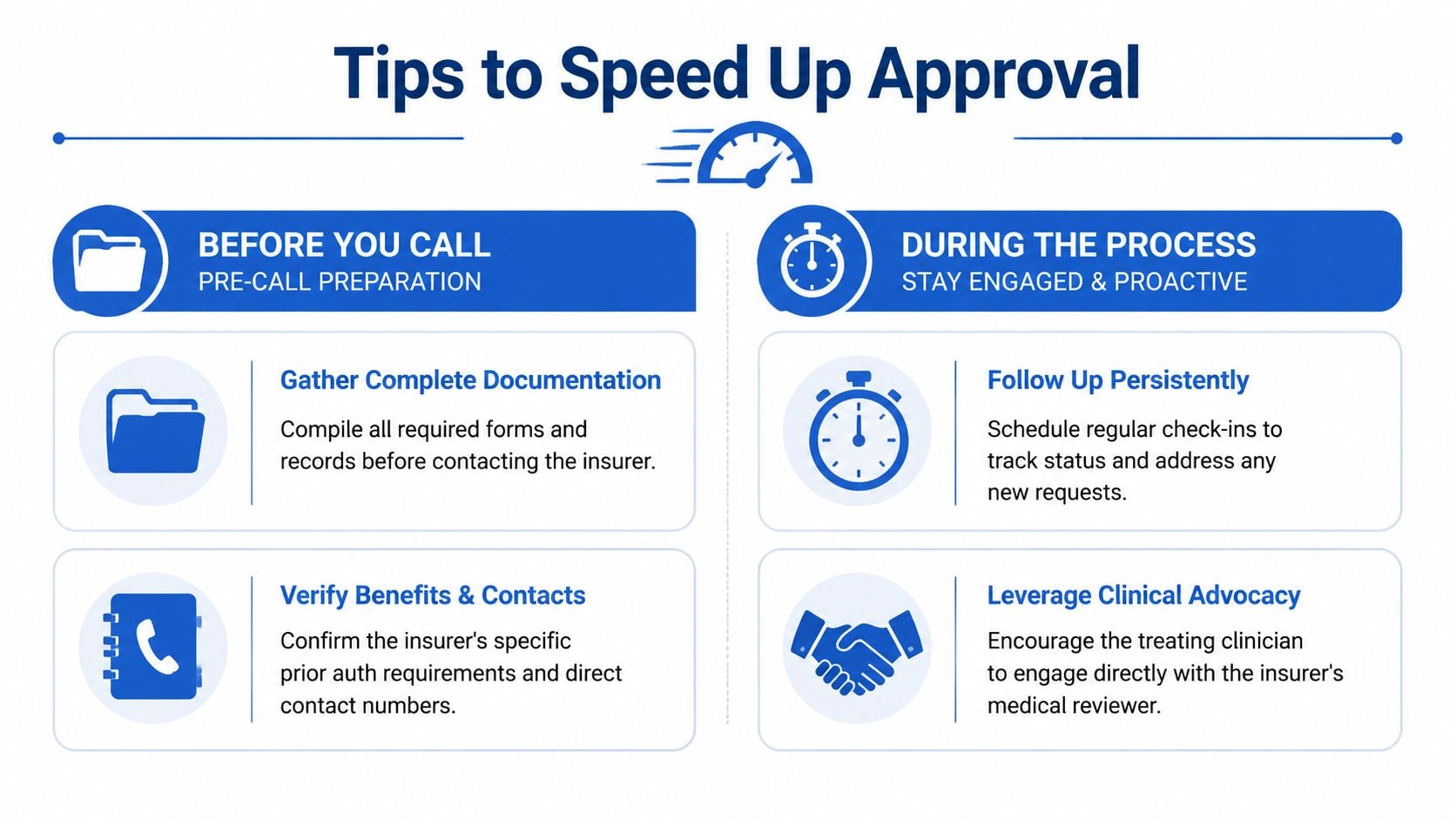
When a medical reviewer questions the level of care, a peer-to-peer conversation can let the treating clinician explain facts that a form cannot capture. Same-day clinical availability matters because the payer may offer a narrow appointment window. The clinician should be ready to discuss current risk, failed lower-level options, medication needs, and the consequences of delay.
A family liaison also has a practical role. While a patient is intoxicated, withdrawing, or overwhelmed, a family member may be the only person able to obtain prior discharge papers, medication bottles, laboratory records, or contact information for earlier providers. The liaison can't make clinical claims for the patient, but they can help close documentation gaps quickly.
If a request is denied, the center should identify the exact reason, obtain the written decision, correct missing information, and determine whether a reconsideration, peer-to-peer review, or formal appeal is appropriate. Approval speed is often engineered through preparation and communication. It shouldn't depend on repeatedly faxing the same incomplete packet.
Tips to Speed Up Approval and Avoid Costly Delays
Public reporting can tell us that insurers receive, approve, deny, and process prior authorization requests, but broad metrics don't answer the question families face: Will this detox admission, residential stay, MAT service, or IOP request be covered for this patient? KFF notes that required disclosures still provide little insight into which specific services are approved or denied, even as the first year of reporting covers 2025 data posted in 2026, as explained in KFF's analysis of prior authorization transparency.
The practical bottleneck may therefore be delay-driven drop-off, not only the final denial. Physician survey findings reported through the AMA indicate that 95% of doctors said prior authorization delays necessary care, 79% reported patients abandon treatment because of authorization hurdles, and 26% reported a serious adverse event tied to prior authorization delays. Those figures come from the AMA's prior authorization research and reports.
Before the call
- Gather complete documentation: Have the diagnosis, recent laboratory or toxicology information, medication list, prior treatment records, withdrawal-risk notes, and level-of-care rationale ready.
- Verify benefits and contacts: Ask whether the policy requires authorization for the requested service, which department handles it, whether the request can be expedited, and where clinical records must be sent.
- Clarify financial exposure: Confirm the approved dates, covered setting, deductible or cost-sharing responsibilities, and what happens if the payer authorizes fewer days than requested.
During the review
- Use precise clinical language: Replace generic statements with observable facts, such as current withdrawal symptoms, inability to remain safe at home, or documented failure of a lower level of care.
- Track the clock: Record when the payer received the request, every follow-up call, outstanding records, reviewer questions, and the next decision deadline.
- Request clinical contact: If the reviewer questions medical necessity, ask whether the treating clinician can complete a peer-to-peer discussion.
- Keep a parallel path open: Discuss whether an interim medication start, a safe waiting plan, or a self-pay bridge is clinically and financially appropriate. Don't begin an alternative arrangement without understanding its risks and payment terms.
Addiction Resource Center LLC offers benefits guidance and substance use treatment options that include medically supervised detox with MAT, residential rehabilitation through a partner facility, and IOP in person or by telehealth. Visit Addiction Resource Center LLC to discuss prior authorization requirements, available levels of care, and the records needed to begin an insurance review.
Nutze the exact CTA link once? We used exact once. Good. But accidental "Nutze" no. Need remove? final already includes "Nutze"? It appears in analysis? final starts no. Wait CTA says exact structure and publisher once. We included publisher in CTA, but publisher was also mention? CTA only. Fine. Need no divider other than CTA, we have none. Word count shorter 2800 maybe ~2500. Fine. But source citation quantitative claim 2024 survey not used. Good. Contradiction "7 business days" infographic exact demanded includes text 7 Business Days, but verified says seven calendar days. Exact image only alt no issue. Table qualitative. Need CTA exact 2-3 sentences, currently 2. Great.