You may be reading this after another night of drinking, taking pills to sleep, or using something that quiets the memories for a few hours. Maybe your spouse found this page, a buddy sent it, or you searched in private because you're not ready to explain everything to a stranger. You don't need a perfect …

You may be reading this after another night of drinking, taking pills to sleep, or using something that quiets the memories for a few hours. Maybe your spouse found this page, a buddy sent it, or you searched in private because you're not ready to explain everything to a stranger. You don't need a perfect explanation before you call. You need a safe starting point, a provider that understands access and insurance, and a plan that treats the substance use without ignoring what's underneath it.
Addiction treatment for veterans should work like treatment for any adult who needs care, with practical attention to medical risk, mental health, privacy, transportation, and insurance. VA benefits and TRICARE can open different doors, including detox, residential care, intensive outpatient treatment, and telehealth. The right choice depends less on your identity as a veteran than on what you need this week and how quickly you can get there.
Table of Contents
- Why Veterans Reach Out for Help Differently
- The Main Levels of Care Available
- VA Care Versus TRICARE Civilian Care
- Understanding Medication-Assisted Treatment for Veterans
- How to Access Benefits and Start Treatment
- Integrated Care for PTSD and Substance Use
- Why a TRICARE-Accepting Local Center Can Be the Faster Route
- What Stops Veterans From Starting and What to Do Instead
Why Veterans Reach Out for Help Differently
The first call often happens. A veteran notices that one drink has become several, that sleep depends on a substance, or that irritability follows them into every conversation. They may sit with the phone in hand, search for treatment, and close the browser before anyone sees it.
That hesitation makes sense. Military training rewards composure, self-reliance, and solving problems without creating extra work for the team. Those habits can protect people in service, but they can become obstacles when alcohol or drugs start controlling sleep, mood, pain, or relationships. Asking for help isn't a failure of discipline. It's a practical decision to use support before the situation becomes more dangerous.
The side door is still a real entrance
Many veterans don't begin with a formal referral. A spouse may make the first inquiry. A former unit member may send a text. A primary-care clinician may recommend a VA substance use program, or a family member may call a TRICARE-accepting clinic in town.
The route matters less than the next step. A good intake coordinator won't demand that you retell every deployment experience before answering basic questions. They'll ask what you're using, when you last used it, whether withdrawal could be dangerous, and what kind of setting you can realistically attend.
Practical rule: You don't have to decide your entire recovery plan before the first call. Ask for an assessment and let a qualified team match the level of care to your current risk.
Service history belongs in the assessment
Deployment exposure, training injuries, chronic pain, transition stress, family strain, and disrupted sleep can all shape substance use. You should mention these factors, but you shouldn't have to prove that your addiction is “service-connected” to deserve respectful care from a civilian provider.
The immediate goal is safety and fit. A provider should understand military culture without treating every veteran as a separate clinical category. You're an adult navigating the same barriers as anyone else, with additional experiences that may affect the kind of care that works.
The Main Levels of Care Available
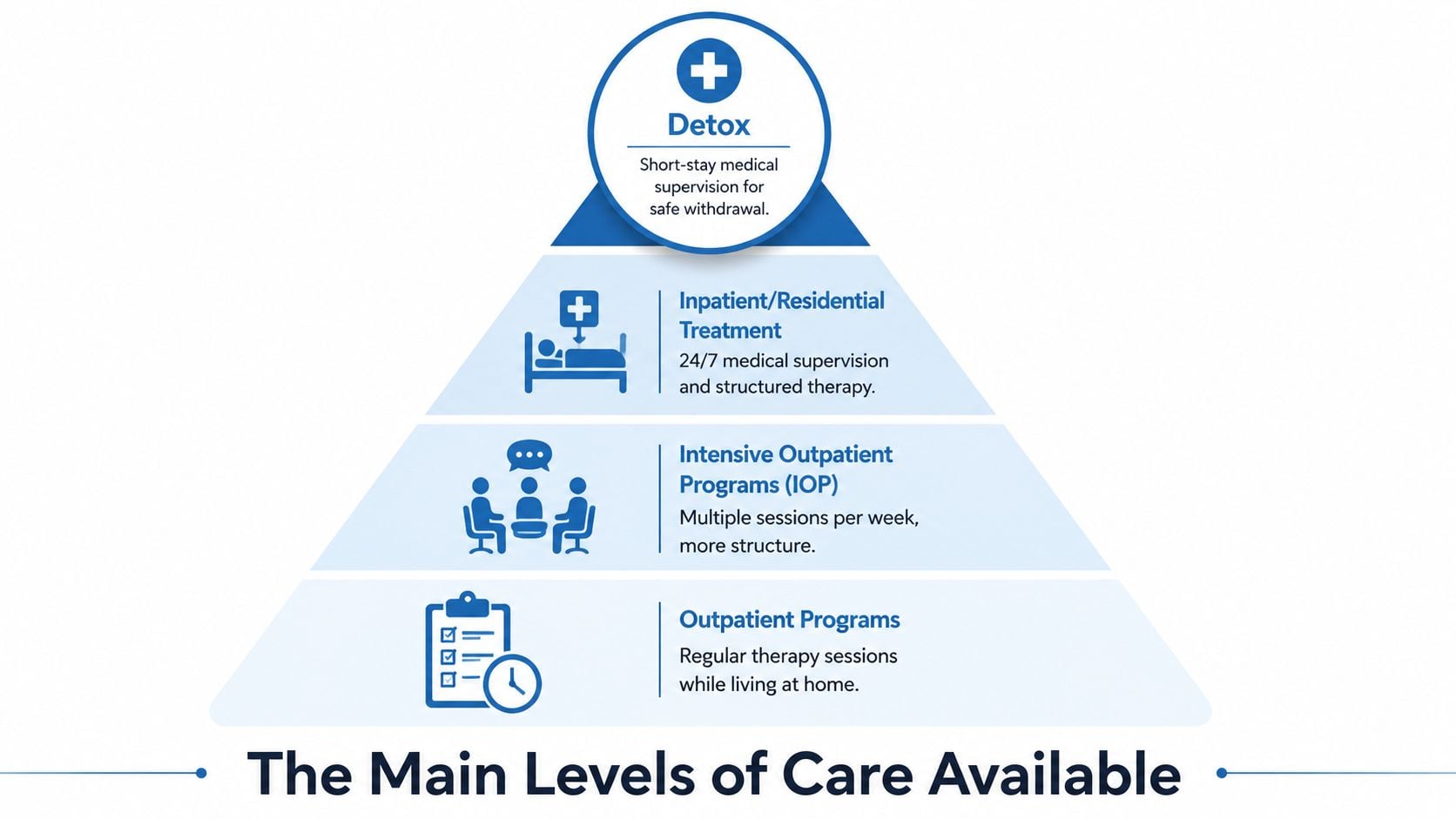
Treatment isn't one building or one schedule. Think of the levels as different amounts of structure. Detox provides the highest short-term medical oversight, while outpatient care gives you the most independence. A clinician should recommend the setting based on withdrawal risk, medical needs, housing, substance access, mental health symptoms, and your ability to participate consistently.
Start with the door that matches the risk
- Detox: This is short-stay medical supervision for withdrawal from substances such as alcohol, opioids, or benzodiazepines. Detox manages the physical danger and discomfort of stopping. It isn't the full recovery plan, so ask what happens immediately afterward.
- Residential treatment: Residential care is structured living with round-the-clock support. It can make sense when the home environment, access to substances, or medical and psychiatric needs make recovery at home unrealistic.
- Partial hospitalization: PHP provides intensive daytime treatment while you return home or to approved housing. It offers more structure than ordinary outpatient care without requiring full residential placement.
- Intensive outpatient treatment: IOP combines several treatment contacts each week with the ability to maintain more of your home, work, or family routine. It may be available in person or by video.
- Standard outpatient care: Weekly therapy, medication management, and recovery planning can work when withdrawal risk is low and your environment supports change.
- Telehealth IOP: Video-based IOP can remove long drives and make care possible for rural veterans or people with demanding schedules. Ask how the program handles drug testing, emergencies, privacy, and medication visits.
Add medication support when it fits
Medication-assisted treatment, or MAT, isn't a level of care. It's a clinical layer that can be added to detox, residential treatment, IOP, or outpatient care. Buprenorphine, methadone, and naltrexone are used in different ways, and a prescriber should consider your substance use, health history, pain, medications, and recovery goals.
Don't choose the setting because it sounds toughest. Choose the setting that gives you enough protection and structure to participate openly, then step down only when your clinical team believes the change is safe.
VA Care Versus TRICARE Civilian Care
VA care and TRICARE civilian care can both be appropriate. The practical question is which route fits your eligibility, urgency, location, privacy preferences, and ability to manage referrals.
| Factor | VA Care | TRICARE Civilian Care |
|---|---|---|
| Who may qualify | Veterans who meet VA health-care eligibility requirements | Active-duty service members, retirees, and eligible family members enrolled in TRICARE |
| Treatment setting | VA programs, medication clinics, mental health services, and approved community providers | In-network civilian detox, residential, PHP, IOP, outpatient, and telehealth programs |
| Main advantage | Coordinated services within the VA system and access to VA specialty programs | More local choices and, in some cases, faster access to a first appointment |
| Common friction | Referral steps, waitlists, or travel to a VA facility | You may need to verify network status, referrals, authorization, and cost sharing |
| Privacy and environment | Care connected to the VA medical system | A civilian location away from a VA campus or military setting |
| Best first question | “Which VA substance use program can assess me now?” | “Which in-network program can admit me at the level I need?” |
VA eligibility isn't automatic for every person who has served. Enrollment, discharge status, clinical need, and local access can affect the route available to you. VA care may offer a coordinated trauma-informed team, but travel or scheduling can make participation difficult.
TRICARE isn't automatic for every veteran either. Eligibility depends on military status and beneficiary category. Plan type, network status, referral requirements, and prior authorization can affect what a civilian provider can offer. A treatment center should verify those details before admission rather than leaving you to guess.
For a practical breakdown of civilian coverage questions, review TRICARE drug rehab options and requirements. Then call the plan or provider directly and ask for the exact cost-sharing and authorization rules that apply to you.
VA care is one route, not the only route. If a civilian provider can offer the right care sooner and your benefits support it, using that option is sensible.
Understanding Medication-Assisted Treatment for Veterans
MAT combines an approved medication with counseling, monitoring, and recovery support. It can reduce cravings, limit withdrawal, and give you enough stability to rebuild routines, relationships, and daily responsibilities while addressing trauma symptoms and relapse triggers.
The medication is a medical decision, not a test of character. Ask whether it lowers danger and helps you remain engaged in treatment. The right choice depends on the substance involved, your health, past withdrawal, access to follow-up, and what you can realistically maintain.
What the main medications do
| Medication | How It Works | How It Is Taken | Best Fit For |
|---|---|---|---|
| Buprenorphine | Partially activates opioid receptors and can reduce withdrawal and cravings without producing the same full opioid effect | Often taken under the tongue or inside the cheek, with dosing managed by a prescriber | People with opioid use disorder who need flexible, office-based support |
| Methadone | Activates opioid receptors in a controlled, long-acting way to support stabilization | Dispensed through regulated opioid treatment programs | People who need structured medication management and consistent opioid stabilization |
| Naltrexone | Blocks opioid effects and can reduce alcohol's reinforcing effects | Available as a daily medication or a longer-acting injection, depending on clinical planning | People who have completed the required detox period and want an opioid-blocking option |
Service-related injuries and chronic pain can complicate medication selection. Tell the prescriber about pain medicines, sleep aids, alcohol use, and any prior overdose. Addiction care, primary care, and pain management may need to coordinate rather than treating each issue separately.
A person using alcohol and opioids may need a plan for both substances. The prescriber should review liver health, current medications, withdrawal history, and overdose risk before choosing treatment. Ask how follow-up will work if you return to duty, relocate, or switch between VA and civilian care.
For a plain-language explanation of medication options, review MAT and addiction medicine guidance. Medication works best alongside counseling, practical support, and scheduled follow-up.
The myths that keep people away
“MAT is trading one drug for another” confuses supervised treatment with uncontrolled use. “It isn't real recovery” treats a cultural belief as a clinical rule. Medication that reduces cravings and withdrawal can help you make decisions that active addiction was blocking.
You do not have to promise lifelong medication during the first appointment. Ask what each option does, what monitoring requires, how it fits your medical conditions, and what the prescriber will change if it does not work for you. A clear plan is better than delaying care while trying to meet someone else's definition of recovery.
How to Access Benefits and Start Treatment
The process becomes manageable when you separate it into four actions. You don't need every record in front of you before calling, but you should be ready to share the substance used, the last use, current medications, major medical conditions, and any immediate safety concern.
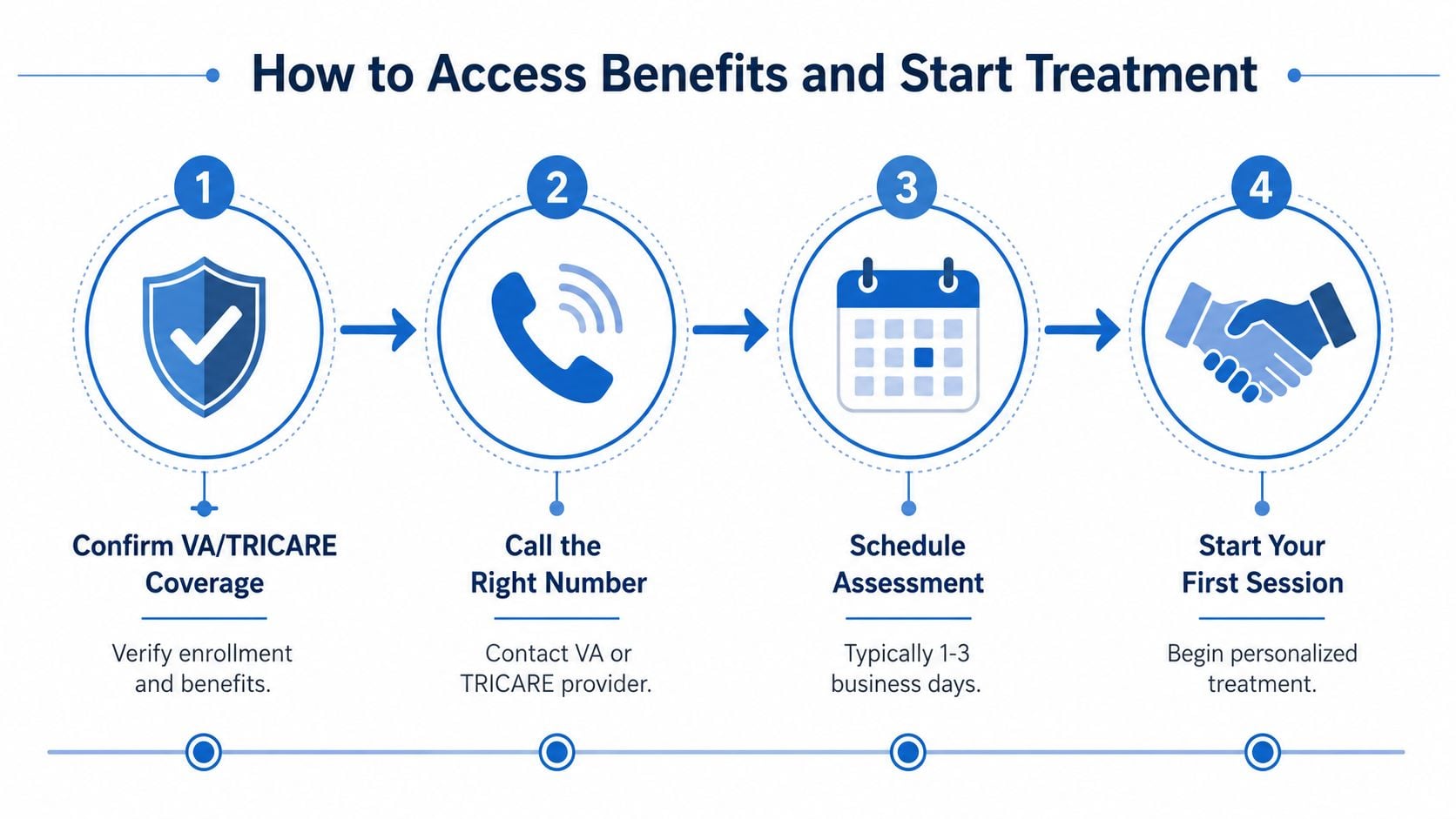
- Confirm coverage. If you're enrolled in VA health care, contact your nearest VA facility and ask for the substance use disorder program. If you use TRICARE, check your plan and regional contractor, then confirm civilian network options.
- Call the right intake team. Tell the coordinator whether you need help with alcohol, opioids, benzodiazepines, stimulants, or more than one substance. Be direct about your last use and past withdrawal. Those answers can change the urgency of the recommendation.
- Complete the assessment. A clinician may meet with you in person or by telehealth. The assessment should determine whether detox, residential, PHP, IOP, or outpatient care is appropriate and identify co-occurring mental health or medical needs.
- Verify authorization and begin. The provider checks benefits, referral rules, prior authorization, network status, and expected out-of-pocket costs. Ask for the admission date, transportation instructions, medication list, and the name of your contact person.
Before sharing records, ask how the program protects substance use information. Federal confidentiality rules under 42 CFR Part 2 provide specific protections for substance use records, and you should understand what you're authorizing before information moves between providers.
Watch this short overview before your call if you want a visual summary of the access process.
If you may be in dangerous withdrawal, have overdosed, or feel at immediate risk of harming yourself or someone else, use emergency services rather than waiting for a routine intake.
Integrated Care for PTSD and Substance Use
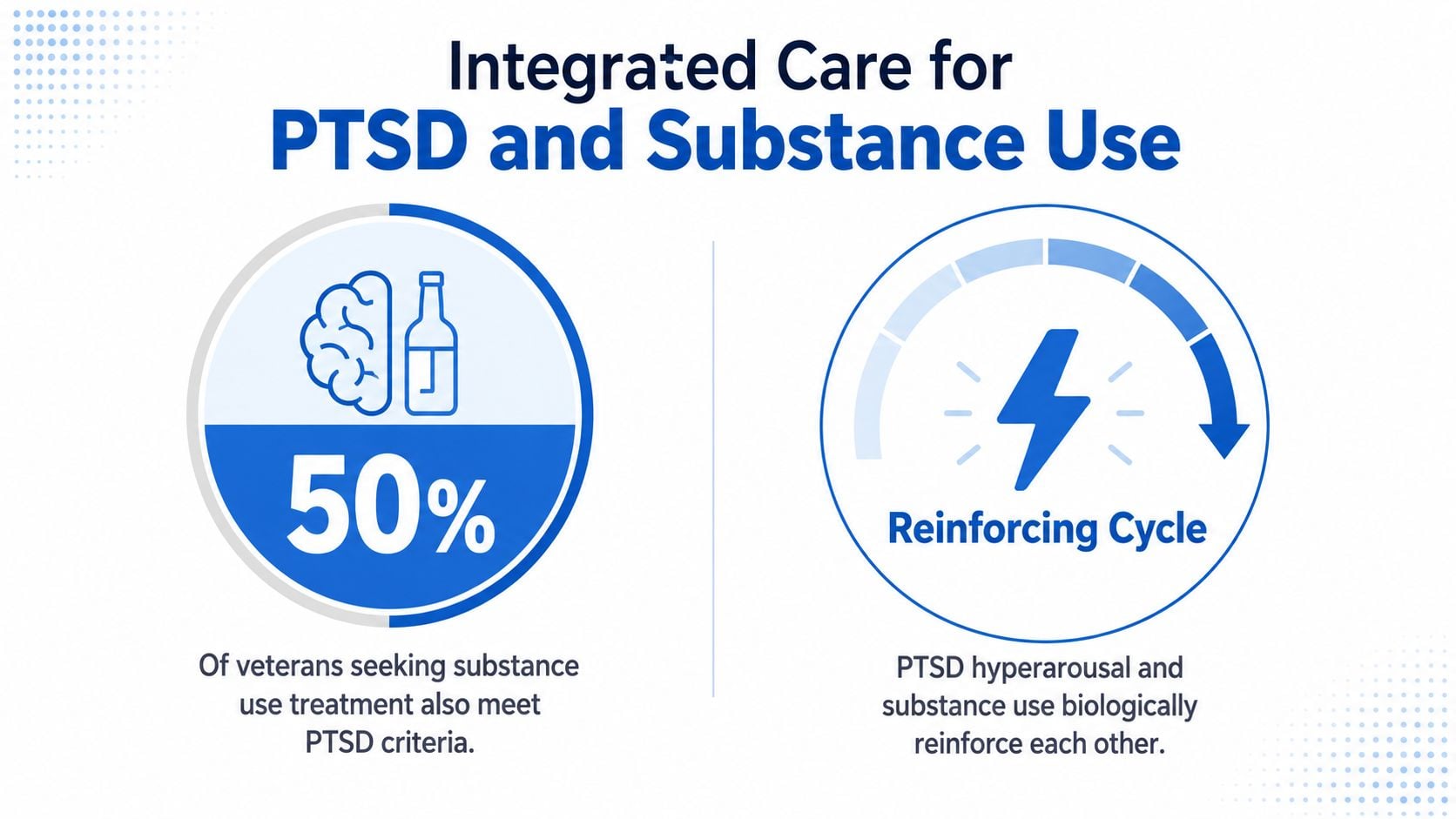
PTSD and substance use often operate as a loop. Trauma symptoms such as hyperarousal, intrusive memories, anxiety, and sleep disruption can make alcohol or drugs feel like fast relief. As that relief fades, the person may use again, while withdrawal, shame, conflict, and poor sleep add new stress.
The clinical case for integrated care is strong. A review found that 63% of OEF/OIF veterans diagnosed with a substance use disorder also met PTSD criteria, and dual diagnosis was linked with greater psychiatric and medical complexity, including conditions such as liver disease, HIV, anxiety disorders, bipolar disorder, and seizures (review of PTSD and substance use among veterans).
One team reduces the handoffs
Integrated care means the substance use and trauma teams coordinate instead of sending you back and forth. Treatment may combine relapse-prevention counseling with Cognitive Processing Therapy, prolonged exposure, or another trauma-focused approach when the clinical team believes you're ready.
Medication management should also reflect the full picture. A prescriber may coordinate medication for PTSD symptoms with medication for alcohol or opioid use disorder, while monitoring interactions and changes in sleep, mood, pain, and cravings.
In a randomized comparison, COPE, a concurrent treatment using prolonged exposure for PTSD alongside substance use treatment, produced larger PTSD reductions than relapse prevention alone. The reported effect sizes were d=1.4 on CAPS and d=1.3 on PCL-M, and PTSD diagnostic remission occurred in 59.3% of the intent-to-treat COPE sample compared with 22.2% for relapse prevention (randomized comparison of COPE and relapse prevention). Among completers, 83% no longer met PTSD criteria in the COPE group, from the same source.
Treating PTSD isn't a reward for staying sober. For many veterans, it is part of what makes sobriety possible.
For additional plain-language background on the overlap, see reVIBE Mental Health on dual diagnosis and this guide to PTSD and substance use. Choose a program that can discuss trauma without forcing you to disclose details before you feel medically and emotionally prepared.
Why a TRICARE-Accepting Local Center Can Be the Faster Route
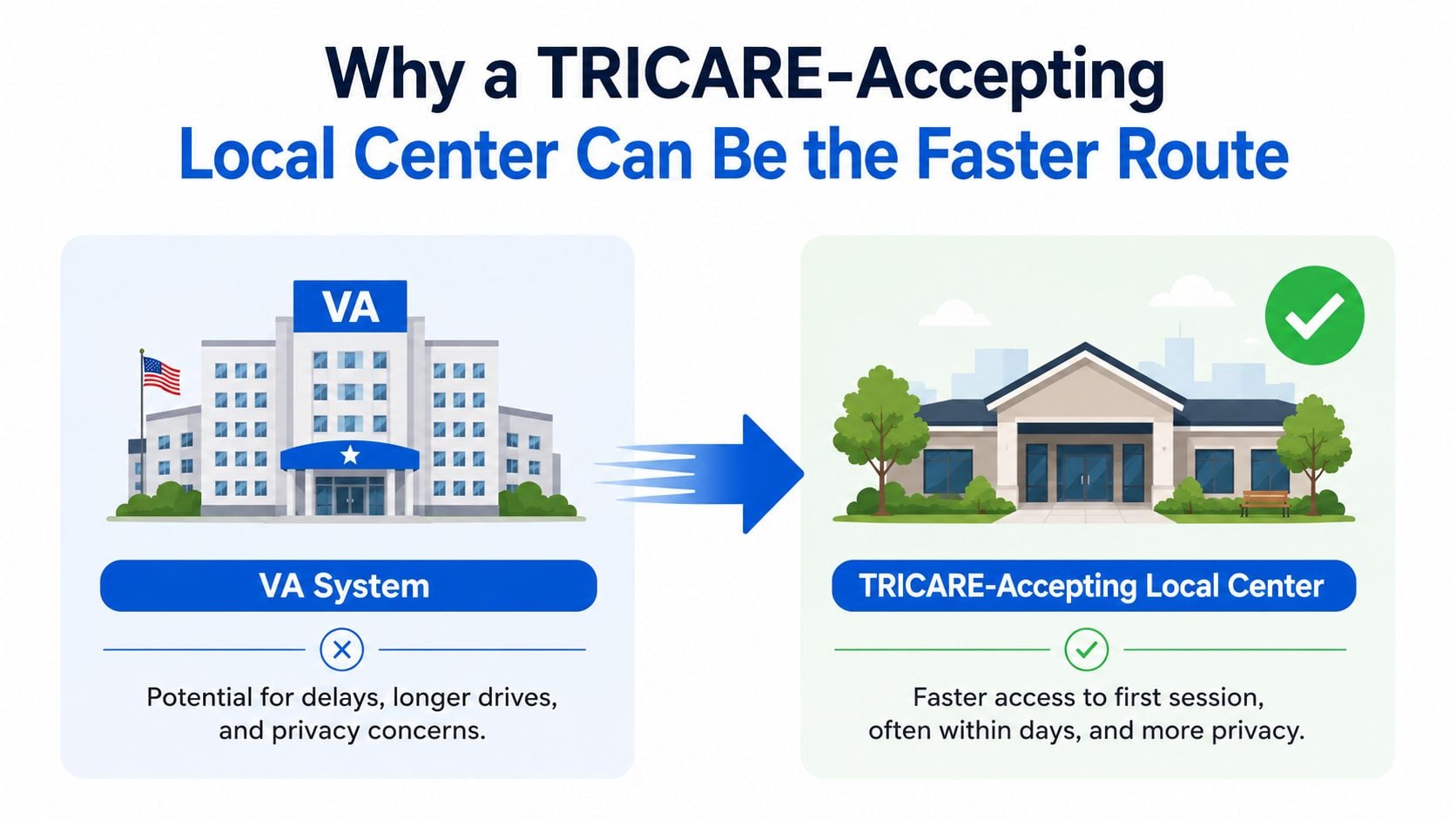
A civilian TRICARE-accepting center can be the practical choice when the VA route creates too much distance, delay, or exposure. This isn't a judgment against VA clinicians. It's a recognition that access determines whether a person reaches treatment while motivation is still present.
A local provider may offer detox, residential placement through a partner facility, IOP, or telehealth without requiring repeated trips to a VA campus. A civilian setting can also feel more private for someone who doesn't want to run into coworkers, former unit members, or people from a familiar medical system.
Look for coordination, not just a TRICARE logo
“Accepts TRICARE” is a starting point, not a complete answer. Ask whether the provider is in network for your plan, whether residential care needs prior authorization, which levels of care are available, and who handles benefits verification.
You should also ask how the center handles medication, co-occurring mental health symptoms, transportation, family participation, and step-down planning. A program that only offers counseling may not be appropriate if you need medical withdrawal management or medication support.
Geography changes the treatment equation
Long drives can turn a good plan into an inconsistent one. A nearby IOP may let you attend while staying connected to family and work. Telehealth can help when distance is the main barrier, but it still needs reliable privacy and a clear emergency plan.
Addiction Resource Center LLC is one civilian option for adults who need medically supervised detox with MAT, residential rehabilitation through a partner facility, or in-person and telehealth IOP. Its team includes medical, nursing, licensed counseling, marriage and family therapy, and recovery support roles. Veterans using TRICARE can ask the center to verify benefits and discuss whether the available setting fits their needs.
What Stops Veterans From Starting and What to Do Instead
The reasons for waiting sound responsible, but most of them keep the problem in charge.
“I should handle this myself.” Recovery isn't a character test. It requires skills for cravings, sleep, trauma reminders, communication, medication decisions, and relapse prevention. Training with a qualified team gives you practice and accountability that willpower alone can't reliably provide.
“Treatment could damage my career or clearance.” Privacy concerns deserve direct answers, not dismissal. Ask the provider what information stays confidential, what releases you would sign, and what limited exceptions apply. Don't let a fear you haven't verified decide your health plan.
“MAT is just another drug.” Supervised medication is different from uncontrolled substance use. Ask a prescriber to compare buprenorphine, methadone, and naltrexone based on your medical history and goals.
“I can't afford rehab.” VA and TRICARE routes may cover different services for eligible people, and civilian programs can verify benefits before admission. Ask for the exact deductible, copayment, coinsurance, authorization, and network details instead of assuming treatment is out of reach.
“The VA is my only option.” VA care can be valuable, but a TRICARE-accepting civilian program may be more accessible if you need local care, a private setting, or a different schedule. Compare both routes on clinical fit and availability.
Your next move should be specific: call a benefits office or treatment center this week, state the substance involved and your last use, and request an assessment. If withdrawal could be dangerous, say that immediately so the coordinator can direct you to medically supervised care.
Addiction Resource Center LLC offers medically supervised detox with MAT, residential rehabilitation through its partner facility, and in-person or telehealth IOP for adults, including veterans and TRICARE beneficiaries. Visit Addiction Resource Center LLC to verify benefits, discuss the right level of care, or schedule a first conversation.