You may be holding a discharge packet in one hand and a phone in the other, trying to figure out why the last program felt “off.” Maybe your loved one got through detox, but nobody asked about the car crash, the violent relationship, or the years spent living on guard. That gap matters. Trauma informed …

You may be holding a discharge packet in one hand and a phone in the other, trying to figure out why the last program felt “off.” Maybe your loved one got through detox, but nobody asked about the car crash, the violent relationship, or the years spent living on guard. That gap matters. Trauma informed addiction treatment treats those experiences as clinically relevant, not as side stories.
If you're a family member, you're probably asking a simpler question: “What does a good program do differently?” The answer shows up in intake questions, group room rules, medication planning, and the way staff respond when someone gets flooded, shuts down, or leaves early. It also shows up in how a provider talks about choice, privacy, and safety.
Table of Contents
- Walking Into Treatment Carrying More Than the Substance
- What Trauma Informed Addiction Treatment Means
- Why Trauma and Addiction Are So Often Entangled
- The Clinical Methods That Make a Program Trauma Informed
- How ARC Puts Trauma Informed Care to Work Across Levels of Care
- Questions to Ask Any Provider Before You Enroll
- Taking the Next Step in Yuba City and Northern California
Walking Into Treatment Carrying More Than the Substance
A 32-year-old walks into an intake office in Yuba City and answers the usual questions. How often are you using? When was the last time? Have you had withdrawal before? Then, almost in a whisper, the fuller story comes out. A car accident that still shows up in nightmares. A violent relationship. Years of scanning every room, every voice, every exit.
That kind of intake changes the whole frame. The substance use is real, but it isn't the whole picture. A trauma informed program hears the use history and the fear history together, because they often belong in the same treatment plan.
What you should expect from a better guide
A useful guide should help you tell the difference between a program that merely says “we understand trauma” and one that changes how care is delivered. That means a working definition, a look at what methods count, and a sense of what to ask if you're comparing options in Yuba City or elsewhere in Northern California.
It should also help you act quickly. If you're in the middle of a crisis, you usually don't need a lecture. You need a short script, a few questions, and a way to judge whether the next call is worth making.
Practical rule: If a program only talks about substance use and never asks how stress, violence, loss, or fear shaped that use, it's probably missing part of the clinical story.
What Trauma Informed Addiction Treatment Means
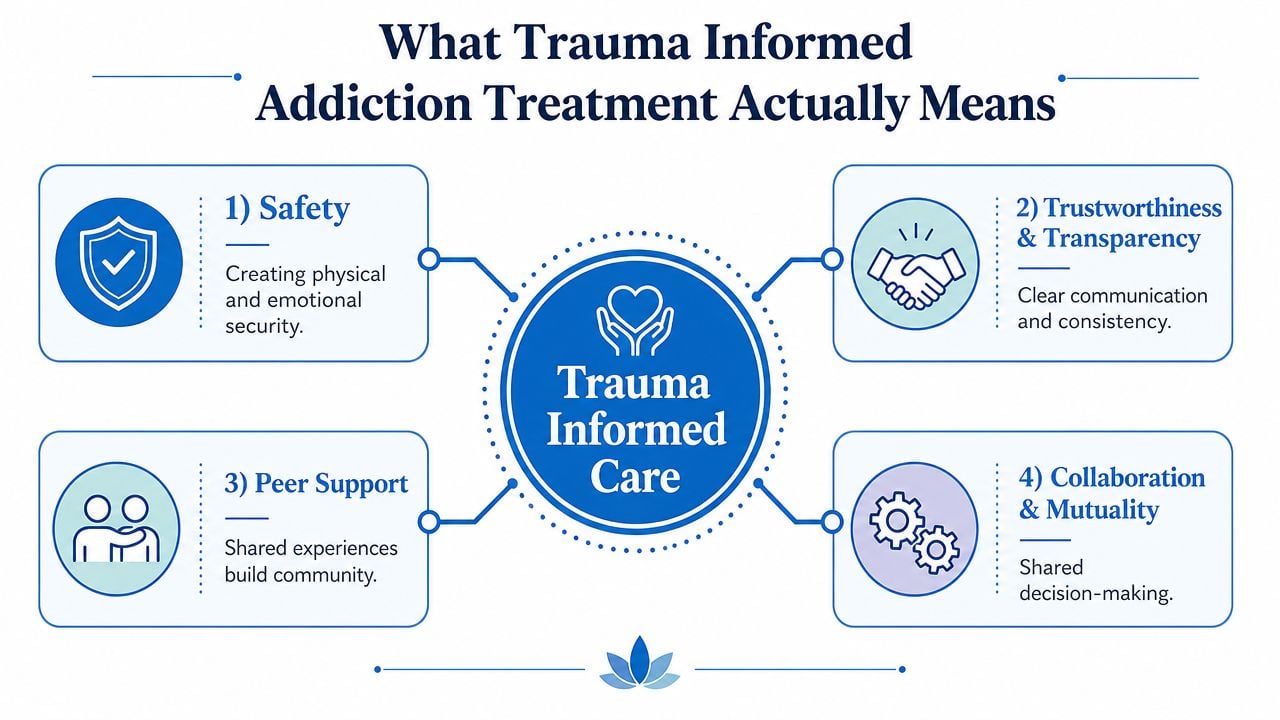
SAMHSA describes trauma-informed care as a system-level approach, not a single therapy. That means the whole program is built to recognize trauma and to reduce the chance of retraumatization in policies, procedures, and daily practice. In plain English, the clinic, the group room, the medication line, and the discharge plan should all feel more predictable and less threatening. A program that adds one trauma class to an otherwise rigid setup has not really changed the way care is delivered.
The five ideas patients should feel
The core ideas are safety, trustworthiness, choice, and collaboration. Safety means the room, the language, and the rules do not keep people on edge. Trustworthiness means staff say what they will do, then do it.
Choice matters because people with trauma histories often come into treatment feeling cornered by systems. Collaboration means the patient is not treated like a passive object being fixed. The plan tries to restore agency instead of taking it away again. Those ideas may sound abstract, but patients feel them quickly when staff explain a urine screen before taking it, ask permission before sensitive questions, and let someone pause when a conversation gets too intense.
A trauma informed program should also fit a biopsychosocial framework for patients. That means it looks at the body, the mind, the home, relationships, and the environment together, instead of treating substance use as the only thing that matters.
Older addiction models often treated trauma talk as a distraction from “real recovery.” That approach could silence the very issue driving relapse, shame, or panic. Trauma informed care starts from a more realistic assumption, people do not heal well when treatment itself feels unsafe.
If you want a plain-language overview of how PTSD and substance use can overlap, this overview of PTSD and substance use is a helpful companion reading.
A trauma informed program is a building with a stronger foundation, not a different room added on later.
Why Trauma and Addiction Are So Often Entangled
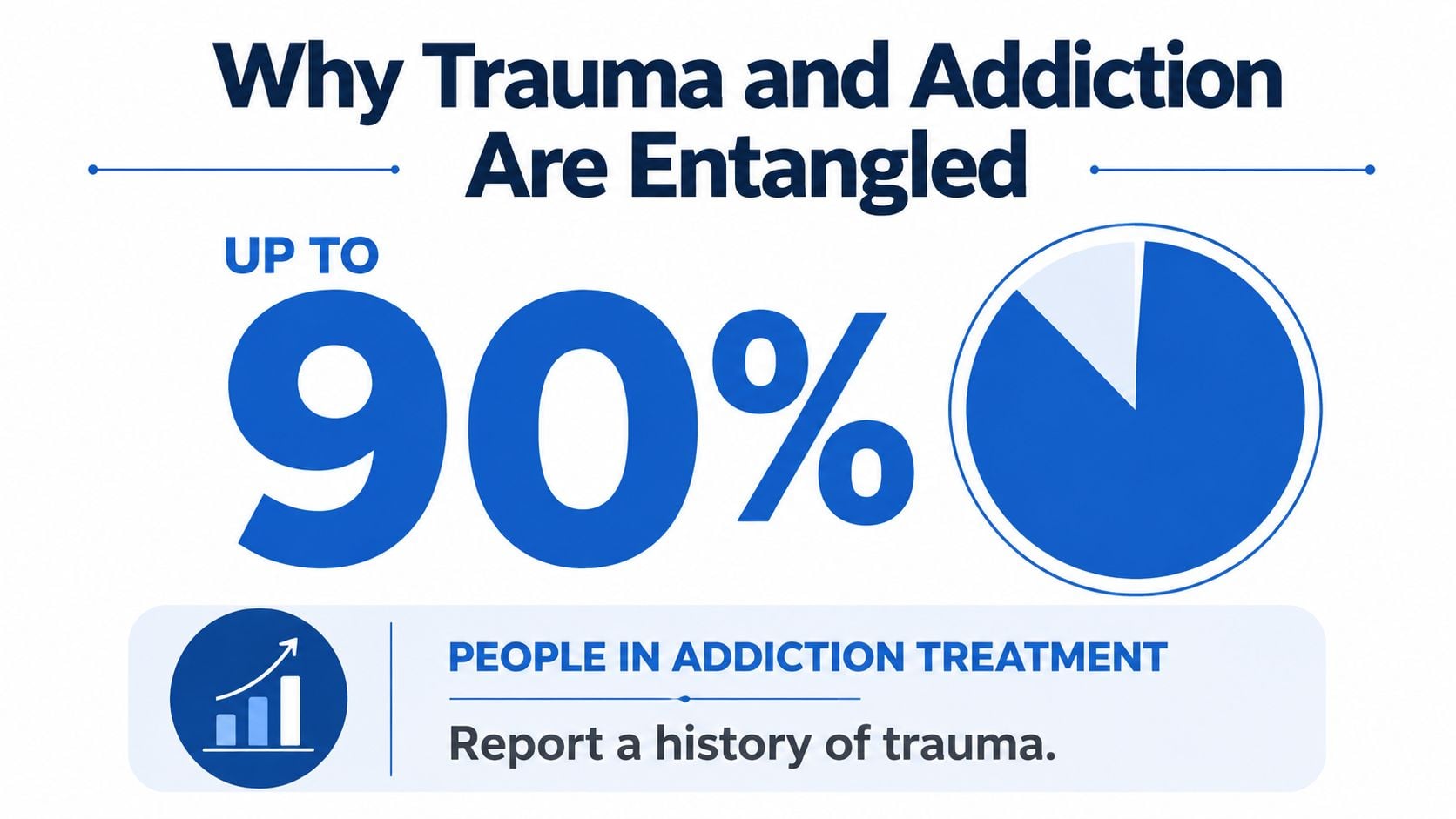
The public health case is hard to ignore. One review reports that up to 90% of people seeking help for substance use disorders disclose prior trauma, and other commonly cited estimates put PTSD co-occurrence at about 46% among people with substance use disorder. In opioid use disorder, trauma history is present in roughly 60% to 70% of cases, which helps explain why a relapse-only lens keeps missing the root issue. PMC review
What those numbers mean in a real program
Those figures don't mean every person in treatment has the same story. They do mean trauma is common enough that a program can't treat it like an exception. A typical intensive outpatient group is statistically likely to include several people with significant trauma histories, so the room itself needs to be managed with that in mind.
That changes treatment design. Staff have to plan for shutdown, anger, avoidance, dissociation, and shame without treating those responses as “noncompliance.” It also means families should expect a program to ask about trauma early, not after someone has already dropped out or relapsed.
For readers who want a broader explanation of how substance use, mental health, and life history fit together, the internal overview on PTSD and substance use gives useful context without reducing the issue to willpower. The main point is simple. Trauma informed care isn't a niche specialty. It's a reasonable default in a population where trauma is common.
The Clinical Methods That Make a Program Trauma Informed
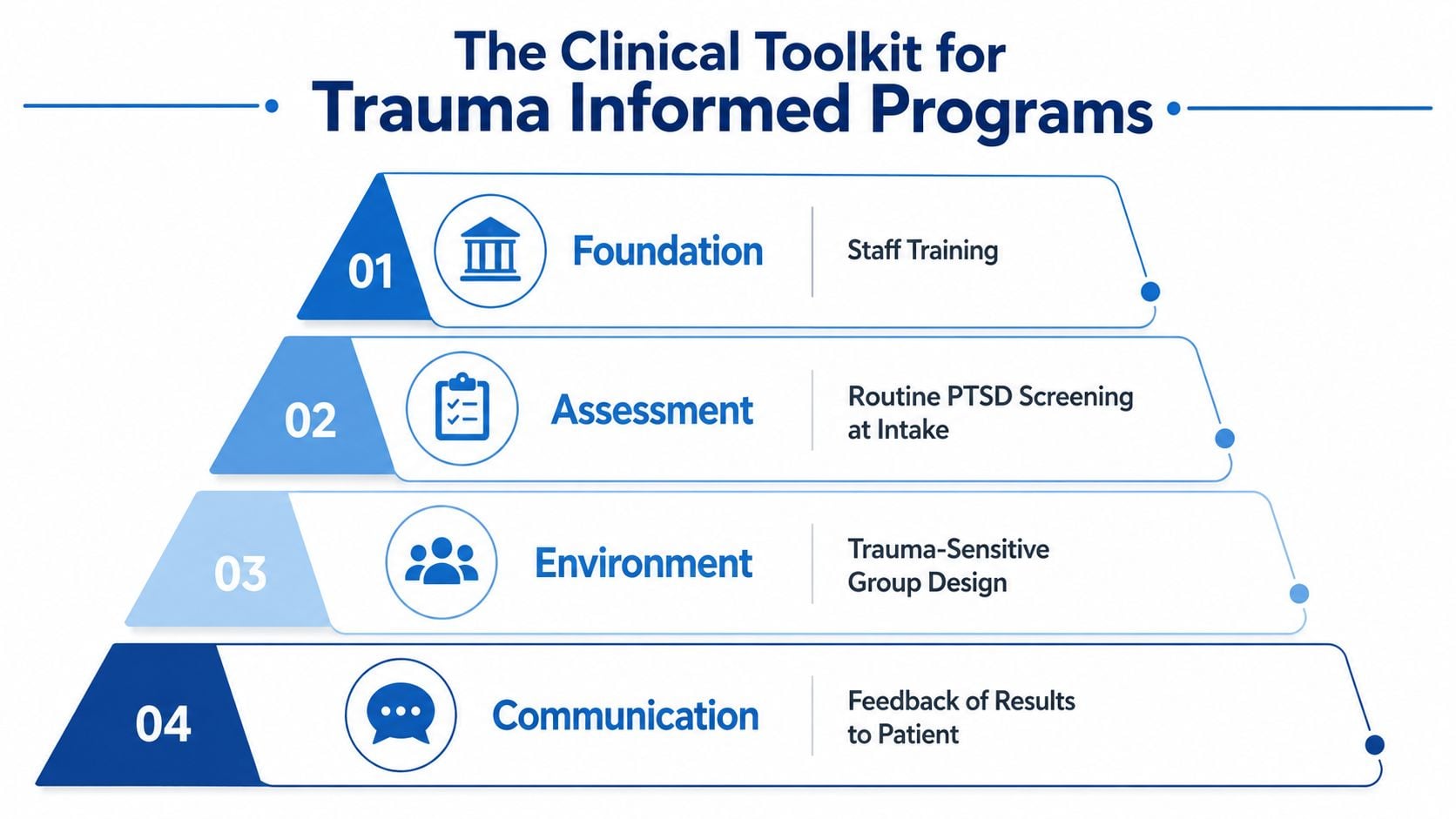
A trauma informed program shows up in the details of intake, not just in the brochure. Someone walks in carrying substance use, fear, shame, and often a trauma history, so the first job is to make the process feel clear instead of exposing. That starts with routine trauma and PTSD screening, followed by a plain explanation of what the answers mean and how they will shape care.
A good intake feels less like paperwork and more like orientation. If the screening identifies trauma, the patient should hear how that information will be used, who will see it, and why it matters for treatment planning. That kind of feedback keeps people involved in their own care instead of leaving them to guess what the program is doing with their story.
What belongs in the toolkit
Trauma-sensitive groups are built to lower pressure for immediate disclosure. Staff learn to notice escalation, pause when someone is flooded, and keep boundaries clear so the room stays predictable. That is part of treatment design, not a side issue that only belongs in the therapist's chair. SAMHSA's trauma-informed framework points to the same system-level idea, policies and practices should actively resist retraumatization, not just talk about compassion. SAMHSA trauma-informed approaches
The therapy menu matters as much as the room setup. Evidence-based trauma-focused care may include Seeking Safety, EMDR, TF-CBT adaptations, or integrated CBT for co-occurring disorders. CBT is often easiest to explain to worried families because it gives the person concrete skills for noticing thoughts, body cues, and behavior patterns, which is why Uptown Psychology CBT services can serve as a useful example of structured skills-based care that can sit alongside trauma work when a clinician tailors it to the person.
Medication also has to stay on the table. MAT for opioid or alcohol use disorder can reduce withdrawal chaos, and less physical distress often means fewer trauma triggers in the body. When depression, anxiety, PTSD, or borderline personality features show up together, a trauma informed program does not send someone to separate silos. It connects the pieces through an integrated biopsychosocial framework for patients, so the team is treating the full picture rather than one symptom at a time.
A 2024 review of implementation research found generally positive effects across psychological well-being, substance use, social stability, and retention or adherence. That does not mean every model works the same way for every person. It does support a practical point, these are not soft add-ons, they are treatment choices that can change how safe people feel and how long they stay engaged.
How ARC Puts Trauma Informed Care to Work Across Levels of Care
At Addiction Resource Center LLC, trauma informed care shows up differently depending on the setting. In medically supervised detox, the priority is physical stabilization without losing emotional safety, especially during the hours when withdrawal, fear, and sleep disruption can make someone feel trapped. 24/7 wellness monitoring helps staff respond early, and MAT can reduce the intensity of the physiological storm that often makes trauma symptoms worse.
Different settings, different needs
In residential rehabilitation through the partner facility, Ona Treatment Center in Browns Valley, the small, serene setting supports regulation in a way that a crowded, chaotic unit often can't. People who've lived on high alert usually do better when the environment itself lowers stimulation and gives the nervous system a break. That's not a luxury, it's part of treatment.
The Intensive Outpatient Program works differently. In person or via telehealth, it gives people a chance to practice coping skills, relapse prevention, individual counseling, group therapy, and recovery mentor support while still living at home. That model matters for parents, workers, and anyone whose life can't pause for a long inpatient stay.
MAT also functions as a long-term stabilizing layer. For many patients, it reduces the daily chaos that can keep trauma symptoms active. The multidisciplinary team, medical doctor, registered nurse, licensed counselors, LMFT, and recovery mentors, is the operational expression of collaboration and choice, because no single person is trying to carry the whole case alone.
Addiction Resource Center LLC is one example of a program built around that continuum. The point is not that every site looks identical. The point is that each level of care should protect safety, preserve dignity, and make room for the person's actual life.
Questions to Ask Any Provider Before You Enroll
Before you agree to a bed, a group slot, or an intake date, ask direct questions. A trauma informed label means little if the answers are vague. If you want a quick way to compare programs, find CARF-accredited providers and then ask how accreditation translates into day-to-day practice.
A short vetting script
-
How do you screen for trauma and PTSD at intake?
You're listening for routine, respectful screening, not a rushed checkbox. -
What trauma-focused therapies do you offer on site, and what do you refer out?
Good programs can name the actual modalities and explain who delivers them. -
How do you protect people from retraumatization in group settings?
Strong answers mention pacing, boundaries, and no pressure to disclose early. -
How is MAT integrated with trauma work?
The right answer is usually that withdrawal safety and trauma treatment are planned together. -
What training has your staff completed, and how often is it refreshed?
You want specifics about supervision, consultation, and ongoing education. -
Who coordinates care when a patient has multiple needs?
Look for a multidisciplinary team, not a random handoff chain.
Red flag: If a program promises “trauma healing” in a fixed number of days, it's selling certainty where careful care should be offering structure.
Other warning signs include group rooms that pressure early disclosure, no MAT option when it's clinically indicated, or rotating clinicians with little supervision. If the staff seem more interested in filling a census than understanding the person, keep looking.
For help checking benefits while you compare programs, use the internal guide on how to verify insurance coverage. A quick question at intake can save a family from a lot of confusion later.

Taking the Next Step in Yuba City and Northern California
If you're ready to move, start with the most practical step. Call the 24/7 line at 530-625-7910, ask for help, and say whether you're looking for detox, residential rehab, MAT, or an IOP option. If you can, schedule a tour of the 1002 Live Oak Blvd., Suite A, Yuba City location so you can see how the space feels before you commit.
Insurance questions should happen early, not after you've already built hope around a program. Families in Northern California often want to know whether private plans like Anthem, Blue Cross, Blue Shield, Aetna, and United Healthcare are accepted, and whether TRICARE is available for veterans and military families. Asking that up front keeps the conversation grounded in what's possible.
Match the level of care to the person's life
A trauma informed choice doesn't always mean residential care. Some people need the structure of detox first, then step down to residential or IOP. Others need the flexibility of telehealth IOP because of work, transportation, caregiving, or privacy concerns.
The better question is not, “What's the most intense option?” It's, “What setting gives this person the safest chance to stay engaged?” A trauma informed plan works best when it fits real life, because treatment that ignores work schedules, child care, or transportation often becomes another source of stress.
Recovery is a process, not a performance. If your first call feels messy or emotional, that doesn't mean you're doing it wrong. It means you're asking for help in a situation that deserves care, clarity, and respect.
Addiction Resource Center LLC offers detox, residential support through its partner facility, MAT, and IOP for adults who need trauma informed addiction treatment in Yuba City and Northern California. If you're comparing programs for yourself or someone you love, visit Addiction Resource Center LLC to ask about care options, insurance, and the next available step.