A late-night call for help usually doesn't sound dramatic. It sounds tired, shaky, and practical. Somebody is sitting at a kitchen table with a phone in one hand and a loved one in crisis nearby, trying to figure out what to do before the night gets worse. That's often where quality of life improvements start, …

A late-night call for help usually doesn't sound dramatic. It sounds tired, shaky, and practical. Somebody is sitting at a kitchen table with a phone in one hand and a loved one in crisis nearby, trying to figure out what to do before the night gets worse.
That's often where quality of life improvements start, not with a big speech or a clean break from the past, but with one decision to get through the next hour safely. In recovery, the first signs of progress are usually ordinary, better sleep, a calmer morning, a meal that stays down, a conversation that doesn't explode. Those small shifts matter because they give a person enough steadiness to start rebuilding the rest of life.
Clinicians talk this way on purpose. A person can be sober and still feel trapped by fear, debt, pain, broken relationships, or a house that doesn't feel safe. Real improvement is broader than stopping substance use, and that's why the best treatment plans look at life in domains, not slogans. If you're trying to decide whether to call a treatment center, a useful question is simple, which part of life feels most broken right now, and what kind of care would help repair it?
Table of Contents
- When Life Starts to Feel Survivable Again
- What Quality of Life Improvements Really Mean
- The Six Life Domains That Change First
- How Detox, MAT, IOP, and Residential Care Rebuild Daily Life
- Two Misconceptions That Slow Down Recovery
- Why Measurement Is the Difference That Lasts
- A Practical Path Forward for Patients and Families
When Life Starts to Feel Survivable Again
The first week after admission often looks less like a breakthrough and more like relief. The person who was pacing at 2 a.m. is finally sleeping in short stretches. The family member who made the call can stop scanning every room for signs of danger. Nobody calls that a cure, but it is a meaningful change.
That kind of change is why quality of life has to be taken seriously. The United Nations report on global quality of life trends treats health, functioning, and day-to-day stability as part of the same picture, because survival alone does not capture how a person is living (UN report). When someone enters care, the first question is often not whether life feels perfect. It is whether the day can be made survivable enough for the next step to happen.
The early pattern is often familiar to families. Sleep may come in broken pieces. Meals become easier to finish. Texts get answered. The person may still be shaky, tired, or scared, but the daily rhythm starts to lose some of its emergency-room feel.
What families usually notice first
The earliest changes are often practical. A person may start showing up for meals, answering texts, or getting through a whole day without a crisis call. That doesn't sound glamorous, but it reduces chaos, and chaos is exhausting for everyone around addiction.
A treatment plan often works like a scaffold around a damaged wall. It does not rebuild everything at once, and it does not pretend the structure is strong before it is ready. It gives the person something stable to lean on while the worse pieces are being repaired.
Practical rule: if life is becoming more predictable, treatment is probably doing something right.
That is also why families should not judge progress only by whether cravings disappear overnight. Recovery usually starts with small stabilizers. A person may not feel better in a dramatic sense, but they can become more reachable, more rested, and less likely to bounce from one emergency to the next.
For some people, that shift becomes easier to spot around the early stretch of sobriety. A useful overview is the 90 days of sobriety guide, which shows how those first months can feel uneven before they feel steady.
The promise here is modest and real. Quality of life improvements usually start with survival feeling less fragile. Once that happens, the rest of the work has room to begin.
What Quality of Life Improvements Really Mean
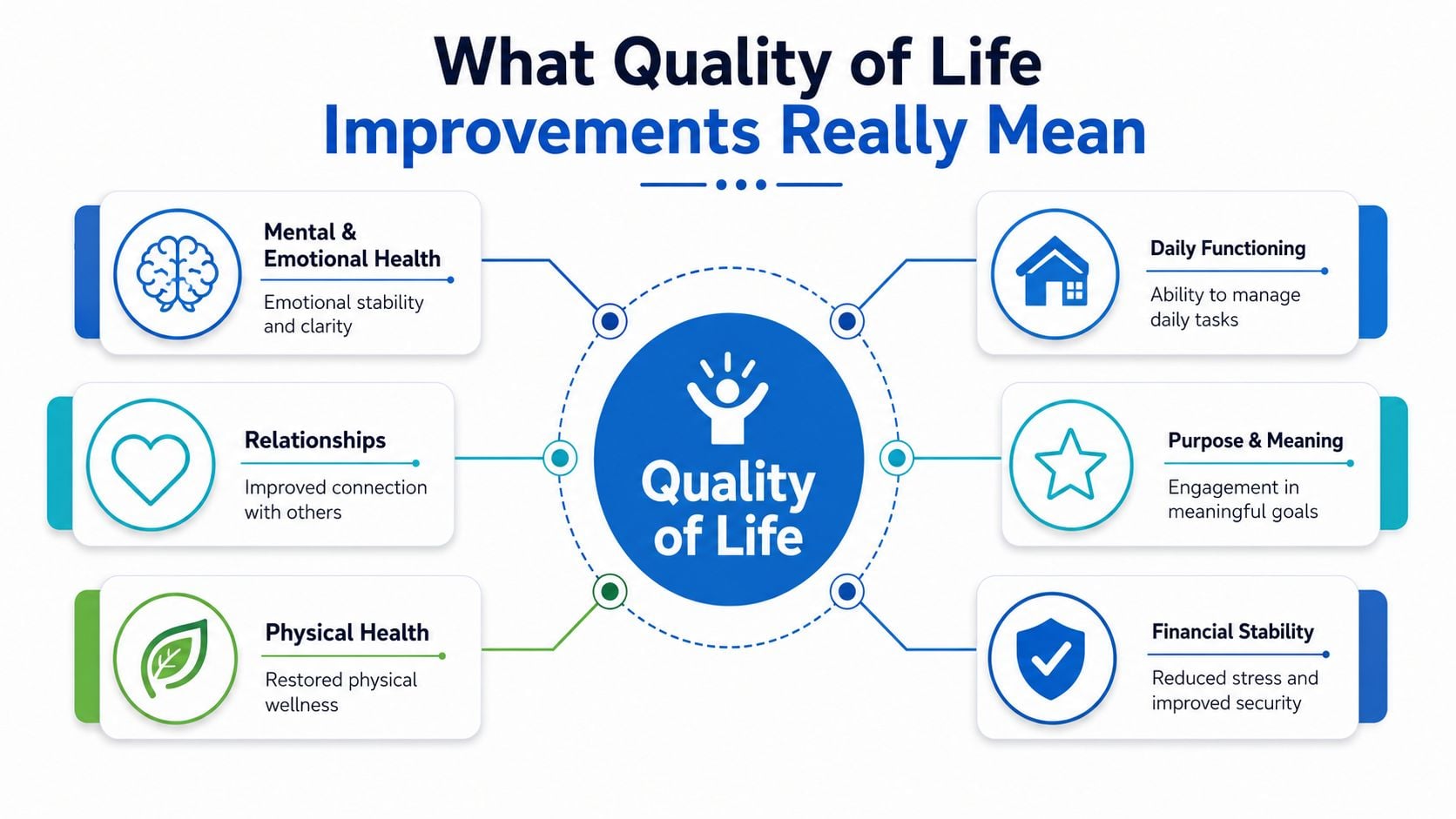
In recovery, quality of life means more than feeling happy. It means being able to live in a way that is safer, steadier, and more workable across everyday life. A person can be abstinent and still have poor quality of life if sleep is broken, rent is unstable, relationships are hostile, or anxiety makes it hard to leave the house.
Clinicians avoid reducing this to one global score because that would be too blunt. The UN's quality-of-life indicator framework treats domains like safe walking after dark, public transport access, digital connectivity, air quality, proximity to public space, shelter cost-to-income ratio, social support networks, and life satisfaction as separate areas (UN SDG presentation). That same logic applies in addiction care. A treatment team needs to know what is improving, what is stuck, and what still feels unsafe.
Why one satisfaction score misses the point
A single happiness score can hide a lot. Someone may say they're “fine” while missing work, skipping meals, and avoiding their kids. Another person may report low mood but still be making steady gains in sleep, routine, and safety. Those are not the same clinical picture, and they shouldn't be treated as if they are.
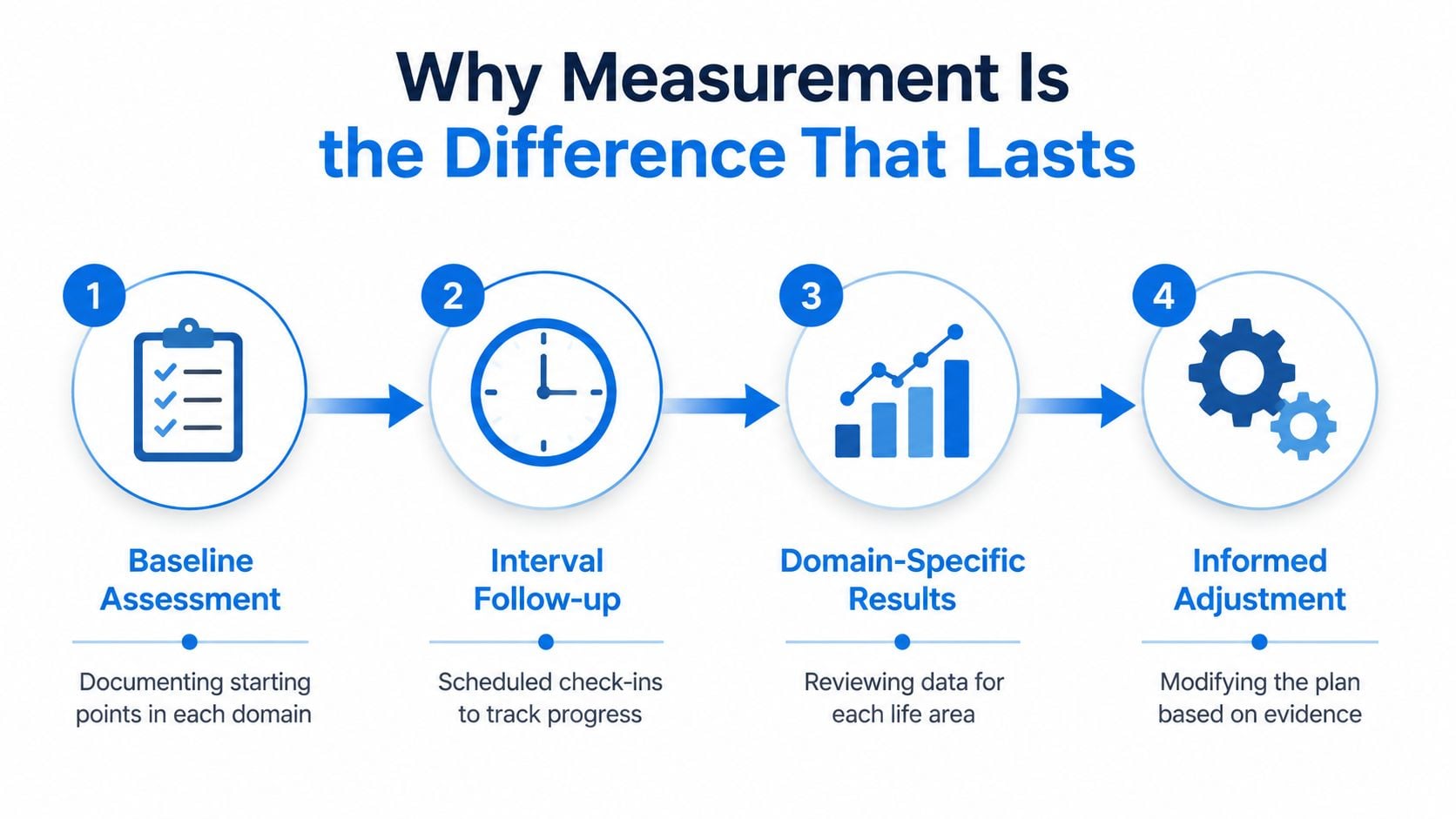
A more useful approach uses validated, responsive instruments and repeat measurement over time. Clinical guidance says a good quality-of-life tool should be valid, reliable, responsive, and practical in the population being treated, and it should be used over time so the team can separate real change from noise (PMCID article). That's why teams look at baseline status first, then follow up later, instead of trusting a single impression.
How providers turn answers into decisions
The point of measurement is action. If sleep is improving but cravings are still intense, the plan may need more medication support. If the person is sober but can't manage daily responsibilities, therapy and case management may need to pick up the pace. If family stress is the main issue, communication work may matter more than adding another class.
Readers often find this reassuring because it gives them language to use. You can ask a provider, “What domains are you measuring?” or “How do you know the plan is helping in real life?” That's a much sharper question than “Is it working?” and it gets at the part families really care about.
The Six Life Domains That Change First
Addiction usually damages the same core areas again and again. Recovery starts to rebuild them in a pattern that families can notice, even before everything feels settled. The six domains that matter most are physical health, mental and emotional health, daily functioning, relationships, housing and safety, and meaning or purpose.
The cleanest way to think about them is like a house under repair. You don't fix the roof, wiring, plumbing, and foundation in one afternoon. You inspect each part, figure out what is failing, and patch the areas that keep the whole place from holding together.
Physical health and mental health
Physical health is where many people feel the first relief. Sleep gets more regular, eating becomes possible again, and the body is no longer spending all its energy on withdrawal, intoxication, or recovery from the last episode. Mental and emotional health follows closely behind, because less chaos often means less panic, less irritability, and a little more clarity.
Treatment teams measure this with symptom tracking, sleep reports, appetite, pain, and mood screening. The goal isn't perfection. It's reducing the daily burden enough that the person can think straight and participate in care.
Daily functioning and relationships
Daily functioning is the part families notice in the ordinary tasks. Does the person get up on time, shower, keep appointments, and follow through on small responsibilities? Those are recovery markers because they show the person can re-enter routine without everything collapsing.
Relationships are a different kind of repair. Trust doesn't come back because someone says sorry once. It comes back when calls are returned, boundaries are respected, and communication stops being dominated by fear or conflict. Treatment teams may look at family contact, conflict patterns, attendance, and the ability to repair after disagreement.
Housing safety and purpose
Housing and safety matter because a person can't stabilize in a place that constantly puts them at risk. The same is true for purpose. People need something to move toward, whether that's work, parenting, school, faith, or rebuilding self-respect.
The most durable improvement usually happens when care protects both the practical and the personal.
Trauma-informed whole-person care can help frame the work, especially when a person's substance use is tied to fear, loss, or unsafe environments. If you want a plain-language overview of that approach, trauma-informed whole-person care shows why safety, trust, and coordinated support matter.
Families often ask what to look for first. Start with the domain that feels most damaged today, then ask whether the treatment plan is targeting it. If the answer is vague, that's a sign the plan may be too generic.
How Detox, MAT, IOP, and Residential Care Rebuild Daily Life
Different levels of care do different jobs. That's the part many families miss, because they hear treatment labels before they hear what those services rebuild. The useful question is not, “What sounds strongest?” It's, “What part of life needs support right now?”
A detox bed, a residential stay, outpatient therapy, and aftercare all serve different domains. When they're matched well, the person doesn't just stop using substances. They regain the parts of life that let recovery hold.
| Level of Care | Primary Quality of Life Domains Improved | Typical Setting |
|---|---|---|
| Medically supervised detox with MAT | Physical health, mental and emotional stability, sleep, craving control | Supervised clinical setting |
| Residential care | Daily functioning, safety, routine, early relationship repair | Live-in treatment environment |
| IOP, in person or telehealth | Relationships, work, school, purpose, ongoing functioning | Structured outpatient schedule |
| Aftercare planning | Long-term stability, relapse prevention, community connection | Ongoing support after primary treatment |
Detox and MAT protect the body first
Medically supervised detox is about getting the body through withdrawal more safely. That matters because a person who feels physically awful can't absorb therapy well. Medication-assisted treatment, or MAT, can reduce the force of cravings and give the nervous system time to settle.
If you're comparing options, Medication assisted treatment options in Massachusetts is a useful example of how MAT is discussed in a treatment context. The broader point is simple, when the body is calmer, sleep, mood, and attention usually become easier to manage.
Residential care rebuilds routine and safety
Residential rehab helps when the home environment is too unstable to support early recovery. It creates a predictable rhythm, meals, groups, sleep, and supervision. That structure gives the person a chance to practice basic functioning without the same triggers pressing in from every side.
This is also where a center like Addiction Resource Center LLC fits naturally as one option among others. It offers medically supervised detox with MAT, residential rehabilitation through its partner facility, and an intensive outpatient program, so people can match care level to what life needs rather than forcing one level to do everything.
IOP and aftercare protect real life
An Intensive Outpatient Program is often the bridge back to normal life because it lets a person keep working, parenting, or caring for family while still receiving support. The flexibility matters when the key quality-of-life domain is daily functioning, not just abstinence. A useful overview of how people move through the continuum is outlined in how to navigate the continuum of care for addiction recovery.
Aftercare is the layer that helps gains last. That might include relapse prevention, accountability, education, and continued check-ins. Without that step, early improvement can fade when stress returns.
Two Misconceptions That Slow Down Recovery
One common mistake is treating sobriety as the same thing as recovery. Stopping substance use is important, but if sleep is still wrecked, housing is unstable, and relationships are untouched, the person is still carrying a heavy load. That load can make relapse more likely, not because the person didn't try hard enough, but because the rest of life never got rebuilt.
The second mistake is assuming more services automatically mean better care. That sounds reasonable, but it isn't always true. Too many layers without clear goals can blur focus, and too many referrals without coordination can leave a family more confused than supported.
Why sobriety alone can leave people fragile
A person may be abstinent and still feel one bad day away from falling apart. If they don't have routine, a place to sleep, a way to handle stress, or repaired relationships, sobriety has to carry too much weight by itself. Recovery gets stronger when the rest of life starts to cooperate.
Why “more” isn't always better
A good plan has the right intensity, not the biggest stack of services. The team should be able to say why each level of care is there and what it is supposed to improve. If they can't explain that, the plan may be too scattered.
Ask what the program is fixing right now, not just what it offers.
Families can spot this in the first conversation. If every answer sounds generic, the program may be selling activity instead of progress. If the answers tie each service to a specific life problem, that's a better sign.
Why Measurement Is the Difference That Lasts
A person can feel slightly better and still be headed in the wrong direction. That is why durable improvement depends on a baseline, a follow-up check, and a plan that changes when real life changes. Without that loop, care starts to rely on guesses instead of information.
Good programs treat measurement like a shared map. The patient describes what daily life feels like. The family adds context when that helps. The clinician uses that picture to adjust medication, therapy frequency, and case management before a crisis forces the issue.
What to ask before enrollment
A few plain questions can reveal a lot about how a program works. Ask whether progress is measured in more than one area, how often those measures are reviewed, and what the team does when one part of life is not improving. Ask whether the family has a role in feedback or in aftercare planning.
If you want a practical framework for personal goal setting, a personal improvement plan gives you a useful point of comparison for what a provider describes. Strong programs do not just hand out a schedule. They keep checking whether the schedule is helping.
Why repeat measurement reduces confusion
Early recovery can look uneven. One week may feel steadier, then the next week may bring more stress or more cravings. Repeat measurement helps teams tell the difference between a rough patch and a problem that needs attention. It also helps families avoid overreacting to one hard day or missing a pattern that is getting worse.
Programs that track domain-specific results are easier to trust because they can point to changes in sleep, mood, attendance, relationships, or safety. That level of detail matters when a family is deciding whether to keep the current plan, step up care, or adjust the level of support. A useful overview of how people move through the continuum of care for addiction recovery can also help families understand why measurement should match the level of care, since detox, MAT, IOP, residential care, and aftercare each rebuild different parts of daily life.
A Practical Path Forward for Patients and Families
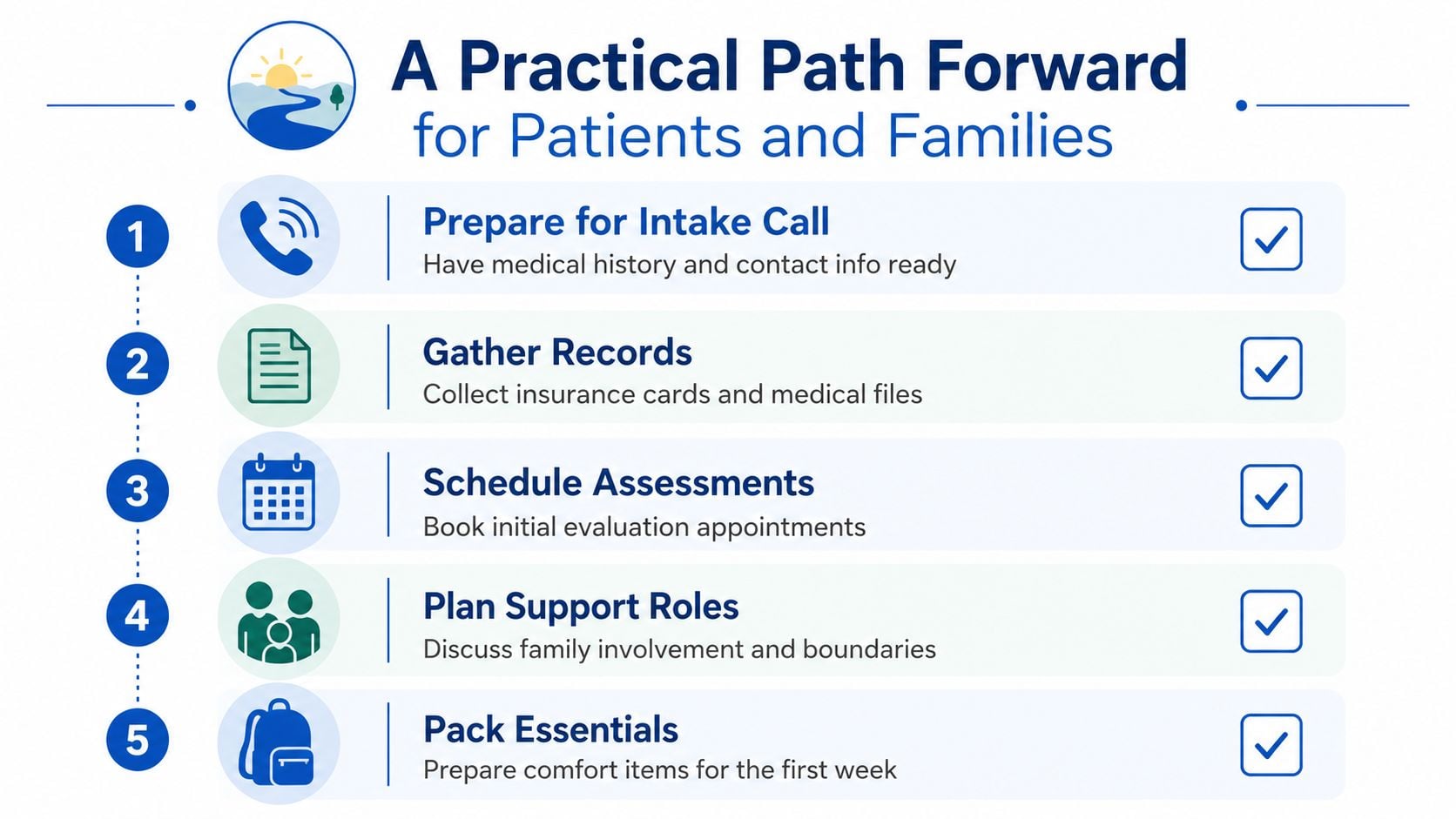
For families, the first week is about preparation, not perfection. Gather ID, insurance information, medication lists, and a short history of what's been happening. Write down the questions you need answered about measurement, aftercare, and family involvement so you don't forget them during the intake call.
For patients, honesty is the fastest route to useful care. Say what's really happening with sleep, cravings, housing, work, and relationships, even if it feels messy. Then look for one or two early wins, like drinking more water, showing up on time, or getting through a night of better sleep.
The simplest way to judge a program is to ask whether it addresses the six domains that matter most, physical health, mental health, daily functioning, relationships, safety, and purpose. If it does, you're probably looking at care that can build something stable, not just stop one behavior.
If you're ready to look at care that matches the part of life that feels most broken, visit Addiction Resource Center LLC to explore detox, residential rehab, IOP, and aftercare planning in one place. The right next step doesn't have to be dramatic, it just has to be clear enough to begin.