Day 68 can feel strange. You may be sleeping better, showing up to work on time, and hearing people say you look more like yourself. Then, without warning, you wake up flat, irritated, or tired of trying. A lot of people expect sobriety to feel steadily better each week. Early recovery rarely works that way. …


Day 68 can feel strange.
You may be sleeping better, showing up to work on time, and hearing people say you look more like yourself. Then, without warning, you wake up flat, irritated, or tired of trying. A lot of people expect sobriety to feel steadily better each week. Early recovery rarely works that way. It often feels more like rebuilding a house while living inside it.
That's why 90 days of sobriety matters so much. It isn't just a round number or a recovery slogan. It's a stretch of time where your brain, body, routines, and relationships start moving out of crisis mode and into something more stable. It's also a period when many people get discouraged because the first burst of motivation fades before long-term balance has fully arrived.
If you're somewhere between day 1 and day 90, or you love someone who is, this stage can be confusing. You may wonder whether your mood swings are normal, whether cravings should be gone by now, or why progress can feel invisible on some days. Similar questions come up in other habit-change journeys too, including resources on achieving 90 days NoFap, where people describe the same mix of hope, doubt, and gradual rewiring.
Table of Contents
- Introduction The First 90 Days
- Why the 90 Day Mark Is a Critical Milestone
- What to Expect A Timeline of Transformation
- Navigating Inevitable Challenges and Relapse Risks
- Evidence-Based Strategies to Reach and Sustain 90 Days
- Celebrating Your Milestone and Planning for Long Term Recovery
- Conclusion Your Foundation for a New Beginning
Introduction The First 90 Days
A person nearing 90 days sober often tells me two things in the same breath. First, “I can't believe I made it this far.” Second, “Why do I still feel so off?”
Both reactions make sense. Early sobriety asks a lot from you. You're not only stopping alcohol or drugs. You're also learning how to wake up, manage stress, eat, sleep, feel, work, and connect with people without the old escape route. That's a lot of change in a short stretch of time.
The first 90 days are often the most fragile because everything is still resetting. Your body is healing. Your brain is relegating old survival patterns. Your routine is still new enough to break under pressure. Even the people around you may not know how to support you yet.
Practical rule: If 90 days feels hard, that doesn't mean recovery isn't working. It usually means recovery is asking you to build skills you didn't need in active use.
This milestone matters because it marks a shift. Not perfection. Not the end of cravings or emotional pain. A shift toward stability. By the time you reach it, you've had to face ordinary life sober often enough to start building confidence that isn't borrowed from a substance.
Why the 90 Day Mark Is a Critical Milestone
The 90-day mark has weight because real changes tend to cluster around it. Some are biological. Some are behavioral. Some show up in the hard reality of relapse risk.
Why 90 days is more than a number
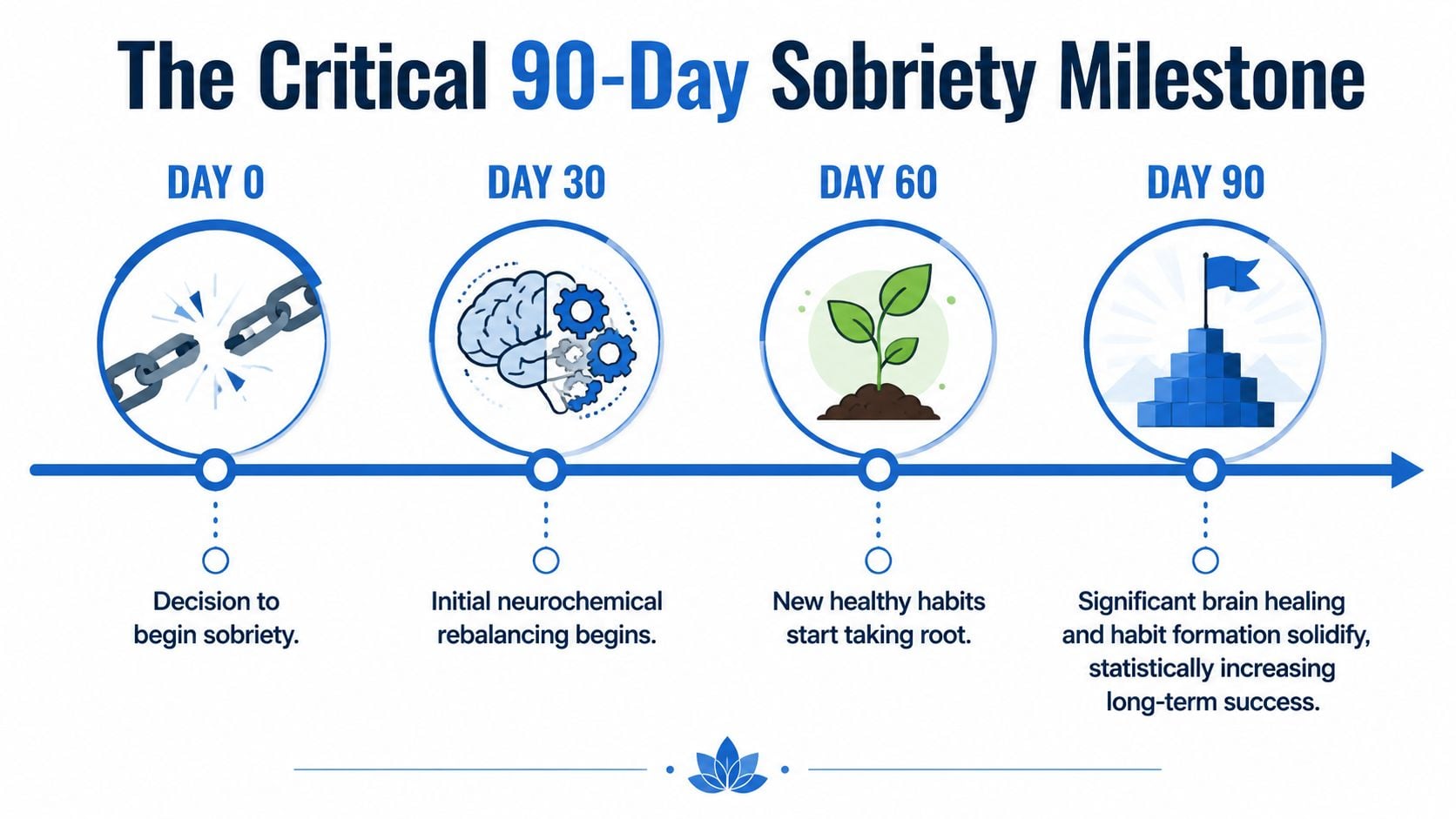
In the first three months, the brain is working hard to recover from chronic substance exposure. Verified clinical evidence notes that the prefrontal cortex shows measurable restoration and metabolic normalization during this window, and the dopamine system often needs about 60 to 90 days to rebaseline receptor sensitivity. That helps explain why cravings, impulsivity, and emotional instability can feel intense early on and then begin to settle by the end of this period.
This is also why people sometimes feel frustrated in the middle of recovery. They expect clear thinking right away, but their brain is still recalibrating. During this same window, symptoms often grouped under post-acute withdrawal can peak in the early weeks and then diminish by day 90. That doesn't mean every symptom disappears. It means the system is becoming less chaotic.
There's a practical lesson here. If your concentration is weak on day 20, your emotions feel jagged on day 40, or your motivation crashes on day 70, that isn't proof that you're failing. It may be proof that your brain is doing exactly what healing looks like.
A routine that supports this healing matters. Sleep, food, movement, hydration, therapy, and structure aren't side issues. They give the recovering brain repeated cues of safety and predictability. If you want help building healthier daily structure, these actionable workouts and nutrition tips can be useful as part of a broader recovery routine.
Why relapse risk changes over time
The first 90 days matter because early relapse risk is unusually high. Data cited in a source discussing National Institute on Alcohol Abuse and Alcoholism findings says about 90% of individuals with alcohol use disorders will experience at least one relapse following initial treatment, and relapse rates are as high as 80% during the first year of sobriety. That source also notes that 65% to 70% of patients will relapse within 90 days of finishing treatment if they do not maintain rigorous engagement in care (details on relapse-rate patterns).
That same source shows why staying engaged matters so much over time. Relapse rates drop to roughly 40% after two years of continuous sobriety, and after five years, the relapse rate declines to less than 15%, with 7.2% of individuals relapsing after five years in recovery.
The first 90 days don't guarantee long-term sobriety. They do give you entry into the period where stability becomes more likely if you keep doing the work.
That's the heart of this milestone. You aren't trying to survive an arbitrary countdown. You're trying to cross the stretch where the old patterns are loudest and the new ones are still weak.
What to Expect A Timeline of Transformation
Recovery rarely unfolds in a neat line, but many people notice recognizable phases. The details differ from person to person, yet the overall pattern is often similar. The body starts by stabilizing. The mind follows. Then emotional and social rebuilding become harder to ignore.
Days 1 through 30
The first month is often about safety, stabilization, and getting through the day without returning to old behavior. Sleep may be uneven. Appetite can swing. Energy can bounce between restless and exhausted. Even simple tasks, like grocery shopping or answering texts, may feel heavier than they should.
Physically, this is the stage where the system begins to recover from substance stress. Verified data notes that liver enzyme levels such as AST and ALT often normalize within 30 to 90 days when alcohol is removed, and the liver begins reducing fatty changes and inflammation during this period. The body is also starting to restore immune and metabolic balance.
Emotionally, the first month can be deceptive. Some people feel relieved and determined. Others feel raw, ashamed, angry, or numb. It is common to cycle through several of those states.
Days 31 through 60
The second month often brings enough stability that deeper issues become easier to feel. That sounds backward, but it's common. Once the crisis eases, your mind has more room to notice grief, boredom, loneliness, resentment, or anxiety.
This is also where routines either start to root or start to slip. You begin to see whether your recovery plan works on normal weekdays, not just in emergencies. Can you manage stress after work? Can you say no to an invitation that doesn't feel safe? Can you reach out before a craving becomes a plan?
A lot of people also notice cognitive improvement here. The fog doesn't always vanish, but thinking can feel less scattered. Tasks that demanded huge effort in the first few weeks begin to feel more manageable.
Days 61 through 90
The last stretch before the milestone can feel surprisingly uneven. Some people feel stronger and more grounded. Others hit the emotional flatness that many recovery articles underplay. You may think, “I should feel better than this by now.” That thought alone can become a trigger if you mistake discomfort for failure.
There are real gains happening. Verified data notes that people maintaining 90 days of abstinence show a statistically significant reduction in blood pressure and a 15 to 20% improvement in sleep architecture, specifically deep sleep and REM cycles, which supports recovery and cognitive clarity (sleep and abstinence findings).
Here's a simple way to visualize the first 90 days:
| Timeframe | Physical Changes | Mental & Emotional Changes | Social & Lifestyle Changes |
|---|---|---|---|
| Days 1 to 30 | Withdrawal settles, sleep and appetite may stay inconsistent, the body begins early healing | Mood swings, irritability, fog, relief, fear | Avoiding old environments, building basic structure, learning to ask for help |
| Days 31 to 60 | More steady energy on some days, daily functioning gets easier | More feelings surface, triggers become clearer, concentration may improve | Boundaries matter more, support routines become essential, new habits begin to feel less forced |
| Days 61 to 90 | Better rest, stronger physical recovery, more consistent regulation | Emotional flatness may appear, cravings can be more psychological than physical, confidence grows unevenly | Relationships start to rebuild, sober routines feel more normal, identity begins shifting from “quitting” to “living differently” |
Recovery progress often shows up before confidence does. Your life may be improving even on days when your mood says otherwise.
Navigating Inevitable Challenges and Relapse Risks
One of the most dangerous myths in early recovery is that if you're doing well, you should feel consistently grateful, energetic, and clearheaded. Many people relapse not because they wanted their old life back, but because they misunderstood a hard phase of healing as proof that recovery wasn't working.
The calibration dip is real
A major challenge between day 60 and day 90 is what many people describe as emotional flatness. The excitement of early change fades. Life isn't falling apart the way it was, but it may not feel rewarding yet either. That gap can be unsettling.
Verified data describes this as a period tied to ongoing dopamine and serotonin stabilization over a longer timeline. In one cited source, 45% of individuals in early sobriety report a spike in depressive symptoms between days 60 and 90, and 70% of those individuals discontinue support during this window due to a lack of targeted education on the “calibration dip” (discussion of the 60 to 90 day emotional dip).
That matters because people often misread this phase. They say things like:
- “I'm not craving, so why am I miserable?” Because emotional systems can lag behind physical abstinence.
- “Maybe sobriety just isn't for me.” More often, you're in a temporary recalibration period.
- “I don't need meetings or therapy anymore.” This is often exactly when support matters most.
When co-occurring mental health needs change the picture
The 90-day mark isn't the same for everyone. If you live with PTSD, bipolar disorder, or another co-occurring condition, the emotional terrain can shift differently from general addiction recovery.
Verified data from a cited SAMHSA-related source states that individuals with co-occurring PTSD have a 60% higher relapse risk at the 90-day mark than those with a single addiction diagnosis, and that co-occurring concerns are a primary issue for 35% of treatment seekers in major markets (co-occurring disorder considerations at 90 days).
That doesn't mean long-term recovery is out of reach. It means generic advice may not be enough. Someone with trauma symptoms may need a plan for intrusive memories, shutdown, nightmares, or intense body-based stress responses, not just a list of craving distractions.
Warning signs that deserve quick action
Relapse usually has a runway. It often starts with disconnection and drift before substance use appears.
Watch for patterns like these:
- Skipping support: You stop going to meetings, stop answering your sponsor or counselor, or tell yourself you'll reconnect next week.
- Romanticizing old use: You remember relief and excitement, but not consequences.
- Withdrawing from safe people: Shame grows in silence.
- Letting routine collapse: Meals, sleep, meds, therapy, and work habits start slipping.
- Testing yourself: You go back to old places, old friends, or old arguments to see whether you can “handle it now.”
If you notice yourself hiding, minimizing, or rehearsing a return to old behaviors in your head, treat that as an emergency signal, not a private thought you need to figure out alone.
Evidence-Based Strategies to Reach and Sustain 90 Days
Willpower helps on a hard day. It doesn't build a stable recovery by itself. People do better when they use support, structure, and repetition. That's the practical side of getting through the first 90 days.

Build structure instead of relying on motivation
In early recovery, routine protects judgment. A written day usually works better than a vague intention to “stay focused.”
Start with a few anchors:
- A consistent wake time gives your day shape.
- Planned meals and hydration reduce the chaos that makes cravings louder.
- Scheduled movement helps with stress, sleep, and agitation.
- Protected evening hours matter because many relapses happen when the day loses structure.
If withdrawal or cravings are intense, medically supervised detox and medication-assisted treatment can be important supports. Some people also need residential treatment before they're ready for outpatient care. Others can benefit from an Intensive Outpatient Program, where therapy and accountability continue while they live at home.
Use support often and early
There's a reason the recovery world talks so much about frequent support at the start. Verified data ties the 90-day milestone to the long-standing benchmark of 90 meetings in 90 days, established in AA and NA communities. That same verified source says individuals who maintain this level of engagement are significantly less likely to relapse in the critical first year (why 90 meetings in 90 days became a standard).
That doesn't mean everyone has to recover through the same model. It does mean high-frequency support works for a reason. The more often you interrupt isolation, the less room relapse has to grow.
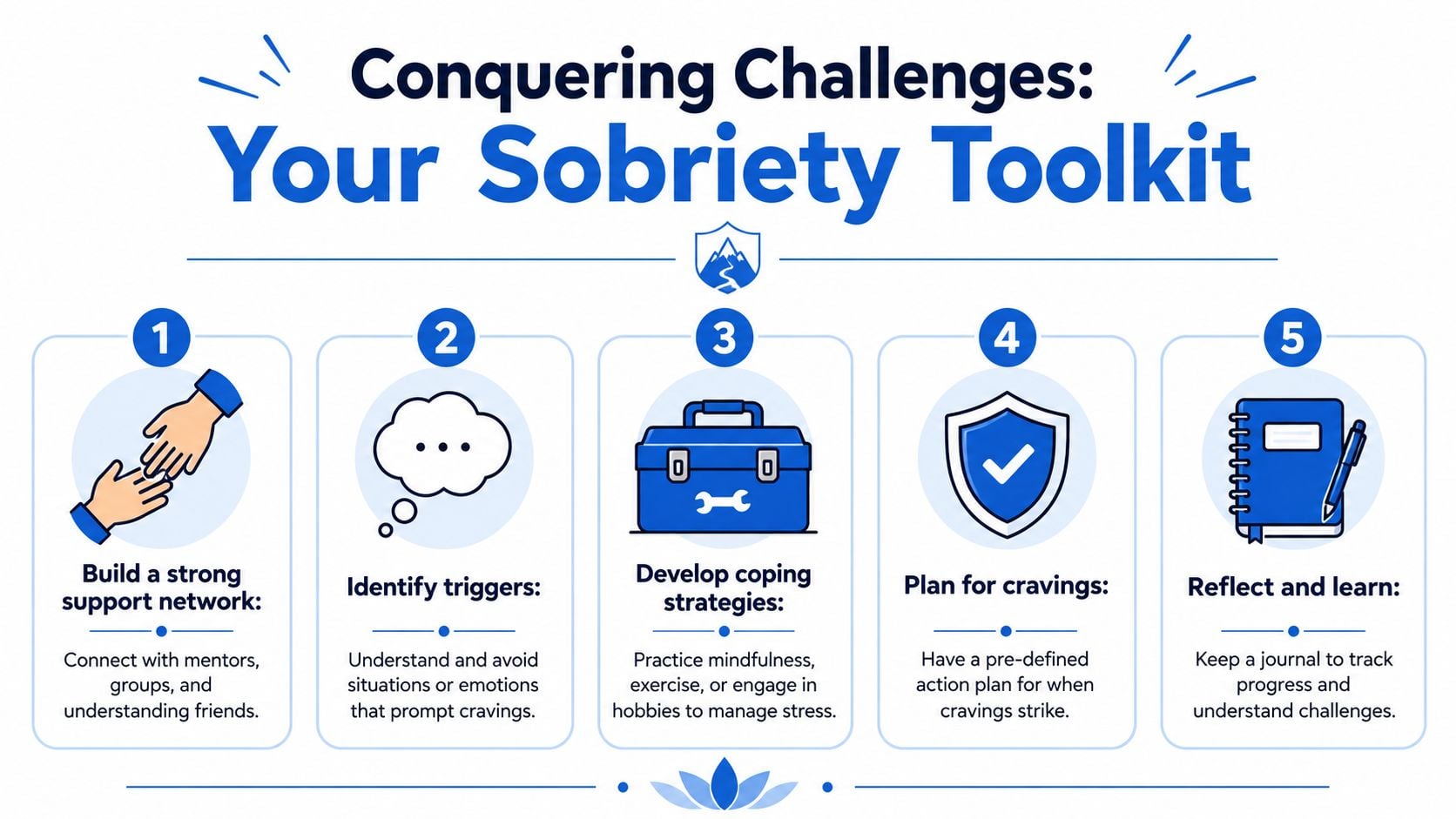
A solid support system often includes:
- Professional care: individual counseling, medical oversight, or dual-diagnosis treatment when needed
- Peer connection: AA, NA, SMART Recovery, alumni groups, or another recovery community
- Daily accountability: a sponsor, mentor, trusted friend, or family member who knows the plan
- Practical relapse prevention: identifying triggers, rehearsing exits, and deciding in advance what you'll do when cravings show up
This short video offers a helpful perspective on building recovery habits that last:
Track progress in ways you can actually see
One reason people give up around 90 days is that recovery can feel invisible. You may not notice change because you're living inside it. Tracking helps.
Try recording a few simple markers each day:
- Sleep quality
- Craving intensity
- Mood
- Meetings or therapy attended
- One thing you handled sober that used to trigger use
If you struggle with consistency, tools for visualizing and tracking goals effectively can help turn a blurry process into something visible. In recovery, visible progress often becomes motivating progress.
Celebrating Your Milestone and Planning for Long Term Recovery
Reaching 90 days deserves acknowledgment. You've done more than avoid a substance. You've endured discomfort, practiced restraint, rebuilt trust with yourself, and stayed present through days you might once have escaped.
Celebrate in a way that protects recovery
A healthy celebration doesn't have to be dramatic. It just needs to reinforce the life you're building.
That might mean sharing the milestone at a meeting, having dinner with supportive people, taking a day trip, buying a journal, framing your chip, or writing down what has changed since day 1. Some people also make a list of what sobriety has already returned to them. Better mornings. Fewer lies. More self-respect. Less chaos at home.
Keep the celebration simple if you need to. Early recovery doesn't require performance. It requires honesty.
Turn 90 days into your next season of recovery
The most useful way to think about 90 days is as a gateway. You've moved out of the most fragile early stretch. Now you need a plan that keeps momentum from turning into overconfidence.
A long-term recovery plan usually includes ongoing therapy, regular peer support, relapse prevention work, healthy routines, and a clear response plan for bad days. If you use insurance, it's smart to ask early what levels of care, follow-up counseling, and medication support are covered. If you're a veteran or part of a military family, check how TRICARE applies to your continuing care options.
The question after 90 days isn't “Am I cured?” It's “What do I need to keep protecting what I've started?”
Conclusion Your Foundation for a New Beginning
The first 90 days of sobriety ask for courage in small, repetitive ways. You wake up. You tolerate discomfort. You reach out. You keep going on days that don't feel rewarding yet. That work matters because this period is a real turning point, not just emotionally, but biologically and behaviorally too.
By this stage, many people begin to experience more stable sleep, clearer thinking, and a stronger sense that a different life is possible. At the same time, the emotional dip between days 60 and 90 can make progress easy to miss. If that's where you are, don't assume you're going backward. You may be standing in one of the most normal, misunderstood phases of early recovery.
What helps most is staying connected. Recovery tends to strengthen when support stays active, especially when mood, motivation, or confidence fluctuate.

If you or someone you love is trying to reach 90 days of sobriety, don't wait for things to get worse before asking for help. A strong foundation can start with one honest conversation, one safe assessment, or one day of structured support.
If you're ready to take that next step, Addiction Resource Center LLC offers compassionate drug and alcohol treatment in Yuba City for adults who need detox, MAT, residential rehab through its partner facility, IOP in person or via telehealth, and support for co-occurring mental health needs. Their team includes medical and counseling professionals, recovery mentors, and aftercare planning, with help available for private insurance and TRICARE. You can learn more, schedule a tour, or reach out for guidance for yourself or a loved one.