One in four U.S. adults living with both serious mental illness and a substance use disorder received neither type of treatment in 2023, according to SAMHSA's national survey. That figure changes the question. The problem usually isn't a shortage of therapies. It's the failure to connect psychiatric care, substance-use treatment, medication, safety planning, and follow-up …

One in four U.S. adults living with both serious mental illness and a substance use disorder received neither type of treatment in 2023, according to SAMHSA's national survey. That figure changes the question. The problem usually isn't a shortage of therapies. It's the failure to connect psychiatric care, substance-use treatment, medication, safety planning, and follow-up into one workable plan.
The right dual diagnosis treatment options depend on withdrawal risk, psychiatric symptoms, housing, transportation, insurance, and the quality of coordination behind the program's marketing. A facility that offers therapy and detox under the same brand may still send you to separate providers who never speak. Choose the care model first, then choose the level of care and specific therapies.
Table of Contents
- What Dual Diagnosis Really Means and Why Coordination Matters
- Integrated Versus Sequential and Parallel Treatment Models
- Levels of Care From Detox Through Intensive Outpatient
- Therapy Modalities and What Each One Treats
- Medication Assisted Treatment and Psychiatric Medication Decisions
- Insurance, TRICARE, Telehealth, and Access Logistics
- Choosing the Right Starting Point for Your Situation
- Practical Questions Families Ask During Treatment
What Dual Diagnosis Really Means and Why Coordination Matters
Dual diagnosis means a person has both a mental-health condition and a substance use disorder. Depression, bipolar disorder, post-traumatic stress disorder, psychosis, anxiety, and other psychiatric conditions can coexist with alcohol, opioid, stimulant, cannabis, or sedative misuse. Each condition needs its own assessment, treatment targets, and outcome tracking, even when one worsens the other.
The access gap remains stark. Among 6.8 million U.S. adults with serious mental illness and a substance use disorder in 2023, 25.4% received both mental-health and substance-use treatment, 47.3% received mental-health treatment alone, and 25.0% received neither, according to the SAMHSA survey cited above. A person can be technically “in treatment” while an addiction team misses suicidal thinking or a psychiatric team overlooks escalating alcohol use. A program that leaves one side of the case unmonitored fails the basic test of integration.
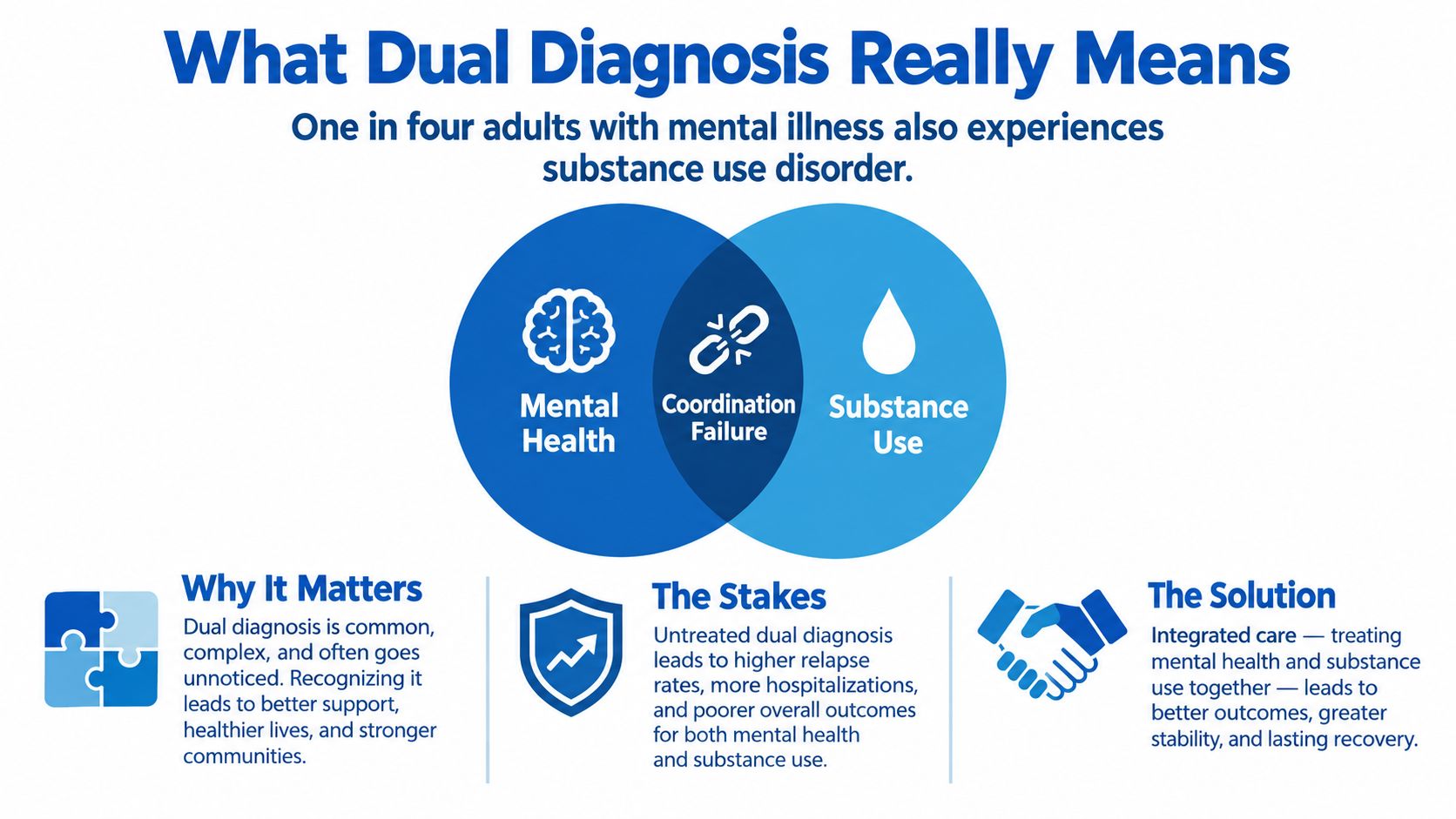
The first test is coordination
The National Institute on Drug Abuse guidance on co-occurring disorders recommends screening people entering mental-health treatment for substance-use disorders and screening people entering substance-use treatment for mental disorders. Screening should happen before a program labels anxiety as “just withdrawal” or treats relapse as a motivation problem.
A credible plan covers psychiatric risk, intoxication and withdrawal, current medications, substance-use patterns, trauma, housing, family support, and medical needs. It names who owns follow-up, how teams share medication changes, and what happens after discharge. Those details matter when families compare programs, assess transportation or insurance limits, or document how mental illness affects daily functioning. For information about disability claims, Melanson Law Group SSDI mental illness offers legal guidance, not clinical care.
Practical rule: Ask whether one clinical team can see both sides of the case, communicate about medication changes, and remain involved when you move to the next level of care.
Integrated Versus Sequential and Parallel Treatment Models
The labels matter because they describe how decisions get made. Integrated treatment uses one coordinated plan for the substance-use disorder and the mental-health condition. Sequential treatment handles one condition first, often postponing psychiatric care until sobriety or postponing addiction treatment until mood symptoms stabilize. Parallel treatment sends the patient to separate systems that may operate at the same time but rarely exchange useful information.
| Care Model | Coordination | Evidence Strength | Typical Access Barriers |
|---|---|---|---|
| Integrated | One plan, shared records, coordinated psychiatric and substance-use care | Strongest rationale for whole-person care | Fewer programs, complex intake, limited specialist availability |
| Sequential | One condition is treated before the other | Can delay needed care and leave symptoms untreated | Discharge gaps, repeated assessments, relapse during handoff |
| Parallel | Separate providers treat separate diagnoses | Depends heavily on communication between teams | Conflicting advice, duplicated work, unclear responsibility |
Integrated care doesn't mean every service must occur in the same building. A psychiatrist, therapist, addiction counselor, primary-care clinician, and recovery mentor can work across locations if they share consent, goals, risk information, and follow-up responsibilities. In practice, that means a medication change reaches the addiction counselor, a relapse reaches the prescriber, and a housing crisis changes the safety plan.
SAMHSA evidence summaries associate integrated programs with reduced substance use, improved psychiatric symptoms and functioning, fewer hospitalizations, greater housing stability, fewer arrests, and better quality of life compared with nonintegrated approaches, as summarized in SAMHSA's evidence-based practices guide. Those are reasons to prefer the model, not a promise that every patient will improve on every measure.
What integrated care should look like
Ask practical questions:
- Who evaluates risk? The answer should include suicide risk, psychosis, overdose risk, withdrawal, medication interactions, and medical instability.
- Who changes medication? A program should identify the prescribing clinician and explain how the therapist receives updates.
- What happens after discharge? Look for step-down care, medication access, relapse response, and a named follow-up contact.
- What gets measured? Abstinence matters, but so do cravings, psychiatric symptoms, attendance, emergency care, housing, and functioning.
A program that uses “integrated” as a slogan but cannot explain these processes is selling a label, not a care model.
Levels of Care From Detox Through Intensive Outpatient
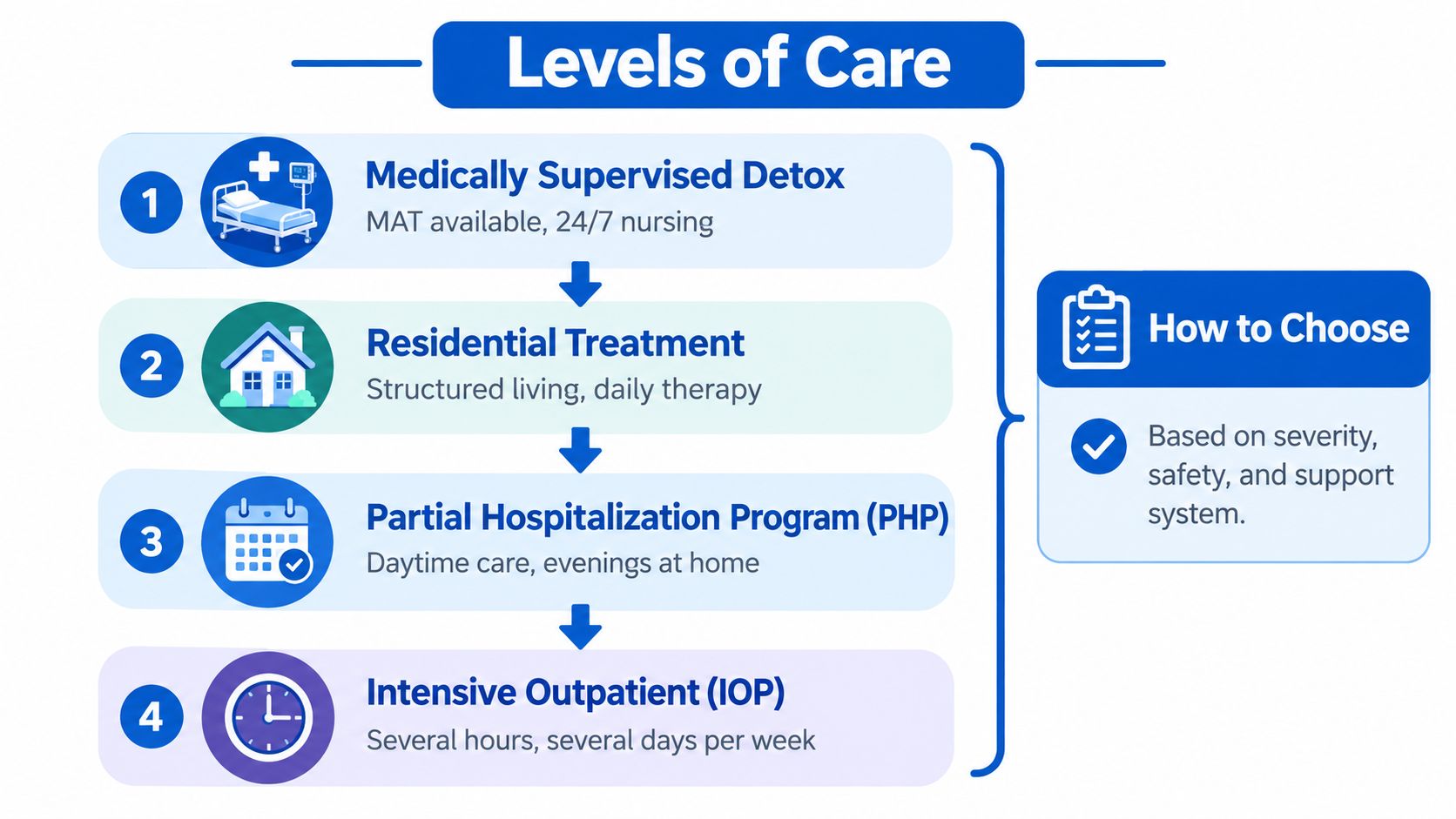
The correct starting point is determined by safety and stability, not by preference alone. Someone in active alcohol or sedative withdrawal needs a different setting from someone with stable housing, no acute risk, and enough support to attend scheduled treatment.
Medically supervised detox
Detox is for stabilization, not complete recovery. Medical staff monitor withdrawal, manage symptoms, assess psychiatric risk, and use medication-assisted treatment when clinically appropriate. Opioid withdrawal, alcohol withdrawal, sedative withdrawal, overdose risk, severe medical illness, confusion, psychosis, or suicidal thinking can make unsupervised withdrawal unsafe.
Residential treatment
Residential care provides structured living, regular clinical contact, medication management, and protection from an environment that reinforces use. It fits people who can't remain safe at home, have repeated relapse in outpatient settings, lack stable housing, or need daily support while psychiatric symptoms are assessed.
Partial hospitalization
A partial hospitalization program offers intensive daytime treatment while the patient returns home or to supportive housing. It can work for people who need substantial structure but don't require overnight medical monitoring. The home environment must be safe enough to support the plan.
Intensive outpatient and standard outpatient care
An IOP combines several clinical sessions across the week with time outside treatment to practice coping skills, attend work, care for family, or rebuild routines. Telehealth can improve access when transportation is a barrier and the patient has privacy, reliable technology, medication access, and a safe place to manage symptoms. It isn't suitable as the sole response to unstable withdrawal, overdose risk, acute psychosis, active suicidality, or unsafe housing.
Read this guide to intensive outpatient programs for a plain-language explanation of how IOP can support mental-health recovery. For a more formal framework, use this level-of-care determination resource to organize questions about severity, safety, support, and treatment intensity.
Step down only when the patient can remain safe and maintain progress outside the current setting. Step up when substance use persists, psychiatric symptoms worsen, appointments are missed, medication isn't tolerated, or the home environment undermines recovery.
Therapy Modalities and What Each One Treats
Therapy should target a defined clinical problem. Cognitive behavioral therapy helps patients identify thoughts, cues, and behaviors that precede substance use or worsen psychiatric symptoms. Effective sessions build practical skills, including challenging catastrophic thinking, planning for cravings, and rehearsing responses to high-risk situations.
Dialectical behavior therapy fits cases in which emotional intensity, impulsivity, self-harm risk, interpersonal conflict, or rapid shifts in distress contribute to substance use. It teaches distress tolerance, emotion regulation, mindfulness, and interpersonal effectiveness. Ask whether clinicians use DBT's core skills consistently or merely display the acronym in program materials.
Match the tool to the barrier
- Motivational interviewing suits ambivalence. It helps a person examine the costs of use and state personal reasons for change without turning treatment into an argument.
- Contingency management provides structured, immediate reinforcement for defined recovery behaviors. Programs may consider it when stimulant or alcohol use persists, within applicable clinical and program rules.
- Family therapy addresses communication, boundaries, safety planning, and ways relatives may unintentionally reinforce recurring crisis patterns.
- Peer recovery support adds practical experience and accountability. A peer mentor does not replace licensed clinical care, but can help with meetings, appointments, transportation, and early recovery routines.
Medication-assisted treatment belongs inside the broader plan, alongside therapy rather than as a substitute for it. Counseling cannot safely manage severe withdrawal, and therapy alone cannot replace psychiatric medication when a clinician determines that medication is indicated.
A Cochrane review of 25 randomized controlled trials found no compelling evidence that one psychosocial approach consistently outperformed another for reducing substance use, improving mental state, or preventing treatment loss among people with serious mental illness and substance misuse. Personalization follows from that finding. It does not justify abandoning therapy.
Choose the modality that matches the patient's barrier, measure its effect, and change course when it fails to help.
Medication Assisted Treatment and Psychiatric Medication Decisions
Medication decisions reveal weak dual diagnosis programs quickly. A sound program can address depression, bipolar symptoms, psychosis, trauma-related symptoms, or severe anxiety without making complete abstinence a prerequisite for psychiatric care. At the same time, clinicians must account for intoxication, withdrawal, adherence, drug interactions, overdose risk, and the patient's history before prescribing.
As noted earlier, screening must consider both substance use and mental health symptoms. The addiction prescriber and psychiatric prescriber should share one medication account: what each drug treats, which side effects require attention, how adherence is tracked, and who responds when symptoms change. This is measurable coordination, not a label. Ask whether the team documents medication decisions in one record and holds planned communication between prescribers.
| Medication Category | Primary Use | Role in Integrated Plan |
|---|---|---|
| Medications for opioid use disorder | Opioid use disorder | Reduce withdrawal and cravings while counseling, monitoring, and relapse-prevention work continue |
| Medications for alcohol use disorder | Alcohol use disorder | Support reduced drinking or abstinence when clinically appropriate, alongside behavioral care |
| Antidepressants | Depressive and some anxiety-related symptoms | Treat diagnosed symptoms while clinicians monitor activation, adherence, and substance-related effects |
| Mood stabilizers | Bipolar-spectrum symptoms and mood instability | Support mood regulation with careful monitoring of response and adverse effects |
| Antipsychotics | Psychosis and other conditions requiring antipsychotic treatment | Address severe symptoms while the team monitors sedation, adherence, and safety |
Medication-assisted treatment supports recovery work rather than replacing it. By reducing withdrawal, cravings, or psychiatric symptoms, medication may help a patient attend therapy, restore routines, and apply relapse-prevention strategies.
Use this medication-assisted treatment effectiveness guide to prepare specific questions. Ask who can start or adjust medication, how quickly psychiatric assessment occurs, and what the program does if side effects or worsening symptoms appear. Refusing to discuss clinically appropriate medication options is a red flag. So is presenting one medication as suitable for every patient. A credible program explains its reasoning, monitors results, and changes the regimen when it is ineffective or unsafe.
Insurance, TRICARE, Telehealth, and Access Logistics
A clinically appropriate program is useless if the patient can't reach it, afford it, or remain enrolled. Insurance authorization, transportation, work schedules, privacy at home, language access, and medication continuity often determine whether treatment starts and whether it survives the first transition.
SAMHSA reported that only 19.3% of people aged 12 or older who needed substance-use treatment received it in 2024, and only 2.5% of people with past-year alcohol use disorder received medication for alcohol use disorder, according to the agency's 2024 survey announcement. Underuse is not proof that options don't exist. It often means people encounter authorization delays, transportation problems, stigma, unclear referrals, or programs that don't offer the care they need.
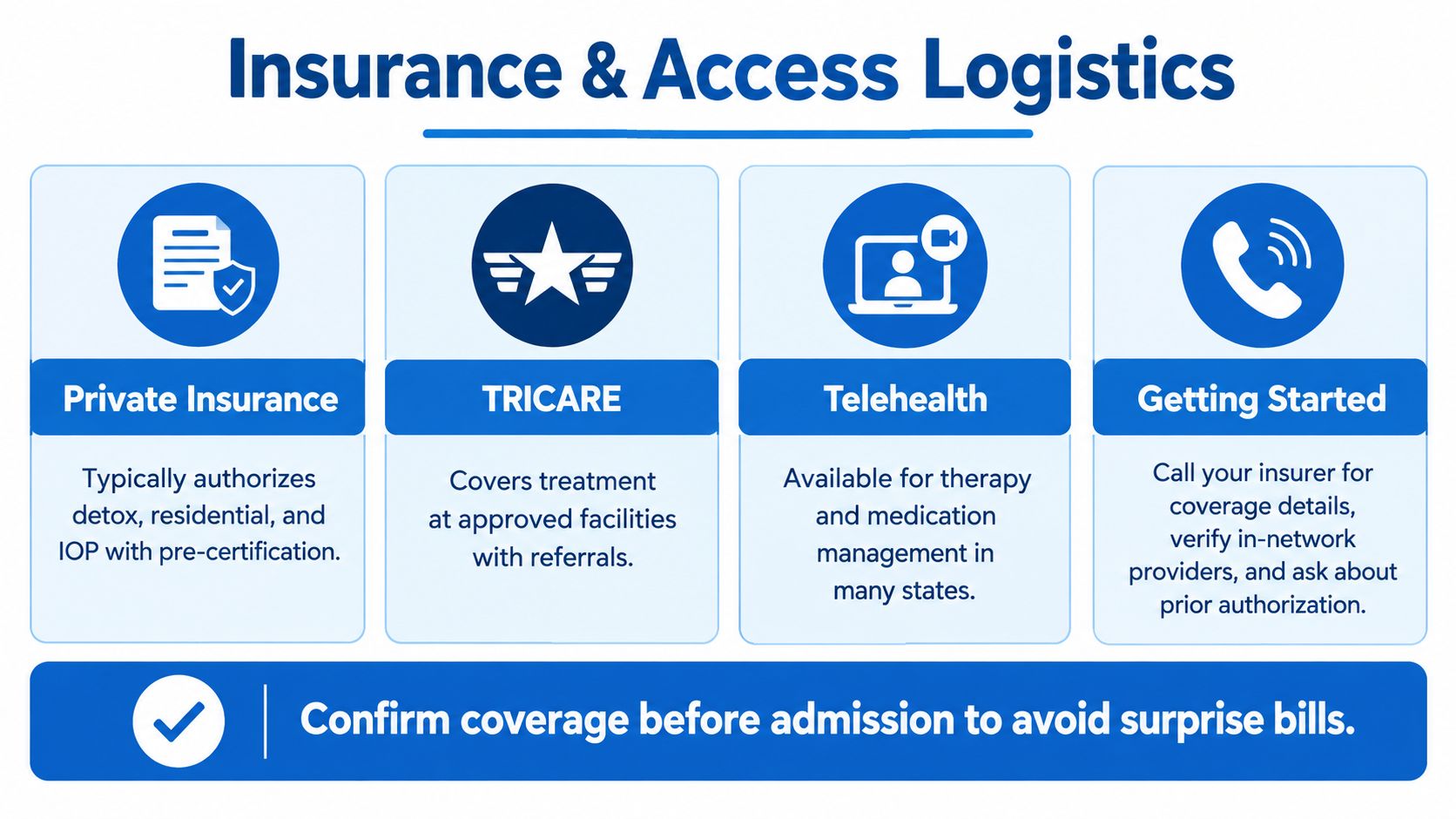
Ask before admission
- Coverage: Is the facility in network, and which services require preauthorization?
- Continuity: Does the program arrange the next level of care before discharge?
- TRICARE: Does the facility accept TRICARE, and who handles referrals and authorization for military families?
- Telehealth: Can therapy and medication management continue remotely, and what happens if technology fails?
- Transportation: Is there a realistic plan for missed rides, appointments, and pharmacy access?
- Privacy: Can the patient participate privately, and how will family involvement be handled with consent?
A telehealth IOP resource can help you assess whether remote treatment fits your circumstances. Telehealth is a delivery method, not a lower clinical standard. If a program uses it to avoid medical assessment, ignores withdrawal risk, or has no emergency escalation process, choose differently.
For veterans and military families, ask for a named benefits coordinator rather than accepting a general promise that coverage is available. A referral mill often pushes admission before explaining authorization, offers vague answers about psychiatric staffing, and has no written step-down plan.
Choosing the Right Starting Point for Your Situation
Start with the highest risk that must be controlled, not the least disruptive option.
- Active withdrawal, overdose risk, serious medical instability, psychosis, or suicidal thinking: Begin with emergency evaluation or medically supervised care. Residential or inpatient psychiatric support may follow. Track withdrawal safety, crisis symptoms, medication response, and engagement.
- Recent relapse with unsafe housing or repeated failed outpatient attempts: Choose residential treatment or a highly structured setting. Track days of use, cravings, sleep, psychiatric symptoms, and attendance.
- Stable housing with significant symptoms but no need for overnight monitoring: Choose PHP or in-person IOP. Track functioning, medication adherence, symptom scores, and whether the patient can use coping skills outside sessions.
- Reliable support, manageable symptoms, and transportation barriers: Consider IOP with telehealth or standard outpatient care. Track appointment attendance, substance-use days, cravings, emergency visits, and follow-up completion.
- Veterans and military families: Start with a provider that verifies TRICARE status and coordinates referrals before admission. Track authorization continuity and whether treatment remains uninterrupted during transitions.
Don't wait indefinitely for a perfect program. Start with a safe, competent option that treats both conditions, then transfer or step up when the assessment shows that the level or staffing isn't enough. A good plan changes when symptoms, substance use, housing, or medication tolerance changes.
At each follow-up, ask four questions: Is substance use decreasing? Are psychiatric symptoms improving? Is the patient staying engaged? Is the current environment safe? If the answers are worsening, waiting is not a neutral decision.
Practical Questions Families Ask During Treatment
What should happen after a relapse?
A relapse should trigger assessment, not automatic abandonment. The team should check intoxication, withdrawal, suicide risk, medication access, housing, and the events that preceded use. Sometimes the right response is more structure, medication adjustment, or a safety plan. Sometimes it is emergency care.
Is abstinence the only measure of progress?
No. Track substance-use days and cravings, but also monitor psychiatric symptoms, sleep, medication adherence, attendance, emergency or inpatient use, housing stability, daily functioning, and the ability to ask for help before a crisis. SAMHSA's evidence summary connects integrated care with improvements across several of these domains, which is why a program should show more than attendance records.
How can family members help without violating privacy?
Ask the patient to sign appropriate consent and agree on what information can be shared. Families can provide medication history, warning signs, transportation, and observations about functioning without demanding unrestricted access to therapy details. They also need boundaries, crisis instructions, and support for their own wellbeing.
When should a peer mentor join the plan?
Bring in peer support when the patient needs practical connection, accountability, or help navigating recovery outside clinical appointments. The mentor should know the crisis plan and communicate concerns through the proper care team, while licensed clinicians retain responsibility for diagnosis and treatment decisions.

The strongest programs make their work visible. They can tell you who coordinates care, what gets measured, how relapse changes the plan, and who remains available after discharge. If they can't answer those questions, keep looking.
Addiction Resource Center LLC provides medically supervised detox with MAT, residential rehabilitation through its partner Ona Treatment Center, and in-person or telehealth IOP for adults with substance-use and co-occurring mental-health needs. Visit Addiction Resource Center LLC to review care options, confirm insurance or TRICARE access, and request guidance for yourself or a loved one.