You're standing in the kitchen after another hard night, trying to decide whether you should drag your loved one to a meeting, go to one yourself, or just keep the peace until morning. That's usually what people mean when they search “AA for family members”, they're looking for something practical, something humane, and something that …

You're standing in the kitchen after another hard night, trying to decide whether you should drag your loved one to a meeting, go to one yourself, or just keep the peace until morning. That's usually what people mean when they search “AA for family members”, they're looking for something practical, something humane, and something that tells them whether they belong in the recovery process too.
The short answer is yes, families belong in the recovery ecosystem. The more accurate answer is that Alcoholics Anonymous is built for the person who drinks, while relatives usually find their own footing through Al-Anon, Alateen, and other parallel supports that help them respond without carrying the whole burden alone. If you've felt confused by mixed advice online, this guide sorts out what AA offers families, what it doesn't, and what a realistic next step looks like in daily life.
Table of Contents
- What Family Members Usually Mean When They Search This
- How Alcoholics Anonymous Actually Works
- AA Versus Al-Anon and Alateen at a Glance
- What Family Members Actually Experience at an Al-Anon Meeting
- Setting Boundaries and Communicating With a Loved One in Recovery
- Protecting the Family Member's Own Mental Health
- Local Resources and a Practical Next-Steps Checklist for Yuba City Families
What Family Members Usually Mean When They Search This
A spouse types the phrase into a phone at 1:12 a.m. after another argument. A parent searches it while sitting alone in the living room, trying to decide whether they should keep asking questions or back off. An adult child searches it because they love someone who drinks too much, and they can't tell whether they're supposed to attend AA, bring their loved one to AA, or find something else entirely. That moment of uncertainty is the search intent behind aa for family members.
The confusion makes sense. AA has a public name, a long history, and a reputation that spills beyond the meeting room. People hear that it helps families, then assume the whole family should go to AA itself. In practice, the family role is usually more indirect, because AA is designed for the person with alcohol use disorder, while relatives need their own peer support and coping tools, as explained in this guide on whether addiction runs in the family.
Practical rule: if the person who drinks needs help staying sober, their family usually needs help staying steady.
That distinction matters because family members are often carrying two jobs at once. They're worried about the person drinking, and they're also trying to manage sleep, work, kids, finances, and the emotional fallout at home. If you've been looking for a meeting room that solves both problems at once, you're not wrong to look. You just need the right room for each job.
Families are part of recovery, but they usually enter through a parallel support path, not by taking the same seat as the person in treatment. That's the piece many articles leave muddy. The rest of this guide clears it up in plain language.
How Alcoholics Anonymous Actually Works
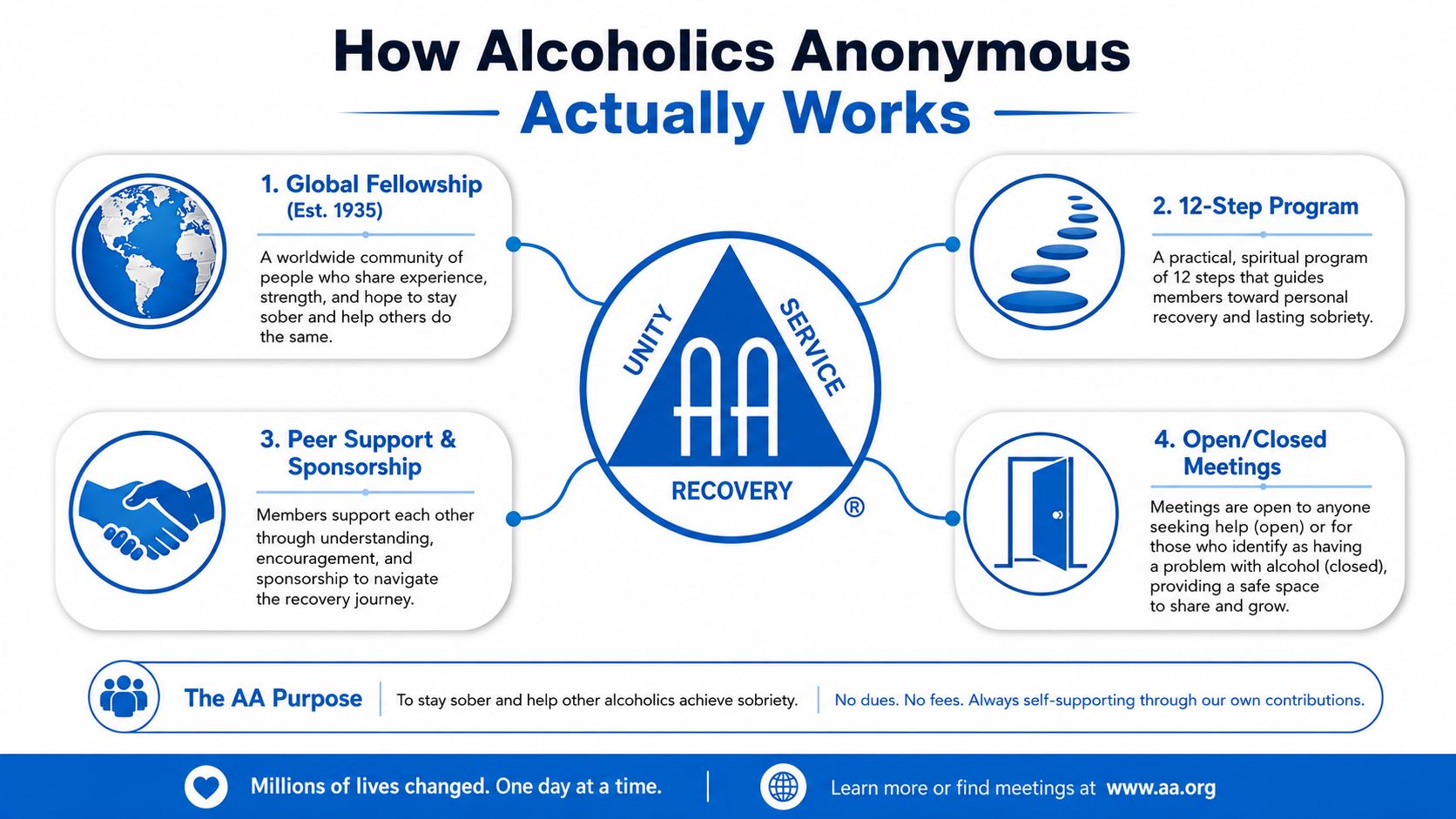
AA started in 1935 and has become a global mutual-aid fellowship built around the Twelve Step model for recovery from alcoholism, with the central idea that sobriety lasts better when a person stays connected to other recovering people instead of relying on willpower alone, according to the historical overview in Alcoholics Anonymous. That basic design explains why AA can be so powerful for the person who drinks, and also why it isn't a family therapy group. Its first responsibility is to the member in recovery.
What AA meetings are doing
AA meetings give people a structured place to listen, speak, and stay accountable. Some meetings are open to observers, and some are closed to people who identify as needing help with alcohol. Sponsorship, anonymity, and regular attendance all support the same goal, which is to make sobriety a lived habit instead of a one-time promise.
Large reviews of the scientific literature have associated AA involvement with roughly twice the rates of abstinence compared with non-attendance, and one review found that this relationship held across 24 studies of social support and AA participation, as summarized in the same historical source above. That doesn't mean AA is magic. It means the social side of recovery matters, and the meetings are built around that reality.
Why families should care
Families often focus on rules, arguments, or relapse prevention plans. Those matter, but the research summary above points to something deeper. Social-support variables consistently mediated AA's impact on abstinence, which means recovery isn't just about whether someone “wants it badly enough.” The people around them, and the quality of that network, are part of the mechanism of change.
That's why families need their own support path too. A spouse can't become the person's sponsor. A parent can't turn a living room into a meeting room and expect the same result. AA is a recovery engine for the individual, and family members need their own tools for boundaries, sanity, and steadier communication. For a broader list of conversation ideas, see AA topics for discussion.
What AA does not do
AA doesn't replace medical care, therapy, detox, or family counseling. It also doesn't ask relatives to manage the drinker's recovery for them. The structure is intentionally focused, and that focus is part of why it works. Families matter enormously, but their role is supportive, not controlling.
AA Versus Al-Anon and Alateen at a Glance
If you want the cleanest answer to “AA for family members,” it's this. Al-Anon Family Groups, founded in 1951, is the closest evidence-based fit for relatives and friends affected by someone else's drinking, while Alateen serves teenagers affected by a parent's or another adult's alcohol use, according to the historical note in Al-Anon/Alateen. AA remains for the person with alcohol use disorder. The family fellowships are for everyone else who has been trying to survive the ripple effects.
Who each fellowship serves
AA is for the person who wants to stop drinking. Al-Anon is for spouses, parents, siblings, adult children, partners, and friends who are affected by someone else's drinking. Alateen is for younger family members and teens who need a peer space of their own.
| Fellowship | Who It Serves | What Happens in Meetings | Best Fit |
|---|---|---|---|
| AA | Person with alcohol use disorder | Members share recovery experience, use the Twelve Steps, and build sober support | Someone working on their own drinking |
| Al-Anon | Relatives and friends affected by alcoholism | Members talk about coping, boundaries, detachment, and family stress | A spouse, parent, sibling, or adult child |
| Alateen | Teens affected by a loved one's drinking | Teens hear from peers and learn coping language for home life | A teen living with a parent's drinking |
What the meetings are trying to produce
AA tries to support sobriety in the person who drinks. Al-Anon tries to help family members stop living in crisis mode. Alateen gives teens language and community so they don't have to carry adult chaos alone. The goals overlap, but they are not the same, and pretending they are the same only confuses families.
Plain truth: a family member can care deeply about the drinker and still need a different room, a different discussion, and a different set of tools.
Retention is also part of the picture. One peer-reviewed study found that 57% of newcomers discontinued Al-Anon meeting attendance within six months, which shows that family support can be available and still hard to sustain. That number shouldn't discourage people. It should set realistic expectations. Families often come in exhausted, skeptical, or embarrassed, and staying connected takes time.
So if you've wondered whether you belong in AA itself, the better question is whether your role is to recover alongside your loved one rather than inside the same fellowship. Most of the time, the answer is yes.
What Family Members Actually Experience at an Al-Anon Meeting
The first thing many newcomers notice is how ordinary the room feels. There's usually a reading to open the meeting, then people share one at a time, and the tone is calm rather than dramatic. Nobody asks you to perform your pain. You can sit, listen, and leave with your dignity intact.
The rhythm of the room
Al-Anon meetings usually keep a simple structure. Someone reads from suggested literature, a topic may be announced, and members share their own experience without giving speeches at each other. Cross-talk and fixing are discouraged, because the room is meant to hold each person's story without turning into a debate.
Confidentiality is treated seriously. People speak more openly when they trust that their names, stories, and families won't get carried outside the meeting. You don't have to explain yourself, defend your choices, or tell the whole history on day one.
What it feels like
The emotional mix can be surprising. Relief often shows up first, because someone in the room has lived something uncannily similar to what you've lived at home. Grief tends to show up too, because hearing your own story in another person's voice can make the loss feel real in a new way. That can be uncomfortable, but it's also part of why people keep returning.
You don't need special clothes. Bring yourself, a notebook if you want one, and a willingness to listen. Kids usually don't belong in a standard meeting, because those rooms are for adults; teens need an Alateen setting instead. If you're unsure about anonymity, ask the meeting contact before you go, or look for a virtual option that lets you turn off your camera until you're ready.
Some people leave the first meeting with one phrase that sticks, sometimes detach with love. It isn't a slogan meant to erase concern. It's a reminder that you can care without chasing, rescue without control, or stay connected without surrendering your own life.
Setting Boundaries and Communicating With a Loved One in Recovery
A family can love someone and still feel lost about what to do next. One person starts trying to manage every detail, another pulls away to keep the peace, and the household ends up swinging between control and silence. The steadier path is to set boundaries that protect everyone in the room, including the person in recovery.
What to stop doing first
Family guidance linked to Columbia recommends cutting back on enabling, keeping alcohol out of the home when that is realistic, encouraging treatment attendance, and using calm check-ins instead of repeated questioning. The same guidance reminds relatives that the person in recovery is still responsible for their own choices, and that relapse risk can change over time, as noted in Columbia's guidance on family responsibilities. That gives families a practical starting point.
The familiar traps usually look like rescue work. People cover for missed shifts, call in sick for the person who drank, search drawers and cabinets for hidden bottles, or press for the truth again and again. Those responses often come from fear, not cruelty, but they keep the whole family locked in the same cycle.
What to do instead
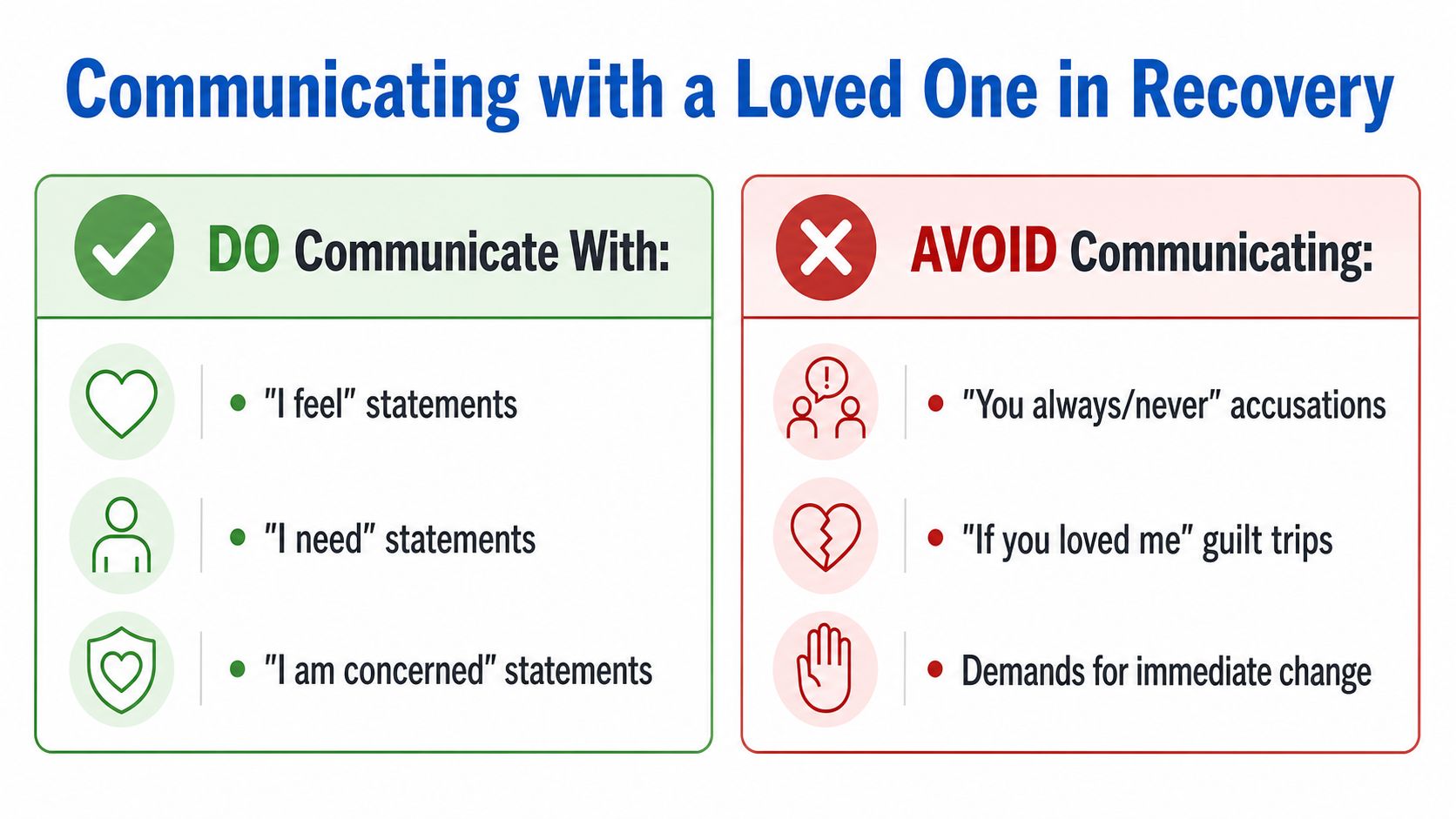
Clear language helps more than long lectures. Say what happened, say how it affected you, say what you will not do, and keep your tone even. A simple pattern can sound like this:
- State your observation: “You came home intoxicated last night.”
- Name the impact: “I felt scared and exhausted.”
- Set the boundary: “I'm not covering for you at work again.”
- Offer the next step: “I'm willing to talk when you're sober.”
That kind of message is firm without being hostile.
Don't promise consequences you won't enforce. Families rebuild trust when their words and actions start matching.
The AA family material also describes a tension many relatives feel, both sides may need to yield for the household to function. That does not mean giving up your own needs. It means accepting that you cannot force sobriety, while still refusing to feed chaos. If the situation is active, urgent, or legally complicated, families sometimes need outside guidance that goes beyond the recovery rooms, and some relatives also need a clearer look at codependency in recovery when the relationship has started to revolve around crisis management.
A healthy communication rule stays simple. Speak to the person, not to the disease. Keep the sentence short, keep the request concrete, and know where the conversation ends if it turns hostile.
Protecting the Family Member's Own Mental Health
When one person in the household is drinking heavily, everyone else's nervous system starts working overtime. Sleep gets lighter. Appetite shifts. The mind starts scanning for the next problem. That kind of stress can look like “just being worried,” but it can also slide into anxiety, depression, anger, or burnout.
When support groups aren't enough
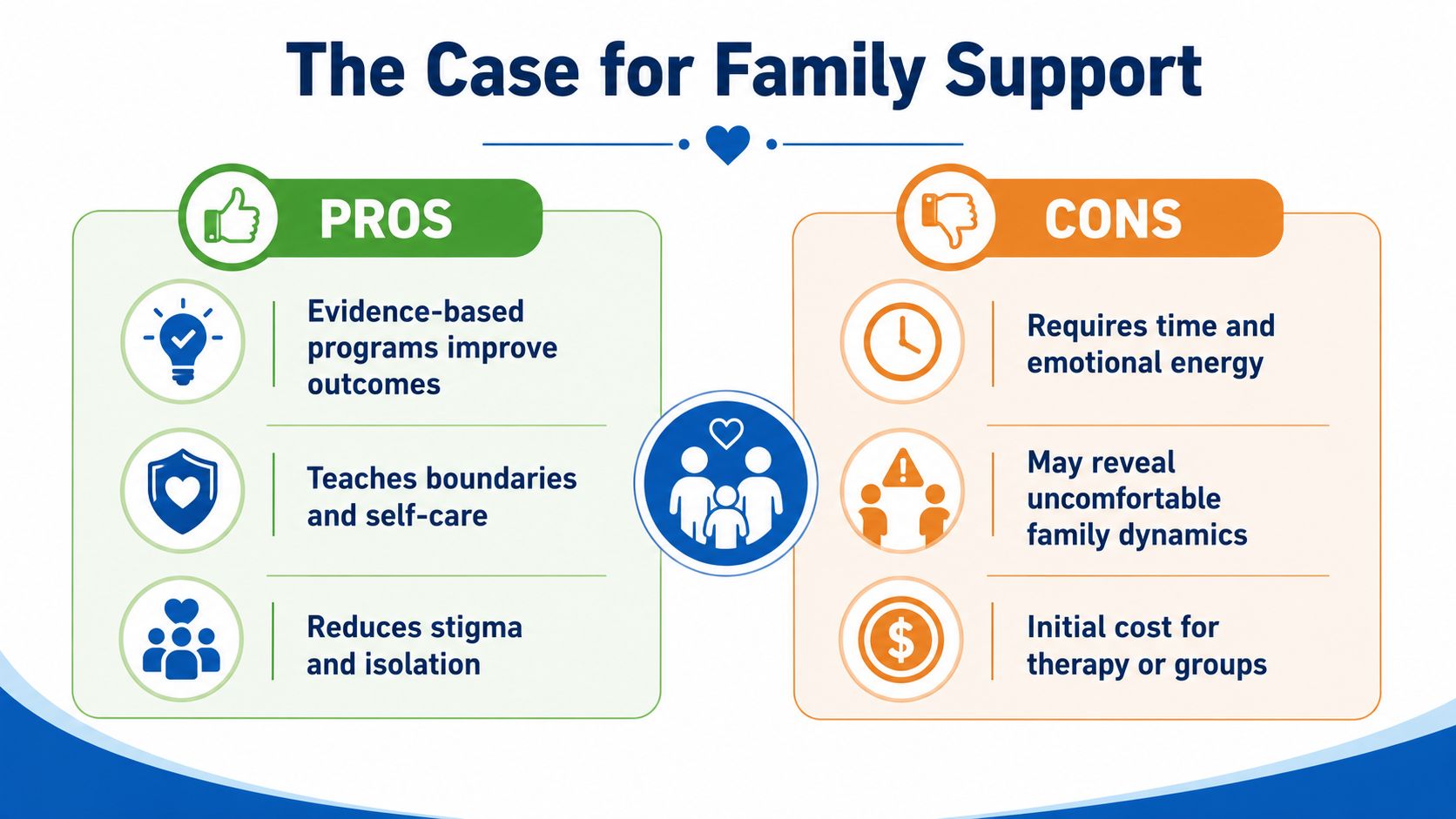
Family support groups are often a strong first step, but they're not always enough on their own. If you're having intrusive thoughts, losing sleep for days at a time, feeling persistently depressed, or noticing that your anger is turning into fear of hurting yourself or the person who drinks, you need more than peer support. That's a signal to reach out for professional help, not a sign of failure.
Why the hybrid option matters
Many family support meetings are now available online, which helps people who need privacy, who live far from a local group, or who can only join after work. That matters for caregivers, military families, and rural relatives who can't reliably attend in person. Virtual meetings won't solve everything, but they remove a real barrier.
If you're trying to find local treatment, referral, or crisis support, the national SAMHSA helpline, 1-800-662-HELP, exists for that purpose. It can help people find the next right step when the situation is bigger than a self-help meeting and smaller than an emergency room.
A simple mental-health check for relatives
- If you're sleeping, thinking, and working normally, peer support and clear boundaries may be enough for now.
- If you're losing sleep or feeling constantly on edge, add more support.
- If you're scared of your own reactions, contact a clinician, crisis line, or helpline now.
The old family-recovery idea is easy to miss. You don't become more helpful by becoming more depleted. You become more helpful by staying grounded enough to make wise choices.
For a deeper look at the family pattern many people mislabel as “trying to help too much,” see codependency in recovery.
Local Resources and a Practical Next-Steps Checklist for Yuba City Families
A family in Yuba City can do several things at once without having to choose only one lane. Peer support helps with the strain at home. Professional treatment addresses the drinking itself. Crisis support matters when the situation is too unstable for willpower, text messages, or a single meeting to carry the load.
Three paths that can work together
The first path is peer support. Al-Anon meetings, whether online or in person, give relatives a place to speak openly without trying to manage the drinker in the room.
The second path is professional treatment. Addiction Resource Center LLC, at 1002 Live Oak Blvd., Suite A, Yuba City, CA, offers a continuum of care that includes medically supervised detox with medication-assisted treatment, an Intensive Outpatient Program offered in person and via telehealth, and individualized aftercare planning. The center is reachable 24/7 at 530-625-7910, and it accepts most major insurance plans, including Tricare beneficiaries, which matters for military families and veterans.
The third path is crisis and referral support. SAMHSA's helpline can help families find treatment navigation when they are not sure where to start. If the home situation involves violence, police involvement, or legal risk, practical guidance such as Texas domestic violence legal advice can help a family think through safety and consequences together.
A checklist for the next 24 hours
- Choose one support step: Find an Al-Anon meeting, online or local, and write down the time.
- Make one safety step: Remove alcohol from shared spaces if that is realistic and safe.
- Make one phone call: Reach out to a treatment provider or helpline if the drinking has become unmanageable.
- Protect your own schedule: Sleep, eat, and keep one ordinary commitment today.
- Say one boundary out loud: Use a short sentence you can repeat without arguing.
A final local note
Yuba City families do not need to solve this alone, and they do not need to guess which room they belong in. The family room, the treatment room, and the crisis line each do different work. Used together, they make recovery easier to start and less likely to fall apart under pressure.
Addiction Resource Center LLC offers a compassionate, confidential place to start when alcohol use is affecting a whole household, not just one person. If you are in Yuba City or nearby and need help for yourself or a loved one, visit Addiction Resource Center LLC to learn about detox, IOP, aftercare, and family support options.