Methadone withdrawal usually begins 24 to 36 hours after the last dose, peaks around days 3 to 6, and the acute phase commonly resolves within 10 to 20 days, but a protracted phase of mood and sleep symptoms can continue for weeks to months. Some people experience lingering symptoms for up to 6 months, even …

Methadone withdrawal usually begins 24 to 36 hours after the last dose, peaks around days 3 to 6, and the acute phase commonly resolves within 10 to 20 days, but a protracted phase of mood and sleep symptoms can continue for weeks to months. Some people experience lingering symptoms for up to 6 months, even after the worst physical discomfort has eased.
So why do many people feel confused when they ask, “How long will methadone withdrawal last?” They often expect one fixed countdown. In practice, withdrawal has an acute physical phase and a longer adjustment phase, and those phases don't follow the same clock.
A person may stop vomiting and sweating, yet still struggle with insomnia, anxiety, low mood, poor concentration, or cravings. That doesn't mean the withdrawal has “failed” or that recovery isn't progressing. It means the body and brain are recovering at different speeds.
Table of Contents
- Why Methadone Withdrawal Does Not Have One Simple Answer
- The Acute Withdrawal Timeline From First Dose to Final Day
- Symptoms You Can Expect During the Acute Phase
- Understanding Protracted Withdrawal and Why It Outlasts the Body
- Factors That Change How Long Withdrawal Lasts for You
- Medical and Medication-Assisted Approaches to Shorten the Process
- Practical Coping Strategies for Each Phase
- When to Seek Professional Care and What Comes Next
Why Methadone Withdrawal Does Not Have One Simple Answer
How long will methadone withdrawal last? The answer depends on which part of withdrawal you mean. Methadone withdrawal is a multi-stage clinical process. One stage reflects the body responding as medication levels decline. Another involves sleep, mood, motivation, stress regulation, and cravings that may remain unsettled after the strongest physical symptoms have eased.
Methadone's long half-life helps explain why symptoms may be delayed. A half-life describes the time needed for the body to eliminate roughly half of a medication. Methadone's half-life can range from about 8 to 60 hours, according to clinical guidance from the National Center for Biotechnology Information. The medication works more like a reservoir that drains gradually than a cup that empties quickly. Its level can keep falling before the nervous system registers a clear shortage.
Two withdrawal questions are hidden inside one
A person asking about duration may mean:
- How long will the intense physical symptoms last?
- How long will cravings, poor sleep, anxiety, or low mood continue?
The first question concerns acute withdrawal. The second concerns protracted withdrawal, sometimes called post-acute withdrawal. These phases have different clocks. Acute symptoms may settle while the brain's stress, sleep, and reward systems are still adjusting, which can leave a person vulnerable to relapse.
The World Health Organization guideline hosted by NCBI describes methadone withdrawal onset within 12 to 48 hours and an acute period lasting about 10 to 20 days. Those ranges describe a general pattern, not a personal deadline.
A taper changes the timeline again. Medically supervised withdrawal may take several days, several weeks, or a few months, depending on the reduction plan and the patient's response. The right schedule is therefore individualized. A clinician may adjust dose reductions when sleep, mood, physical symptoms, or cravings worsen, rather than forcing everyone to follow one detox clock.
Practical rule: Choose a taper around symptom response, safety, sleep, mental health, and relapse risk. Do not judge progress only by the day the acute symptoms end.
For a broader explanation of how detox timelines differ across substances and treatment settings, see this guide to how long detox takes. Methadone withdrawal has a short-term physical phase and a longer recovery phase, and both matter when planning safe care.
The Acute Withdrawal Timeline From First Dose to Final Day
How long does the acute phase take after the last methadone dose? There is no single countdown. Methadone leaves the body gradually, so symptoms may start later and build over several days. Clinical guidance describes onset within 12 to 48 hours, while another review places common onset around 24 to 36 hours and peak symptoms around 96 to 144 hours. These ranges show why a personal withdrawal clock cannot be set by one date. The ASAM National Practice Guideline provides clinical context for withdrawal management.
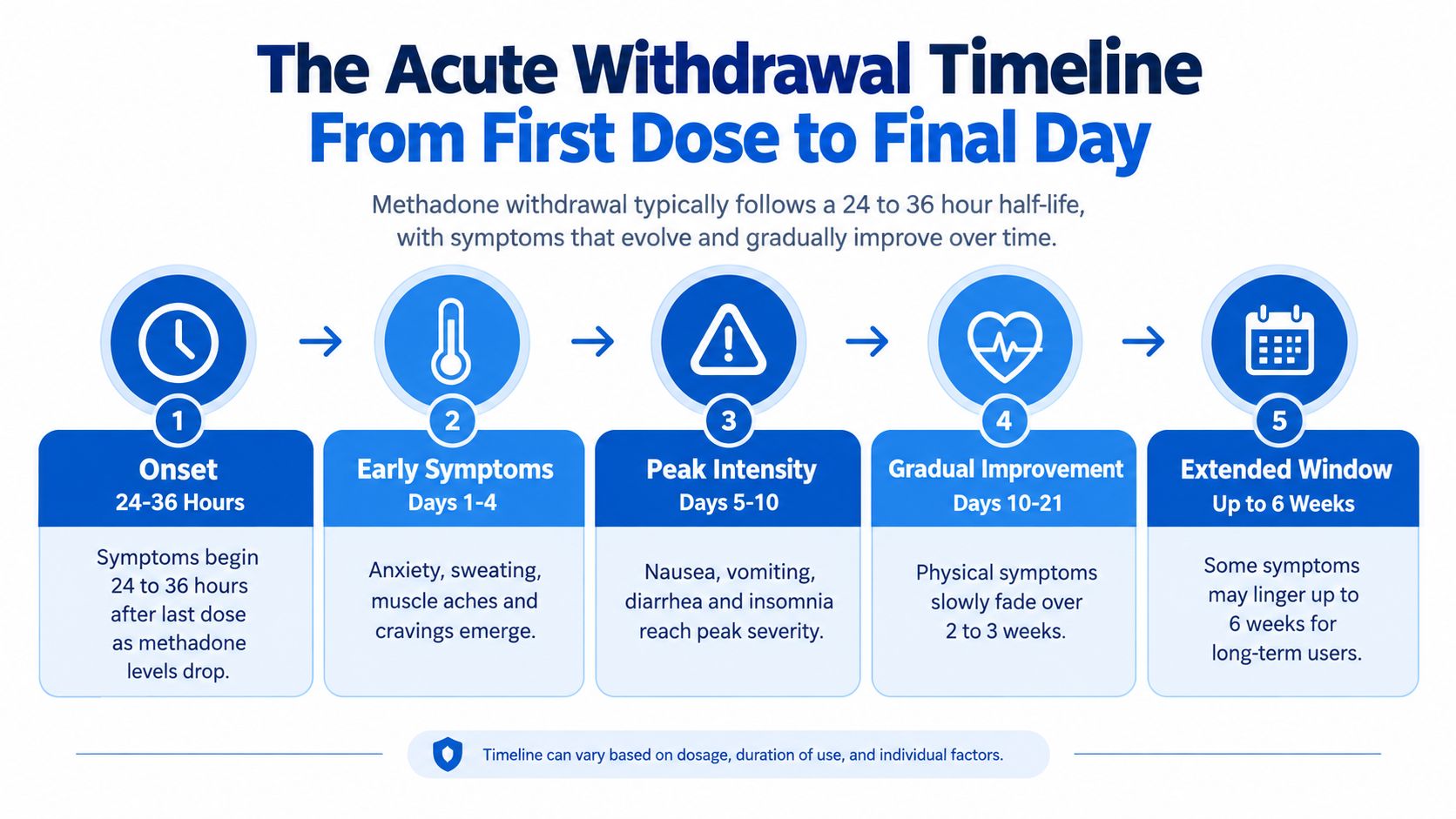
A practical day-by-day view
Before symptoms begin: Methadone remains in circulation after the last dose. You may feel stable at first, although uneasiness or cravings can appear before physical symptoms.
Around 24 to 36 hours: Early withdrawal may bring anxiety, restlessness, yawning, sweating, muscle discomfort, sleep difficulty, and cravings. Symptoms often develop gradually instead of arriving together.
The next several days: As methadone levels decline, physical symptoms may intensify. Muscle aches, chills, stomach cramps, nausea, diarrhea, insomnia, and irritability can become more noticeable.
Around days 3 to 6: This is a common peak window, although some clinical guidance places the broader peak through days 3 to 10. Poor sleep, gastrointestinal distress, sweating, restlessness, and cravings may feel particularly difficult.
The following one to two weeks: Symptoms usually ease in stages rather than stopping overnight. The acute period commonly lasts about 10 to 20 days, but dose, treatment duration, metabolism, tapering, and general health can change the course. The guideline notes that some symptoms may last up to 10 days, while other guidance describes symptoms that continue after the main physical phase.
Methadone's long and variable half-life helps explain the delay. It works like a slowly draining tank: the opioid level falls over time, so withdrawal can begin later and feel more prolonged than withdrawal from a faster-clearing opioid.
A taper adds another variable. Gradual dose reductions can spread acute symptoms across a longer period, while a faster reduction may produce a sharper change. The appropriate pace depends on symptom response, sleep, mood, cravings, and relapse risk, rather than a one-size-fits-all detox clock.
For a plain-language explanation of physical and emotional changes during detox, read about what happens during detox.
Symptoms You Can Expect During the Acute Phase
Acute withdrawal symptoms reflect the nervous system reacting to a lower opioid level. The experience can feel flu-like, but the pattern also includes autonomic changes, gastrointestinal distress, sleep disruption, emotional distress, and strong opioid cravings.
The first cluster is autonomic activation. Sweating, chills, gooseflesh, watery eyes, a runny nose, yawning, dilated pupils, tremors, and a racing heartbeat can appear as the body loses methadone's stabilizing opioid effect. These symptoms often build after the delayed onset rather than appearing immediately after the last dose.
Muscle and joint discomfort can make even simple movement unpleasant. People may describe aching, restlessness, muscle tension, tremors, or increased sensitivity to pain. Anxiety and insomnia may arrive early, then worsen when physical discomfort and repeated nighttime waking begin to reinforce each other.
Gastrointestinal symptoms often become more prominent as withdrawal intensifies. Nausea, vomiting, diarrhea, abdominal cramping, and reduced appetite can create a dehydration risk, particularly when sweating occurs at the same time.
Acute Methadone Withdrawal Symptoms by Day
| Symptom | Typical Onset (Day) | Peak (Day) | Resolution (Day) |
|---|---|---|---|
| Anxiety and restlessness | 1 to 2 | 3 to 6 | Gradually improves over the acute phase |
| Sweating and chills | 1 to 3 | 3 to 6 | Usually fades as physical withdrawal eases |
| Muscle and joint aches | 1 to 3 | 3 to 6 | Often improves during the following one to two weeks |
| Nausea, vomiting, and cramps | 2 to 4 | 3 to 6 | Commonly settles during the acute period |
| Diarrhea | 2 to 4 | Several days into withdrawal | May linger while other symptoms improve |
| Insomnia | Early withdrawal | Variable | Can continue beyond acute withdrawal |
| Irritability and low mood | Early withdrawal | Variable | May persist into protracted withdrawal |
| Cravings | Early withdrawal | Often stronger during the first week | May return in waves for weeks or months |
Cravings aren't a character flaw. They reflect the brain's learned expectation that opioid relief will return, combined with stress, poor sleep, and discomfort. A craving can feel urgent without requiring immediate action, but people need a safety plan before the urge arrives.
Understanding Protracted Withdrawal and Why It Outlasts the Body
Acute withdrawal is the period when physical symptoms are most obvious. Protracted withdrawal is the less visible phase that can follow, when the body has largely cleared the medication but sleep, mood, motivation, concentration, and cravings remain unstable.
Clinical reviews describe lingering symptoms such as dysphoria, fatigue, insomnia, and irritability lasting 6 to 8 months in some people. Other guidance describes a protracted phase lasting up to 6 months, with symptoms that may include low mood and cravings. The NIH review of opioid withdrawal and abstinence explains why the full recovery process can extend beyond the acute physical period.
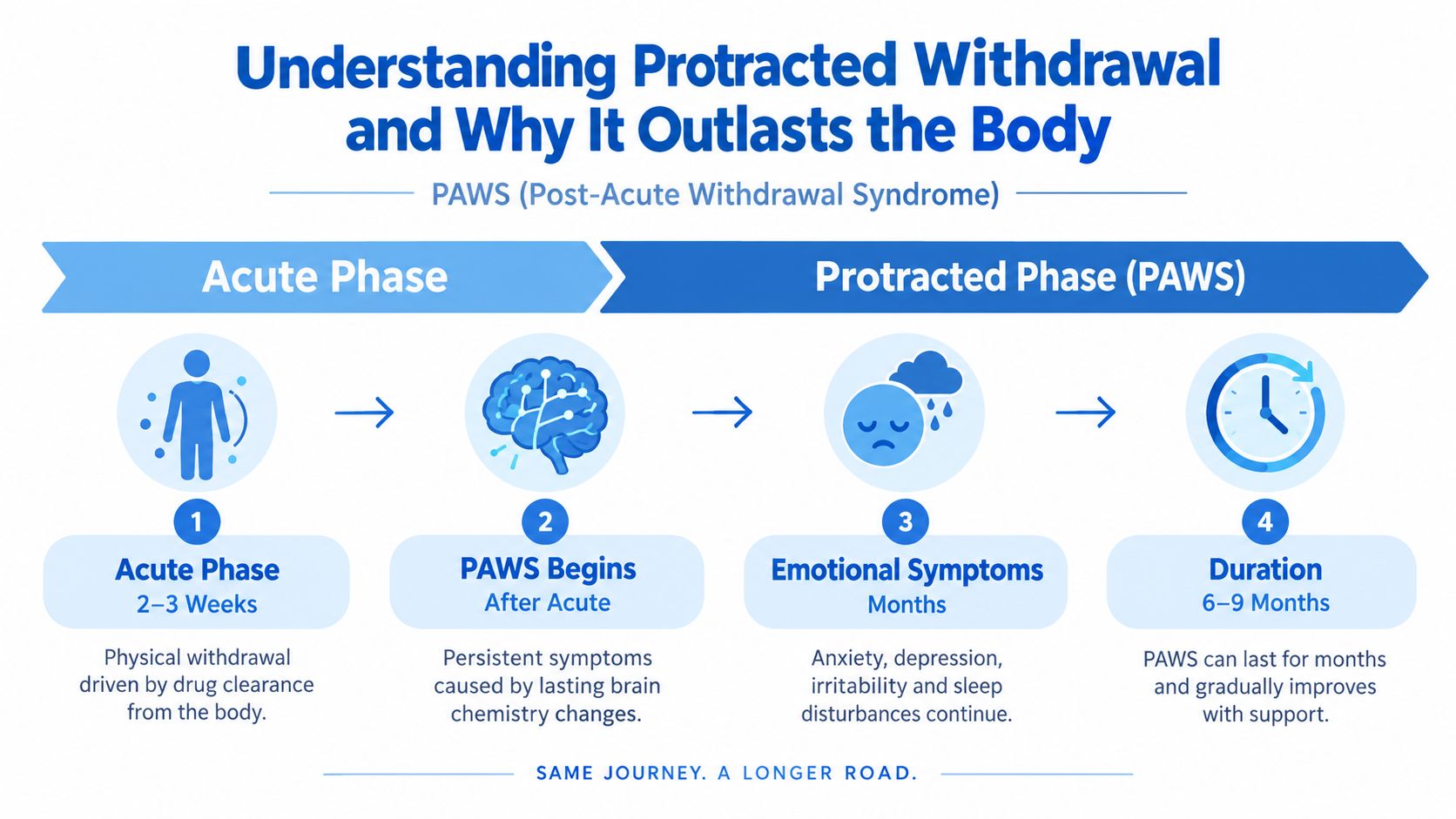
Why symptoms continue after the physical phase
Long-term opioid exposure can affect systems involved in reward, stress, sleep, and emotional regulation. As those systems adapt, ordinary activities may feel less rewarding for a while. A person may think, “I should be better by now,” because the vomiting or diarrhea has stopped, yet still feel flat, anxious, exhausted, or unable to sleep.
Common protracted symptoms include:
- Sleep disruption: Difficulty falling asleep, frequent waking, or unrefreshing sleep.
- Mood changes: Dysphoria, irritability, anxiety, or reduced ability to feel pleasure.
- Cognitive strain: Poor concentration, low motivation, and mental fog.
- Craving waves: Sudden urges triggered by stress, memories, places, conflict, or fatigue.
These symptoms often come in waves. A person may have a relatively good day followed by a difficult evening, without having returned to the beginning of withdrawal. That uneven pattern can feel discouraging, but gradual improvement isn't always linear.
The relapse risk can remain after physical detox because emotional pain and sleep loss weaken judgment and coping capacity. A person who returns to an opioid after tolerance has fallen may face overdose danger, especially if they use the amount that once felt familiar. Protracted withdrawal therefore deserves active follow-up, not a simple instruction to wait it out.
Factors That Change How Long Withdrawal Lasts for You
No clinician can predict an exact withdrawal calendar from the medication name alone. The timeline depends on the interaction between the dose, the treatment history, the person's health, and the way methadone is reduced.
| Factor | Effect on Timeline |
|---|---|
| Current methadone dose | A higher dose can mean a stronger adjustment as the dose falls, while a lower dose may produce a different and sometimes earlier symptom pattern. |
| Length of treatment | Longer exposure can create more established physical dependence and may make reductions harder to tolerate. |
| Tapering speed | A gradual reduction may spread withdrawal across a longer period while reducing abrupt symptom spikes. |
| Metabolism | Age, liver function, and genetic differences in drug-processing enzymes can change how long methadone remains active. |
| Other substance use | Alcohol, sedatives, stimulants, or other opioids can complicate symptoms and increase safety concerns. |
| Mental health | Anxiety, depression, trauma-related symptoms, and severe insomnia can amplify distress and craving. |
| Pain and general health | Chronic pain, poor nutrition, and medical illness can make the adjustment harder to manage. |
Dose and duration are only part of the picture
A person taking methadone for a shorter period may still experience significant withdrawal, while someone on long-term maintenance may have a more extended adjustment. The dose matters, but it doesn't tell the whole story. Two patients taking the same daily amount can have different experiences because their bodies process the medication differently and because their sleep, pain, stress, and mental health differ.
Metabolism also deserves caution. Methadone's half-life is already variable, and liver function or genetic variation in drug-processing enzymes can alter clearance. That variability helps explain why one person notices symptoms sooner while another remains stable for longer after the same last dose.
Taper speed changes the question itself
Stopping abruptly asks the body to adapt to a sudden change. Tapering asks it to adapt through smaller changes over time. The second route may make the acute symptoms less concentrated, but it can extend the overall treatment process.
The Scottish prescribing guideline emphasizes that opioid withdrawal and tapering must be individualized, with the duration shaped by dose, treatment history, and response to reductions. A pause or slower reduction isn't failure. It's clinical information that the current plan needs adjustment.
Medical and Medication-Assisted Approaches to Shorten the Process
The safest approach usually isn't to force withdrawal to end as quickly as possible. It is to reduce avoidable suffering and risk while helping the patient reach a sustainable next step. A clinician may recommend outpatient care when the person is medically stable, has reliable support, and can attend follow-up. Inpatient or residential care may be more appropriate when symptoms, relapse risk, medical conditions, or mental health concerns require closer observation.
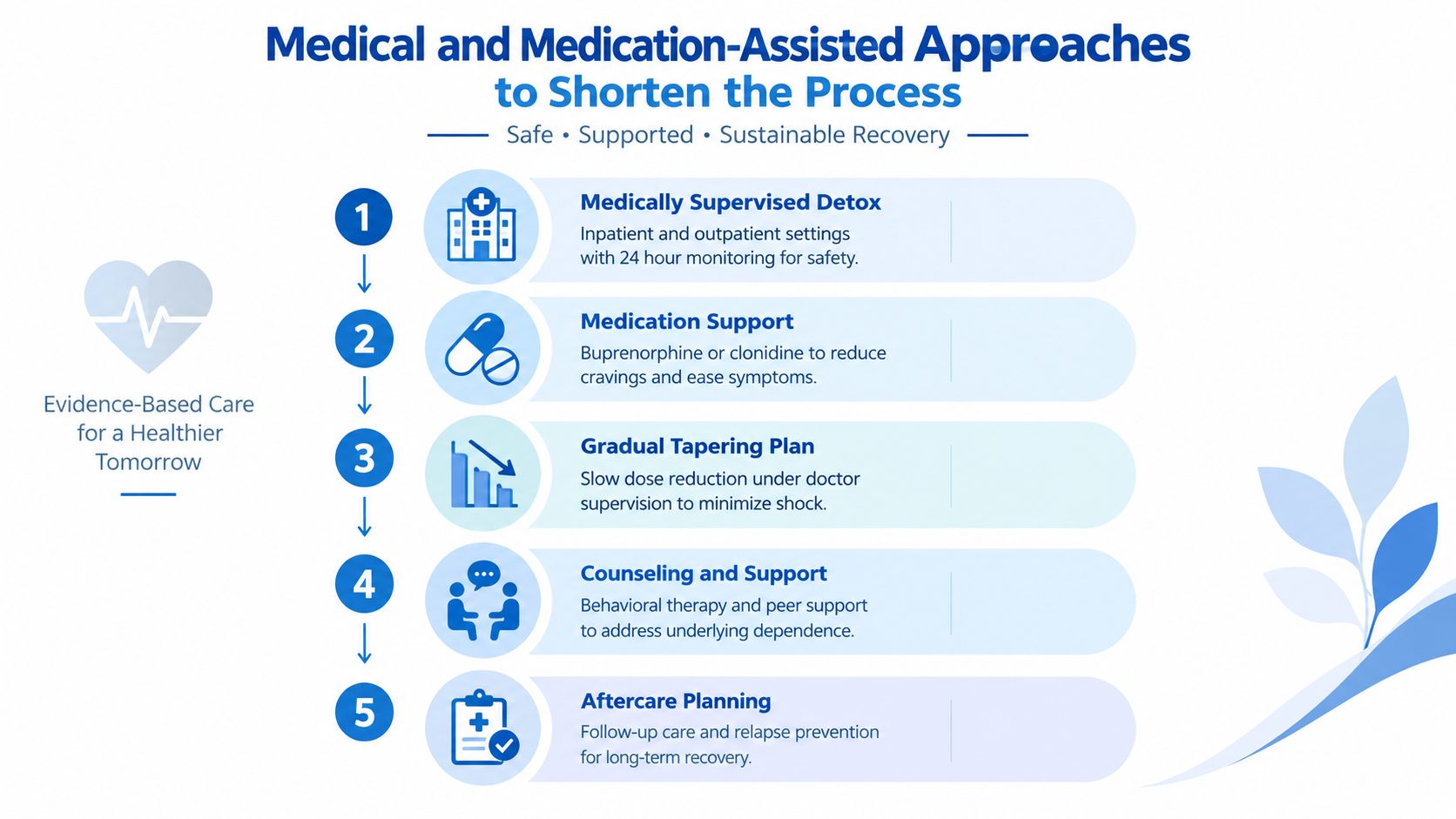
Three clinical pathways
A supervised methadone taper reduces the dose gradually and adjusts the pace when symptoms become difficult. This approach may take weeks, months, or longer, but it can avoid the abrupt drop associated with stopping suddenly. The treatment team considers the person's dose, stability, cravings, sleep, and relapse history rather than following a rigid calendar.
A transition to buprenorphine or buprenorphine-naloxone may be appropriate for some patients. Transition timing and dosing require medical planning because taking buprenorphine too soon after a full opioid agonist can trigger withdrawal. A clinician must determine whether the transition is suitable and how to manage the change safely.
Symptom-targeted medication can support autonomic and physical symptoms. Clinicians may consider clonidine or lofexidine for autonomic withdrawal symptoms, along with medications for nausea, diarrhea, pain, or sleep when appropriate. These medications require review because blood pressure, sedation, other prescriptions, and medical history affect safety.
Medication decisions belong with the treatment team. A drug that helps one symptom can create a problem when combined with another medication or medical condition.
A medication review can also help identify interactions and gaps in symptom control. For people who have difficulty traveling to appointments, house call medication checks from Life Primary Care may offer a practical way to review current medicines with a qualified clinician.
Detox is only one part of treatment. Counseling, peer support, relapse prevention, and aftercare address the cravings and emotional symptoms that may remain after the acute phase. You can learn more about the role of medically supervised detox before choosing a setting.
Practical Coping Strategies for Each Phase
Coping tools work best when they support a clinical taper or medication-assisted treatment plan. They can't replace medical care, particularly when vomiting, diarrhea, severe insomnia, mental health symptoms, or relapse risk becomes difficult to manage.
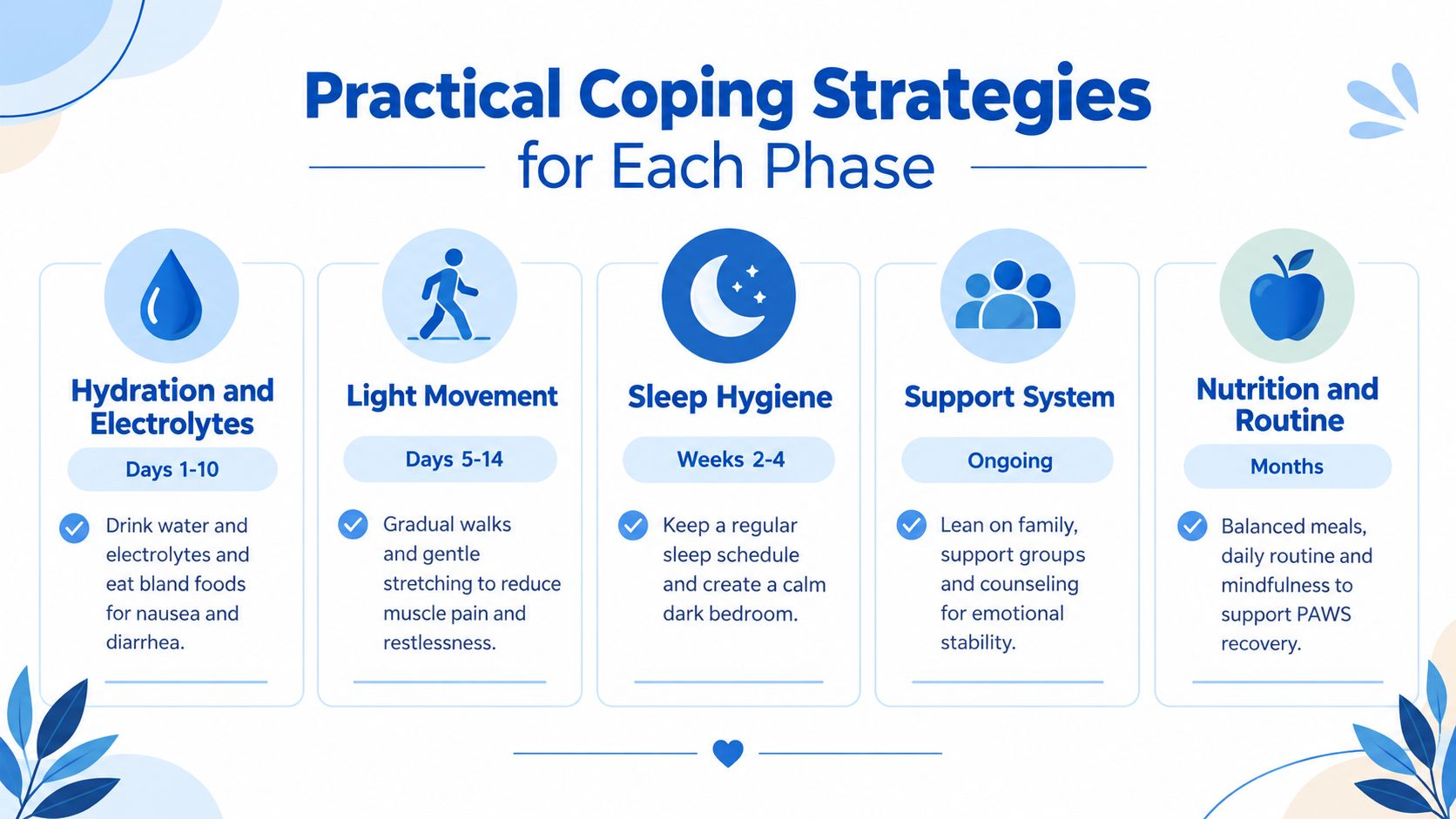
During the early physical phase, focus on reducing strain on the body. Take small, frequent sips of water or an electrolyte drink, and choose bland foods that are easier to tolerate when nausea or diarrhea is present. If you can't keep fluids down, home care is no longer enough and a clinician should assess you.
Match the tool to the phase
Acute symptoms: Keep supplies within reach, reduce unnecessary commitments, and ask a trusted person to check in. A calm room, loose clothing, fluids, and simple food can make the physical symptoms more manageable.
After the physical peak: Add gentle walking or stretching only as tolerated. Movement shouldn't become a test of willpower. Short activity can provide structure without pushing an exhausted body too hard.
Sleep disruption: Wake at a consistent time, keep the bedroom dark and quiet, limit stimulating activities before bed, and avoid treating one poor night as proof that sleep won't return.
Craving waves: Use urge surfing. Notice where the craving appears in the body, name it, breathe slowly, and delay action while contacting a support person. Write down the trigger and what happened next so you can recognize patterns.
Protracted symptoms: Build a simple daily schedule with meals, appointments, movement, rest, and support. When motivation is low, structure can carry you through tasks that mood alone won't initiate.
A written relapse prevention plan should include warning signs, names and phone numbers of supportive people, treatment contacts, safer places to go, and steps to take after a lapse. Peer groups and counseling can reduce isolation while the brain's reward and stress systems continue to settle.
When to Seek Professional Care and What Comes Next
Withdrawal can be uncomfortable without being an emergency, but some symptoms require prompt medical attention. Seek urgent help for persistent vomiting or diarrhea with signs of dehydration, confusion, dizziness, fainting, chest pain, an irregular or very rapid heartbeat, severe shortness of breath, or suicidal thoughts.
A relapse also deserves immediate attention, not shame. After a period without opioids, tolerance can drop, so returning to a previous amount may be dangerous. If someone has used again, contact emergency services or a medical professional, stay with the person, and use naloxone if it is available and appropriate.
Who should avoid unsupervised withdrawal
People who are pregnant, have significant medical conditions, live with serious mental health symptoms, use multiple substances, or take a high methadone dose should seek professional guidance before changing treatment. The same applies to anyone who has previously experienced severe withdrawal, repeated relapse, or difficulty staying safe alone.
The next step may be a monitored outpatient taper, residential treatment, a transition to buprenorphine, continued methadone treatment, or another evidence-based medication plan. Therapy and aftercare matter because completing acute detox doesn't automatically resolve triggers, grief, trauma, sleep problems, or cravings.
Addiction Resource Center LLC provides medically supervised detox with medication-assisted treatment, residential rehabilitation through its partner facility, Ona Treatment Center, and an Intensive Outpatient Program offered in person and through telehealth. Visit Addiction Resource Center LLC to discuss withdrawal planning, MAT, relapse prevention, or support for a loved one.