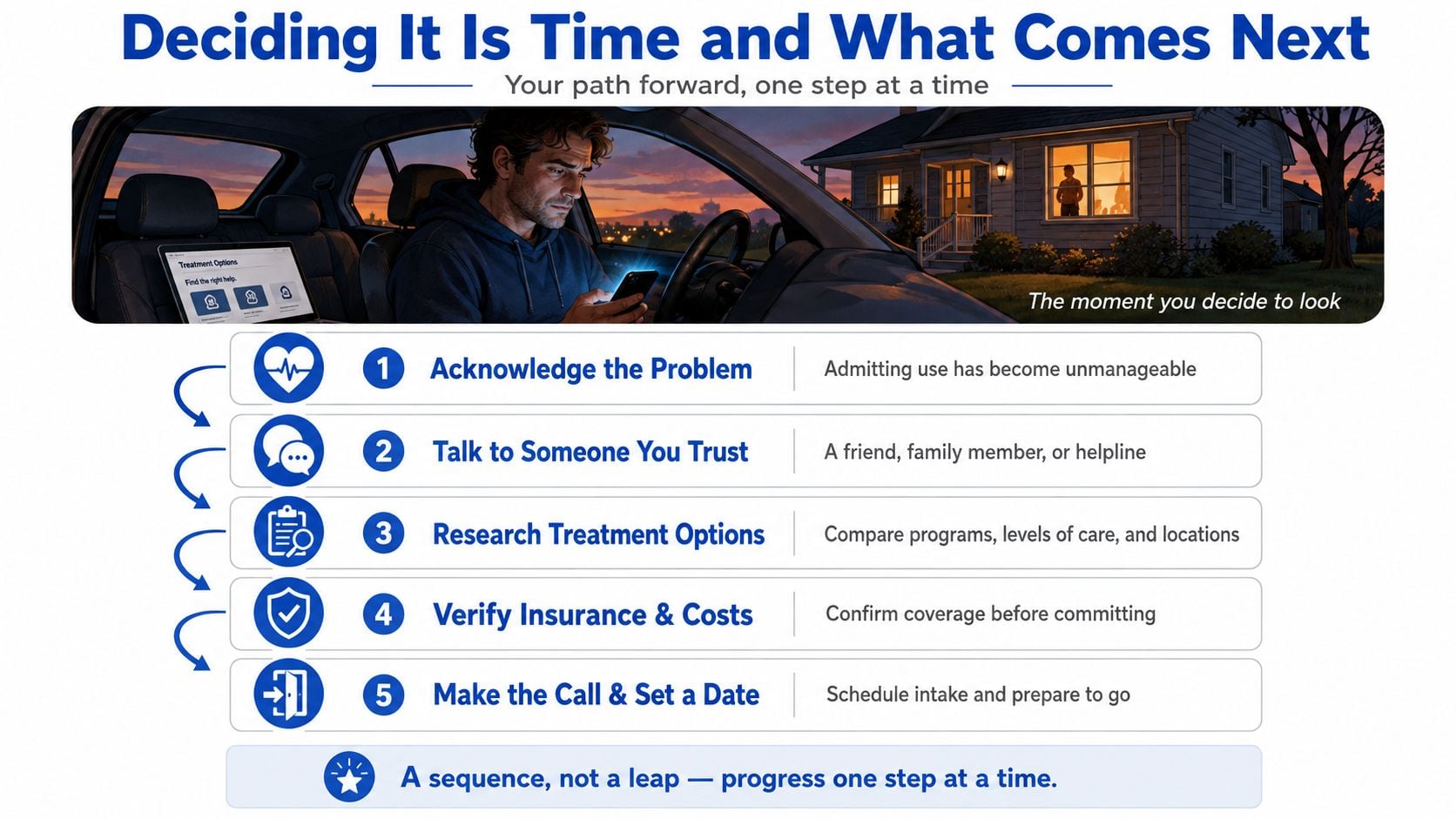
A family conversation has just ended. Someone is sitting in a parked car, searching for drug rehab on a phone while a sibling waits at home, unsure whether the next call will lead to help or another dead end. That moment is common. Deciding to seek treatment matters, but getting through the door usually depends …

A family conversation has just ended. Someone is sitting in a parked car, searching for drug rehab on a phone while a sibling waits at home, unsure whether the next call will lead to help or another dead end. That moment is common. Deciding to seek treatment matters, but getting through the door usually depends on handling practical details quickly.
The process is more manageable when you treat it as a sequence, not one enormous leap. You need a safe assessment, an honest discussion about withdrawal and medication, a clear insurance plan, and a backup route when the first facility can't admit you.
Table of Contents
- Deciding It Is Time and What Comes Next
- The Intake Assessment and What to Expect
- Understanding Detox and Medication-Assisted Treatment
- Navigating Insurance, TRICARE, and Payment
- When You Are Not Ready or Hit Roadblocks
- Choosing the Right Level of Care After Detox
- Taking the First Step With Addiction Resource Center
Deciding It Is Time and What Comes Next
Start by gathering the information an admissions counselor will ask for. Put your identification, insurance card, prescription list, and a short substance-use timeline in one place. Write down what you use, how often you use it, when you last used it, and whether you've experienced withdrawal, overdose, or other medical problems.
Choose one reliable person to help answer calls or manage logistics. That person might be a sibling, partner, friend, or another relative. You don't have to involve your entire family, and you can ask a program about a confidential assessment before deciding who should receive updates.
The first call is a screening conversation, not a contract. Admissions staff expect hesitation, changing plans, and incomplete information. Be direct about what you want today, whether that's detox, medication treatment, residential care, outpatient counseling, or an assessment to understand your options.
Separate an emergency from a planned admission
An overdose, severe confusion, seizure, chest pain, suicidal thinking, or dangerous withdrawal requires urgent medical help. Go to an emergency department or contact emergency services. A person with suicidal thoughts can also contact the 988 Suicide & Crisis Lifeline rather than waiting for a routine intake appointment.
A planned admission starts with a phone screening. The counselor will usually ask about substances, last use, health conditions, medications, housing, and insurance, then recommend the safest next step. In the United States, treatment need is widespread while access remains limited. SAMHSA's 2024 National Survey on Drug Use and Health summary estimated that 10.2 million people aged 12 or older needed substance use treatment, but only 19.3% received it.
Don't wait for a crisis to make the call. Prepare your documents, ask one person to stay available, and request a specific next action before ending the conversation. The rest of the process comes down to understanding the assessment, choosing safe withdrawal care, verifying payment, handling ambivalence, and securing a continuing-care plan.
The Intake Assessment and What to Expect
An intake assessment isn't an interrogation. Clinicians use the answers to decide whether you need medically supervised withdrawal, residential structure, intensive outpatient treatment, standard outpatient care, medication treatment, or mental-health support alongside addiction treatment.
Expect an initial phone pre-screen, followed by a fuller assessment if you arrive at the program. The in-person process may include a physical examination, medication reconciliation, and a urine drug screen. Answer accurately, especially about your last use and previous withdrawal. Staff need the truth to protect you, not a version that sounds more acceptable.
What clinicians need to understand
The assessment usually covers these areas:
| Assessment Domain | Typical Questions | Why It Matters |
|---|---|---|
| Substance use | What do you use, how often, how much, by what route, and when was the last use? | Helps estimate intoxication, dependence, overdose risk, and withdrawal needs |
| Withdrawal history | What happened when you stopped before? Have you had seizures, delirium, or severe symptoms? | Guides the decision about medical monitoring |
| Medical health | What diagnoses, injuries, allergies, and prescriptions do you have? | Prevents medication conflicts and identifies conditions requiring medical care |
| Mental health | Have you experienced depression, anxiety, trauma, psychosis, self-harm, or suicidal thoughts? | Identifies co-occurring conditions that need coordinated treatment |
| Pregnancy and reproductive health | Could you be pregnant, or are you receiving reproductive healthcare? | Affects medication and withdrawal-management decisions |
| Living situation | Where will you sleep, and is the environment safe and substance-free? | Helps determine whether outpatient care is realistic |
| Work, legal, and family context | What responsibilities, court matters, employment concerns, or family pressures affect treatment? | Supports a workable discharge and recovery plan |
Questions about legal issues, employment, and family substance use aren't moral judgments. They help clinicians understand stress, safety, transportation, housing, and the support available after discharge. Mental-health needs deserve equal attention. SAMHSA reported that among 21.2 million adults with both a mental illness and a substance use disorder, 41.2% received neither type of treatment, while 14.5% received both in the 2024 data summarized by the agency.
Before calling, make a one-page summary with your medications, allergies, recent use, withdrawal symptoms, medical conditions, and emergency contacts. You can also review what to expect in rehab during intake and admission so the questions feel familiar. Ask what information will be shared with an insurer, and ask how the program handles confidentiality under applicable privacy rules, including 42 CFR Part 2.
Understanding Detox and Medication-Assisted Treatment
Detox and rehabilitation solve different problems. Medical detox is supervised withdrawal management, designed to reduce immediate physiological danger and stabilize the person. It doesn't, by itself, teach relapse-prevention skills, repair relationships, address trauma, or create a durable continuing-care plan.
Medication-assisted treatment, also called medication treatment, combines an approved medication with counseling and recovery support. For opioid use disorder, the established medications are methadone, buprenorphine, and extended-release naltrexone. They should be discussed during the clinical assessment, not reserved for a final crisis.
The treatment gap is substantial. SAMHSA reported that approximately 4.8 million people aged 12 or older had past-year opioid use disorder in 2024, but only 17.0% received medication for opioid use disorder, or about 818,000 people. NIDA has separately reported that only about 11% of people with opioid use disorder receive one of the three FDA-approved medications, as summarized in its medications for opioid use disorder guidance.
Detox alone isn't a complete plan
Methadone and buprenorphine reduce overdose and mortality risk compared with no medication treatment. In an NIH-funded follow-up study after a nonfatal overdose, opioid-related deaths during the following year were 59% lower among patients receiving methadone and 38% lower among those receiving buprenorphine than among patients receiving neither medication, according to the NIDA material above.
Naltrexone can be appropriate for some patients, but it requires a period of opioid abstinence before initiation. A clinician must determine whether the timing is safe. For alcohol use disorder, medication treatment is also underused. SAMHSA reported that among 27.9 million people aged 12 or older with past-year alcohol use disorder, only 2.5% received medication for alcohol use disorder, approximately 697,000 people.
| Approach | Duration | Medications | Best Fit |
|---|---|---|---|
| Detox followed by separate counseling | Focused on withdrawal stabilization | May include withdrawal medications | Someone who needs immediate medical monitoring and has a confirmed next step |
| Medication treatment during or after stabilization | Ongoing, based on clinical need and patient preference | Methadone, buprenorphine, or naltrexone for opioid use disorder | Someone who needs an evidence-based option to reduce overdose risk and support retention |
| Detox plus residential or outpatient rehabilitation | Continues after withdrawal care | May include medication treatment | Someone who needs therapy, structure, relapse prevention, and coordinated mental-health support |
You don't have to choose between medication and counseling. Medication can work alongside individual therapy, family therapy, 12-step meetings, SMART Recovery, or other recovery supports. Ask whether the program can start medication promptly, how it monitors withdrawal, and what happens after discharge. A medication-assisted treatment clinic overview can help you prepare questions before the call.
Navigating Insurance, TRICARE, and Payment
Insurance verification feels intimidating because families often fear discovering that treatment is unaffordable. Don't guess. Give the facility your member identification and ask the admissions coordinator to verify benefits before you commit to an admission date.
Use this script with the insurer or program:
“Is substance use disorder treatment covered under this plan, and what level of care is authorized for this patient?”
Then ask whether the facility is in network or out of network, whether residential treatment requires prior authorization, how many days can be reviewed, what you would owe for intensive outpatient care, and whether MAT medications are billed separately. Request the name of the representative, the reference number for the call, and a written explanation of any denial.
Questions that prevent billing surprises
- Coverage: Is detox, residential treatment, IOP, outpatient counseling, and medication treatment covered?
- Authorization: Does the insurer require a referral, preauthorization, or a physician assessment?
- Network status: Is this specific facility in network, and what changes if it isn't?
- Patient responsibility: What are the deductible, copay, coinsurance, and out-of-pocket obligations?
- Medication billing: Are methadone, buprenorphine, naltrexone, or other prescriptions billed through the medical or pharmacy benefit?
- Continuation: What services can continue after discharge, and does the same provider accept the plan?
Parity protections generally require mental-health and substance-use benefits to be handled comparably to medical benefits, but authorization rules and network limitations still affect access. If you need a plain-language checklist, this reVIBE Mental Health coverage guide offers useful questions for reviewing benefits.
TRICARE beneficiaries should call the plan and ask specifically about detox, residential treatment, outpatient services, medication treatment, referrals, and network requirements. Active-duty service members, retirees, and dependents can have different administrative steps. TRICARE Prime and TRICARE Select may also involve different referral or network rules, so confirm the route for the exact beneficiary and facility.
Self-pay, sliding-scale programs, state-funded services, and payment plans may be available when insurance falls short. An admissions team can often run a confidential benefits check and explain estimated costs before treatment begins. The practical guidance in how to pay for rehab is useful when several payment sources need to be combined.
When You Are Not Ready or Hit Roadblocks
A person doesn't need to feel completely certain before asking for help. Ambivalence is common. Someone may want the drug use to stop while fearing withdrawal, losing a job, facing family anger, or entering an unfamiliar facility.
Families often make resistance worse by arguing about whether the person has a problem. Use motivational interviewing techniques instead. Ask open questions, reflect what you heard, and connect treatment to the person's own priorities.
Try this: “What worries you most about continuing this, and what worries you most about stopping?”
Don't threaten, shame, or demand a lifetime promise during the first conversation. Ask for a smaller commitment, such as an assessment, a medication appointment, a tour, or permission to speak with an admissions counselor. The goal is movement, not a perfect declaration of readiness.
Have an escalation plan
The first facility may have a waitlist, lack the right level of care, require abstinence, or deny admission because of medical or psychiatric needs. That isn't the end of the search.
- Ask for a referral partner. Request the name of a facility that can manage the withdrawal risk or medication need the first program can't handle.
- Call the insurer again. Ask for a care manager, behavioral-health line, or list of in-network programs with current openings.
- Request a lower-barrier option. Ask about outpatient medication treatment, telehealth, interim support, or an assessment while waiting for residential care.
- Confirm the next appointment. Don't leave with “call us later.” Get a date, contact name, and instructions for what to do if symptoms worsen.
- Escalate urgent symptoms. Overdose, severe withdrawal, psychosis, chest pain, seizures, confusion, or suicidal thinking require immediate medical evaluation.
A recent analysis found that 38.6% of respondents reported not knowing where to obtain treatment, illustrating why navigation matters as much as motivation. The same analysis of treatment access barriers discusses stigma, waitlists, prior authorization, mandatory in-person assessments, and abstinence rules that can block entry.
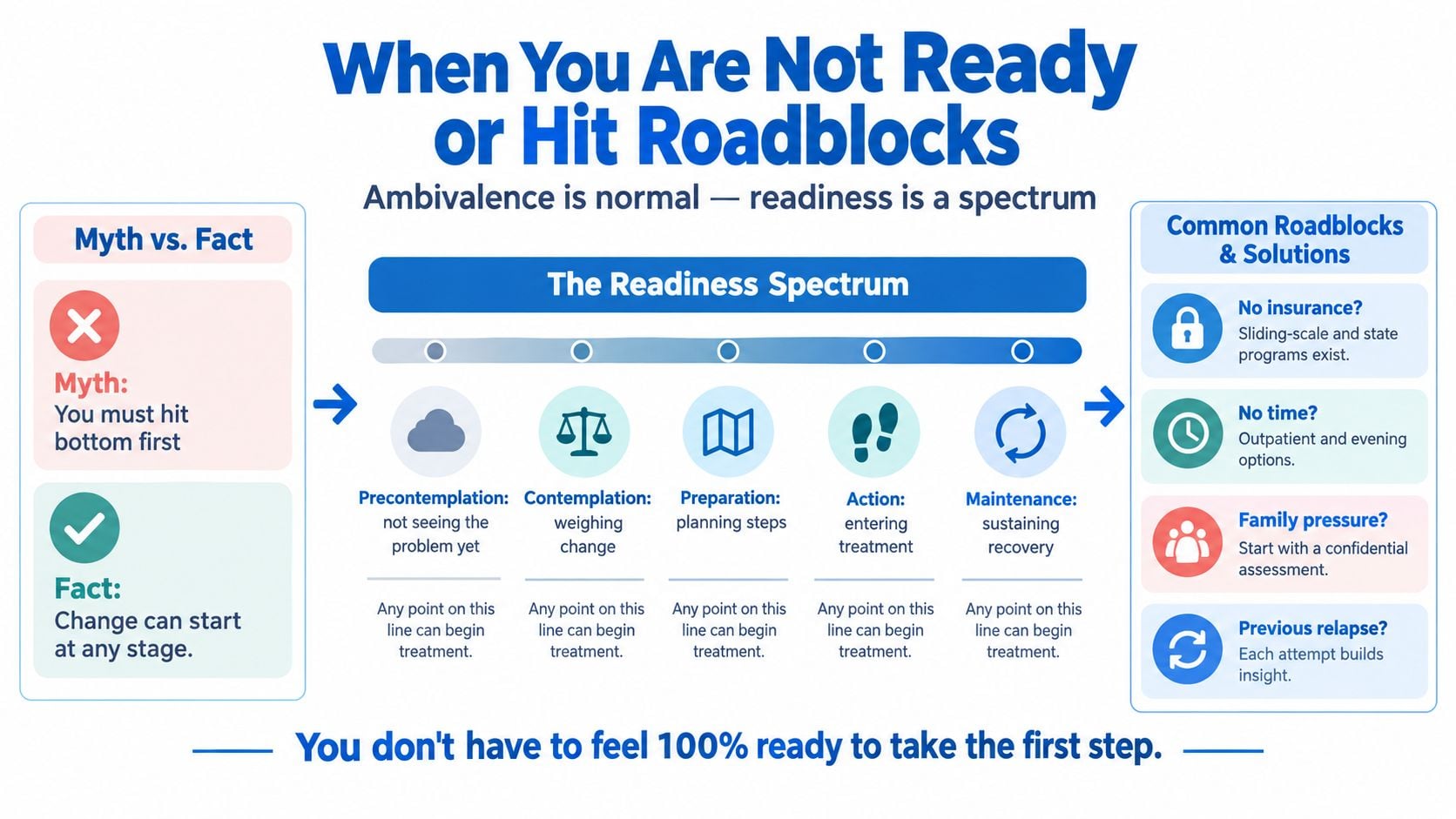
Previous treatment or relapse doesn't disqualify anyone from trying again. Each contact can reveal a better medication plan, safer housing arrangement, or more suitable level of care. Make the first call to open a door, not to solve the entire disorder in one conversation.
Choosing the Right Level of Care After Detox
The right placement depends on risk and environment, not on which program sounds most impressive. A person with unstable housing, severe co-occurring mental-health symptoms, repeated relapse, or limited support may need residential structure. Someone with a safe home, reliable transportation, and a supportive household may be able to participate in outpatient care.
Compare the setting with the situation
| Level of Care | Weekly Clinical Hours | Best Fit For | Key Limitation |
|---|---|---|---|
| Residential rehabilitation | Varies by program and treatment plan | People needing structured housing, intensive support, or separation from active substance use | Less flexibility for work, caregiving, and daily responsibilities |
| Partial hospitalization or IOP | Varies by program and schedule | People with stable housing who need frequent clinical contact while remaining in the community | Home exposure and transportation can undermine attendance |
| Outpatient medication treatment and counseling | Varies by clinician and need | People who can attend appointments and safely manage between visits | Requires follow-through, medication access, and a workable recovery environment |
| Telehealth and hybrid outpatient care | Varies by service and technology | People limited by distance, transportation, or work schedules | Not suitable for every withdrawal risk, crisis, privacy situation, or physical assessment |
Clinicians commonly consider withdrawal severity, medical stability, mental-health symptoms, housing, employment, family support, transportation, and prior treatment history. Ask how the program applies ASAM placement criteria and how it will respond if your condition changes.
Telehealth can remove a transportation barrier, but access isn't automatically usable access. Nationwide claims research covering approximately 16 million insured adults found monthly telehealth substance-use treatment services increased from about 45 in 2019 to 10,974 in 2023, while rural patients experienced roughly a 90% increase in overall treatment use, compared with about 49% among urban patients. The reported telehealth access findings also showed uneven use among Medicaid-covered patients, making insurance confirmation essential.
Before choosing online care, confirm that you have reliable internet, a private place to speak, technology support, medication access, and a rapid in-person route if withdrawal or a crisis develops. Ask when placement will be reassessed. Treatment plans should remain responsive, and the first level of care is a starting point rather than a permanent label.
Taking the First Step With Addiction Resource Center
A useful first call should produce a next action. Addiction Resource Center LLC offers a confidential consultation for adults and families seeking detox, residential rehabilitation, MAT, or IOP, including in-person and telehealth options. The team can discuss the substance-use history, current safety concerns, insurance, location, and the level of care that appears appropriate.
What happens after you reach out
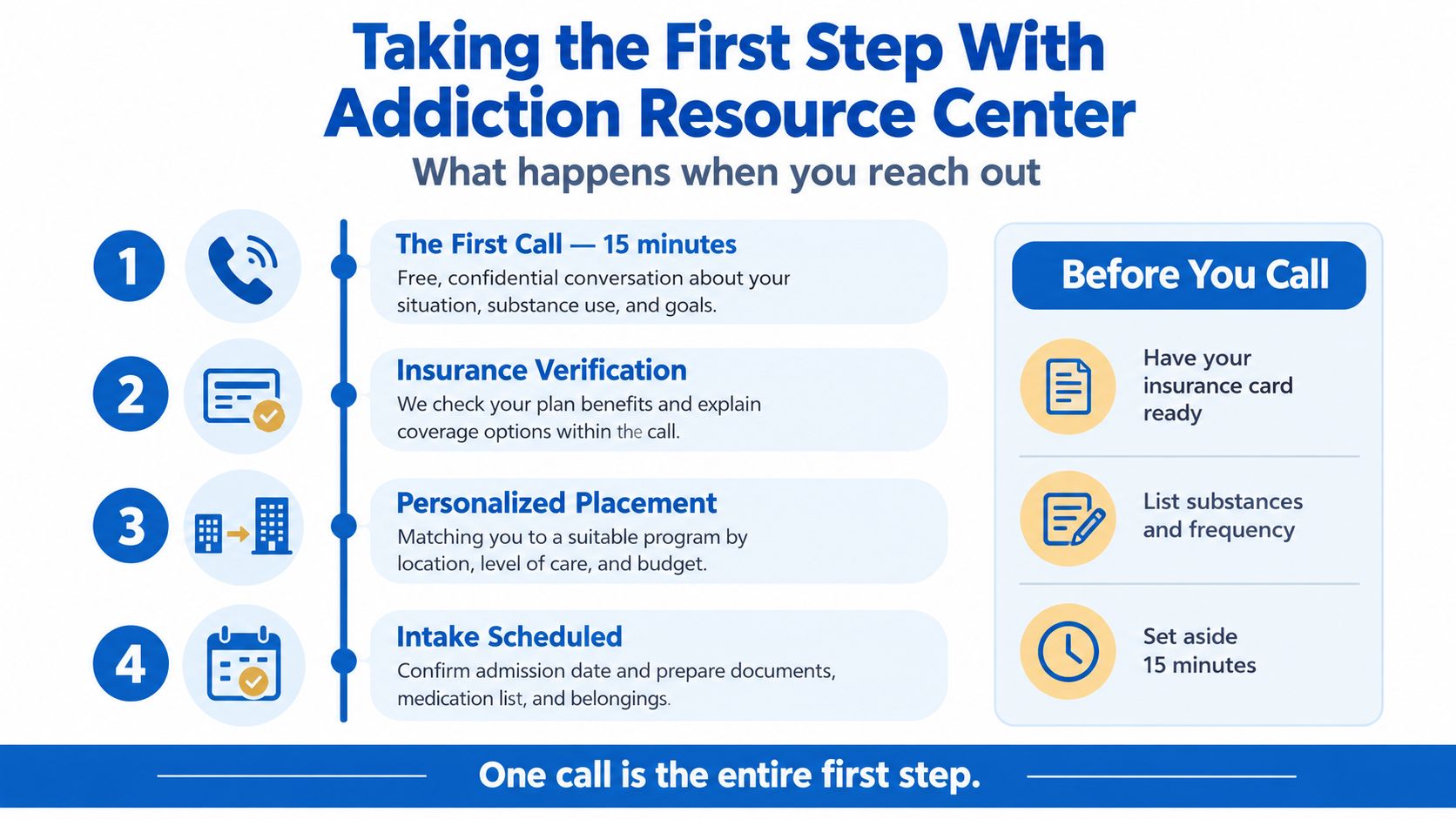
The initial conversation gathers basic demographics, recent substance use, medications, medical and mental-health concerns, and insurance information. The admissions team can then complete a same-day screening and explain whether medically supervised detox, residential treatment through a partner facility, IOP, telehealth, or another referral makes sense.
Insurance verification should happen before admission whenever possible. The team can contact the insurer, check TRICARE eligibility when relevant, clarify network status, and identify expected out-of-pocket costs. Ask for the result in plain language, including what is covered and what still needs authorization.
Placement is more than naming a facility. For a residential referral, transportation and admission timing may need coordination. For a person waiting for detox or residential care, the clinical team may discuss a bridge medication plan or outpatient referral when medically appropriate. A warm handoff to IOP or telehealth can prevent the gap that often occurs between an initial assessment and ongoing treatment.
Someone who isn't ready to enroll can still ask for a family consultation or resource referral. That conversation can help a relative choose safer language, plan the next call, and identify options when the preferred program has no opening.
The center serves adults in Yuba City and Northern California, offers a 24/7 phone and text line at 530-625-7910, and has an accessible location at 1002 Live Oak Blvd., Suite A, Yuba City. You can also use the contact options on the website to request a confidential pre-screen or schedule an appointment.
Before calling, keep your insurance card, medication list, and substance-use timeline nearby. If the first program can't admit you, ask for a referral partner and continue down the escalation plan rather than waiting without a date.
Addiction Resource Center LLC offers confidential assessments, insurance and TRICARE guidance, medically supervised detox with MAT, residential referrals, and IOP through in-person or telehealth care. Visit Addiction Resource Center LLC to request a pre-screen, schedule an appointment, or get practical guidance for yourself or someone you love.