Yes, UnitedHealthcare generally covers drug rehab when the requested care is medically necessary, the facility is in-network or qualifies for an exception, and the plan's authorization requirements are met. The three details you must verify are your plan structure, the level of care you need, and whether UnitedHealthcare approved treatment before admission. You may be …


Yes, UnitedHealthcare generally covers drug rehab when the requested care is medically necessary, the facility is in-network or qualifies for an exception, and the plan's authorization requirements are met. The three details you must verify are your plan structure, the level of care you need, and whether UnitedHealthcare approved treatment before admission.
You may be calling after a night of withdrawal, a relapse, or a family conversation that ended with, “We need to do something today.” The person answering the phone may ask for a member ID, diagnosis, facility name, and admission date before telling you whether treatment can proceed. That process feels urgent because it is, but a simple “yes” from an insurance representative still doesn't guarantee that the bill will be paid.
For Northern California families, the practical question isn't only whether UHC covers addiction treatment. It's which service your plan covers, at which facility, under what clinical criteria, and with what approval. The checkpoints below give you a way to get a usable answer instead of a vague benefits summary.
Table of Contents
- What Most UHC Members Actually Want to Know
- Why Parity Law and the ACA Set the Baseline
- The Five Levels of Care UHC Distinguishes
- In-Network Versus Out-of-Network Coverage
- How to Verify Your Specific UHC Benefits
- Prior Authorization and Why So Many Claims Stall
- What to Do When UHC Denies or Cuts Off Treatment
- Your Action Plan for Getting UHC to Say Yes
What Most UHC Members Actually Want to Know
A UnitedHealthcare member usually wants to know three things: Can I get into treatment, will UHC pay, and what will I owe? The answer is generally yes to the first two when the plan includes substance-use-disorder benefits and the requested service meets medical-necessity rules. The amount UHC pays still depends on the member's Evidence of Coverage, deductible, coinsurance, network status, state, and level of care.
Start with the plan itself. Group plans generally operate under the Mental Health Parity and Addiction Equity Act, while non-grandfathered individual and small-group plans generally include substance-use-disorder treatment within the Affordable Care Act's essential-health-benefit framework. Those protections create a baseline, but they don't turn every rehab program into a covered provider or eliminate authorization requirements. CMS explains how parity and addiction-treatment coverage interact.
Next, identify the requested service precisely. Detoxification, residential rehabilitation, partial hospitalization, intensive outpatient treatment, medication-assisted treatment, and outpatient counseling are not interchangeable billing categories. A plan may approve one and deny another if the clinical records don't support the requested setting.
Finally, confirm prior authorization before a nonemergency admission. UHC's California detox policy says medically necessary detox may be covered but requires prior authorization in many circumstances, and it distinguishes acute inpatient detox from outpatient treatment. It also states that methadone maintenance requires prior authorization. UHC's California substance-use detox policy is useful, but your own plan documents control.
Practical rule: Never treat “your benefit is active” as “your rehab stay is approved.”
For people looking in and around Yuba City, the next call should be to a treatment provider that can verify benefits and explain which level of care fits the clinical picture. That local conversation is more useful than relying on a generic online answer about whether UnitedHealthcare covers drug rehab.
Why Parity Law and the ACA Set the Baseline
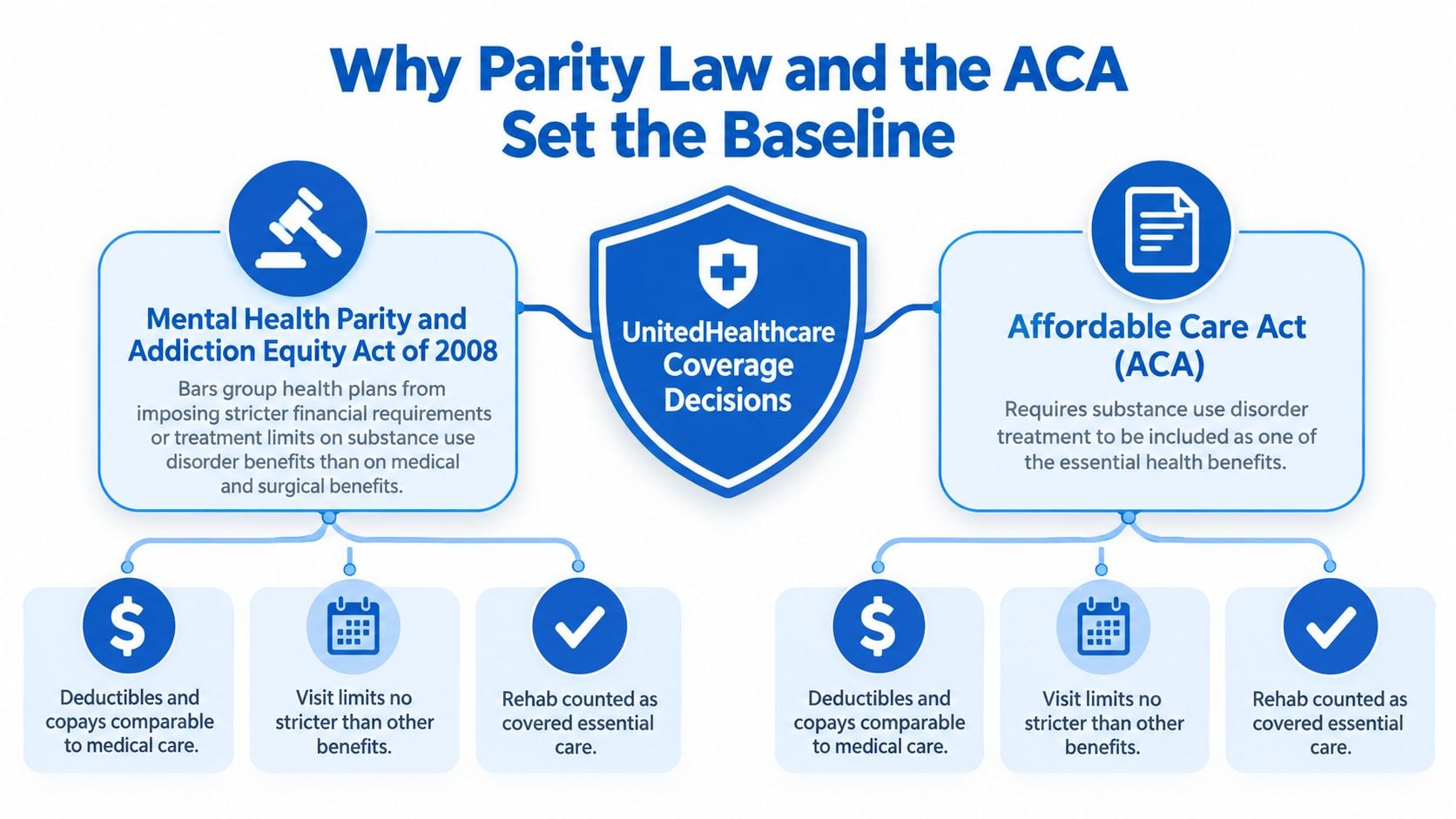
Federal law creates a two-layer floor for many UHC members. The first layer is the Mental Health Parity and Addiction Equity Act of 2008. In general, a group health plan that offers substance-use-disorder benefits can't impose more restrictive financial requirements or treatment limitations on those benefits than it applies to substantially comparable medical or surgical care. That includes more than deductibles. Prior authorization, treatment limits, and other access restrictions can also raise parity questions.
The second layer comes from the Affordable Care Act. For non-grandfathered individual and small-group plans, mental-health and substance-use-disorder services are one of the 10 essential-health-benefit categories. That generally means plans in those markets include substance-use treatment, although deductibles, copayments, coinsurance, network requirements, and clinical eligibility still apply.
The legal floor isn't a payment guarantee
Parity doesn't require every plan to offer every substance-use service. The ACA's essential-health-benefit rule applies to specific individual and small-group markets, not every type of insurance arrangement. Medicaid and Medicare Advantage plans follow related but separate rules, and employer-sponsored coverage can differ based on plan design and administration.
That's why your Evidence of Coverage remains decisive. It tells you whether your plan covers residential rehabilitation, how it defines medical necessity, whether out-of-network treatment is available, and which services require authorization. A federal protection can support an appeal, but it doesn't replace a benefits verification call.
The distinction is easy to miss. Parity says addiction care can't be treated more restrictively than comparable medical care under the applicable rules. It doesn't say every facility, duration, or treatment preference must be paid. A helpful plain-language resource is Benely's guide to mental health parity, especially if you need to understand why a restriction may be legally questionable.
Use parity as leverage when the plan applies a restriction that appears tougher than a comparable medical restriction. Use your plan documents to determine what benefit exists in the first place.
The Five Levels of Care UHC Distinguishes
UnitedHealthcare reviewers don't evaluate “rehab” as one single service. They evaluate the setting, intensity, clinical risk, and documentation supporting the requested level. That's why two people with the same diagnosis can receive different decisions.
| Level of Care | Typical Setting | Intensity | Authorization Note |
|---|---|---|---|
| Detoxification | Hospital, medical detox unit, or supervised outpatient setting | Withdrawal monitoring and medical support | Acute inpatient detox and some medication services may require prior authorization |
| Residential rehabilitation | Live-in treatment facility | Around-the-clock structure and recovery support | Records must show why lower-intensity care isn't safe or sufficient |
| Partial hospitalization program | Day-treatment program with the patient living elsewhere | High clinical contact during the day | Authorization generally depends on documented functional and safety needs |
| Intensive outpatient program | Clinic or telehealth program | Structured therapy while living at home | Clinical notes must support the need for more than standard outpatient care |
| Outpatient counseling and MAT | Office, clinic, or telehealth setting | Scheduled therapy, medication management, and recovery support | Medication and specific services may have separate authorization or formulary rules |
Detoxification is not the same as residential care
Medically supervised detox focuses on withdrawal safety. A person at risk for severe withdrawal, medical instability, or complications may need an acute inpatient setting. Someone with lower medical risk may be assessed for a supervised outpatient approach. UHC's California policy specifically distinguishes acute inpatient detox from outpatient treatment, so the request must match the actual clinical need.
Residential rehabilitation addresses what happens after or alongside withdrawal management. The record should explain the person's relapse risk, home environment, ability to remain safe, and why a less intensive setting won't provide adequate support. A request that says only “the patient wants residential rehab” is weak. A request that connects symptoms and risks to the level of care is much stronger.
PHP, IOP, outpatient care, and MAT
PHP provides structured daytime treatment without residential placement. IOP offers substantial therapy and monitoring while the patient lives outside the program. Standard outpatient counseling is less intensive and may be appropriate when the person can remain safe with scheduled visits and community support.
Medication-assisted treatment belongs in this continuum, not outside it. Medication, counseling, monitoring, and recovery planning may be authorized or reviewed separately. Methadone maintenance requires prior authorization under the cited California UHC policy, so ask specifically about the medication and the prescribing program rather than asking only whether “MAT” is covered.
In-Network Versus Out-of-Network Coverage
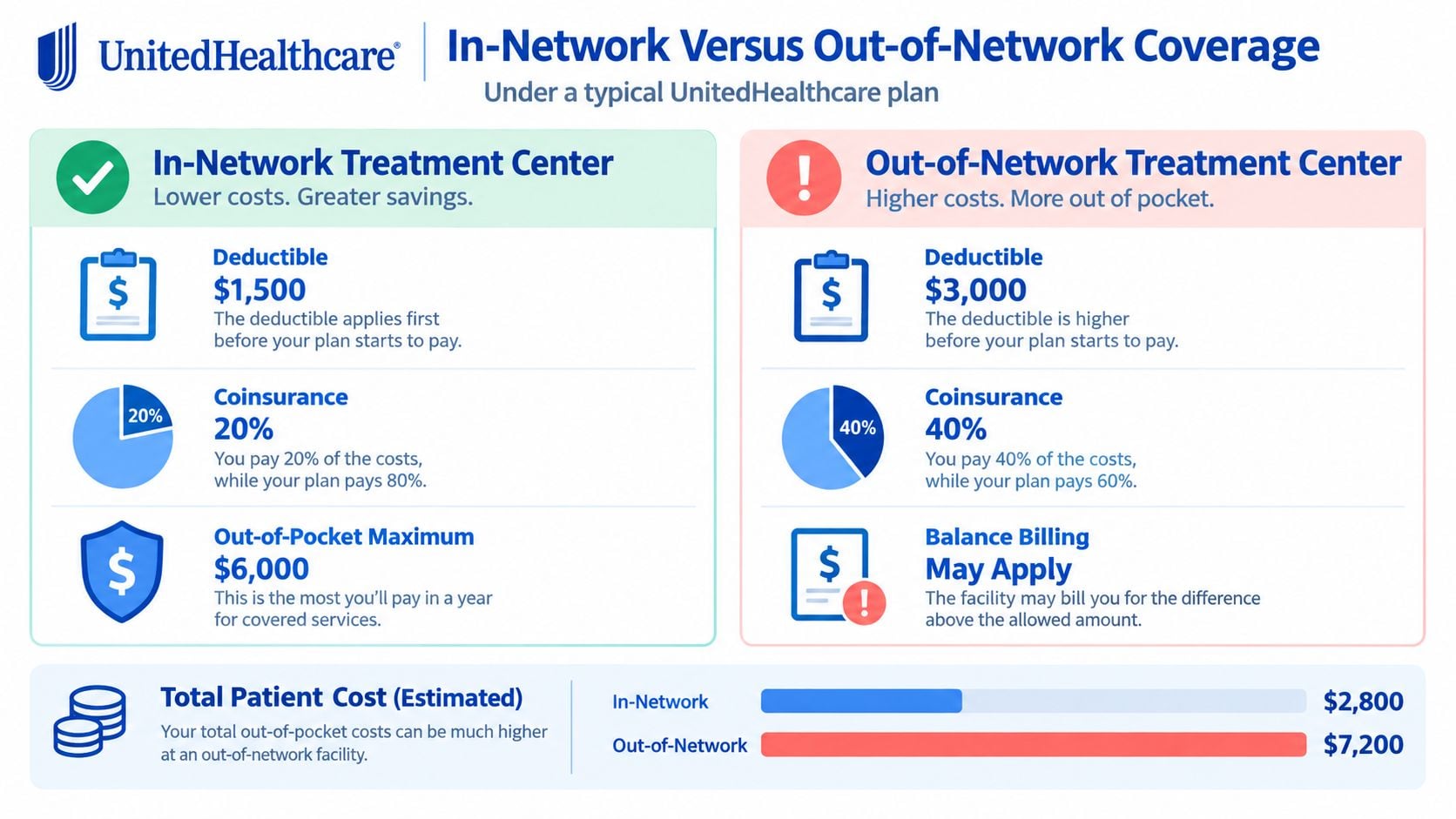
Network status can decide whether a workable treatment plan becomes financially realistic. An in-network facility has a contracted rate with UHC, so the plan generally applies its in-network deductible, coinsurance, and out-of-pocket rules. An out-of-network facility may trigger a separate deductible, higher coinsurance, a different allowed amount, or balance billing, depending on the plan.
A dollar example makes the risk clear, but it must be treated as an illustration, not a prediction. Suppose your plan showed a $500 in-network copay for an approved service, while an out-of-network provider billed $10,000 and the plan allowed only part of that charge. Your actual responsibility could be substantially higher than the in-network amount because the provider's bill and UHC's allowed amount may not match.
Confirm the facility, clinicians, and benefit tier
Don't rely only on a facility's statement that it “accepts UnitedHealthcare.” Ask UHC whether the specific facility, its clinicians, and the requested service are in-network for your exact plan. Some employer plans use tiered networks, so “in-network” may still mean different cost levels.
Ask these questions before signing admission paperwork:
- Network status: Is this facility contracted for my plan and for substance-use treatment?
- Service status: Is residential, detox, PHP, IOP, or outpatient MAT covered under my benefit?
- Cost sharing: Which deductible, coinsurance, copayment, and out-of-pocket maximum apply?
- Allowed amount: How does UHC calculate payment for out-of-network care?
- Exceptions: Can I request a single-case agreement because an in-network provider can't deliver the clinically required level of care?
An out-of-network exception is realistic when the network lacks an appropriate provider, not because another facility is preferred. Get the request and decision in writing. For a plain-language explanation of patient spending, review this guide to out-of-pocket costs.
Northern California members may also ask Addiction Resource Center about benefits verification. The center accepts most major insurance plans, including UnitedHealthcare, and describes detox, residential referral through Ona Treatment Center, and IOP delivered in person or through telehealth. Confirm the exact network and authorization position for your plan before admission.
How to Verify Your Specific UHC Benefits
Call the member-services number on the back of your insurance card. Have the card in front of you, and don't end the call without the representative's name, the date, and a reference number.
Use this call script
“Is my plan active, and does it include substance-use-disorder treatment?” Ask whether the benefit is administered through a behavioral-health department or another claims administrator.
“What are my deductible and remaining balance for substance-use treatment?” Ask whether the deductible differs between in-network and out-of-network care.
“What coinsurance or copayment applies to detox, residential treatment, PHP, IOP, outpatient counseling, and MAT?” Make the representative address each level separately.
“What medical-necessity criteria apply to the level of care my clinician is requesting?” Ask for the criteria or policy in writing. If the representative cites ASAM criteria, ask which dimensions and documentation are required.
“Is this facility in-network for my exact plan and for this specific level of care?” Confirm the treating clinicians too. A facility's general participation doesn't answer every service question.
“Is prior authorization required, who submits it, and what information must be included?” Ask how long the initial authorization covers and whether UHC requires continued-stay or concurrent review for residential treatment.
“What is the process for an internal appeal and an expedited review if delay threatens health or safety?” Request the instructions, deadlines, mailing address, fax number, and online submission method in writing.
Prepare the insurance card, photo ID, recent clinical notes, medication list, facility name, and desired admission date. A treatment provider may help coordinate the clinical submission, but you should still understand what was requested and when.
For another practical benefits-verification checklist, use this insurance coverage verification guide.
Keep a call log. Write down every answer, the representative's exact department, and the reference number. If a later denial contradicts the call, that record can help your provider and appeal reviewer understand what happened.
Prior Authorization and Why So Many Claims Stall
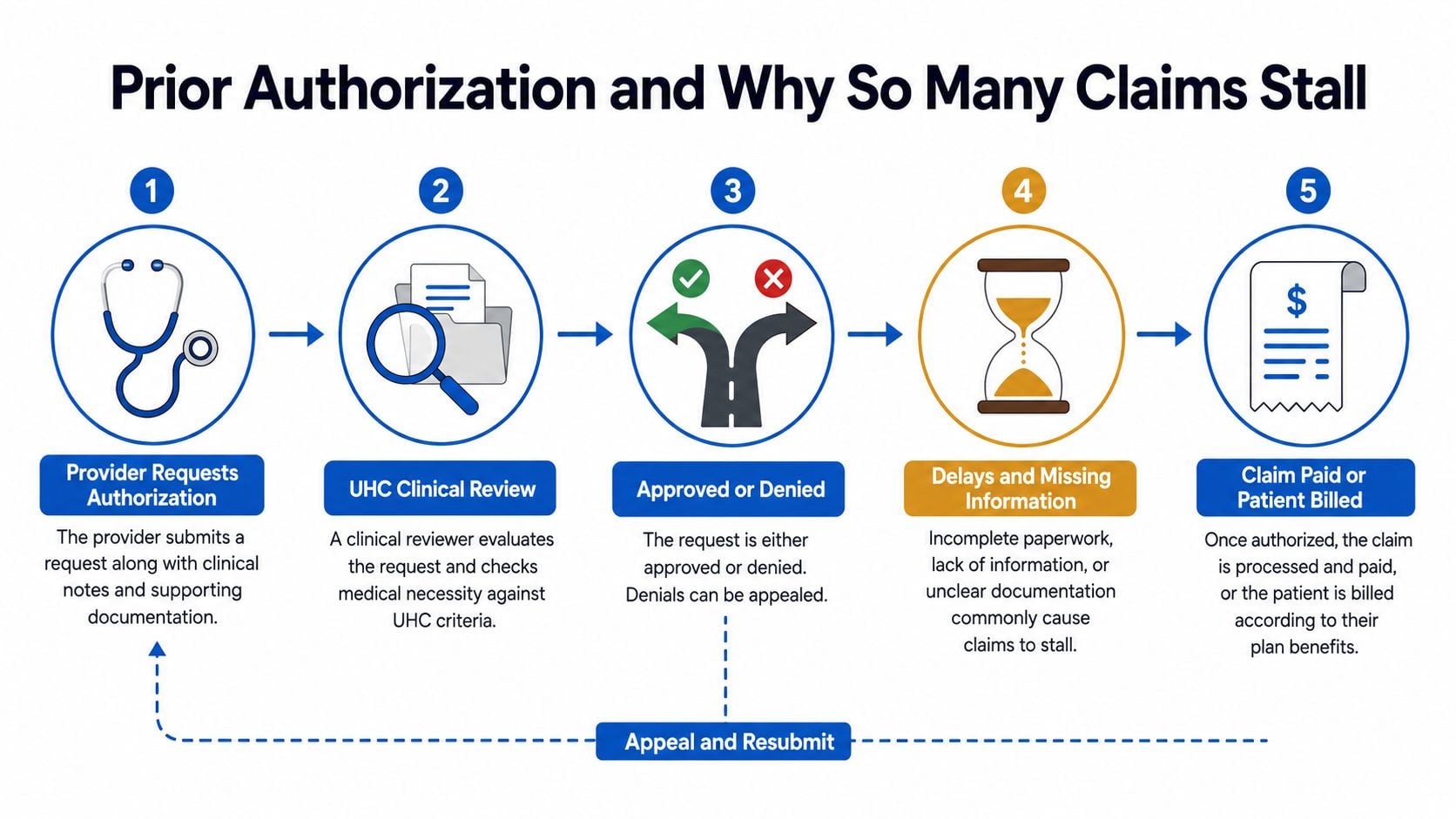
Prior authorization is a clinical review before treatment begins. The provider submits the diagnosis, symptoms, risk factors, treatment history, assessment, and proposed level of care. UHC then decides whether the request satisfies the plan's medical-necessity rules.
Approval still isn't a promise that every charge will be paid. CMS specifically warns that prior authorization doesn't guarantee payment, and the final claim can still depend on eligibility, network status, covered services, and plan terms.
The Delaware enforcement action matters
In September 2025, Delaware regulators announced a $450,000 penalty and corrective action plan involving UnitedHealthcare. The announcement cited improper prior authorization for medication-assisted treatment and failure to use the full ASAM criteria when determining medically necessary substance-use treatment. The Delaware regulator's announcement gives members a concrete reason to question a review that appears incomplete.
The practical point isn't that every UHC denial is unlawful. It's that a reviewer should evaluate the full clinical picture rather than reduce the decision to one narrow factor. Your clinician should document withdrawal risk, relapse risk, overdose risk, home conditions, prior treatment response, co-occurring mental-health needs, and why the requested setting is appropriate.
Federal parity rules also treat prior authorization, step therapy, and provider-network admission standards as restrictions that must be comparable with medical and surgical care. Many group-plan requirements began applying to plan years starting in 2025, while additional individual-market requirements generally apply in 2026, as described by CMS. Ask the plan to identify the rule and criteria it used, not merely to repeat the phrase “not medically necessary.”
Ask for the record, not just the verdict. A denial without the clinical rationale, criteria used, and authorization history is a poor starting point for a fair appeal.
Incomplete submissions stall requests. Missing progress notes, unclear dates, absent medication information, or a mismatch between the requested level and the assessment can all create avoidable problems. Before your provider submits, ask to review the requested level of care and the supporting clinical narrative.
For a plain-language explanation of the administrative step, see this guide to prior-authorization requirements.
What to Do When UHC Denies or Cuts Off Treatment
A denial, early discharge, or refusal to cover MAT is not the end of the process. Treat it as a document request and appeal trigger.
Start with the written decision
Ask UHC for the denial in writing. Request the specific clinical rationale, criteria used, reviewer notes, authorization record, and service dates affected. If a residential stay was cut short, ask for the concurrent-review decision and the information the reviewer relied on.
Then work with the treating clinician to assemble a focused response:
- ASAM assessment: Identify the level-of-care needs across the relevant clinical dimensions.
- Safety evidence: Document withdrawal danger, relapse history, overdose risk, suicidality, medical instability, or other urgent concerns when applicable.
- Treatment history: Explain previous treatment, what failed, and why the requested setting addresses the current risk.
- Least restrictive setting: Show why outpatient care, IOP, PHP, or another lower level isn't sufficient right now.
- Continuity plan: Explain how MAT, counseling, monitoring, and step-down care connect.
File the internal appeal according to the plan's instructions. Request an expedited review when waiting could threaten health or safety. Your clinician should clearly state why delay creates risk and attach supporting records.
If the internal appeal fails, ask whether the decision qualifies for an independent external review. State oversight may also be appropriate. In California, a complaint may go to the Department of Managed Health Care or the Department of Insurance, depending on how the plan is regulated. Use that route when the record suggests a repeated parity problem, an unsupported medical-necessity decision, or failure to consider the complete clinical assessment.
For providers handling payment disputes after out-of-network care, Happy Billing's guide to out-of-network underpayment appeals offers a separate claims-focused perspective. Patients should still concentrate first on the written denial and clinical appeal record.
Emergency withdrawal situations require immediate medical attention. Don't delay emergency care while waiting for authorization. For nonemergency admission, obtain the review instructions before treatment starts whenever possible.
Your Action Plan for Getting UHC to Say Yes
Verify the plan benefit, the requested level of care, and prior authorization before admission. Confirm the facility and clinicians are in-network, ask for the medical-necessity criteria, and keep the reference number, denial letters, ASAM assessment, and clinician statements.
In Yuba City, Addiction Resource Center offers MAT-capable detox, a residential referral pathway through Ona Treatment Center, and IOP in person or through telehealth. It accepts most major insurance plans, including UnitedHealthcare. Families who also need relationship support can consider online therapy for couples alongside an appropriate treatment plan.
Addiction Resource Center LLC can verify your UnitedHealthcare benefits, explain potential out-of-pocket costs, and help identify the appropriate next step for detox, residential referral, MAT, or IOP. Visit Addiction Resource Center LLC or call or text 530-625-7910, available 24/7, to discuss treatment for yourself or a loved one.