It's 11 p.m. in Yuba City, and your phone keeps lighting up with texts from a family member who's spiraling. You're trying to stay calm, but you don't know whether to call a crisis line, a clinic, or drive across the valley for help. That's the moment when behavioral health services California can feel impossible …

It's 11 p.m. in Yuba City, and your phone keeps lighting up with texts from a family member who's spiraling. You're trying to stay calm, but you don't know whether to call a crisis line, a clinic, or drive across the valley for help. That's the moment when behavioral health services California can feel impossible to sort out, especially if you're tired, worried, and staring at a screen full of search results.
This guide is meant for that exact moment. It gives you a plain-language map of the care options, how they fit together, how people in Northern California can get in, and what to do if the nearest provider is too far away. It also keeps the focus on practical steps, because in a system shaped by shortages and wait times, knowing the next move matters more than memorizing policy terms.
Table of Contents
- When Someone in Your Family Needs Help Tonight
- What Behavioral Health Services California Means
- Types of Care From Detox to Outpatient
- How to Access Care Through Insurance and Referrals
- Rural Access and the California Provider Shortage
- How to Choose the Right Provider
- Local Next Steps With Addiction Resource Center
- Your First Call Starts the Path to Care
When Someone in Your Family Needs Help Tonight
A parent in Yuba City may be sitting at the kitchen table at midnight, trying to decide whether a loved one needs detox, a therapist, or the emergency room. That confusion is normal. When a person is in crisis, the family is usually trying to answer three questions at once, what kind of help is needed, how fast it needs to happen, and where that help can be found.
California's behavioral health system is built to respond at different levels of urgency, but that's hard to see when you're under stress. Some people need immediate crisis support, some need a monitored start to withdrawal care, and others need a steady outpatient plan after a hospital discharge or a relapse. The first job is not to find the perfect long-term program. The first job is to place the person on the right rung of care.
If your search starts with the most urgent question, emergency addiction treatment can help you think through the first hours of a crisis with more structure. Emergency addiction treatment guidance is useful when you need a quick, calm framework for what to do before daytime appointments open.
If the situation feels unsafe, treat it as urgent first and complicated second.
That approach keeps families from getting stuck in research mode when action is needed. Once the immediate pressure eases, you can map out the longer path, whether that means detox, residential treatment, an intensive outpatient program, or a referral from a primary care doctor. The rest of this guide is organized around that practical path, so you can move from panic to a plan without having to decode the system on your own.
What Behavioral Health Services California Means
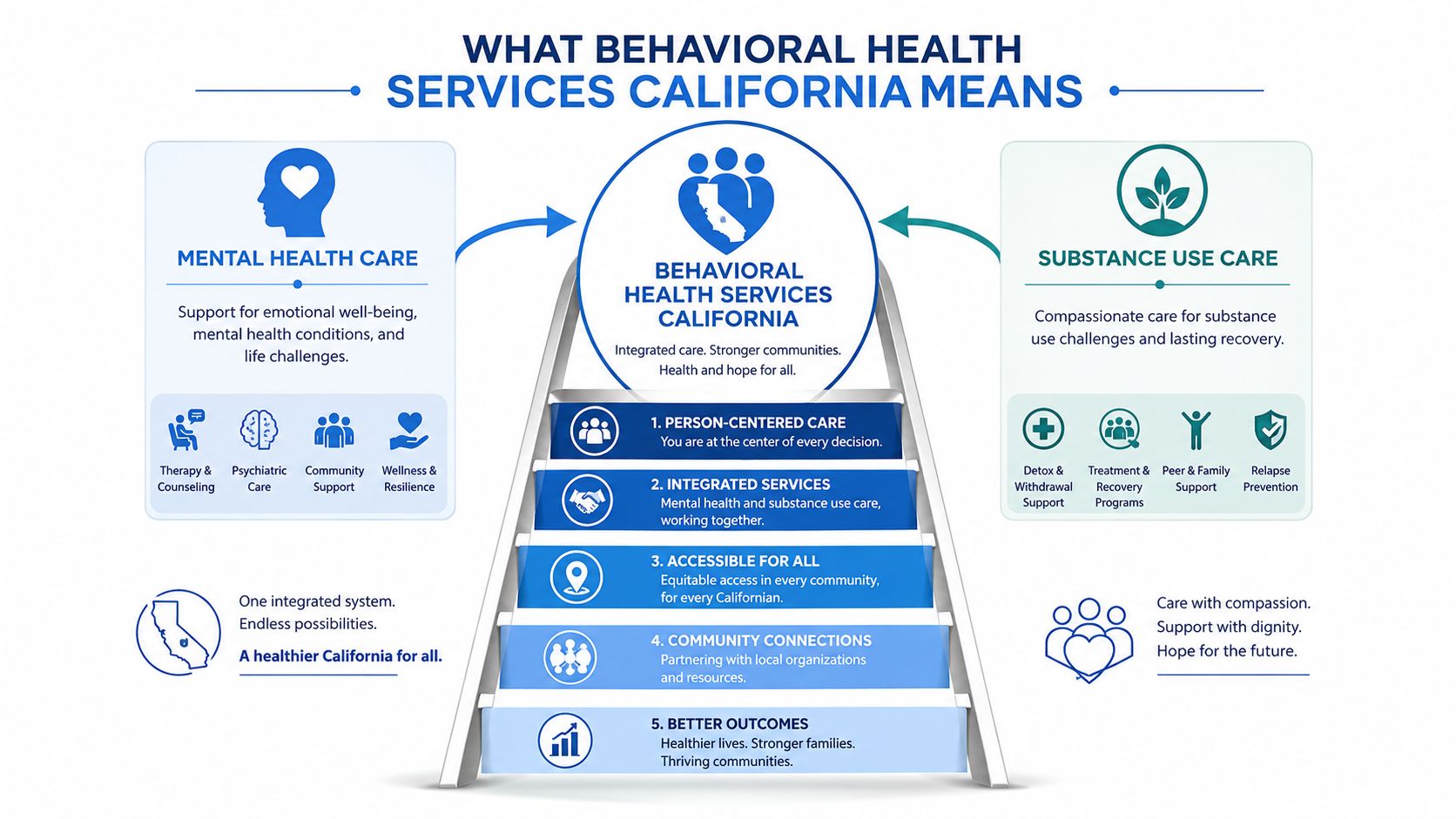
At its simplest, behavioral health is the umbrella that covers mental health care and substance use care together. California uses that broader frame because real people rarely fit into neat boxes. Someone can be dealing with anxiety, depression, alcohol use, withdrawal risk, and sleep problems all at the same time, and the care system works better when those needs are treated together instead of one after another.
Think of care like a ladder
The easiest way to picture it is as a ladder. The bottom rungs are the most accessible supports, like outpatient visits and follow-up counseling. Higher rungs add more structure, more monitoring, and more time each week, which matters when someone can't safely stay at home without extra support.
That ladder doesn't only serve people with one diagnosis. It's built for co-occurring disorders, which means mental health and substance use conditions happening together. In practice, that can look like a person starting with crisis support, moving into detox, then stepping down into outpatient therapy once they're stable enough to work, sleep, and care for family again.
California's state data show why this broad view matters. In 2020 and 2021, more than one-third of all inpatient hospitalizations and one-fifth of all emergency department visits were linked to a behavioral health diagnosis, and HCAI estimates that equals about 3 million behavioral-health-related hospitalizations each year, or roughly six hospitalizations every minute (HCAI behavioral health data). That isn't a niche service line. It's part of the daily flow of the health system.
Why people get confused
People often think they have to choose between “mental health” and “addiction treatment.” They usually don't. The better question is, what's driving the most urgent need right now, safety, withdrawal risk, depression, relapse, or a mix of all of them?
California's public system has expanded, but need remains high. In 2022 to 23, $11.6 billion in funding was available to the state's public behavioral health system, nearly double the amount available in 2014 to 15, while the state still had more than 1.2 million adults living with serious mental illness, and 1 in 13 children experiencing a serious emotional disturbance (CHCF data landscape). The key takeaway is simple, access exists, but the system is still under strain, so knowing the right rung of care saves time and frustration.
Types of Care From Detox to Outpatient
Different levels of care solve different problems. A person in active withdrawal needs a different setting than someone who is stable enough for weekly therapy, and a family looking at care for the first time usually needs a way to compare those options without getting buried in jargon. The clearest way to do that is to think in stages.
The table below keeps the comparison simple.
| Care Type | Setting | Best For |
|---|---|---|
| Medically supervised detox with MAT | Monitored clinical setting | People who need help getting through withdrawal safely |
| Residential rehab | Live-in treatment environment | People who need structure, distance from triggers, and daily support |
| Intensive Outpatient Program, IOP | Scheduled visits, often several days a week | People who need strong support but don't require overnight care |
| Standard outpatient care | Regular appointments | People who are stable enough for lighter follow-up |
| Crisis services | Emergency or rapid-response settings | People in immediate danger, severe distress, or unsafe withdrawal |
Detox and MAT
Detox is the start line when the body needs medical help to stop using safely. When medication-assisted treatment, or MAT, is part of the plan, the goal is to ease withdrawal and reduce immediate risk while the person gets through the hardest part. Families often expect detox to be a cure, but it's really the doorway into the next phase of treatment.
That next phase matters because detox alone doesn't teach coping skills, repair routines, or build relapse prevention habits. It just makes it possible to do that work more safely. A Yuba City adult who finishes detox may step down into an IOP, including telehealth when travel is a barrier, so the transition doesn't break the recovery plan.
Residential, IOP, outpatient, and crisis care
Residential care is the most structured option on this list. People live in the program, follow a schedule, and get support away from the pressure of their usual environment. That works well when home life, triggers, or instability make it hard to stay on track.
IOP sits in the middle. It's more intensive than regular outpatient care, but it still lets people keep some work, family, or school responsibilities. Standard outpatient care is lighter, which can be a good fit after stabilization. Crisis services are different from all of these because they're for the moment when safety is the immediate issue and the person can't wait for a normal appointment.
For a broader view of how these pieces fit together, the continuum of care overview can be a useful companion while you compare programs.
How to Access Care Through Insurance and Referrals
Getting into treatment is often less about “finding the right website” and more about choosing the right entry door. For a Yuba City resident, that door might be private insurance, Medi-Cal, a military benefit, a primary care referral, or telehealth enrollment. The process is easier when you treat it like a checklist instead of a maze.
Insurance plans such as Anthem, Blue Cross, Blue Shield, Aetna, and UnitedHealthcare usually start the same way, with a coverage check and a call to confirm behavioral health benefits. Medi-Cal members often need help confirming which services are covered and which providers are in network. Tricare beneficiaries should ask directly whether the program accepts their plan and whether the service they need is authorized.
A practical first move is to verify benefits before you commit to an intake date. If you're helping a family member, keep the member ID number, date of birth, and a list of current medications in one place before you call. If you're trying to make your own practice more reachable for patients, a HIPAA ready cloud phone system can help a care team handle sensitive calls with more privacy and consistency.
Referrals and telehealth
Primary care referrals still matter, especially when a doctor has already documented symptoms, withdrawal concerns, or co-occurring anxiety and depression. A referral can shorten the handoff because the provider already understands the clinical picture. For rural residents, telehealth can remove the most obvious barrier, distance.
A referral starts the conversation, but telehealth often keeps it going.
That matters in places where the nearest specialist may be too far away for weekly travel. If you want a step-by-step refresher on benefit checks, the insurance verification guide lays out the basic questions to ask before the first appointment.
The big idea is simple. Many adults can start within days if they know which door to knock on first, and a phone call is often enough to begin that process.
Rural Access and the California Provider Shortage
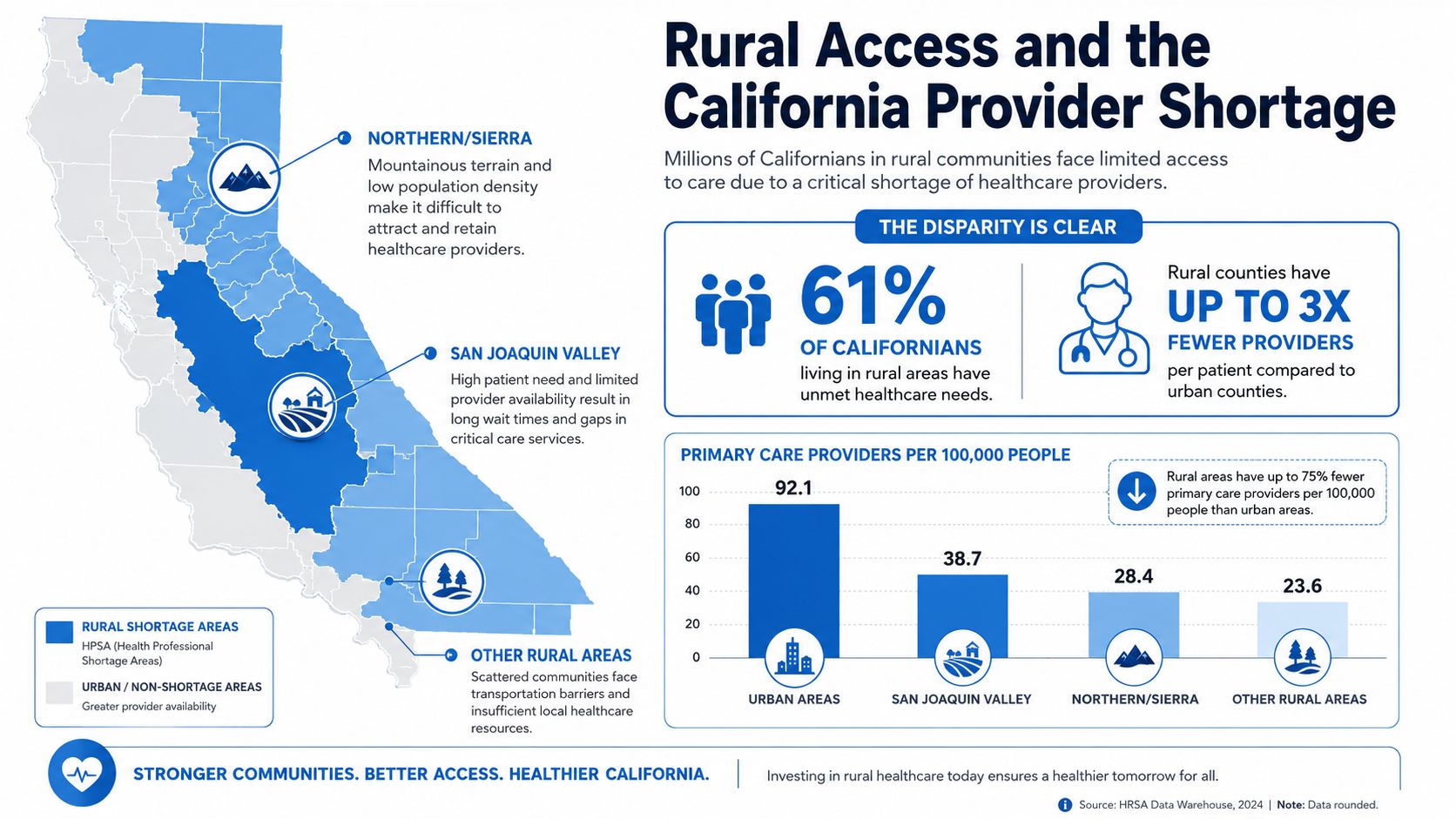
A common mistake is assuming that California access looks the same everywhere. It doesn't. In the San Joaquin Valley, Northern and Sierra regions, and other rural counties, people often face a much thinner provider network than families in larger urban areas.
California shortage modeling projects shortages across all behavioral health roles in all 58 counties in 2025, and locating a behavioral health specialist can be twice as difficult as finding a primary care clinician (CHCF regional almanac). That's why a person in Yuba City might be able to find a general medical appointment faster than a specialist visit, even when the need is clearly behavioral health related.
Why the shortage changes the plan
When supply is tight, care has to be designed differently. That's where telehealth, multidisciplinary teams, and stepped care become practical tools instead of buzzwords. A person may start with a remote assessment, then move into a higher level of support only if symptoms or relapse risk call for it.
That approach also helps families set realistic expectations. A local clinician may not be available tomorrow, but a program that combines medical staff, counseling, and remote follow-up can still move a person forward. California's own modeling says the pressure is statewide, with shortages projected across every county, so rural families aren't imagining the delay. They're living inside a system that is already stretched.
What to ask when options are scarce
If local options are thin, ask whether the program offers hybrid care, whether intake can happen by telehealth, and whether treatment can step down or step up as needs change. Ask who handles medication, who provides therapy, and who stays in touch after the first visit. Those questions matter because in a shortage environment, continuity is often what keeps treatment from stalling.
The practical goal isn't to find a perfect local match on the first try. It's to find a service that can start now and keep going when in-person access is limited.
How to Choose the Right Provider
The right provider should do more than answer the phone. It should make the next step clear, keep your information private, and offer a level of care that matches the person's actual need. Proximity matters, but fit matters too.
Start with the basics. Does the provider accept the insurance you have? Does it offer a full continuum, from detox through aftercare, or only one piece of the process? Does it have a team that can handle both substance use and mental health needs without sending you somewhere else for every issue?
Practical rule: choose the program that can explain the care plan in plain language, not the one that uses the most jargon.
A quick checklist for the first call
- Insurance acceptance: Ask whether the plan is in network, whether there are authorization steps, and whether telehealth is covered.
- Continuum of care: Confirm that the program can support the person beyond intake, especially if detox, residential care, or IOP may be needed.
- Multidisciplinary staff: Look for medical, counseling, and recovery support roles working together.
- Privacy and monitoring: Ask how information is protected and how follow-up happens after hours or between visits.
- Local access: If the site is nearby, ask whether a tour is possible before admission.
The reason this checklist matters is simple. Behavioral health treatment works better when the person feels seen, not processed. In rural areas, where people may already be worried about distance, confidentiality can make the difference between following through and putting the call off for another week.
California's system is large, but the best provider for your family is still the one that can answer direct questions, explain the plan, and adjust care as needs change.
Local Next Steps With Addiction Resource Center
For Yuba City residents who want a direct path, Addiction Resource Center LLC is located at 1002 Live Oak Blvd., Suite A, Yuba City, CA. The center's 24/7 phone and text line is 530-625-7910, which matters when the need shows up at night, not during office hours. Families can call to ask about admission, tour options, or guidance for a loved one who's unsure about treatment.
The program offers medically supervised detox with MAT, residential rehabilitation through its partner facility, Ona Treatment Center in Browns Valley, and an Intensive Outpatient Program that's available in person and via telehealth. That combination can fit different stages of recovery, from the first medically supported withdrawal period to the more flexible outpatient phase.
The care team includes a medical doctor, registered nurse, CADC, LMFT, and recovery mentors, which gives clients access to both clinical and practical support. For people who feel overwhelmed by a first call, that kind of team structure can make the process easier to understand. It also gives families a clearer sense of who is involved in care and who to contact with questions.
Insurance is part of the entry process too. The center accepts most major insurance plans and welcomes Tricare beneficiaries, which can matter for adults who need substance use treatment and don't want to spend days sorting out coverage before they start. For some families, the right next step is calling, asking what level of care fits, and then deciding whether to come in for a tour or begin intake remotely.
If you're choosing between programs in Northern California, this kind of concrete setup is what to look for, a place that can handle detox, step-down care, family questions, and telehealth without making you restart the search each time the need changes.
Your First Call Starts the Path to Care
Behavioral health care in California makes more sense once you see the ladder, the access routes, and the rural reality behind the wait times. First, understand what level of care the person needs. Then, choose a provider that can explain the plan clearly and protect privacy. After that, make the call that fits the situation.
In Yuba City and nearby communities, telehealth and local teams can still turn a hard moment into a workable plan. The first call is not a final decision. It's just the first rung.
If you're looking for detox, residential support, IOP, or help figuring out what comes next, Addiction Resource Center LLC can help you start that conversation with a real person. Visit Addiction Resource Center LLC to review services, or call 530-625-7910 to ask about the right next step for you or someone you love.