Recovery usually doesn't happen on a neat schedule. A classic longitudinal study found that the median time from first treatment episode to last use was 9 years PubMed, which reframes addiction as a long clinical journey rather than a short crisis. That's why long term addiction treatment programs matter, they're built to keep people connected …

Recovery usually doesn't happen on a neat schedule. A classic longitudinal study found that the median time from first treatment episode to last use was 9 years PubMed, which reframes addiction as a long clinical journey rather than a short crisis. That's why long term addiction treatment programs matter, they're built to keep people connected long enough for stabilization, skill-building, and follow-through to stick.
The strongest programs don't treat detox, rehab, outpatient care, and aftercare as separate events. They function as a continuum of care, where each phase has a different job and the handoff between phases matters as much as the phase itself. For families and individuals in crisis, that means the right question isn't just “How fast can we get in?”, it's “What happens after the first week, after discharge, and after the first setback?”
Table of Contents
- Why Long Term Addiction Treatment Programs Matter
- Clinical Components of Long Term Addiction Treatment
- Evidence Based Outcomes and Completion Rates
- Who Should Consider Long Term Addiction Treatment
- The Continuity of Care Gap After Residential Treatment
- How to Evaluate Long Term Addiction Treatment Programs
- Taking the Next Step Toward Long Term Recovery
Why Long Term Addiction Treatment Programs Matter
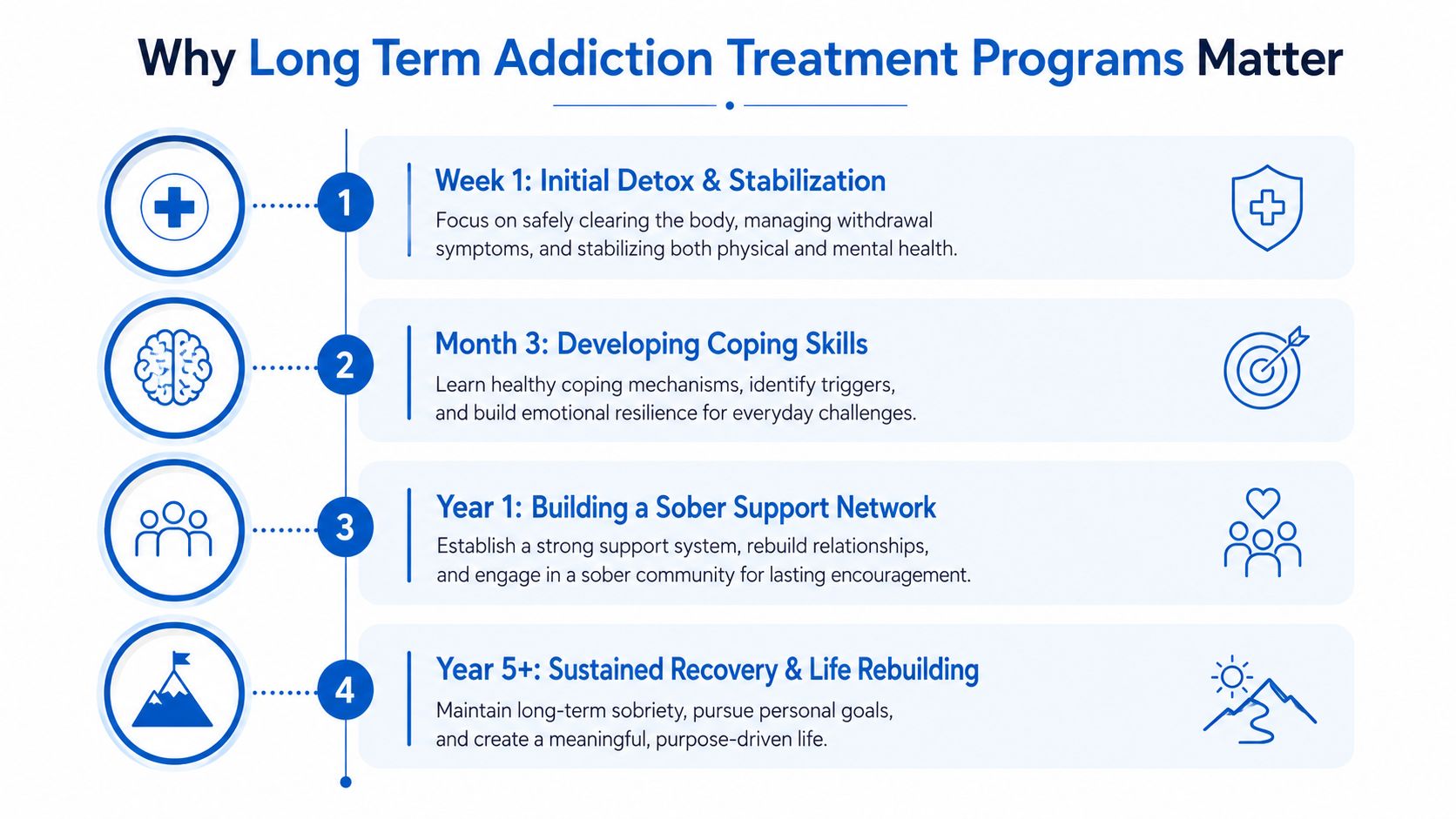
The most important thing to understand is that addiction recovery often unfolds over years, not weeks. That long horizon is not a reason to be discouraged. It's a reason to choose care that's designed for retention, repetition, and steady adjustment instead of a single burst of treatment.
Recovery works better as a sequence
Detox can help the body stabilize. Residential care can add structure and distance from triggers. Outpatient care then lets someone practice recovery skills in real life while still getting support. Aftercare keeps that support from disappearing the moment someone leaves the facility.
That sequence matters because each stage solves a different problem. A person in withdrawal needs medical oversight, not a discussion group alone. A person leaving residential treatment often needs coping routines, relapse-prevention planning, and a way to stay connected to clinicians while rebuilding daily life.
Practical rule: if a program treats discharge like the finish line, the treatment plan is incomplete.
Long-term planning also reduces the common misunderstanding that “more time in treatment” means a patient is failing. In reality, sustained engagement is often what makes recovery possible. Federal service data recognize long-term residential care as a distinct treatment category, and independent summaries of treatment data report completion rates that vary by level of care, which is one reason clinicians think in terms of matching intensity to need rather than picking a one-size-fits-all model SAMHSA-linked summary in PubMed context.
For teams using modern care coordination tools, the transition between phases can also be tracked more cleanly with systems that support documentation and handoffs. A practical overview of healthcare AI adoption can be useful for clinics trying to reduce missed steps in communication, especially when several providers are involved.
Why short programs often feel unfinished
A short stay can still be useful, especially for stabilization. But a brief episode rarely gives enough time for new habits to become automatic, for family dynamics to settle, or for relapse-prevention skills to be tested outside a controlled setting. The gap between “I stopped using” and “I can live differently” is where sustained treatment earns its value.
That's also why families often feel confused when someone leaves detox and still seems vulnerable. The person may be medically more stable, but not yet behaviorally stable. Long term addiction treatment programs are built around that reality, not around wishful thinking.
Clinical Components of Long Term Addiction Treatment
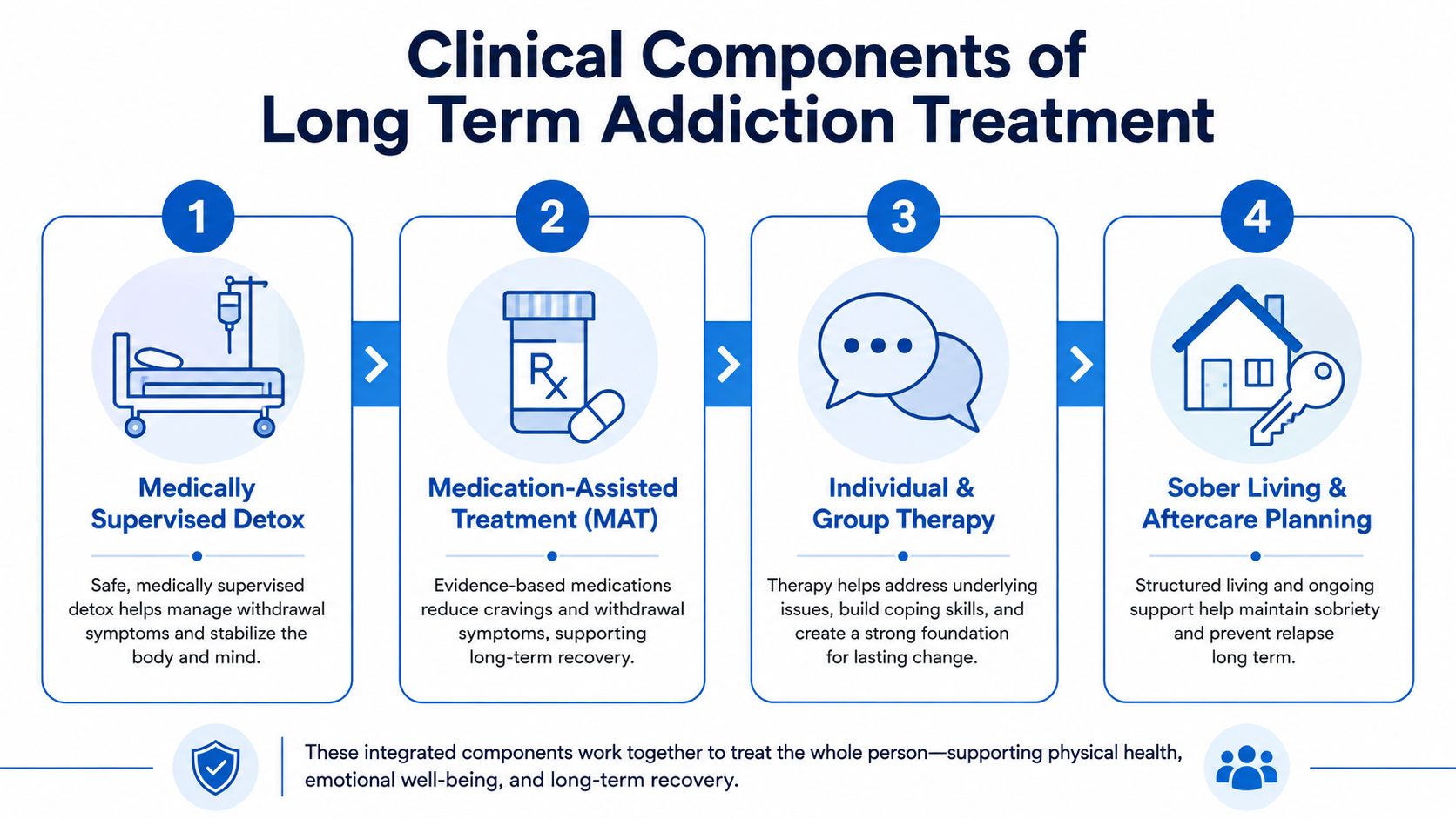
A strong program does not depend on one service. It connects detox, therapy, family support, and follow-up care so a person can move from crisis care to maintenance care without slipping through the cracks. The clinical question is whether those services are arranged in a purposeful sequence, because treatment works more like a relay than a single race.
Detox and stabilization
For many patients, medically supervised detox is the first phase. Its role is to manage withdrawal, monitor safety, and prepare someone for the next level of care. Detox by itself is not treatment completion, because the body may be stable before the person has had time to practice new routines and coping skills.
Medication-assisted treatment, or MAT, often belongs in this stage when it is clinically appropriate. It can ease withdrawal distress and support stabilization while the care team decides what ongoing treatment should look like. A clear overview is available in the MAT addiction medicine guide, which explains how this approach fits into addiction care.
Residential rehab, therapy, and family work
Residential treatment adds structure. Patients live in a setting with fewer triggers, a predictable schedule, and consistent therapeutic contact. That kind of environment gives clinicians more room to address avoidance, shame, conflict, and impulse control without the interruptions of daily life.
Individual therapy and group counseling serve different purposes. One-on-one sessions can go deeper into trauma, grief, depression, or relapse history. Group work helps people hear their own experience reflected in someone else's story, which can reduce isolation and make change feel more possible. Family involvement matters too, because home routines, boundaries, and communication patterns often shape relapse risk long after discharge. The ProMed Certifications EBP guide is a useful reference for understanding why structured, evidence-based services are often paired with coordinated clinical oversight.
Clinical insight: recovery plans often fail when they depend on motivation alone and ignore the environment a person returns to.
Step-down care and aftercare planning
Intensive Outpatient Programs, or IOPs, bridge the gap between residential care and ordinary life. They let people keep working or handling family responsibilities while still receiving structured therapy, check-ins, and relapse-prevention support. In a stepped model, IOP is not a weaker version of care. It is the next layer, like moving from a cast to physical therapy after the most urgent injury has been stabilized.
Aftercare planning should be specific. It should name who the patient calls, what happens if cravings spike, where support meetings or counseling happen, and how medication follow-up is handled. For a clearer view of how services are arranged across levels, the continuum of care resource lays out the clinical handoffs that keep treatment from ending too abruptly.
Some patients also need a blended model that combines in-person and remote support. That matters for rural and semi-rural communities, where relocating for months is often unrealistic and care gaps can appear after discharge if no local follow-up exists. A practical plan may include telehealth check-ins, local counseling, medication management, and scheduled step-down visits, so recovery support stays connected even when the residential stay ends.
Evidence Based Outcomes and Completion Rates
Families often hear confident promises, but the numbers behind treatment are more useful than the sales language around them. The clearest figures separate completion, retention, and short-term abstinence, because each one measures a different part of recovery.
What completion rates mean
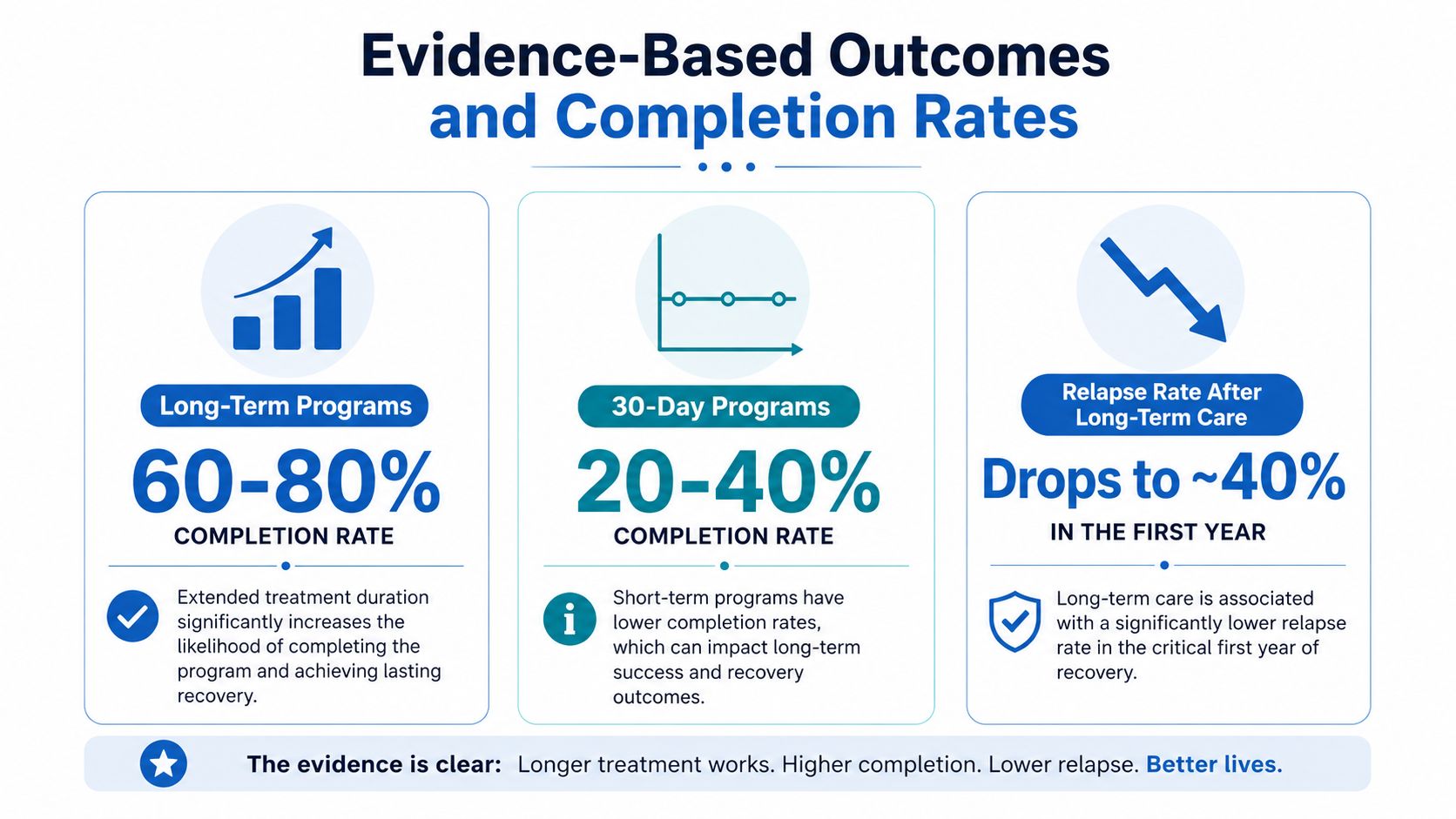
Across U.S. treatment settings, about 42% of all treatment discharges are recorded as completed, while independent summaries report completion around 65% or higher in residential rehab AddictionGroup treatment statistics. Those numbers do not mean the other discharges were wasted. They show that more structured settings are better at keeping people engaged long enough to finish a clinical plan.
Completion is also not the same as a permanent cure. It shows that a person stayed with the process through a meaningful treatment episode, which is important because retention is part of the treatment itself, not just a side effect of it.
What longer engagement changes
Continuing-care research reports that long-term treatment is most effective when it lasts at least 3 to 6 months, with evidence suggesting that up to 12 months of tapered follow-up may be needed for strong outcomes PMC continuing-care review. The same review reports better 12-month outcomes for patients treated for 3 months or more, including lower illicit drug use and better employment and criminal-justice functioning.
A separate review of structured long-term treatment defined as 18 months or longer found substantially better substance-use outcomes than shorter standard care ScienceDirect abstract. In that review, clinical follow-up data also showed 69% abstinence at 2 months and 57% at 12 months, along with major reductions in use days from intake to 12 months.
These findings matter for the continuity-of-care gap that many guides leave out. A person may finish residential care with real progress, then lose momentum if the next level of support is unclear, too far away, or impossible to attend from a rural or semi-rural home. Step-down planning helps bridge that gap, and blended care models can keep contact going through telehealth, local counseling, medication follow-up, and scheduled visits when returning to an area without nearby specialty services.
A careful way to read outcome claims
If a program only advertises a headline number, ask what happened at discharge, at 3 months, and after the step-down plan started.
That question matters because outcomes usually improve when programs keep patients connected after the most acute phase. For a clearer explanation of how researchers think about effective care, the evidence and outcomes resource is a useful companion read.
For clinicians and administrators, strong outcome claims should always be tied to program design. The primary advantage of long term addiction treatment programs is not a promise of perfection. It is giving people enough time for change to become visible, repeatable, and supported. The ProMed Certifications EBP guide is a practical reference for readers who want a broader clinical lens on why method and outcomes both matter.
Who Should Consider Long Term Addiction Treatment
Some recovery plans need more time to hold. That becomes clear when a person has already tried treatment, returned to use, and found that the earlier plan did not last long enough or did not fit daily life. In those cases, the problem is often not effort. It is usually a mismatch between the level of support and the realities the person returns to after discharge.
Clues that short care may not be enough
Repeated treatment attempts are a strong sign that a longer plan may be needed. So are co-occurring mental health conditions, unstable housing, severe substance use patterns, and weak social support. When someone leaves treatment and walks straight back into the same stressors, recovery habits have very little room to take root.
The home setting matters too. Family conflict, unsafe housing, exposure to active use, or a work schedule that leaves no room for appointments can all make short-term care fragile. In those situations, the plan needs more than a discharge sheet. It needs a daily structure the person can live with.
Helpful test: if the person's home life can't support early recovery, the treatment plan has to account for that before discharge.
Rural and semi-rural realities
Rural areas often have limited specialty services and fewer specialized programs. Research notes that rural settings are disproportionately disadvantaged by limited basic services and underuse of care compared with urban areas, and that specialty programs for women or racial minorities are often missing PMC rural treatment access review. A judicial task force on rural opioid treatment also identified barriers around accessibility, availability, stigma, funding, and bias against MAT PMC rural treatment access review.
For people who cannot relocate for months, that gap changes the whole treatment decision. A blended model may be more workable than a single extended residential stay. Detox may come first, then residential care if needed, followed by IOP, telehealth follow-up, local counseling, and community recovery support. The continuum of care in addiction recovery matters here because the handoff between services often determines whether treatment gains hold after discharge.
Who should ask for a longer assessment
- People with repeated relapse histories: Several episodes of return to use usually call for a more durable plan, not a shorter one.
- Families seeing mental health overlap: Anxiety, depression, trauma, and substance use often need coordinated treatment.
- Patients with limited transportation or housing stability: Practical barriers can make outpatient-only care too fragile.
- Veterans and insured patients using TRICARE or private coverage: Benefit details can affect what level of care is feasible, so the assessment should include coverage questions early.
- Rural residents: A flexible continuum may matter more than a full-time residential placement.
A long-term plan is not always a full residential stay. Sometimes it is a specific combination of services that stays active long enough to outlast the strongest triggers and support the move from residential care into daily life.
The Continuity of Care Gap After Residential Treatment
Discharge is often the point where a recovery plan becomes fragile. Families tend to focus on getting a loved one into treatment, but the transition out of residential care can create a new risk if the next steps are not already arranged. Research on post-acute treatment access found major barriers, including a lack of continuity of care, limited detox and residential bed availability, unstable housing, and few options for choosing a treatment pathway PMC post-acute access study.
A residential stay can stabilize someone enough to think clearly, sleep more regularly, and begin treatment. The hard part is making sure that progress does not stop at the door. Discharge planning works like handing off a relay baton. If the next runner is not in place, the momentum slows fast.
Why the handoff is so fragile
A person can leave residential care feeling hopeful and still be unprepared for daily life. If outpatient appointments are not scheduled, if medication follow-up is unclear, or if the person returns to unstable housing, the treatment gap opens quickly. That gap is where cravings, old routines, and isolation often return.
Another study reported that treatment gaps persisted after ACA implementation, with no significant reduction in insurance-related barriers and increased social, organizational, and individual barriers such as poor knowledge of available services, difficulty finding appropriate treatment, and anticipated stigma PMC post-acute access study. As a result, discharge planning is a clinical issue, not an administrative afterthought.
What blended care looks like
Blended care models can help patients who cannot relocate for months. A practical mix may include telehealth visits, local IOP, medication follow-up, family sessions, and recovery mentoring. The aim is to keep the person connected, even when the setting changes.
This approach is often a better fit for rural and semi-rural patients. Travel, childcare, work schedules, and transportation problems can make a single care setting hard to sustain. A blended plan gives clinicians more ways to respond without losing structure. As noted in the continuum of care guide, stepping care up or down works best when the transition is planned in advance.
Why aftercare should be treated like treatment
Aftercare is not a courtesy call. It is the part of care that helps gains survive the first months back in the community. Families should expect a clear plan for follow-up dates, crisis contacts, and what to do if symptoms return.
Addiction Resource Center LLC is one example of a provider that offers detox, residential rehabilitation through a partner facility, and IOP in person and via telehealth, along with 24/7 wellness monitoring and individualized planning. For patients in Northern California who need a blended continuum instead of a single long stay, that kind of structure can help close the gap between residential care and daily life.
How to Evaluate Long Term Addiction Treatment Programs
A brochure can make a weak program look polished. Families do better when they ask direct questions about who provides care, how the treatment plan changes over time, and what support looks like after someone steps down to a lower level of care. If those answers stay vague, that is a warning sign.
Questions that reveal program quality
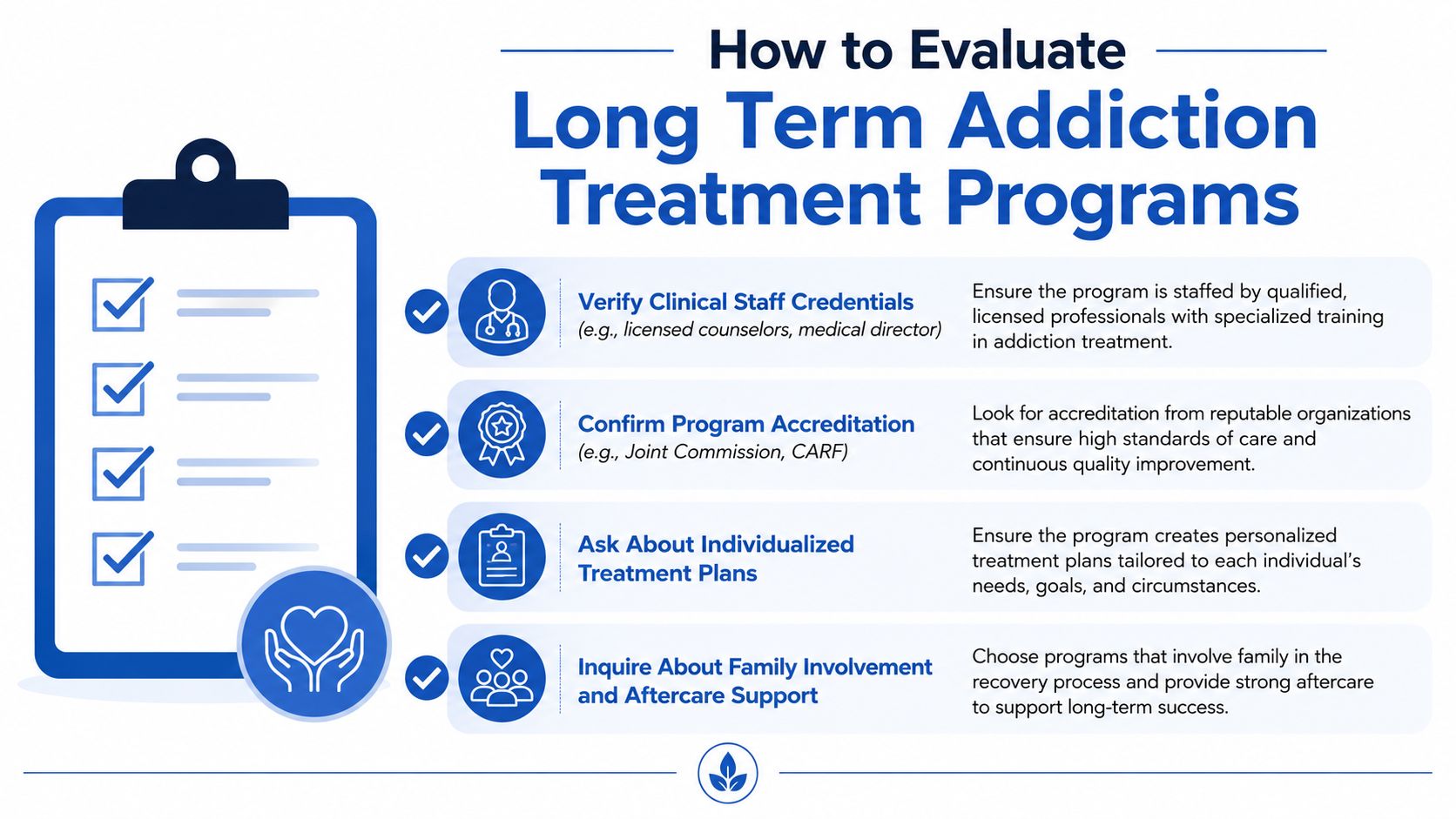
Start with the clinical team. Ask who provides therapy, who oversees medications, and how communication happens between counselors, medical staff, and case managers. Addiction treatment often overlaps with sleep problems, mood symptoms, trauma, and medication management, so the people involved should be licensed and coordinated, not working in separate silos. Ask how often the treatment plan is reviewed and whether it changes as the person's needs change.
Accreditation and family involvement also matter. A program that offers family education, relapse-prevention planning, and coordination for the next level of care is showing that recovery continues after the first phase ends. A program that avoids those conversations may be focused on admission more than continuity.
Insurance and practical access
Coverage questions should come early, before anyone has toured a building or committed to a plan. Ask whether the program accepts your insurance, whether prior authorization is required, and what costs may still remain. If the patient uses TRICARE or private insurance, ask how benefit verification is handled before admission.
Practical access deserves the same attention. A person may benefit from treatment but still be unable to leave work, home, or caregiving duties for months at a time. In that situation, ask whether outpatient care, telehealth, or a blended model is available. That matters especially for rural and semi-rural patients, where travel and transportation can make a single location hard to sustain.
Red flags that deserve attention
- Quick-fix promises: Recovery does not fit a sales pitch that sounds easy.
- No licensed clinical staff: Peer support has value, but it cannot replace medical and therapeutic oversight.
- No step-down plan: If discharge is unclear, the treatment path stops too soon.
- No family or aftercare discussion: Recovery depends on what happens after formal care ends.
- Unclear medication policy: Patients should know whether MAT is available and how follow-up is handled.
A program should also be able to explain how it supports real life after discharge. That includes return to work, family routines, local support, and the handoff from residential care to outpatient care or telehealth. A useful way to judge readiness is to ask whether the team can describe the next phase as clearly as the first one. If you need a simple reminder to follow through on that first call, use a commitment device for goals can help turn a decision into action.
Taking the Next Step Toward Long Term Recovery
A father calls after a night of fear because his daughter cannot keep living the way she is. That moment is common, and it rarely arrives with a polished plan. The person answering should expect uncertainty and help the caller sort out what comes next.
What to say when you call
You do not need a script. Start with the basics, describe the substance use pattern, say whether detox may be needed, mention any history of relapse, and include mental health or housing concerns if they are part of the picture. If you are calling as a family member, say that clearly, then ask what details will help the assessment move forward.
If the first call feels hard to start, make it a small task instead of a life decision. A simple reminder to follow through can help turn intention into action, even when the whole process still feels uncertain.
What to expect from a first conversation
A serious program will ask about health history, current use, insurance, safety, and support at home. It should also explain how detox, residential care, IOP, and aftercare fit together, since recovery often depends on the handoff between levels of care after the first phase ends. For people in rural or semi-rural areas, that handoff matters even more, because travel, work, and caregiving can make long stays away from home unrealistic, and a blended plan with outpatient care or telehealth may be a better fit.
Families often worry that calling on someone's behalf is unusual. It is not. Treatment teams speak with spouses, parents, adult children, and close supports every day, as long as privacy rules are followed. That contact can reduce confusion, clarify next steps, and make the first conversation easier to manage.
If you are ready to take that step, Addiction Resource Center LLC can help with medically supervised detox, MAT, residential care through its partner facility, IOP in person or via telehealth, and individualized aftercare planning. Reach out through Addiction Resource Center LLC to ask about the right level of care, verify insurance, or get help deciding what should happen next.