If you're staring at a phone screen at night, trying to decide whether you can keep working, keep caring for your family, and still get real help for substance use, you're not alone. A lot of people reach the point where weekly therapy feels too light, but residential treatment feels impossible. An Intensive Outpatient Program …


If you're staring at a phone screen at night, trying to decide whether you can keep working, keep caring for your family, and still get real help for substance use, you're not alone. A lot of people reach the point where weekly therapy feels too light, but residential treatment feels impossible. An Intensive Outpatient Program in California can sit in that middle ground, giving you structure without asking you to leave your life behind.
California's treatment system already uses IOP as a core part of care, not a side option. In the state's 2019 N-SSATS profile, 688 facilities offered intensive outpatient services and those facilities reported 8,719 clients in treatment on a single day, which was 9.0% of all clients in treatment that day, out of 1,797 substance abuse treatment facilities and 96,960 clients overall (Samhsa California state profile). For many families, that matters because it means IOP isn't a fringe idea, it's a widely used part of the continuum of care.
Table of Contents
- Finding a Balance Between Recovery and Real Life
- What Exactly Is an Intensive Outpatient Program
- IOP vs Other Levels of Addiction Care
- Who Qualifies for an Intensive Outpatient Program
- A Typical Week in a California IOP
- Navigating Insurance and Costs for IOP in California
- How to Choose the Right IOP and Begin Your Recovery
Finding a Balance Between Recovery and Real Life
A parent is trying to keep up with school pick-up, a shift schedule, and a growing concern about substance use. A college student is missing classes and hiding the problem from roommates. A worker in a busy California city cannot step away from life completely, but they still need more than a weekly appointment. That is the setting where an intensive outpatient program often makes sense.
A California IOP gives people a way to receive structured care while still returning home each day. It fits those who need more contact than a standard outpatient visit can provide, yet do not need overnight residential treatment. For many families, that middle ground matters because recovery has to work inside real life, not outside it.
Balance usually depends on schedule, location, and access. Some programs offer morning, afternoon, or evening sessions so people can keep working or manage childcare. Others use telehealth for part of the week, which can reduce the burden of driving across traffic-heavy areas or arranging time off. If you are comparing options, a guide to virtual IOP programs near me can help you sort out whether remote care may fit your routine.
Practical rule: if you can live safely at home, but substance use is still disrupting work, family life, or health, IOP is often worth asking about.
Insurance questions can affect the balance just as much as scheduling. Families often want to know whether a program accepts private insurance, Medi-Cal, or military coverage such as Tricare, and whether the provider can explain benefits before admission. Wait times also matter. A program may sound like the right fit, but if the first opening is far away or delayed, the best option on paper may not be the best option in practice.
For families, that can bring some relief. You are not choosing between doing nothing and stepping away from life entirely. You are looking for a structured level of care that can support recovery while daily responsibilities stay in place, and that is often the difference between getting started and putting treatment off again. Find help for depression in Grande Prairie.
What Exactly Is an Intensive Outpatient Program

An intensive outpatient program is best understood as a part-time commitment to full-time recovery. Instead of one therapy session a week, you're coming in for multiple hours on multiple days, with a schedule built to give structure, repetition, and accountability. RAND's California analysis describes a typical IOP as about 10 hours of psychotherapy plus 15 to 30 minutes of medication management per week (RAND).
What usually happens inside the program
The exact mix varies by provider, but the core services are usually familiar and practical. You can expect group therapy, individual counseling, relapse-prevention education, and skills-building work focused on coping, triggers, and daily routine. Some programs also include family sessions, because recovery rarely happens in isolation.
The point isn't to fill a calendar for its own sake. The point is to create enough clinical contact that a person can practice recovery skills while still using them in their daily lives the same day. That's one reason IOP can feel more realistic than residential care for someone who is medically stable and able to live at home.
Helpful way to think about it: weekly therapy is like checking the weather once a week. IOP is like carrying a real forecast through the whole week, with help adjusting when conditions change.
People often confuse IOP with a light or optional service. It isn't. It's a structured treatment model meant for people who need more than standard outpatient support, and the weekly hours reflect that higher level of clinical contact. If you're also sorting through mental health needs, a resource like Find help for depression in Grande Prairie can show how outpatient mental health support is organized in another setting, even though California's treatment system has its own rules and access realities.
An IOP is not meant to replace every other level of care. It's a focused, in-between structure that can help people keep moving while they recover.
IOP vs Other Levels of Addiction Care
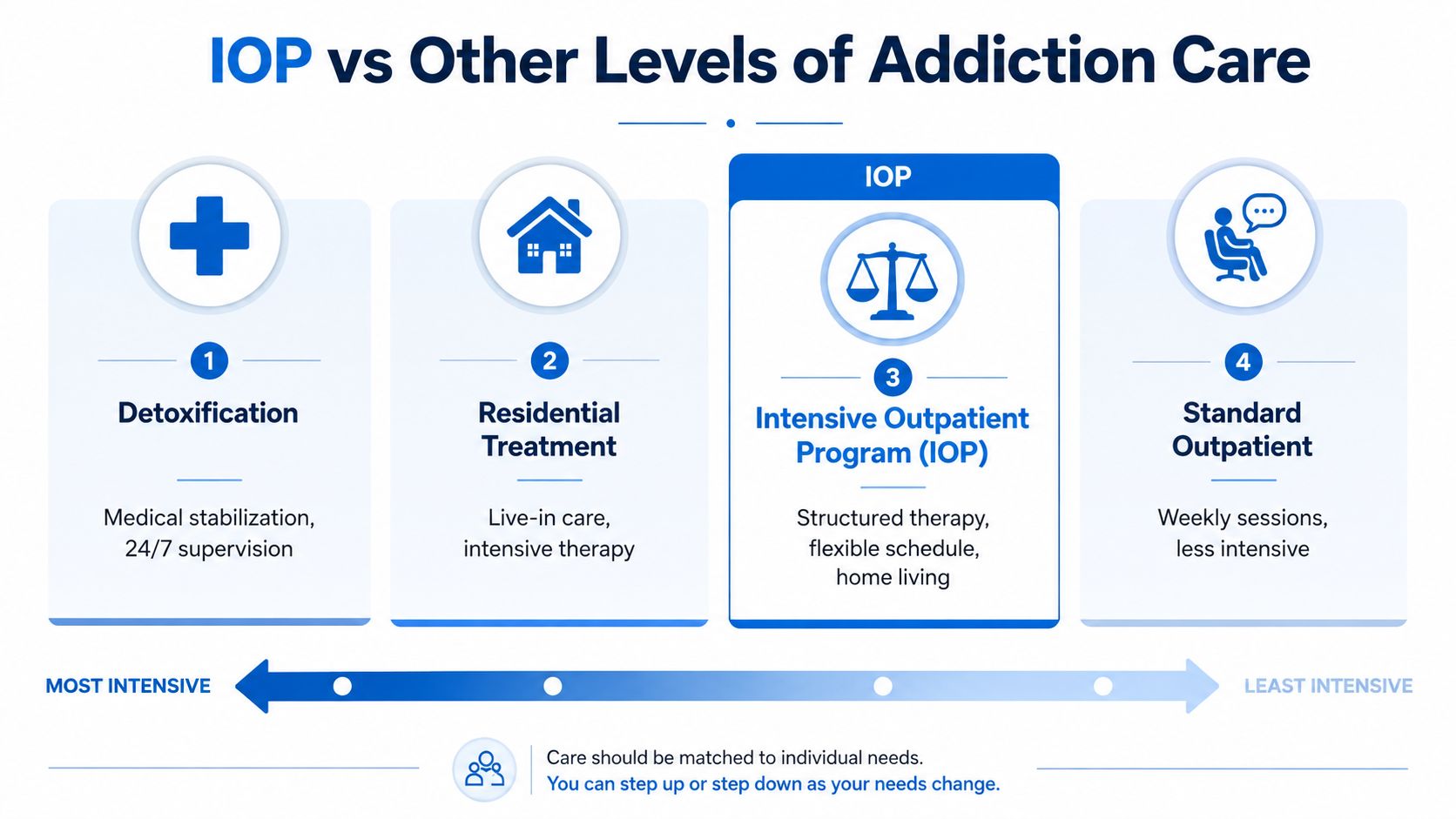
The clearest way to understand IOP is to place it beside the other common levels of addiction care. Each one serves a different need, and the right choice depends on safety, stability, and how much support a person requires right now.
| Level of Care | Time Commitment | Living Situation | Best For |
|---|---|---|---|
| Detoxification | Medical stabilization, 24/7 supervision | Stays in a monitored setting | People who need withdrawal management and close medical oversight |
| Residential Treatment | Intensive therapy throughout the day | Lives at the facility | People who need a highly structured environment away from daily triggers |
| Intensive Outpatient Program | Multiple hours on several days each week | Lives at home | People who need structured care but don't need 24-hour containment |
| Standard Outpatient | Usually one session per week | Lives at home | People with more stability who still want ongoing support |
IOP sits in the middle. That's what makes it so useful. It gives more contact than standard outpatient therapy, but it doesn't require you to move into a facility or step completely away from work and family life. A practical comparison of inpatient and outpatient rehab can help here too, and the guide on inpatient vs outpatient rehab is a good companion read if you're still trying to sort out the bigger picture.
Why the middle level matters
A lot of people think treatment has to be either “barely anything” or “all of everything.” That's not how clinical care works. Many adults need a step-up from weekly therapy because cravings, relapse risk, or mental health symptoms are still too active for a light schedule. Others need a step-down after a higher level of care so they can practice stability with support still in place.
The right level of care is the one you can safely participate in, not the one that sounds most intense.
Residential treatment can be the right call when home is unsafe or too chaotic. Standard outpatient can work when someone is stable and needs maintenance. IOP fills the gap when life still has to continue, but the person needs more contact, more accountability, and more time in treatment than a weekly appointment can provide.
Who Qualifies for an Intensive Outpatient Program
The strongest IOP candidates are usually people who can live safely at home and participate consistently. Research on intensive outpatient programs notes that they're most effective for individuals who do not need detoxification or 24-hour supervision, and that engagement can be undermined by unstable housing, lack of support, and severe financial insecurity (PMC research review). That makes stability, both physical and social, a major part of the decision.
Good fit factors
A person may be a good fit if they can show up reliably, follow a schedule, and use the program while staying in their everyday environment. Motivation matters, but so does the setting around them. If someone has a sober or at least safe home base, transportation they can count on, and enough emotional support to keep attending, they're often in a stronger position to benefit from IOP.
When IOP isn't enough
IOP is not the right first step for everyone. If someone needs medical detox, has a high risk of relapse without constant supervision, or can't safely remain at home, a higher level of care is usually more appropriate. The same is true when ongoing substance use is so disruptive that the person can't participate meaningfully in sessions.
Families often ask a hard but important question, “Can this person really use a program like this?” That question is better than asking only whether the program works in theory. If attendance is likely to collapse because housing is unstable, transportation is unreliable, or the person has no one helping them stay accountable, the program may need stronger wraparound supports.
A simple rule helps here. If the person can reasonably attend multiple weekly sessions, stay safe between sessions, and use skills in real life, IOP may be appropriate. If not, the first conversation should probably be about a higher level of care or more immediate stabilization.
A Typical Week in a California IOP
In a California IOP, the week usually has a rhythm. Someone might attend group therapy on Monday, skill-building on Wednesday, and individual counseling later in the week, then return home to work, family, or school obligations in between. The structure is intentional, because recovery needs repetition more than inspiration.
In Los Angeles County, the average length of stay in an IOP during FY 2021–22 was 83.6 days, and the county reported that 57.7% of admissions had mental health issues and 68.9% were unemployed (Los Angeles County Department of Public Health). That doesn't mean every California program looks exactly like Los Angeles County's system, but it does show that IOP often serves people with overlapping needs and real-life pressures.
What the week can look like
A practical schedule might include group sessions on three days, one individual session, and occasional family work. Group therapy gives people a place to hear from peers, notice patterns, and practice honesty without carrying the whole conversation alone. Individual counseling lets the clinician focus on personal triggers, grief, trauma, relapse history, or family tension that doesn't belong in a group setting.
Family sessions, when they're included, can be a turning point. They help relatives understand what recovery requires and reduce the kind of confusion that leads to conflict at home. That matters because treatment doesn't stop when a session ends, it spills into the next meal, the next commute, and the next hard conversation.
California's geography makes telehealth especially important. If someone is dealing with transportation barriers, caregiving duties, or a commute that would otherwise knock them out of treatment, virtual sessions can keep the schedule realistic. That option is especially helpful in a state where access isn't evenly distributed across counties.
Use the schedule to test fit: if the session times are impossible before you start, they'll be impossible after you enroll.
A week in IOP should feel structured, not chaotic. There should be enough repetition to build habits, enough flexibility to keep life moving, and enough clinical contact to make progress visible.
Navigating Insurance and Costs for IOP in California
Cost worries stop a lot of people before they ever make a call. That's understandable, especially when treatment feels urgent and money already feels tight. The good news is that IOP is often covered by insurance, but the details matter.
The safest first move is to verify benefits before you start. Ask whether the plan covers outpatient substance use treatment, whether preauthorization is required, and what the deductible or copay structure looks like. If you're comparing payment paths, this guide on Intensive Outpatient Program cost can help you frame the questions before you call.
What to ask an admissions team
- Coverage details: Ask whether the program is in-network, out-of-network, or both, and how that changes your out-of-pocket share.
- Authorization needs: Ask whether your insurer needs clinical approval before the first session, because delays often happen there.
- Plan type: Ask whether the plan handles mental health and substance use benefits the same way, because they're not always billed identically.
- Military family support: If you use Tricare, ask directly whether the provider welcomes Tricare beneficiaries and can verify that coverage before intake.
For veterans and military families, clarity matters. Many admissions teams can walk through the process in plain language and confirm whether your plan fits the program you're considering. That kind of verification reduces surprises later, when you're already trying to focus on treatment.
If you're looking at California providers, one practical option is Addiction Resource Center LLC in Yuba City, which offers IOP and accepts Tricare beneficiaries. It also provides telehealth IOP, which can matter if you're trying to balance insurance approval with a workable schedule. The right question isn't just “Can I afford treatment?” It's also “Can I realistically start treatment without being delayed by paperwork or access barriers?”
How to Choose the Right IOP and Begin Your Recovery
A family calling around California for treatment often starts with the same question, which program can actually help without creating new stress. Choosing an IOP should feel like a careful clinical decision, not a quick search result. Ask whether the program is properly licensed, what credentials the staff hold, whether it uses evidence-based therapies, and how it plans discharge and aftercare before you enroll.
Clear access information matters just as much as clinical quality. California's workforce shortage picture makes that plain, with 77.6% of counties designated as Mental Health Professional Shortage Areas and some contexts showing an estimated 8 to 12 week wait for care (California shortage overview). If a provider cannot tell you when you might start, that is a real issue, not a minor inconvenience.
A quick evaluation checklist
- Licensing and oversight: Confirm that the program is set up for the level of care it advertises.
- Staff mix: Look for clinicians who can handle both substance use and co-occurring mental health needs.
- Therapy approach: Ask about group therapy, individual counseling, relapse prevention, and family involvement.
- Scheduling reality: Confirm session times, telehealth options, and whether the program can fit your life.
- Aftercare planning: Ask what happens after IOP ends, because recovery does not stop at discharge.
For readers in Northern California, Addiction Resource Center LLC is one local option to consider. The center is located at 1002 Live Oak Blvd., Suite A, Yuba City, CA, and it offers substance use treatment with IOP services, a multidisciplinary team, telehealth availability, and Tricare acceptance. The 24/7 phone and text line is 530-625-7910, which gives families a direct way to ask about current openings and next steps.
If you are making calls today, start with immediate availability, then ask about insurance, then ask whether the schedule fits your work, family, or school obligations. A good program should answer clearly and respectfully, because the first contact already tells you something about how the team will treat you during care. Recovery often begins with small, practical steps like these, and the right IOP makes those steps feel possible instead of overwhelming.