If you're reading this after a hard phone call, you probably already know the pattern. A parent notices the cannabis getting heavier, or the drinking more secretive, and at the same time the person they love is withdrawing, sleeping at odd hours, talking in ways that don't make sense, or sounding scared by things no …

If you're reading this after a hard phone call, you probably already know the pattern. A parent notices the cannabis getting heavier, or the drinking more secretive, and at the same time the person they love is withdrawing, sleeping at odd hours, talking in ways that don't make sense, or sounding scared by things no one else can hear. Families usually start by asking which problem came first, but that question can keep them stuck while both problems keep feeding each other.
The more useful question is simpler. How do we treat schizophrenia and substance abuse together, in the same care plan, with the same urgency? That's the frame clinicians now use when they talk about dual diagnosis, and it matters because psychosis and substance use don't behave like separate tracks that can be fixed one after the other. They interact, they complicate each other, and they respond best when a team is willing to address both at once.
Table of Contents
- When Two Conditions Collide
- How Common the Combination Really Is
- Why the Two Conditions Feed Each Other
- Screening and Diagnosis in Practice
- Integrated Treatment Approaches That Work
- Relapse Prevention and Family Support
- Insurance Coverage and Local Next Steps
- Bringing It All Together
When Two Conditions Collide
A family often sees it before anyone names it. Someone starts missing work, stops answering texts, and seems harder to reach emotionally. Then the substance use changes, maybe more marijuana, more drinking, or a shift toward stimulants, and the person also starts sounding suspicious, detached, or confused in a way that feels bigger than intoxication alone.
That's when the language of dual diagnosis starts to matter. Clinically, it means a person is living with schizophrenia and a substance use disorder, and both need attention, not just the one that looks loudest that week. The old habit of treating addiction in one place and psychosis in another often leaves families bouncing between systems that each say, in effect, “stabilize the other issue first.”
Why the “which came first” question gets in the way
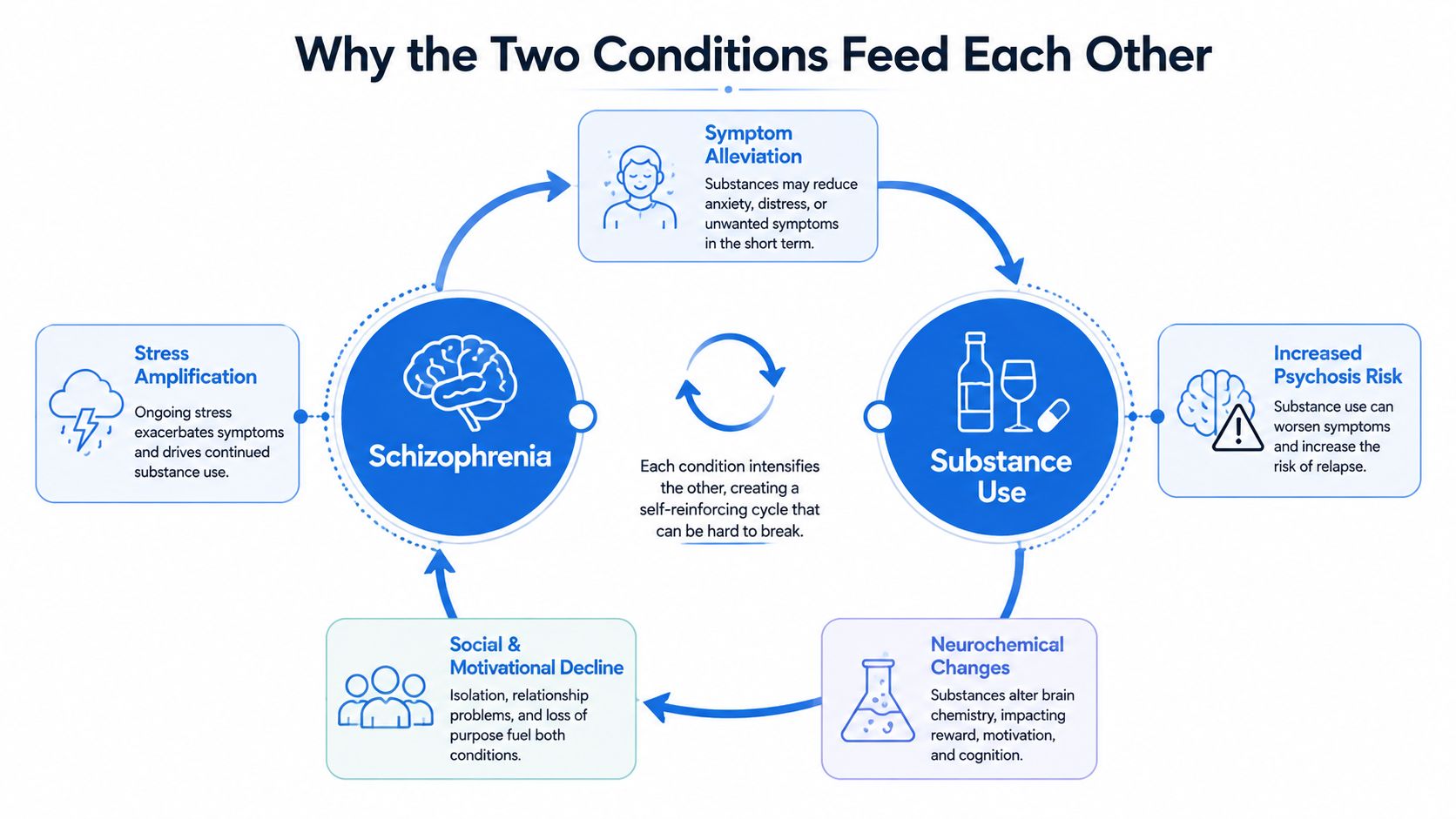
The better clinical lens is mutually reinforcing conditions. Substance use can worsen psychosis, and psychosis can increase the pull toward substances as a person tries to reduce fear, insomnia, agitation, or isolation. That's why integrated treatment has become the practical standard, because the care team has to understand the whole picture, not just whichever symptom showed up most recently.
Practical rule: if a person's psychiatric symptoms and substance use are rising together, treat them as linked until proven otherwise.
That shift in thinking also changes how families talk. Instead of asking whether the cannabis “caused” the schizophrenia or whether the schizophrenia “caused” the drinking, the focus moves to safety, pattern recognition, and care coordination. A thoughtful program will ask about both histories on day one, because both histories affect medication choices, relapse risk, and the level of supervision needed.
For readers who want a broader behavioral-health lens, how mental health affects substance use is a useful companion piece from Zoe Behavioral Health. It's especially helpful for families trying to understand why self-medicating can look like relief at first and still end up making symptoms harder to manage.
How Common the Combination Really Is
The numbers are hard to ignore. In the landmark U.S. Epidemiologic Catchment Area (ECA) study, 47% of people with a lifetime diagnosis of schizophrenia met criteria for some form of substance abuse, compared with 16% in the general population, and the odds of a substance abuse diagnosis were 4.6 times higher in schizophrenia. The same study also found 33.7% met criteria for an alcohol disorder and 27.5% for another drug use disorder, which shows the overlap wasn't limited to a single substance class. Those figures are still cited because they helped define schizophrenia as a high-risk condition for co-occurring substance use disorders and shaped later dual-diagnosis treatment models (ECA study).
The burden stays high across later reviews
More recent evidence points in the same direction. A 2018 systematic review reported that 41.7% of people with schizophrenia had any substance use disorder, with 27.5% involving illicit drugs, 26.2% cannabis, 24.3% alcohol, and 7.3% stimulants (systematic review). Other reviews note that lifetime substance use disorder prevalence in schizophrenia commonly ranges from 47% to 70%, and can reach about 80% when tobacco is included, which is one reason integrated care has to think beyond alcohol and illicit drugs alone (clinical review).
The pattern matters because it crosses countries, settings, and decades. It's not a rare edge case and it's not a sign that someone is “failing treatment” in a moral sense. It's a common clinical pairing that calls for a plan built around the reality of overlapping symptoms, overlapping triggers, and overlapping recovery needs.
Why the Two Conditions Feed Each Other
The simplest explanation, self-medication, only tells part of the story. Newer clinical reviews describe several pathways at once, and that matters because families often need a model that explains why the problem seems to deepen even when everyone is trying to help (review of mutual pathways).
A two-way loop, not a one-way cause
Substance use can precipitate psychosis in vulnerable people, especially when there's already a biological or environmental risk in the background. Schizophrenia can also push someone toward alcohol or drugs because the person is trying to blunt fear, quiet voices, sleep, or escape intense distress. Those pressures can reinforce each other over time through shared dopamine-related mechanisms, which is one reason the symptoms can become more entrenched rather than less.
Cannabis deserves special attention because it's repeatedly identified as the most commonly used illicit substance in this population, and continued use after diagnosis is associated with worsening psychotic symptoms, relapse, and reduced functioning. That doesn't mean every person who uses cannabis will develop schizophrenia, and it doesn't mean cannabis is the only issue. It does mean the risk conversation should be specific, not vague.
Some families need permission to stop asking, “Which one is the real problem?” The real problem is the loop.
A trauma-aware approach helps here too, especially when substance use started as an attempt to survive overwhelming symptoms. The principles described in trauma-informed care fit well with dual-diagnosis work because they reduce shame and keep the conversation centered on safety, trust, and pacing. That's important, because people don't open up when they feel blamed for the very behavior they used to cope.
The practical takeaway is straightforward. If substance use and psychotic symptoms are rising together, don't separate them into different stories just yet. Treat them as interacting problems, ask how each one affects the other, and build the plan around interruption of the cycle, not a debate over the first domino.
Screening and Diagnosis in Practice
Good screening starts with a simple decision. Clinicians should ask about both psychosis and substance use at the same time, rather than waiting to “stabilize” one before looking at the other. That matters because intoxication, withdrawal, medication side effects, and psychosis can blur into one another, and a rushed assessment can miss the pattern.
What a real dual-diagnosis evaluation usually includes
A strong intake usually covers a few concrete pieces. The clinician asks for a medical history, a psychiatric history, a medication list, and a substance timeline, then checks for safety concerns such as suicidal or homicidal ideation. Many programs also use urine drug screening, because it gives the team a clearer picture of recent exposure when memory or trust is shaky.
Common tools include the AUDIT for alcohol use, the DAST for drug use, and structured psychosis assessments as part of the psychiatric interview. Families sometimes worry that these tools are too clinical or too impersonal, but they're what help a provider separate withdrawal from paranoia, stimulant effects from thought disorganization, and medication nonadherence from relapse.
Bring the timeline, not just the label. Dates, substances, approximate amounts, sleep changes, and symptom changes often matter more than a single diagnosis name.
A useful intake question is whether the provider treats co-occurring disorders in-house or sends the person elsewhere for the other half of care. If the answer is a referral chain, ask how communication is handled between teams, because fragmented handoffs are where plans often fall apart. If you want a plain-language guide to how programs structure this kind of care, the internal overview on dual diagnosis addiction treatment is a helpful starting point for comparing options.
The best assessments don't just name the disorders. They decide the level of care, the medication strategy, whether withdrawal management is needed, and whether the person can safely start outpatient support or needs a higher level of containment first.
Integrated Treatment Approaches That Work
Integrated treatment means one team is planning for both conditions together, not sending the person back and forth between unrelated services. That can include medically supervised detox, medication-assisted treatment (MAT) when appropriate, residential rehabilitation, intensive outpatient programming, telehealth follow-up, and ongoing psychiatric medication management. The right mix depends on risk, severity, and how much structure the person needs right now.
Matching care level to current acuity
A person who's in active withdrawal, unstable, or at risk of harming themselves may need medical detox first. Someone who's medically safer but still overwhelmed by hallucinations, heavy use, or repeated relapse may need residential care where the day is structured and the clinical team can monitor sleep, medication response, and substance triggers. For people who can remain safe outside 24-hour supervision, an IOP can provide frequent therapy, relapse-prevention work, and medication follow-up without full residential placement.
The day-to-day work is practical. A physician reviews medications and psychiatric symptoms, a registered nurse monitors wellness and side effects, licensed counselors and an LMFT support coping and family communication, and recovery mentors help with accountability and recovery routines. That mix is not cosmetic. It's what makes it possible to adjust treatment when the person has a bad week instead of waiting until the next crisis.
For a broader overview of how co-occurring care is organized, the expert guide to integrated recovery in 2026 lays out the same core principle from a different provider perspective. The message is consistent, integrated care works because it stops asking the person to fix one diagnosis before anyone will touch the other.
| Level of Care | Best For | Typical Duration | Key Services |
|---|---|---|---|
| Medical detox with MAT | Withdrawal risk, early stabilization, medication assessment | Short-term, based on medical need | 24-hour monitoring, withdrawal support, medication review |
| Residential rehabilitation | High relapse risk, unsafe home setting, severe symptom overlap | Time-limited, based on progress | Structured routine, therapy, psychiatry, case management |
| Intensive Outpatient Program, in person or telehealth | People who can stay safe outside 24-hour care | Ongoing, scheduled weekly support | Group therapy, individual therapy, relapse prevention, medication coordination |
| Ongoing outpatient medication management | Maintenance after stabilization | Long-term follow-up | Antipsychotic management, substance-use check-ins, family coordination |
One of the most common myths is that someone has to be “clean” before psychosis can be treated, or “psychiatrically stable” before addiction can be addressed. In real clinical life, those conditions usually need attention together, because waiting for perfection only gives the cycle more time to tighten.
Relapse Prevention and Family Support
Recovery doesn't end when discharge papers get signed. The most fragile period is often the handoff into ordinary life, where old friends, old routines, insomnia, and stress can reopen the door to substance use or symptom flare-ups.
What makes a relapse plan actually useful
Strong aftercare starts with triggers. Those can be people, places, emotions, boredom, paydays, conflict, or the substances themselves. From there, the plan should include coping skills from CBT and motivational interviewing, regular group and individual therapy, medication adherence for antipsychotic treatment, and peer recovery mentors who can notice drift before it becomes crisis.
Families need support too, not just instructions. Schizophrenia and addiction change the rhythm of a household, and relatives often end up carrying fear, guilt, and exhaustion while trying to look calm. Programs that offer psychoeducation, family therapy, or community supports such as NAMI Family-to-Family or Al-Anon can help relatives learn how to respond without overfunctioning or disappearing.
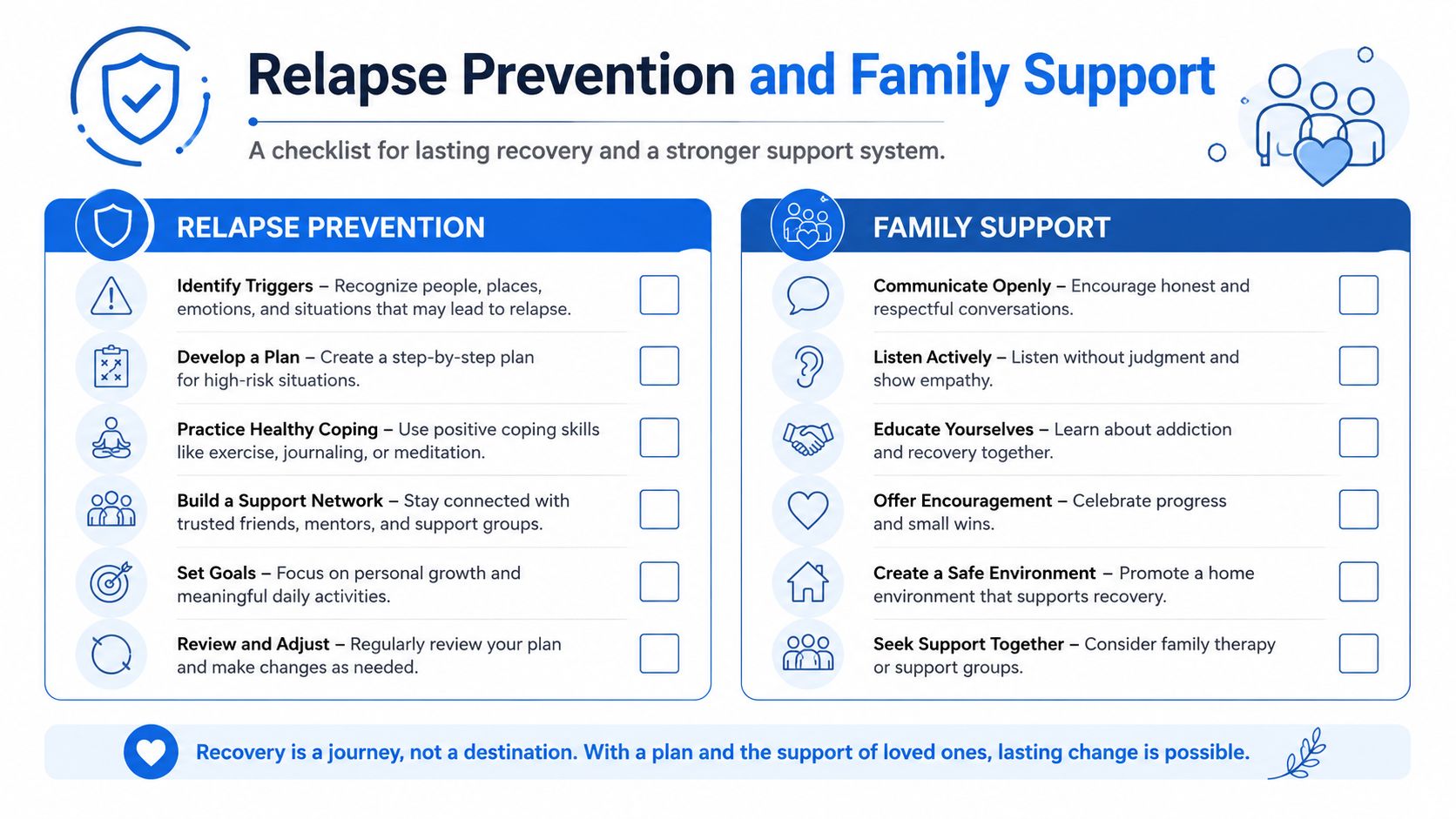
A solid crisis plan should name the warning signs, the emergency contacts, the local crisis line or emergency department, and the difference between urgent change and an immediate medical or psychiatric emergency. The internal guide on family relapse prevention can help families think through those roles before they're under pressure. That kind of preparation doesn't remove risk, but it does make the response faster and less chaotic when symptoms start shifting.
Families don't need to predict every relapse. They do need a shared script for what happens when things start to go off course.
Insurance Coverage and Local Next Steps
Coverage is often the thing that turns concern into action. Many major private plans, including Anthem, Blue Cross, Blue Shield, Aetna, and United Healthcare, cover co-occurring disorder treatment at some level, and TRICARE covers substance use treatment for eligible veterans and military families. California state programs can also help fill gaps when someone needs a level of care that insurance doesn't fully cover.
What to ask before you commit
The first call should be direct. Ask whether the program treats co-occurring schizophrenia and substance abuse, whether psychiatric medication management is available on site, whether detox, residential care, or IOP are offered, and how family communication is handled. If you're in Yuba City or elsewhere in Northern California, ask whether the provider can coordinate across levels of care so the transition from detox to outpatient support doesn't become a dead end.

One local option is Addiction Resource Center LLC in Yuba City, which offers medically supervised detox with MAT, residential rehab through its partner facility in Browns Valley, and IOP by telehealth or in person. It also works with a multidisciplinary team that includes medical, nursing, counseling, LMFT, and recovery support staff, which is the kind of setup families should look for when dual diagnosis is part of the picture. If the person you're helping needs a starting point, call, verify insurance, and ask for an intake that specifically addresses both mental health and substance use together.
Bringing It All Together
Schizophrenia and substance abuse aren't separate puzzles that happen to sit next to each other. They often reinforce each other, which is why integrated care usually does better than a plan that treats one diagnosis and hopes the other calms down on its own.
If you need three moves today, make them simple. Call a provider that explicitly treats co-occurring disorders, ask whether MAT and psychiatric care are coordinated in the same system, and involve family early instead of waiting for the next crisis.
If you're ready to talk to a team that understands co-occurring mental health and substance use needs, Addiction Resource Center LLC offers detox with MAT, residential care, and outpatient support in Northern California. Their team can help you sort out next steps, verify coverage, and build a plan that addresses both schizophrenia and substance use with one coordinated approach.