Your phone is in your hand. The test is coming up fast. You've probably already searched for what to drink for a drug test, and the internet has given you a pile of promises. Water. Cranberry juice. Vinegar. Detox drinks with bright labels and urgent claims. That kind of panic is human. People worry about …

Your phone is in your hand. The test is coming up fast. You've probably already searched for what to drink for a drug test, and the internet has given you a pile of promises. Water. Cranberry juice. Vinegar. Detox drinks with bright labels and urgent claims.
That kind of panic is human. People worry about jobs, school, probation requirements, military consequences, family conflict, and simple embarrassment. When the stakes feel high, a “quick fix” sounds better than waiting.
The hard truth is that there isn't a drink that reliably erases drug metabolites from your body on demand. What does exist is a lot of misinformation, plus a testing system that often checks for tampering as carefully as it checks for drugs. If you understand that science, the online advice starts to make more sense, and a safer path becomes easier to see.
If your situation involves service-related consequences, legal context matters too. Some readers in the military may need legal help for military drug offenses alongside medical or recovery support.
Table of Contents
- The Urgent Search for a Quick Fix
- How Drug Tests See What You Cannot
- A Realistic Timeline for Drug Detection
- Debunking Myths About Detox Drinks and Home Remedies
- The Hidden Risks of Trying to Mask or Dilute a Sample
- Safer Alternatives and Responsible Next Steps
- Find Confidential Support in Yuba City
The Urgent Search for a Quick Fix
A lot of people asking what to drink for a drug test aren't looking for trivia. They're trying to solve a problem before work on Monday, before a custody hearing, before a probation check-in, or before a return-to-duty appointment. The urgency is real, and it can push smart people toward bad advice.
One common pattern looks like this: someone hears they may be tested, searches online, buys a detox drink, and spends the next day trying to “flush out” their system. The plan feels active, which is comforting. But feeling in control and being in control aren't the same thing.
Why panic drives bad decisions
Stress narrows attention. People stop asking, “Will this change what the lab measures?” and start asking, “What can I drink right now?” That's understandable, but it skips the most important piece. Drug testing isn't just about what's in the cup. It's also about whether the sample itself appears valid.
A quick fix is appealing because it offers certainty. Drug testing science usually doesn't.
That's why so many internet answers fail people. They focus on drinks, not biology. They focus on marketing, not specimen validity. They focus on the moment before the test, not the days or weeks when the body is processing metabolites.
The better question
Instead of asking only what to drink for a drug test, ask two better questions:
- What type of test is it? Urine, saliva, blood, and hair don't work the same way.
- What is the lab trying to detect? Usually it's not the drink you had that morning. It's the byproducts left after your body processed a substance.
If you're scared right now, that doesn't mean you need false hope. It means you need honest information, fewer myths, and a plan that won't make the situation worse.
How Drug Tests See What You Cannot
Drug tests work a little like cameras. Each type captures a different kind of evidence, over a different period of time. A blood test is looking at what's circulating now or very recently. A saliva test tends to focus on recent exposure in oral fluid. A hair test gives a much longer historical view. A urine test, which is the type typically considered when asking what to drink for a drug test, looks for substances your body has already processed and excreted.
To make that easier to picture, this overview helps:
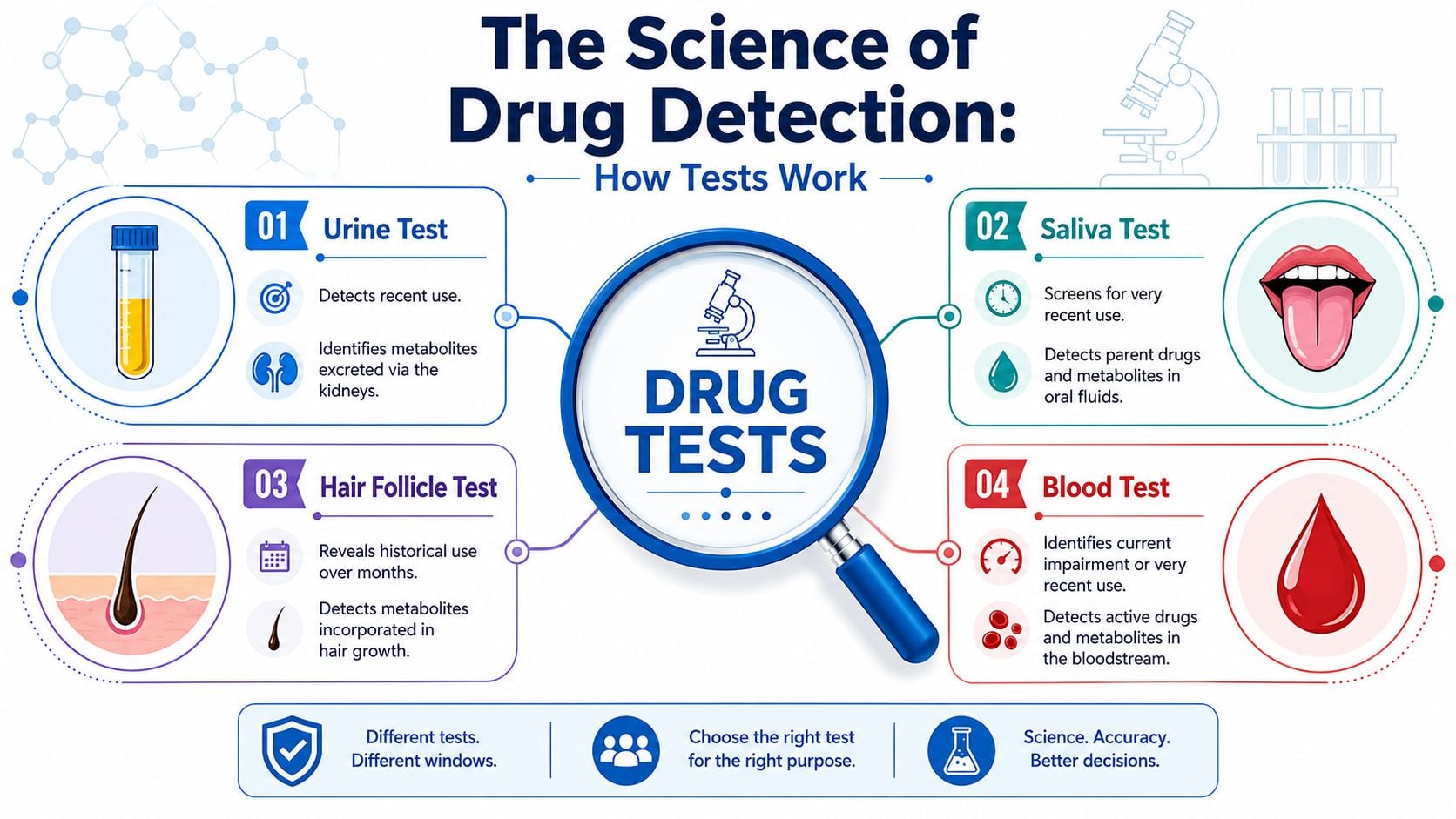
Different tests look for different clues
Most online advice lumps all drug tests together. That creates confusion. Authoritative lab guidance notes that most content on this topic talks almost entirely about urine tests, even though urine specimen integrity checks and adulterant detection are specific to urine, while saliva, blood, and hair follow different rules, as explained by ADLM guidance on drug testing methods.
That matters because a strategy that aims to dilute urine won't translate to a hair test. It also won't answer questions about oral fluid testing, where the issue is different.
Here's the simple version:
- Urine tests look for metabolites filtered by the kidneys.
- Saliva tests look for recent drug exposure in oral fluid.
- Blood tests can help identify current or very recent presence in the bloodstream.
- Hair tests reflect exposure incorporated into hair growth over time.
Urine testing focuses on metabolites
A metabolite is what remains after your body breaks down a drug. Think of it as a footprint. The drug may no longer be active in the same way, but the footprint is still there, and the lab can detect it.
That's why “flushing” language is misleading. You're not rinsing a stain off a countertop. You're waiting for your body to metabolize and clear evidence naturally, at its own pace.
A short video can make that idea easier to follow:
Practical rule: If a substance is still within its detection window, no drink can reliably make the underlying biology disappear.
Once people understand this, the question changes. It stops being “What beverage beats the test?” and becomes “How long do these footprints remain detectable?”
A Realistic Timeline for Drug Detection
Time matters more than any beverage. That's the part many search results avoid because it's less comforting. But if you need a realistic answer, this is the place to begin.
Published clinical guidance reports that marijuana or THC remains detectable in urine for 1 to 7 days after last use in occasional users, but up to 25 days or longer in chronic users; heroin is detectable for 1 to 3 days, and cocaine for 2 to 3 days according to FDA average data summarized in a review available through PubMed Central on urine drug detection and adulteration. The same source states that these timelines are not affected by drinking coffee, cranberry juice, or detox drinks.
Average Drug Detection Windows in Urine
| Substance | Occasional User | Chronic / Heavy User |
|---|---|---|
| Marijuana / THC | 1 to 7 days | Up to 25 days or longer |
| Heroin | 1 to 3 days | Qualitatively longer depending on pattern of use |
| Cocaine | 2 to 3 days | Qualitatively longer depending on pattern of use |
A different evidence-based summary also describes common urine detection ranges of about 1 to 3 days for opioids, 2 to 3 days for stimulants, up to 4 days for MDMA and benzodiazepines, and 1 to 7 days for cannabis, while emphasizing that abstinence is the only dependable approach and that alcohol metabolite EtG can be detected for up to 80 hours after ingestion, as noted in this medical review of detox products and drug testing.
Why one person's timeline is not another's
Two people can use the same substance and get different testing outcomes. Frequency of use matters. Test type matters. The body's normal metabolism matters. That's one reason homemade formulas and “guaranteed cleanse” products fail so often. They assume every body clears every substance on the same schedule.
The lab doesn't care what the label on a detox drink promises. It measures what is still present.
This is especially important for cannabis. Readers often hear one short timeline and assume it applies to everyone. It doesn't. The difference between occasional use and chronic use can be large, and that gap is one reason cannabis-related testing anxiety is so common.
If you're trying to make sense of your own risk, a calendar is more useful than a shopping list. Ask when the last use occurred, what substance was involved, and what specimen type will be collected. Those facts are much more relevant than whether you choose water, tea, or juice the night before.
Debunking Myths About Detox Drinks and Home Remedies
The market for quick fixes is built on a simple message: if you drink the right thing at the right time, you can outsmart the test. That's appealing, and it sounds scientific because it often uses words like cleanse, flush, balance, or support.
The problem is that these claims usually blur together two very different ideas. Hydration means taking in fluid. Detoxification in the drug-testing sense would mean meaningfully changing how quickly your body eliminates metabolites. Those are not the same thing.
This visual summary captures the gap between the claim and the truth:
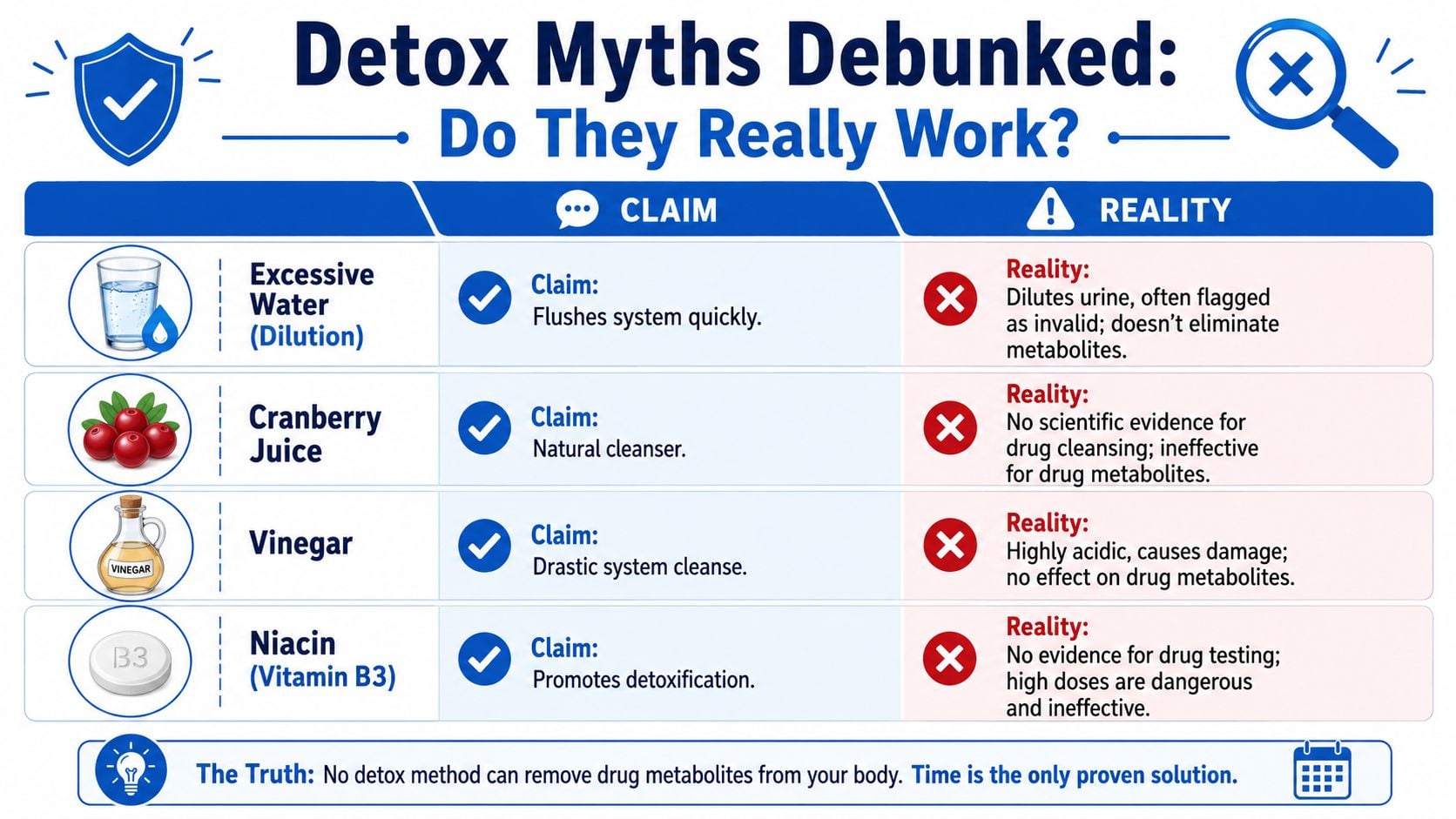
Why the popular remedies sound believable
A few examples come up again and again.
- Water loading: people think more fluid means fewer metabolites.
- Cranberry juice: people treat it like a natural “cleanser.”
- Vinegar: people assume acidity will somehow alter the result.
- Niacin: people hear it “boosts metabolism.”
- Commercial detox drinks: people trust a branded product more than a home remedy.
Each myth borrows a piece of truth from somewhere else. Water does change urine concentration. Cranberry juice is linked in the public mind with urinary health. Vitamins do affect normal body processes. That sliver of plausibility is what keeps the myths alive.
For readers navigating employment screening rules, this is one reason practical, policy-focused resources can help. If you're dealing with workplace testing requirements, a DOT physical urine test guide may help you understand the process better than a detox ad ever will.
What the evidence actually supports
For a standard urine drug test, the main issue with large fluid intake is dilution, not chemical cleansing. A clinical explainer notes that drinking a very large amount of fluid shortly before collection can water down the sample enough to produce a negative dilute result, meaning the specimen may not be concentrated enough for reliable measurement and may need to be repeated, according to medical guidance on what to drink before a drug test.
Commercial detox drinks don't solve that underlying problem. Available medical reporting says they may create only temporary dilution and that results are inconsistent. That fits what toxicology practice already suggests. Validated testing is built to be accurate, and no beverage has been shown to remove drug metabolites from the body on demand.
Here's the plain-language version:
- Water can dilute urine. It doesn't erase the body's metabolic record.
- Cranberry juice doesn't have scientific support for clearing drug metabolites faster.
- Vinegar doesn't change urine testing in a reliable, protective way.
- Niacin is not a proven drug-test solution and can be risky when misused.
- Detox drinks often sell a story of cleansing, but the practical effect is usually just another version of dilution.
Many “detox” products are really trying to manipulate the sample, not remove the evidence.
That distinction matters. If a method doesn't shorten the detection window, it isn't a true fix. It's a gamble.
The Hidden Risks of Trying to Mask or Dilute a Sample
People often frame dilution as low risk. They think, “At worst, I just drank extra water.” In real testing programs, it's not always that simple. A suspicious sample can create more scrutiny, not less.
One of the clearest facts on this issue comes from specimen validity research. Consuming 2 to 3 glasses of water, 12 ounces each, at the same time can produce urine that is 10-fold diluted within 30 minutes, and the same guidance explains that labs often flag the result because creatinine drops along with everything else. When urine creatinine falls below standard thresholds, often below 20 mg/dL, the specimen may be marked diluted and retesting can follow, according to government and academic material on specimen validity checks.
What a diluted result can mean
A person hoping for a quiet negative result may instead get a result that raises procedural questions. Depending on the setting, that can mean a repeat collection, closer observation, or additional review. Even when the first result isn't outright positive, it may not produce the clean resolution the person wanted.
A lot of internet advice breaks down when it treats the test as if the only possible outcomes are pass or fail. Real testing programs often have a third lane. The sample itself can be challenged.
Why urine validity testing matters
Urine testing programs often include specimen validity testing. That means the lab isn't only asking whether drug metabolites are present. It may also ask whether the urine looks physiologically normal.
The earlier clinical review on urine adulteration notes that extreme values such as nitrite concentrations over 500 mg/mL or pH outside the 3 to 11 range are statistically indicative of adulteration and can trigger further testing for oxidants or other substances. I'm not repeating that source here because the key point is simpler: labs know people try to tamper with urine, and many programs actively check for it.
If your concern is a different specimen type, the logic still changes by matrix. Readers dealing with oral fluid testing may find it helpful to compare the rules in a focused resource on how to pass a mouth swab test, because mouth swab questions are often confused with urine myths.
A method that risks a flagged specimen can leave you in a worse position than doing nothing at all.
That's the science behind why so many cheat methods fail. They don't just fail to remove evidence. They create new evidence of attempted masking.
Safer Alternatives and Responsible Next Steps
Once you strip away the myths, the safest path becomes more straightforward. Don't chase a magic drink. Don't stack risky supplements. Don't assume a watered-down sample counts as a win.
What to do if the test is soon
If a test is imminent, focus on choices that don't create extra problems.
- Stay normally hydrated: ordinary hydration supports routine health. Overhydration can create dilution concerns.
- Review legitimate medications: prescription drugs, over-the-counter medicines, and supplements can matter for interpretation. Bring accurate information if disclosure is appropriate in your setting.
- Ask what type of test you're taking: urine, saliva, hair, and blood aren't interchangeable.
- Avoid unregulated detox products: they may add health risk without solving the testing issue.
Medical sources also note that detox drinks can cause dehydration, electrolyte imbalance, high sugar exposure, allergic reactions, and medication interactions, with particular concern for people taking prescribed medications, living with diabetes, or recovering from substance use disorder, as summarized by medical information on detox drink risks.
When the test points to a bigger issue
Sometimes the most important question isn't how to pass. It's why the test feels so frightening. For some readers, this moment reveals a pattern they've been trying to manage alone.
That doesn't mean you've failed. It means you have useful information.
A constructive next step may include:
- Talking with a healthcare professional if you're using prescribed medication and need clarity about testing.
- Being honest in settings where disclosure is appropriate and protected, especially when paperwork or verification can prevent confusion.
- Seeking substance use support if you've been relying on repeated quick fixes, hiding use, or feeling unable to stop without help.
People usually feel relief when they move from secret strategies to real support. The immediate stress may not vanish, but the situation becomes more manageable, more medically sound, and less isolating.
Find Confidential Support in Yuba City
A common moment goes like this. Someone searches late at night for what to drink for a drug test, reads about detox drinks, then realizes the bigger fear is not the cup itself. It is what happens after. A job, a court requirement, a family conversation, or the exhausting cycle of trying to stay one step ahead.
That is often the point where real help becomes more useful than another internet trick. Drug tests do more than look for a substance. They also check whether the sample looks normal in the first place. If you have been trying to dilute, flush, or mask a test, the stress can keep building because specimen validity checks are designed to catch changes in concentration, temperature, and chemical balance. A quick fix can fail twice. Once on the drug screen, and again on the validity screen.
For someone in Yuba City, the better question may be, what kind of support do I need right now?
- Addiction Resource Center LLC
- Address: 1002 Live Oak Blvd., Suite A, Yuba City, CA
- Phone and text: 530-625-7910
Some people need medically supervised detox. Others need outpatient treatment, medication support, help with co-occurring mental health symptoms, or a private conversation with a professional who can explain options clearly. That first contact can reduce confusion fast. You can ask what level of care fits your situation, what confidentiality looks like, and how to start without turning your life upside down.
Shame often tells people to hide and keep improvising. Medical care offers a safer path. Reaching out can mean you want honest answers, local support, and a plan that protects your health instead of gambling on another masking method.
If you're searching for what to drink for a drug test because you feel cornered, take the next step that protects your health and future. Addiction Resource Center LLC offers confidential guidance, medically informed care, and a simple way to talk through your options by phone, text, or in person.