If you're searching for help right now, the process can feel confusing fast. One website says “dual diagnosis,” another says “integrated care,” and a third promises detox, therapy, and aftercare without making clear how those pieces connect. Families usually aren't trying to become experts, they just want to know whether a center can treat both …

If you're searching for help right now, the process can feel confusing fast. One website says “dual diagnosis,” another says “integrated care,” and a third promises detox, therapy, and aftercare without making clear how those pieces connect. Families usually aren't trying to become experts, they just want to know whether a center can treat both mental health and substance use together, or whether they'll end up bouncing between separate providers.
That distinction matters. When two conditions keep feeding each other, treating only one can leave the other untouched, and the person stays stuck in the same cycle. Co occurring disorders treatment centers exist to break that loop with one coordinated plan, one team, and a clearer path through recovery.
Table of Contents
- What Are Co-Occurring Disorders Treatment Centers
- Understanding Co-Occurring Disorders and Integrated Care
- Evidence-Based Treatments at Co-Occurring Disorders Treatment Centers
- Levels of Care at Co-Occurring Disorders Treatment Centers
- What Integrated Treatment Looks Like in Practice
- What to Expect During Intake and Treatment
- Finding Co-Occurring Disorders Treatment in Northern California
- Taking the Next Step Toward Recovery
What Are Co-Occurring Disorders Treatment Centers
A mother may be calling after her son's second hospital discharge. A spouse may be reading treatment websites late at night, trying to figure out why one program says it handles addiction but never mentions depression, trauma, or anxiety. That's usually the point where the phrase co occurring disorders treatment centers starts to matter, because the underlying question isn't just where to go, it's what kind of care can truly hold both problems at once.
A true center for co occurring disorders treats a substance use disorder and a mental health condition together, in the same plan. That can mean trauma and alcohol use, anxiety and opioids, bipolar symptoms and stimulant misuse, or any other pair that keeps colliding in daily life. The core idea is simple. If one condition keeps provoking the other, separate treatment tracks can leave the person half treated.
Practical rule: if a program talks a lot about addiction but never explains how psychiatric symptoms are assessed and managed, it may not be integrated enough for a real dual-diagnosis case.
That's why integrated care is more than a buzzword. Federal analysis shows that treatment systems that separate mental health and substance use care leave most patients partially untreated, and only about 6% of people with co-occurring disorders receive both kinds of treatment in a coordinated way (HHS analysis). For families, that usually means the safest question is not “Do you treat addiction?” It's “How do you treat both conditions together?”
If you're also sorting out how coverage works for chronic behavioral health needs, a plain-language guide to managing chronic illness coverage can help you think through the paperwork side without losing sight of the clinical fit. One more useful lens is trauma. Many people need trauma-responsive care, not just symptom management, and trauma informed addiction treatment is often part of that conversation.
Understanding Co-Occurring Disorders and Integrated Care
Co-occurring disorders are not just two diagnoses sitting side by side. They often act like two intertwined vines, where each one wraps around the other and makes it harder to pull free. A person may drink to quiet panic, then feel worse anxiety after the alcohol wears off. Someone may use stimulants to get through depression or exhaustion, then crash harder and feel more hopeless.
That cycle matters because it changes what treatment has to do. If a center only stabilizes substance use without addressing the psychiatric driver underneath, the person may relapse as soon as distress returns. If it only treats mood symptoms while ignoring the substance use, the medication plan or therapy gains can get undone by continued use.
Integrated care is the model designed for that reality. In 2020, about 54% of outpatient mental health facilities and 53% of outpatient substance use disorder facilities in the United States had a special program for integrated co-occurring disorders care, and that represented a 10-percentage-point increase since 2014 for substance use facilities (HHS report). Earlier survey work also found that only 35% of U.S. substance abuse treatment facilities offered co-occurring disorder services in 2004, rising to 53% by 2019/2020 (HHS report).
What those numbers mean in plain language: integrated care is more common than it used to be, but it still isn't universal.
The treatment gap remains large. Among the 9.2 million U.S. adults with co-occurring disorders in 2018, only 8% received treatment for both conditions, while about half received no treatment at all (NCBI Bookshelf summary). SAMHSA's national estimate later placed the number of adults with both mental illness and substance use disorder at about 21.2 million in its 2024 NSDUH release (NCBI Bookshelf summary). The practical takeaway is clear. A center that coordinates care is serving a very large, very under-treated population.
Evidence-Based Treatments at Co-Occurring Disorders Treatment Centers
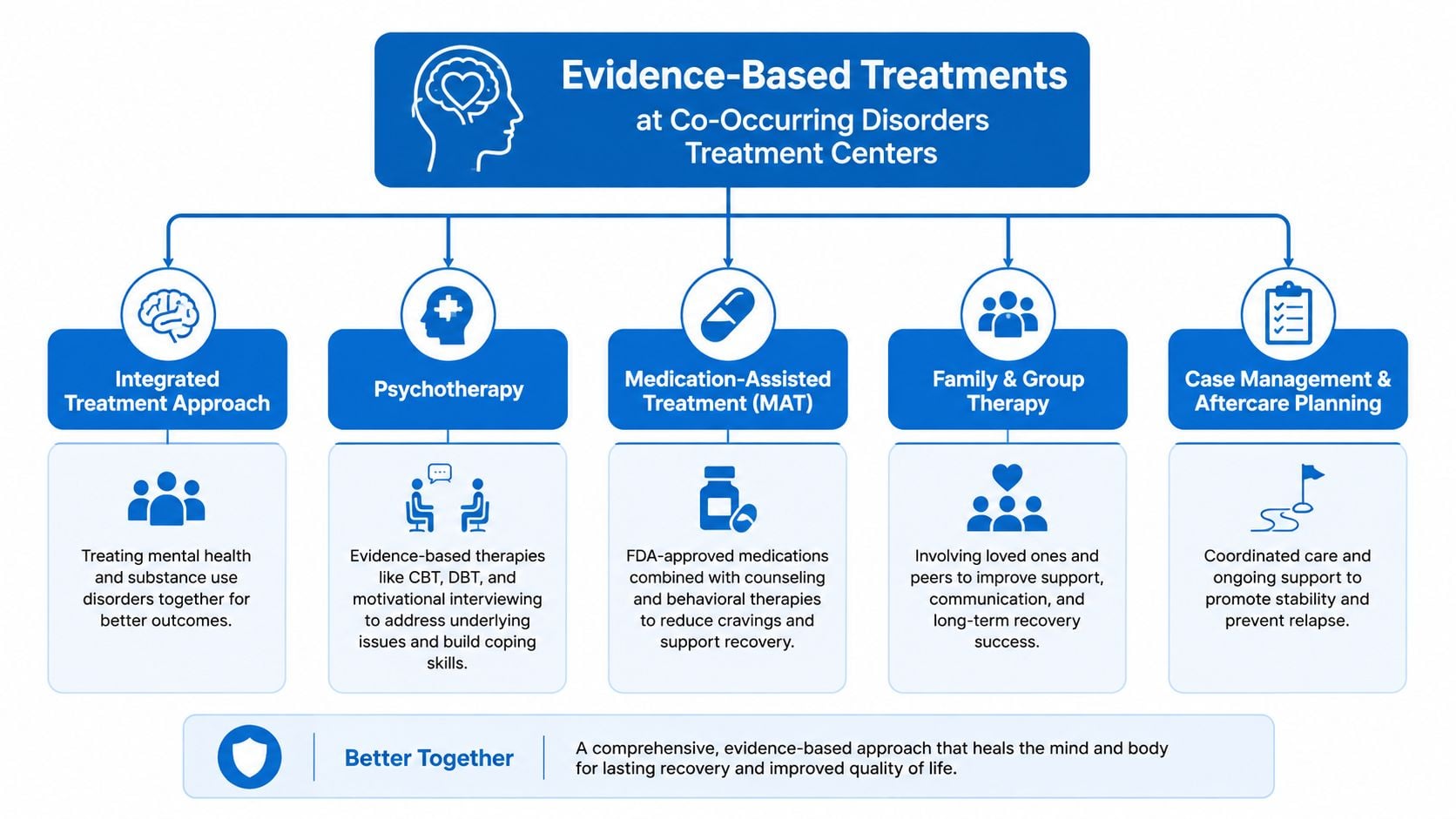
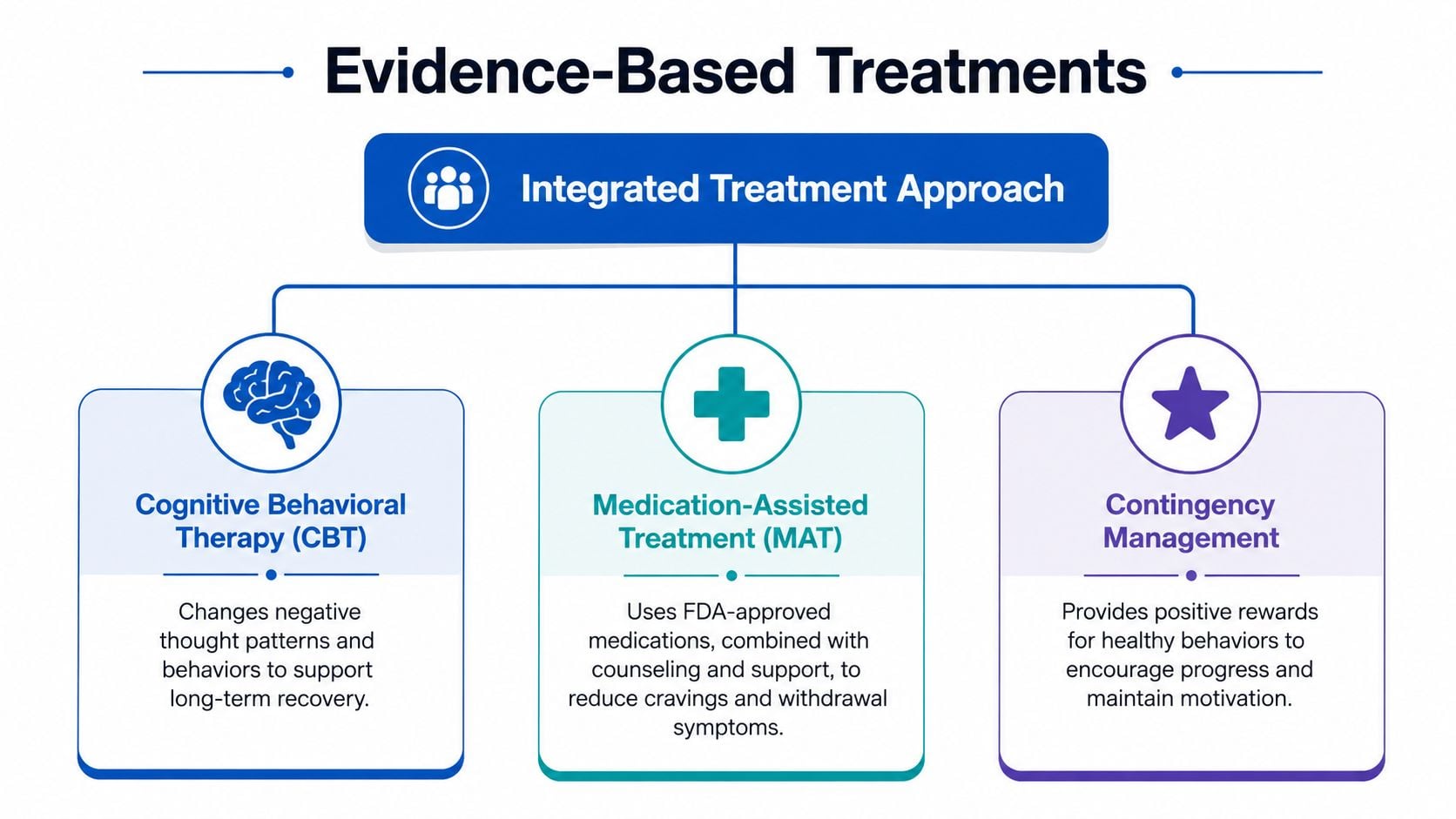
A solid program doesn't throw random services at the problem. It builds a treatment plan around a few proven tools and makes them work together. That matters because dual-diagnosis care has to address both the biology of substance use and the emotional patterns that keep it going.
Medication and counseling together
Medication-assisted treatment, often shortened to MAT, uses FDA-approved medications alongside counseling and recovery support. In co-occurring care, MAT can help calm withdrawal, reduce cravings, or stabilize a person enough to participate in therapy with more consistency. It isn't a standalone fix, but it often gives people enough breathing room to start doing deeper work.
The key is coordination. A clinician should know what psychiatric medications are already in the picture, what symptoms are being tracked, and what substance-related risks might affect the plan. That's one reason a good center won't treat medication management as a side service.
Therapy that targets both conditions
Cognitive behavioral therapy helps people notice the thoughts, triggers, and routines that keep the cycle going. Dialectical behavior therapy can also be useful when emotional storms, impulsivity, or self-harm behaviors are part of the picture. These therapies work best when the therapist understands both the mental health diagnosis and the substance use pattern, not just one side of the story.
Useful checkpoint: ask whether the therapist is treating the substance use as a separate “problem” or as part of the same clinical map as the anxiety, trauma, or mood symptoms.
Peer support that makes the plan real
Recovery mentors and peer support professionals help translate clinical goals into daily life. They can talk through routines, triggers, family dynamics, and the ordinary moments that don't show up in a therapy note but still determine whether someone stays on track. SAMHSA's guidance describes integrated care as collaboration among medical, mental health, SUD, mutual-support, and peer-recovery professionals, and treats that collaboration as a best practice for people with co-occurring disorders (PMC summary).
For a deeper look at one piece of that model, medication assisted treatment effectiveness is a useful companion resource. The main point is simple. The strongest centers don't make you choose between therapy, medication, and support. They weave them into one plan.
Levels of Care at Co-Occurring Disorders Treatment Centers
Recovery usually moves in stages, and the right level of care depends on how stable someone is when they start. A center should be able to explain those stages without making them sound mysterious or rigid. Think of them as rungs on a ladder, not as a one-size-fits-all package.
Starting with the safest support
Detoxification is the medically supervised phase where withdrawal can be monitored and managed. For some people, that stage includes medication support to make symptoms safer and more tolerable. It's the first step when substance use has become physically difficult to stop without help.
Residential rehabilitation comes next for people who need structure around the clock. Living at the facility can help someone step away from triggers, stabilize sleep and routines, and focus on treatment without constant outside pressure. That setting is often a better fit when symptoms are severe, unpredictable, or unsafe to manage at home.
Bridging back to daily life
An intensive outpatient program, or IOP, gives people a structured schedule while they keep living at home. That can be a strong fit for someone who's medically stable but still needs several sessions a week, especially if work, family, or transportation make full residential care unrealistic. Standard outpatient care is lighter, usually meant for ongoing support, relapse prevention, and regular check-ins.
Telehealth matters too, especially for people who live far from a center or who have trouble getting transportation. When follow-up is the weak point, virtual care can keep the treatment plan from falling apart between appointments. For readers trying to understand how those levels fit together, how to navigate the continuum of care for addiction recovery is a helpful companion.
The best program doesn't lock someone into one level forever. It should be able to step care up or down as symptoms change.
What Integrated Treatment Looks Like in Practice
A patient arrives with PTSD symptoms, heavy drinking, and a history of panic that spikes at night. In a fragmented system, that person might be sent to one clinic for trauma work, another office for addiction counseling, and a third provider for medication. In an integrated center, the same treatment team sees the whole picture and builds one plan around it.
That usually starts with a shared care meeting. The medical provider looks at psychiatric symptoms and medication needs, the counselor focuses on trauma, triggers, and coping skills, and the recovery mentor helps the patient build structure for the hours outside therapy. Everyone is working from the same map, so the patient isn't repeating the same story to three disconnected providers.

A typical week might include individual therapy, medication management, peer support, and family education. None of those pieces should feel optional or unrelated. If a person learns a coping skill in therapy, then practices it in group, then checks in with a peer mentor about using it during a stressful evening, the plan starts to hold together in real life.
The biggest difference is coordination. Integrated care keeps one issue from undoing progress in the other area. It also reduces the frustration families feel when they're told a symptom is “not the addiction side” or “not the mental health side,” because the whole point is to stop splitting the person into pieces.
What to Expect During Intake and Treatment
Intake should feel thorough, not chaotic. A good center screens for mental health and substance use together, because the first conversation has to be broad enough to catch what's really happening. Patients should expect questions about symptoms, substance patterns, medications, medical history, stressors, support systems, and personal goals.
The most important thing to listen for is whether the staff is connecting the dots. If a person says they drink when panic starts, the clinician should ask how often panic happens, what triggers it, what treatment has been tried before, and whether withdrawal or medication interactions are part of the picture. That's how a plan becomes personal instead of generic.
After intake, the center should build a treatment plan with clear steps and realistic goals. The plan may include therapy, medication management, group work, peer support, and family involvement, but the order and intensity should match the person's needs. The work starts early, because aftercare should begin on day one, not only at discharge.
Research on access barriers points to common structural problems like lack of follow-up funds, transportation issues, supportive housing shortages, and child care gaps, along with underserved groups such as veterans, people with low socioeconomic status, people involved in the criminal justice system, and people experiencing homelessness (Michigan HHS guide). That's why strong aftercare planning matters so much.
Before admission, families can ask for these details:
- How screening works: Make sure both substance use and mental health symptoms are assessed up front.
- How aftercare is arranged: Ask what happens if transportation, housing, or childcare becomes a barrier.
- How family is included: Find out whether education or family sessions are part of the plan.
- How the center handles transitions: Ask what support exists if the person steps down from residential to IOP or outpatient care.
A center that answers these questions clearly is usually more prepared for real life, not just intake paperwork.
Finding Co-Occurring Disorders Treatment in Northern California
A local search gets easier when you stop looking for broad promises and start checking for concrete features. The first sign of a serious program is a multidisciplinary team that works together. A medical doctor, registered nurse, licensed counselors, and a licensed marriage and family therapist should be involved in care, not just listed somewhere on a webpage.
Accreditation is another useful signal. Facilities accredited by the Joint Commission are more likely to have robust integrated care programs, which can matter when you're trying to tell the difference between a real dual-diagnosis track and a label used for marketing. Insurance fit matters too, especially for military families and veterans who need to know whether Tricare is accepted.
Privacy should be part of the conversation early. Families often hesitate to ask how sensitive health information is handled, but that's a fair question when addiction and mental health records are involved. Good programs can explain confidentiality in plain language.
One Northern California option is Addiction Resource Center LLC, located at 1002 Live Oak Boulevard, Suite A, Yuba City, CA. It offers 24/7 wellness monitoring, a full continuum of care, and phone or text access at 530-625-7910. That makes it a practical example of the kind of local access many families are looking for when they need both structure and a way to ask questions quickly.
If you're comparing centers, keep the checklist simple:
- Team coordination: Are psychiatric and substance use services coordinated in one plan?
- Accreditation and staffing: Does the program show the depth needed for integrated care?
- Insurance and access: Does it accept your coverage and offer a workable level of care?
- Aftercare planning: Does it prepare for housing, transportation, and follow-up needs?
A center that can answer those questions without hesitation is usually the one worth a deeper conversation.
Taking the Next Step Toward Recovery
The clearest path forward is the one that treats both conditions at the same time, matches care to the person's current level of need, and plans for the hard part after discharge. Integrated treatment is the standard to look for, because it keeps one problem from erasing progress in the other. The right center should also help you verify the team, the accreditation, the insurance fit, and the aftercare plan before you commit.
If you're comparing options in Northern California, you don't have to sort this out alone. A conversation with a real treatment team can tell you quickly whether a center is prepared to manage co-occurring needs or is only borrowing the language.
Addiction Resource Center LLC offers integrated support for substance use and co-occurring mental health needs, along with detox, outpatient care, and practical aftercare planning. If you're ready to ask real questions about treatment for yourself or a loved one, visit Addiction Resource Center LLC and start the conversation today.