Discover daily mindfulness practices for sobriety that build mental clarity and strengthen your recovery journey with proven techniques.


Addiction doesn’t just damage the body-it hijacks your ability to think clearly and manage emotions. Mindfulness for sobriety works by rewiring how you respond to cravings, stress, and the triggers that pull you back.
At Addiction Resource Center, we’ve seen firsthand how simple daily practices create lasting change. This guide shows you exactly how to build a mindfulness routine that sticks.
How Mindfulness Changes Your Brain During Recovery
Interrupting the Automatic Craving Loop
Mindfulness works in recovery because it interrupts the automatic loop between craving and use. When you feel an urge, your brain typically fires the same neural pathways it has for months or years, pushing you toward the substance. Mindfulness-Based Relapse Prevention, developed at the University of Washington’s Addictive Behaviors Research Center, breaks this pattern. The approach teaches you to observe cravings without acting on them. Research published in JAMA Psychiatry showed that MBRP reduced relapse risk significantly compared to standard treatment.
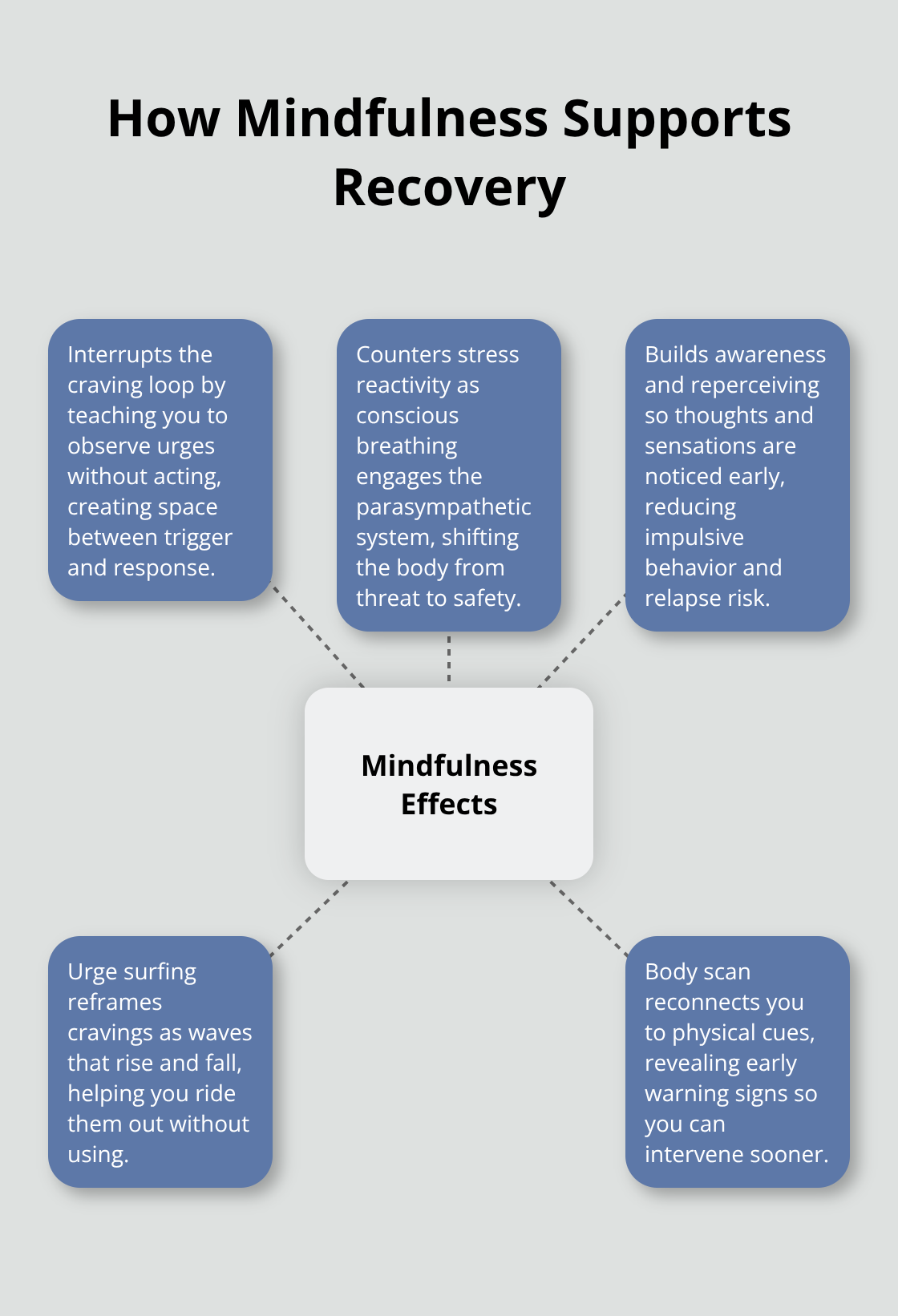
The technique works because you don’t fight the craving or pretend it doesn’t exist. Instead, you pause, notice the physical sensations, acknowledge the thought, and let it pass. Your brain literally learns a new response pathway when you repeat this process.
Why Stress Triggers Demand Immediate Attention
Stress acts as the primary driver of relapse, according to research by Sinha. When cortisol spikes, your prefrontal cortex shuts down and your amygdala takes over, making you reactive rather than thoughtful. Mindfulness-based stress reduction directly counters this by activating your parasympathetic nervous system. When you practice conscious breathing, your exhale becomes longer than your inhale, which signals safety to your body. The practical advantage is enormous: instead of reaching for a substance when stress hits, you have a tool that works within seconds. Emotional triggers like anxiety and anger follow the same pattern, and mindfulness teaches you to respond with intention rather than impulse.
Developing Awareness as the Foundation for Change
You cannot change what you don’t notice. Mindfulness increases self-awareness by making you conscious of thought patterns and emotional states before they drive behavior. The standard MBRP protocol runs 16 hours across eight weekly sessions, though shorter formats of 10 to 12 hours have proven effective in clinical trials. One core component is urge surfing, which teaches you to ride cravings as temporary physical experiences that peak and subside. When you observe a craving without judgment, you realize it’s not permanent and not an emergency. This shift in perception is what researchers call reperceiving, and it fundamentally changes your relationship to discomfort. People who develop this skill report greater sense of agency in their choices and lower relapse rates. The body scan meditation, another formal practice within MBRP, helps you reconnect with physical sensations and recognize early warning signs of stress before they escalate into dangerous moments.
Moving From Theory to Daily Action
Understanding how mindfulness changes your brain is one thing. Putting that knowledge into practice each day is what actually transforms your recovery. The next section shows you the specific techniques you can start today-meditation methods, breathing exercises, and movement practices that fit into your real life, not some idealized version of it.
What Mindfulness Practices Actually Work for Daily Sobriety
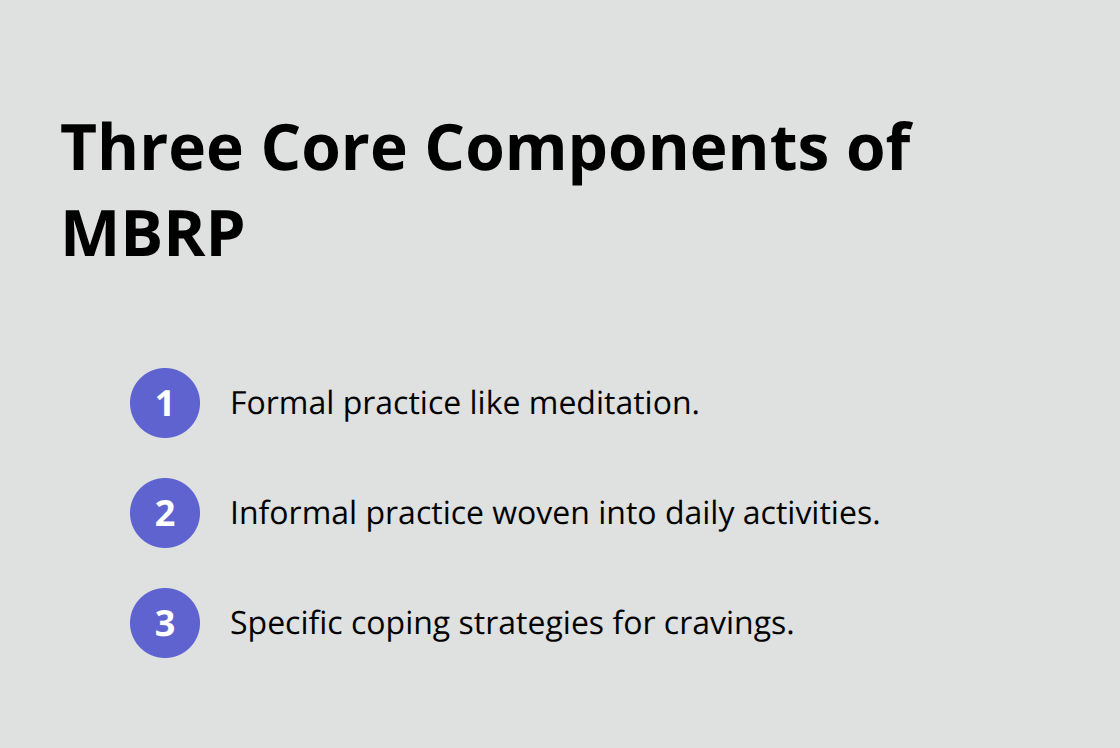
Starting a mindfulness practice doesn’t require sitting in silence for an hour or mastering complicated techniques. The most effective practices for sobriety are the ones you’ll actually do, which means they need to fit into your existing life without demanding perfection. Research on Mindfulness-Based Relapse Prevention identified three core components that matter: formal practice like meditation, informal practice woven into daily activities, and specific coping strategies for cravings. You don’t need all three to see results. Many people find that starting with one technique and building from there creates momentum without overwhelm.
The key is consistency over duration. Five minutes of daily breathing work beats an occasional 30-minute session because your brain needs repetition to rewire those automatic craving pathways.
Breath Work as Your First Line of Defense
Conscious breathing is the fastest tool available when stress or cravings spike. The mechanics are straightforward: inhale through your nose for a count of four, hold for a count of four, then exhale through your mouth for a count of six. The longer exhale activates your parasympathetic nervous system within seconds, shifting your body from threat mode to safety mode. This isn’t theoretical. Research on stress and relapse shows that when cortisol spikes, your ability to think clearly disappears. Breathing interrupts that cascade before it gains momentum. Practice this during low-stress moments first-try three times daily for two minutes-so your nervous system recognizes the pattern. When an actual craving or anxiety hits, your body already knows what to do. Some people find it helpful to pair the breathing with a specific location, like at the kitchen table or in their car, which creates a trigger for the practice itself. Over time, even reaching for the doorknob to step outside becomes a cue to take three conscious breaths.
Body Awareness Reveals Your Personal Warning Signs
The body scan meditation teaches you to notice physical sensations before they escalate into emotional overwhelm. Start lying down in a quiet space for five to ten minutes. Move your attention slowly from the top of your head down through your body, noticing temperature, tension, tingling, or numbness without trying to change anything. This practice reveals patterns you’ve never noticed: maybe anxiety always starts as tightness in your chest, or cravings show up as restlessness in your legs. Once you recognize these early signals, you can respond before the urge becomes overwhelming. Those who developed this body awareness reported a stronger sense of agency in their choices. The practical advantage is enormous. Instead of suddenly finding yourself in the grip of a craving with no warning, you catch it at the 20 percent mark when you still have options. Move the body scan into daily life through mindful movement like walking slowly through your home, noticing each step and breath, or taking a shower where you focus entirely on the sensation of water and temperature.
Layer Mindfulness Into Activities You Already Do
The mistake most people make is treating mindfulness as something separate from life, something you add on top of everything else. Instead, layer mindfulness into activities you already do. During meals, eat the first three bites with complete attention, noticing texture, taste, and temperature. While brushing your teeth, feel the bristles and the movement of your arm. Walking to your car, focus on the sensation of your feet on the ground and the air on your skin. These informal practices count as much as formal meditation. Bowen and colleagues, who developed MBRP, emphasized that informal practice is where real change happens because you train your brain in the exact situations where old patterns usually take over. The urge surfing technique works especially well during these routine moments. When a craving arises while you wash dishes, pause and observe it like a wave: it builds, peaks, and passes. You don’t fight it or distract yourself. You notice it fully, and within five to fifteen minutes, the intensity drops. That direct experience teaches your brain something no amount of theory ever could.
Moving From Daily Practice to Sustained Recovery
These three techniques-breath work, body awareness, and informal mindfulness-form the foundation of a practice that actually sticks. The next section shows you how to build these practices into a routine that adapts to your life, not the other way around. You’ll learn how to create a schedule that works, track what’s actually changing, and find the support that keeps you moving forward when motivation fades.
Building a Sustainable Mindfulness Routine
Anchor Your Practice to Existing Habits
Starting a mindfulness routine is easy. Keeping it consistent when work deadlines pile up, family demands increase, and stress spikes is where most people fail. The truth is that willpower alone does not sustain practice. Structure does. Research on habit formation shows that consistency matters far more than duration, which means five minutes every single day beats sporadic longer sessions. The most practical approach is to anchor your practice to an existing habit, a technique behavioral scientists call implementation intentions. If you shower every morning, that is when you do three minutes of conscious breathing before stepping into the water. If you drink coffee, that is when you sit with your body scan for five minutes.
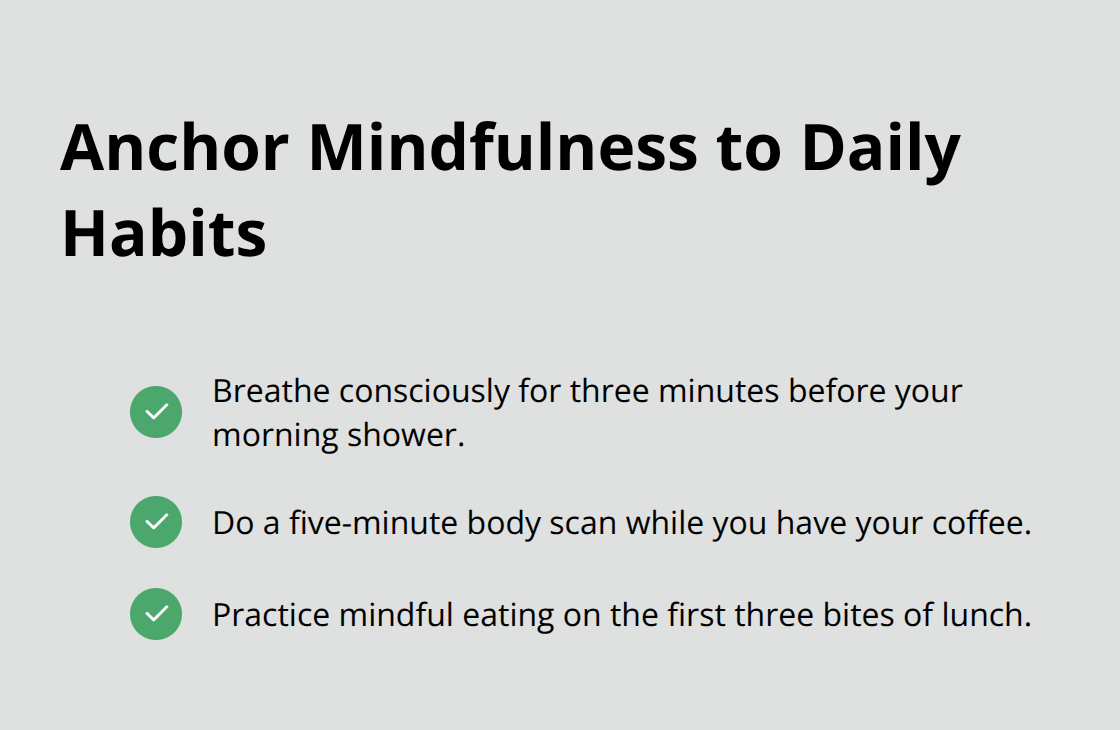
If you take a lunch break, that is when you practice mindful eating on the first three bites. This removes the need to find time because you use time you already have.
Track What Actually Works for You
Track what actually happens, not what you wish would happen. Write down the date, the technique you used, how many minutes you practiced, and crucially, how you felt before and after on a scale of one to ten. After two weeks, you will see patterns. Maybe breathing work drops your anxiety from an eight to a four, but body scans barely register. That is valuable data. Double down on what works for you specifically, not what the research says should work. Adjust your schedule based on real results. If mornings do not work, try evenings. If five minutes feels rushed, extend to seven. If sitting meditation triggers restlessness, switch to walking meditation. The goal is finding your practice, not forcing yourself into someone else’s framework.
Build Connection to Combat Isolation
The isolation of early recovery makes people vulnerable. You face cravings and triggers alone, which is exactly when old patterns reassert themselves. Finding people who understand what you navigate is not optional. Studies on addiction recovery show that those with strong social support have significantly lower relapse rates than those attempting recovery in isolation. This does not mean you need a twelve-step meeting if that is not your style, though many people combine mindfulness practice with group support. Some people join online meditation communities where they practice together at set times. Others find a single accountability partner who texts them each morning asking if they did their practice. Some use apps like Insight Timer, which shows how many people globally meditate at that exact moment, creating a sense of connection without requiring direct conversation. The point is that you need something beyond yourself pushing you forward. When motivation crashes on day thirty (which it will), external accountability keeps you moving until motivation returns.
Combine Personal Practice With Professional Support
Professional support alongside your personal practice creates the conditions where real change happens. The combination of daily practice, honest tracking, and community connection transforms mindfulness from something you try once into something you actually do. If you are building a routine while also managing triggers and stress, having trained professionals guide your work accelerates your progress. Addiction Resource Center provides substance abuse counseling and personalized addiction therapy programs that integrate mindfulness with evidence-based treatment approaches. Our team helps you develop a practice that fits your life and supports your recovery goals.
Final Thoughts
Mindfulness for sobriety works because it interrupts automatic patterns and returns control to you. The practices in this guide are simple, evidence-based, and fit into your actual life without demanding perfection. Five minutes of daily breathing work, a body scan once or twice weekly, and mindfulness woven into routine activities create measurable shifts in how you handle cravings, stress, and emotional triggers.
Research shows that people who practice mindfulness consistently report lower relapse rates, reduced craving intensity, and better emotional regulation. More importantly, they report feeling more in control of their choices and more connected to their own values. That sense of agency matters because it keeps you moving forward when motivation fades.
Your next step is choosing one technique and committing to it for two weeks. Track what happens and notice what shifts, then adjust based on your real experience. If you are managing triggers and stress while building this practice, Addiction Resource Center provides personalized addiction therapy and substance abuse counseling that integrates mindfulness with evidence-based treatment approaches.