You notice someone's eyes look different after drinking. Maybe their pupils seem wide, maybe they don't react normally to light, and now you're wondering whether that's expected, dangerous, or a sign of something else. That's a reasonable question. Alcohol and dilated pupils often get discussed as if the answer is simple, but it isn't. Alcohol …

You notice someone's eyes look different after drinking. Maybe their pupils seem wide, maybe they don't react normally to light, and now you're wondering whether that's expected, dangerous, or a sign of something else.
That's a reasonable question. Alcohol and dilated pupils often get discussed as if the answer is simple, but it isn't. Alcohol can affect pupil size, yet it doesn't cause one single, predictable response in every person. In some situations, pupils may look larger. In others, they may look smaller. Sometimes the bigger clue isn't size at all, but how slowly the pupils react.
The safest way to think about it is this. Pupil changes can happen with alcohol, but pupil size alone should never be used to judge how intoxicated someone is or whether they're “just drunk.” Context matters. So do the rest of the symptoms.
Table of Contents
- How Alcohol Actually Affects Your Pupils
- Comparing Pupil Responses Alcohol vs Other Drugs
- When Pupil Changes Are a Sign of Danger
- Pupil Cues in Long-Term Alcohol Use and Recovery
- Recognizing When to Seek Professional Help for Alcohol Use
- Find Compassionate Alcohol Addiction Treatment in Yuba City
How Alcohol Actually Affects Your Pupils
A lot of people have heard that alcohol dilates pupils. That can happen, but it's only part of the story.
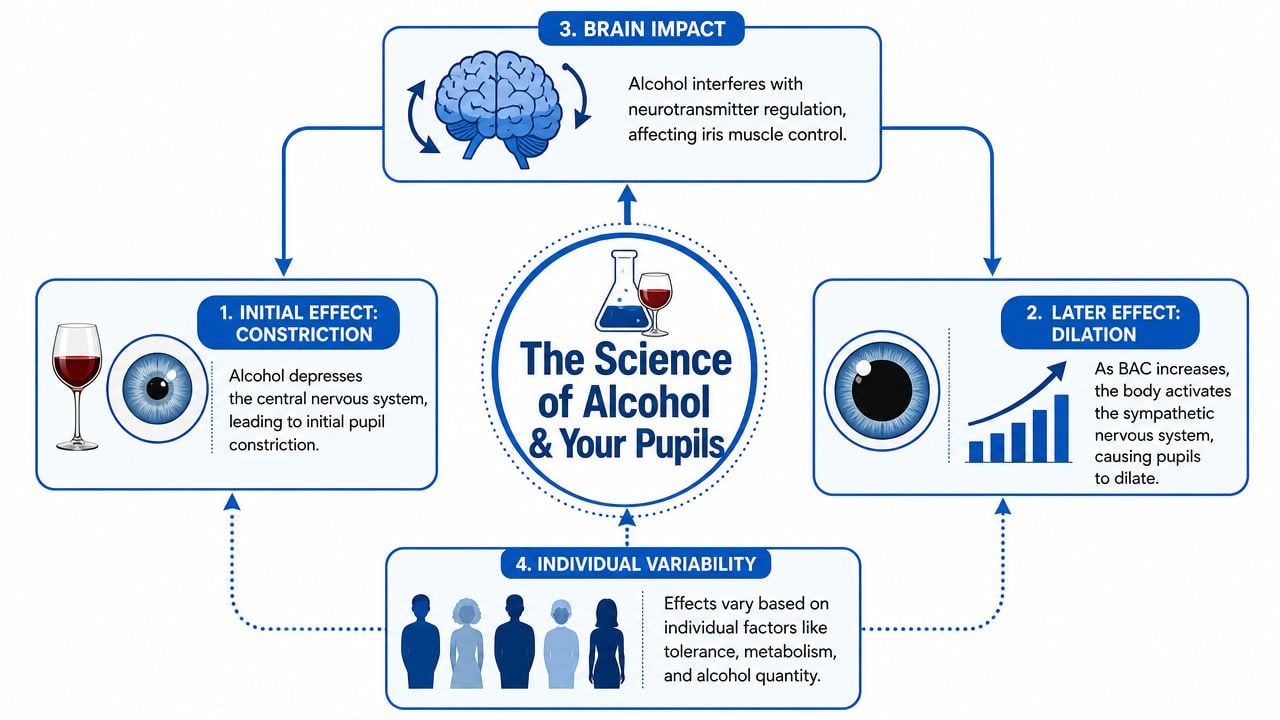
Clinical and educational sources note that alcohol isn't expected to produce one fixed pupil response. Depending on dose, timing, and the person's own physiology, intoxication can be associated with temporary dilation or constriction. One useful explanation is that alcohol can disrupt the balance of the autonomic nervous system. Ethanol may suppress parasympathetic tone, which reduces the normal constricting action of the iris sphincter and can shift the pupil toward dilation, as described in this discussion of alcohol-related mydriasis.
Why the same substance can cause different pupil changes
The main point is variability. Alcohol depresses the central nervous system, but the visible effect in the eyes doesn't always look the same from one person to another.
A few factors can change what you see:
- Dose and timing: Early in drinking, one effect may dominate. Later, a different one may show up.
- Individual physiology: Some people are more sensitive to alcohol's effects on nerves, reflexes, and vision.
- Other exposures: Medications, other drugs, fatigue, or underlying neurologic issues can change pupil size and reactivity.
Practical rule: If someone has been drinking and their pupils look unusual, pay attention to the whole person, not just the eyes.
That's where many readers get tripped up. They expect one neat answer, but the more reliable observation may be sluggish pupil reactivity, not whether the pupils are definitely big or definitely small.
What your eyes may feel like during intoxication
Alcohol can also slow the pupillary light reflex. In everyday terms, the pupils may not adjust as briskly when light changes. That helps explain why some people report glare sensitivity, blurry vision, or discomfort in bright settings when they've been drinking.
This is why alcohol and dilated pupils can be confusing in real life. A person might not have dramatically enlarged pupils, yet their eyes still aren't responding normally.
Pupil changes from alcohol are supportive clues, not stand-alone proof of intoxication.
That distinction matters because many other substances and medical conditions can cause similar eye findings.
Comparing Pupil Responses Alcohol vs Other Drugs
When people look at someone's pupils, they're often trying to answer a bigger question. Is this alcohol, another drug, a combination, or something medical?
Alcohol is harder to read from the eyes alone because its pupil effects are less consistent. Other substances often get associated with more recognizable patterns. That doesn't mean the eyes can diagnose the cause, but it does help explain why alcohol can be misleading.
Why alcohol is less predictable
With alcohol, the direction of the pupil change may vary. Pupils may dilate, constrict, or mainly become slower to react. That's different from the way people commonly describe certain other drug classes in day-to-day clinical conversation.
For example, opioids are widely associated with pinpoint pupils. Stimulants and some hallucinogens are more often associated with visibly enlarged pupils. If you're trying to understand stimulant-related eye changes in more detail, this overview of methamphetamine pupil dilation gives a useful comparison point.
Pupil Response to Common Substances
| Substance Class | Typical Pupil Response | Examples |
|---|---|---|
| Alcohol | Variable. Pupils may appear larger, smaller, or simply slower to react to light | Beer, wine, liquor |
| Opioids | More commonly associated with pinpoint pupils | Heroin, fentanyl, oxycodone |
| Stimulants | More commonly associated with dilation | Methamphetamine, cocaine |
| Hallucinogens | Often associated with dilation | LSD, psilocybin |
| Mixed substance use | Unpredictable | Alcohol combined with other substances |
A table like this is helpful, but it still has limits. Real people don't read like textbooks.
Consider two examples:
- A sleepy person with small pupils after drinking: That could be alcohol, but it could also suggest an opioid is involved.
- A restless person with large pupils after drinking: Alcohol alone can do that in some settings, but stimulants or hallucinogens may fit better if behavior also looks unusually energized or agitated.
The eyes can suggest a pattern. They can't reliably tell you the full story.
Another key difference is consistency. With alcohol, the same person may not show the same pupil response every time they drink. That's why clinicians rely on the broader picture, including mental status, speech, balance, breathing, and responsiveness.
If you're watching someone and trying to decide whether this looks “normal for being drunk,” treat certainty with caution. Alcohol and dilated pupils may happen together, but they don't form a dependable one-to-one rule.
When Pupil Changes Are a Sign of Danger
Sometimes unusual pupils are just one part of intoxication. Sometimes they're a signal that something more serious may be happening.
What raises concern isn't just that the pupils look large or slow. It's when eye changes show up alongside signs that the brain and body aren't functioning safely.
Warning signs that matter more than pupil size
If someone has been drinking, these findings deserve immediate attention:
- Trouble waking them up: They don't respond normally to voice, touch, or shaking.
- Breathing concerns: Breathing seems slow, irregular, shallow, or stops for stretches.
- Vomiting with reduced awareness: They may not be able to protect their airway.
- Skin changes: Pale, bluish, or cold skin suggests the body is under strain.
- Abnormal pupils with other neurologic signs: Unequal pupils, fixed pupils, confusion out of proportion, collapse, or signs of head injury are not things to brush off as “just alcohol.”
Unequal pupils deserve special respect. Alcohol alone doesn't neatly explain one pupil being larger than the other. That can point to head trauma, a neurologic emergency, or another substance.
For families trying to understand broader patterns around drinking, Oceans Luxury Rehab's alcohol abuse insights can be a useful background read.
When to call 911
Call 911 if the person is hard to wake, has slow or abnormal breathing, has a seizure, collapses, may have a head injury, or has pupils that are fixed or very unequal.
Don't wait for the pupils to “go back to normal.” Don't assume sleep will fix it. If you think alcohol is involved, stay with the person until help arrives.
The public safety stakes are real. In the United States, 11,904 people died in alcohol-impaired driving crashes in 2024, and about 30% of all traffic crash fatalities involved drunk drivers with BACs of 0.08 g/dL or higher, according to NHTSA's drunk driving data. Those numbers matter here because alcohol doesn't just change appearance. It impairs judgment, reflexes, attention, and motor control.
If something feels off, treat it as a medical problem first and a drinking problem second.
Pupil Cues in Long-Term Alcohol Use and Recovery
Most conversations about pupils focus on a single night of drinking. There's another angle that matters more for some readers. In recovery settings, pupil responses may reflect cue reactivity, not just intoxication.
Pupil responses and alcohol cue reactivity
Researchers have studied whether pupils change when people with alcohol dependence see alcohol-related cues. The idea is simple. The eyes may reveal fast, automatic brain responses that a person can't fully describe on a questionnaire.
An independent study found that among alcohol-dependent patients, greater pupillary dilation to alcohol cues predicted relapse better than questionnaires alone, adding 27% of variance to a model that already explained 47% of the variance in relapse outcomes, according to the published study on pupillary responses and relapse. The strongest signal appeared in a very early window, 150–250 milliseconds after stimulus onset, which suggests the pupils may reflect rapid brain processing of alcohol cues.
Why this matters in recovery
That doesn't mean someone's pupils can diagnose relapse risk by simple observation across the room. The study used pupillometry, which is a structured way of measuring pupil response.
Still, the idea is important. The eyes may sometimes reflect how strongly the brain reacts to alcohol-related triggers. For people in treatment, that can help explain why cravings can feel sudden and powerful even when they're trying hard to stay on track.
Recovery isn't only about willpower. The brain can react before a person has time to talk themselves through the urge.
That's one reason relapse prevention plans usually focus on triggers, routines, coping skills, and support systems, not only motivation.
Recognizing When to Seek Professional Help for Alcohol Use
A person doesn't need dramatic pupil changes to need help with alcohol. In fact, the signs that matter most usually show up in behavior, relationships, health, and daily functioning.
Patterns that matter more than eye changes
Consider getting professional support if any of these sound familiar:
- You keep drinking despite harm: Arguments, missed work, risky decisions, legal trouble, or worsening health haven't led to lasting change.
- Cutting down hasn't worked: You've tried to stop or limit alcohol, but the pattern keeps returning.
- More alcohol is needed for the same effect: Tolerance often changes how a drinking problem looks from the outside.
- Life starts revolving around alcohol: Plans, sleep, mood, and relationships begin to organize around drinking or recovering from it.
- Loved ones are worried: Other people often notice a pattern before the drinker is ready to name it.
If you're unsure, ask a simple question. Is alcohol making life smaller, less stable, or less safe?
That's enough reason to talk with a professional. Seeking help isn't a sign that things are hopeless. It's often the moment things start getting clearer.
Find Compassionate Alcohol Addiction Treatment in Yuba City
If alcohol has moved from an occasional concern to an ongoing problem, local treatment can make the next step feel manageable. Some people need a safe place to get through withdrawal. Others need outpatient structure, counseling, or a plan that addresses both substance use and mental health.
What supportive treatment can look like

A good treatment program usually starts by asking practical questions. Is detox needed? Are there co-occurring mental health symptoms? Would in-person care help most, or would telehealth fit real life better?
For people comparing options, this guide from Still Water Wellness Group can help frame what to look for in rehab and how to think through the search process.
Treatment is rarely one-size-fits-all. Some people benefit from medically supervised detox with medication-assisted treatment. Others need residential rehabilitation, an intensive outpatient program, family support, relapse prevention work, or a combination of these.
Local next steps
In Yuba City, Addiction Resource Center LLC offers a full continuum of care for adults seeking help with alcohol or other substances. Services include medically supervised detox with medication-assisted treatment, residential rehabilitation through partner facility Ona Treatment Center in Browns Valley, and an Intensive Outpatient Program available in person and through telehealth.
The care model is practical and personal. A multidisciplinary team, including a medical doctor, registered nurse, licensed counselors, an LMFT, and recovery mentors, provides individualized planning, wellness monitoring, accountability, education, and aftercare support. The center also accepts most major insurance plans and welcomes Tricare beneficiaries.
If you're worried about yourself or someone you love, it helps to start with a real conversation instead of trying to decode every physical sign alone.
If you need guidance, Addiction Resource Center LLC in Yuba City offers compassionate help for detox, outpatient care, relapse prevention, and treatment planning. You can reach the team at their Yuba City location at 1002 Live Oak Blvd., Suite A, or call or text 530-625-7910 any time to ask questions, verify insurance, schedule a tour, or get support for a loved one.