Find trusted addiction recovery resources online to support your journey toward healing and lasting sobriety today.

Finding the right addiction recovery resources online can feel overwhelming when you’re searching for support. At Addiction Resource Center, we’ve compiled this guide to help you navigate therapy apps, support communities, and professional treatment options all in one place.
Whether you’re taking your first step or looking to strengthen your recovery journey, these tools and platforms are designed to meet you where you are.
What Online Resources Actually Work for Recovery
Three Categories That Serve Different Purposes
Online addiction recovery resources fall into three distinct categories, and knowing the difference matters because they serve different purposes in your recovery journey. Apps and digital tools track sobriety milestones and manage daily urges-I Am Sober lets you visualize your progress with day counters and withdrawal timelines, while Nomo tracks money saved and calories avoided alongside your sobriety clock.
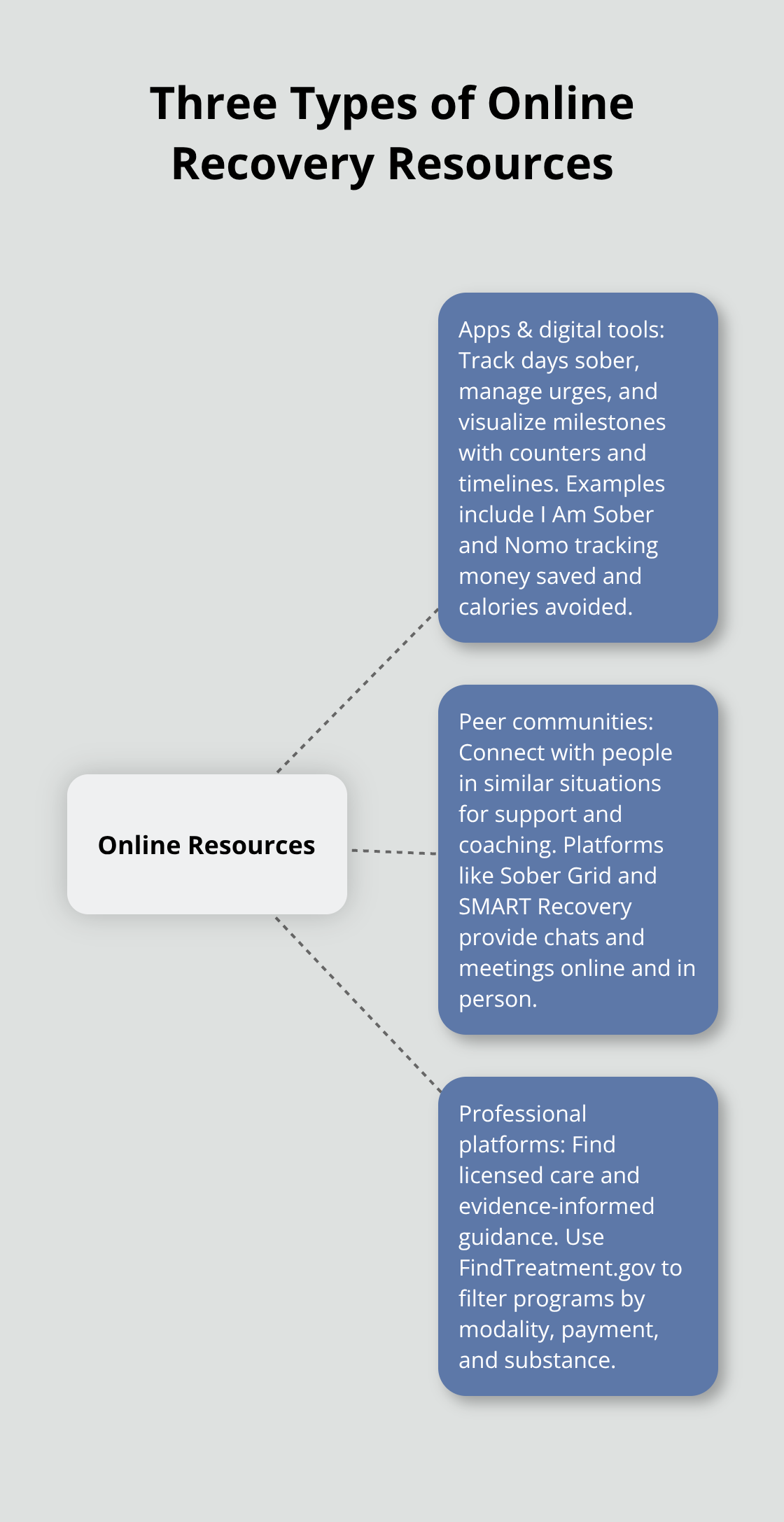
These work best as daily accountability mechanisms, not replacements for treatment. Peer-led communities and support networks connect you with people in similar situations; Sober Grid functions as a recovery-focused social network with location-based chat and low-cost peer coaching, while SMART Recovery offers meetings both in-person and online with evidence-informed self-empowerment strategies. Professional treatment platforms and information centers provide clinical guidance-FindTreatment.gov filters licensed programs by modality, payment type, and substance of concern, making it genuinely useful for locating outpatient options near you.
Spotting Credible Resources Versus Empty Promises
Credibility matters because the addiction recovery space attracts both legitimate providers and predatory ones. Check whether a resource holds accreditation from organizations like the Joint Commission or CARF, which indicate accountability standards. Verify that any app or online platform has privacy protections and doesn’t sell your data-many free apps compensate through data harvesting.

If a resource claims to cure addiction without mentioning ongoing support, medication, or therapy, skip it. The 988 Suicide and Crisis Lifeline, operated by SAMHSA, maintains 24/7 support with Spanish-language options and direct connections to local treatment-that’s the standard to expect. SAMHSA’s National Helpline provides free, confidential referrals nationwide. Look for resources backed by federal agencies like NIDA or NIAAA, which publish peer-reviewed evidence rather than marketing claims.
How Online Access Eliminates Geographic Barriers
Geographic barriers disappear when treatment moves online. Rural communities historically struggle to access medication for opioid use disorder, but telehealth platforms now deliver buprenorphine prescriptions and counseling to underserved areas-the MATE Act expanded these capabilities significantly. Online support groups run 24/7, meaning someone in recovery can access a live clinician-led session from Herren Project at 2 a.m. if cravings spike, rather than waiting for the next in-person meeting. Apps like the 12-Step Daily Meditations app provide hundreds of hours of recovery audio content, much of it free, enabling consistent daily practice without leaving home. Cost typically drops when you eliminate travel time and childcare barriers, making recovery more affordable for people already financially strained by addiction’s consequences.
The variety of online tools available means your next step depends on what you need right now-whether that’s daily accountability, peer connection, or professional guidance to start treatment.
Tools That Actually Deliver Results
Sobriety Trackers Transform Abstract Goals Into Measurable Progress
I Am Sober and Nomo function as accountability mechanisms that track concrete metrics like days sober, money saved, and time reclaimed. I Am Sober includes withdrawal timelines specific to different substances, so someone quitting alcohol sees exactly when acute symptoms typically subside, while someone in opioid recovery gets different benchmarks. The visual day counter works because humans respond to measurable progress; seeing a number climb creates psychological momentum that abstract encouragement never delivers. Nomo calculates financial savings-someone in recovery from a cocaine habit watches their tracker show thousands of dollars preserved monthly, transforming abstract commitment into visible evidence that sobriety pays. These apps work best as daily tools paired with counseling or support groups, which amplifies their impact significantly.
Clinical Platforms Cut Through the Noise of Finding Legitimate Care
FindTreatment.gov filters licensed programs by insurance type, treatment modality, and specific substance focus, eliminating hours of phone calls to unsuitable programs. SAMHSA’s National Helpline provides free confidential referrals nationwide and connects directly to treatment facilities rather than generic information. For medication-assisted treatment specifically, the Buprenorphine Practitioner Locator and Pharmacy Lookup tools identify prescribers and pharmacies offering MOUD in your area-critical because buprenorphine access varies dramatically by region, and these tools eliminate dead ends. Sober Grid combines peer connection with low-cost professional coaching and location-based matching so you find people in your geographic area, with anonymous profiles for those prioritizing privacy. SMART Recovery offers both in-person and online meetings with facilitators trained in self-empowerment methodology, backed by evidence showing participants develop practical urge-management skills rather than relying solely on group accountability.
Professional Support Groups Operate When You Need Them Most
Herren Project runs free clinician-led online support groups accessible nationwide at multiple times daily, addressing the reality that crisis moments don’t respect business hours-someone facing intense cravings at midnight accesses professional support immediately rather than waiting for the next morning meeting. The 12-Step Daily Meditations app provides hundreds of hours of recovery audio content with much available free, establishing daily practice consistency without transportation barriers or scheduling conflicts that derail in-person meeting attendance. These platforms recognize that recovery demands flexibility; the person working night shifts, managing childcare, or living in rural areas can access support on their schedule rather than adapting their life around meeting times. When you combine these tools with professional treatment, you create a recovery infrastructure that responds to your actual circumstances instead of forcing you into a one-size-fits-all framework.
How to Find and Start Professional Treatment
Professional treatment is where recovery actually happens, and the tools you selected in the previous section work best when paired with clinical guidance from counselors and therapists. SAMHSA’s National Helpline operates 24/7 at 1-800-662-4357 and provides free, confidential, 24/7, 365-day-a-year treatment referral and information service in English and Spanish. FindTreatment.gov filters licensed programs by insurance coverage, treatment modality, and substance type, eliminating the frustration of calling programs that don’t match your needs or payment situation.

Locate Treatment Options That Match Your Situation
For medication-assisted treatment specifically, the Buprenorphine Practitioner Locator identifies prescribers in your area offering MOUD, which matters because buprenorphine access varies dramatically by region and some areas have severe shortages. Start with SAMHSA’s helpline first if you’re uncertain whether you need outpatient care, residential treatment, or medication support; their counselors assess your situation and direct you to appropriate options rather than pushing you toward expensive programs that don’t fit your circumstances. Outpatient programs typically cost less than residential treatment and work well for people with stable housing and employment, though intensity varies from once-weekly counseling to daily appointments depending on your needs.
Understand What Substance Abuse Counseling Actually Involves
Substance abuse counseling involves practical skill-building, not theoretical discussion about your childhood. Your counselor teaches you urge-management techniques, helps you identify triggers, and works through real situations you face weekly rather than exploring abstract concepts. Research shows cognitive-behavioral therapy and motivational interviewing improve retention rates and reduce relapse, so ask whether your program uses these evidence-based approaches. The first appointment involves assessment questions about your substance use history, mental health, family situation, and medical conditions; this information determines whether you need medication, psychiatric support, or trauma-informed care alongside counseling.
Take Action This Week, Not Next Month
Most programs require urine screening during treatment to monitor progress and accountability. Recovery momentum matters, and delay typically leads to abandonment-so schedule an appointment this week rather than next month. When you contact a program, have your insurance information ready and ask specifically about their cancellation policy, session frequency, and whether they offer telehealth options if transportation presents difficulties.
Final Thoughts
The addiction recovery resources online you’ve explored throughout this guide represent real options that work when you take action. Sobriety trackers hold you accountable daily, peer communities connect you with people who understand your struggle, and professional platforms eliminate the guesswork from finding legitimate treatment. None of these tools replace clinical care, but they strengthen recovery when paired with counseling and medication if needed.
Your next step depends on where you are right now. If you’re still deciding whether treatment makes sense, call SAMHSA’s National Helpline at 1-800-662-4357 for a free assessment. If you’ve already committed to recovery, download a sobriety tracker this week and join an online support group while you wait for your first counseling appointment. If you live in an area with limited local options, explore telehealth programs that deliver buprenorphine prescriptions and therapy remotely.
Recovery requires professional guidance alongside daily accountability tools. At Addiction Resource Center, we provide substance abuse counseling and personalized addiction therapy designed to address your specific situation rather than forcing you into a generic program. Seeking professional help isn’t weakness or failure-it’s the decision that separates people who talk about recovery from people who actually achieve it.