You may be lying awake listening for the sound of the front door, trying to tell from footsteps whether tonight will be tense, loud, apologetic, or unpredictable. Maybe you've gotten good at scanning the room in seconds. Is your partner sober enough to talk? Do the kids need to stay upstairs? Should you hide the …

You may be lying awake listening for the sound of the front door, trying to tell from footsteps whether tonight will be tense, loud, apologetic, or unpredictable. Maybe you've gotten good at scanning the room in seconds. Is your partner sober enough to talk? Do the kids need to stay upstairs? Should you hide the debit card, cancel dinner plans, or act like everything is normal for one more night?
That kind of living wears people down. Not all at once. It happens through a hundred small adjustments. You stop bringing up important topics after dinner. You check their mood before you check your own. You become the one who remembers bills, smooths things over, makes excuses, and cleans up what alcohol keeps breaking.
If that's where you are, your experience is real. Living with an alcoholic partner can feel lonely even when you're never physically alone. It can leave you confused about what counts as support, what counts as enabling, and whether you're overreacting or not reacting enough.
You are not overreacting.
There is a path forward, even if your partner refuses help right now. That path starts with your safety, your clarity, and your stability. It includes boundaries that hold, practical steps for protecting your health and finances, and a realistic way to talk about treatment without making your life revolve around whether they say yes.
Table of Contents
- Introduction You Are Not Alone
- Understanding the Dynamics of Alcoholism in a Partnership
- The Toll on You Recognizing the Impact on Your Health
- Practical Coping Strategies Boundaries and Safety
- Protecting Your Future Legal and Financial Self-Care
- Encouraging Treatment How to Help Without Enabling
- Finding Your Own Support Resources for Partners and Families
Introduction You Are Not Alone
Many partners arrive at the same exhausted place. They still love the person. They may even see the good in them when alcohol isn't in charge. But love starts getting mixed with dread. You wait for promises that don't hold. You replay conversations, wondering whether you were too harsh, too soft, too hopeful, too angry.
That confusion makes sense. Alcohol problems distort the rhythm of a home. One day your partner is remorseful and affectionate. The next day they deny what happened, minimize it, or turn the conversation back on you. Over time, your confidence can erode. People start doubting their own judgment when they've spent months or years adapting to chaos.
Living with an alcoholic partner changes more than the relationship. It changes how you think, sleep, plan, and protect yourself.
What usually doesn't help is waiting for one dramatic moment of clarity. Individuals rarely experience a clean turning point. They get a steady accumulation of stress, broken trust, financial strain, and emotional exhaustion. The work then becomes less about finding the perfect answer and more about making your next safe, sane decision.
That's where this guide is focused. Not on making you responsible for your partner's recovery. Not on asking you to be more patient, more persuasive, or more self-sacrificing. The goal is steadier than that. Protect your body. Protect your mind. Protect your money. Protect your options.
If your partner seeks treatment, good. If they don't, your life still matters.
Understanding the Dynamics of Alcoholism in a Partnership
Alcohol use disorder isn't just “bad choices repeated a lot.” Choice matters, but addiction also behaves like a chronic condition that keeps hijacking judgment, emotional regulation, and follow-through. That doesn't excuse cruelty, dishonesty, or intimidation. It does explain why logic, pleading, and repeated promises often fail to produce lasting change on their own.
A useful comparison is diabetes or asthma. No one fixes those by arguing harder. They require recognition, treatment, daily management, and accountability. Alcohol addiction works differently in the details, but the same principle applies. Shame by itself rarely creates recovery. Neither does love by itself.
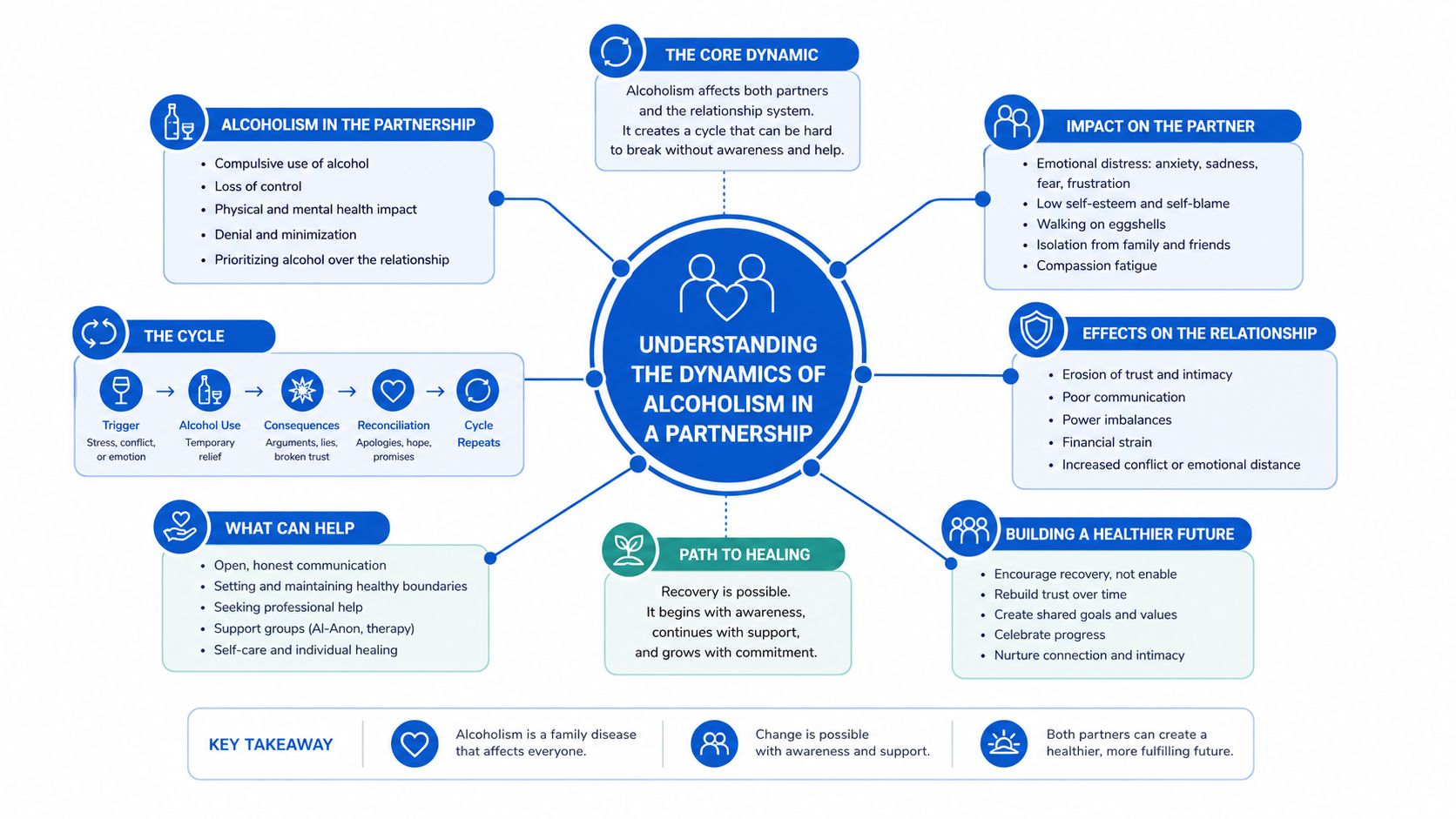
A lot of partners get stuck because they keep treating each incident like a separate argument. It usually isn't separate. It's part of a cycle. The details vary, but the pattern often looks familiar.
A cycle you may recognize
| Phase | What it often looks like at home |
|---|---|
| Tension builds | Irritability, avoidance, secrecy, defensiveness, blaming, unease in the house |
| Drinking or escalation | More alcohol use, arguments, neglect, disappearing, reckless spending, unsafe behavior |
| Remorse or damage control | Apologies, promises, tears, affection, minimization, bargaining |
| Brief calm | A few steadier days, hope returns, hard topics get postponed |
The calm phase is often what keeps partners hooked into waiting. You think, maybe this time they mean it. Sometimes they do mean it in that moment. Meaning it and sustaining change are not the same thing.
A clinical paper on spouses of alcohol-dependent partners reported that consequences for wives clustered into physical, psychological, and social domains, including stigma, social isolation, injury, violence, and financial difficulties across countries. That matters because it frames alcoholism as a family-level problem, not only an individual one (clinical paper on spouses of alcohol-dependent partners).
What this means for you
Once you understand the pattern, some things become clearer:
- You didn't create the cycle. Your tone, timing, or patience didn't cause the addiction.
- You can't manage it into submission. Monitoring, covering, threatening, or rescuing may change a night. They usually don't change the illness.
- You still have responsibility for your side. Your boundaries, your safety plan, your money, and your support system are within your control.
Practical rule: Depersonalize the addiction without minimizing the harm. Alcohol may explain the pattern. It does not erase the impact on you.
The Toll on You Recognizing the Impact on Your Health
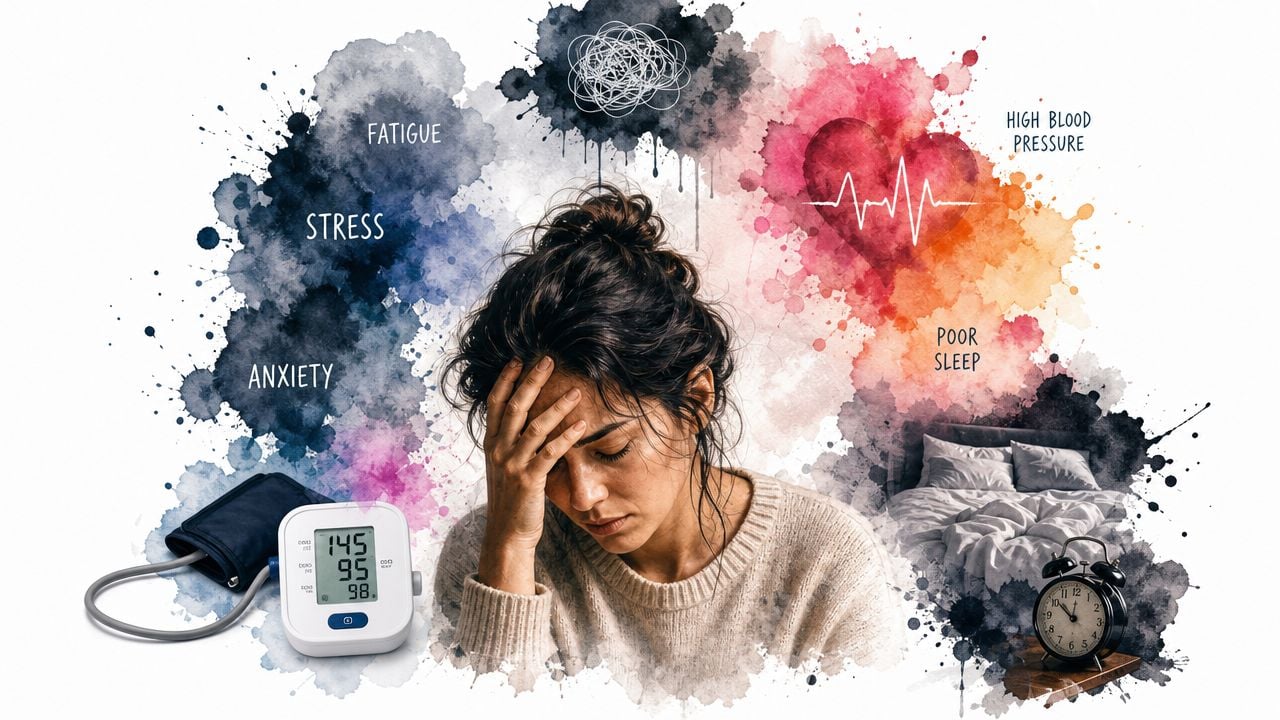
The first thing I want partners to hear is this. If you feel “off” all the time, your body may be reacting exactly the way a stressed body reacts. Many people normalize symptoms because they've been living with them so long. They say they're just tired, just tense, just bad at coping. Often, they're not weak at all. They're overloaded.
When your body starts carrying the stress
A phenomenological study of spouses found that partners commonly experienced fatigue, pain, and sleeplessness. The same study cited earlier evidence that violent behavior was present in 60% of partners with alcohol use disorder versus 12% in a comparison group (phenomenological study of spouses of alcohol-dependent partners).
That kind of environment affects the nervous system fast. People develop headaches, stomach problems, jaw tension, shallow breathing, racing thoughts, and the strange exhaustion that comes from never fully relaxing. Even on a quiet day, your body may stay braced for the next disruption.
Common signs include:
- Sleep disruption: You stay alert for sounds, arguments, late arrivals, or mood shifts.
- Stress symptoms: Your shoulders, stomach, and chest carry tension all day.
- Neglect of your own care: You postpone appointments, skip meals, or numb out because there's always another crisis.
If anxiety has become part of your daily baseline, it can help to build a small reset routine instead of waiting until you're overwhelmed. Simple grounding tools, breathing, and body-based calming practices can be a good place to start. This guide on how to calm anxiety naturally is one practical resource many people find useful.
The mental load gets heavy fast
The psychological side is often less visible but just as serious. You may second-guess yourself constantly. You may rehearse conversations, hide information from friends, or become hyperaware of tiny changes in tone. That isn't “being dramatic.” It's what people do when home no longer feels emotionally predictable.
A few patterns show up often:
- Hypervigilance: You scan for risk before you can rest.
- Isolation: You stop inviting people over or telling the truth about what's happening.
- Emotional confusion: You feel love, resentment, hope, guilt, and fear in the same day.
Here's a brief explainer that captures why these patterns can feel so destabilizing:
When partners start naming these effects clearly, they usually make better decisions. Not always easier decisions. Better ones. You don't need to prove you're suffering “enough” to deserve support. If living with an alcoholic partner is eroding your health, that is enough reason to act.
Practical Coping Strategies Boundaries and Safety
Most partners are told to “set boundaries,” but they're not always told what that means in real life. A boundary is not a speech about what your partner should do. It's a decision about what you will do when a line is crossed.
That shift matters. If your boundary depends on them becoming reasonable while intoxicated, it isn't a boundary yet. It's a wish.
Boundaries that protect you
Good boundaries are specific, behavioral, and enforceable. They're usually short enough to say in one breath.
Examples:
- Transportation: “I won't get in a car with you if you've been drinking.”
- Money: “I won't give you cash or cover alcohol-related spending.”
- Conversation: “If you're intoxicated, I'm ending this conversation and leaving the room.”
- Home environment: “If yelling starts, I'm taking the kids and going to my backup location.”
- Sleep: “I'm sleeping separately when you've been drinking.”
Some boundaries feel cold at first because you're used to overfunctioning. They aren't cold. They're protective. The point is not to punish your partner. The point is to stop arranging your life around active drinking.
You can be compassionate and still refuse chaos access to your body, home, wallet, and time.
What usually doesn't work:
| Often backfires | More effective |
|---|---|
| Arguing while they're drunk | Waiting for a sober window |
| Threats you can't carry out | Limits you're prepared to enforce |
| Long lectures | Brief, calm statements |
| Repeated rescuing | Letting natural consequences land |
The old recovery phrase still helps here. You didn't cause it, you can't control it, and you can't cure it. Partners sometimes hear that as hopeless. I don't see it that way. I see it as a release from an impossible job description.
A safety plan is not overreacting
If alcohol brings aggression, intimidation, property damage, coercion, stalking, or unsafe driving into the home, safety planning moves to the front of the line. Not later. Not after one more talk.
Start with logistics, not emotion:
- Choose a safe exit. Know where you'd go for a night or longer.
- Prepare documents. Keep identification, insurance cards, medications, keys, and essential records accessible.
- Create a contact list. Pick two or three people who understand that “I need help” means now.
- Set a code phrase. Use it with a friend, family member, or older child if you need quick help without explaining.
- Protect your phone access. Keep it charged and with you.
- Decide your red lines in advance. Drunk driving with children, threats, physical intimidation, and blocked exits are examples of lines that require immediate action.
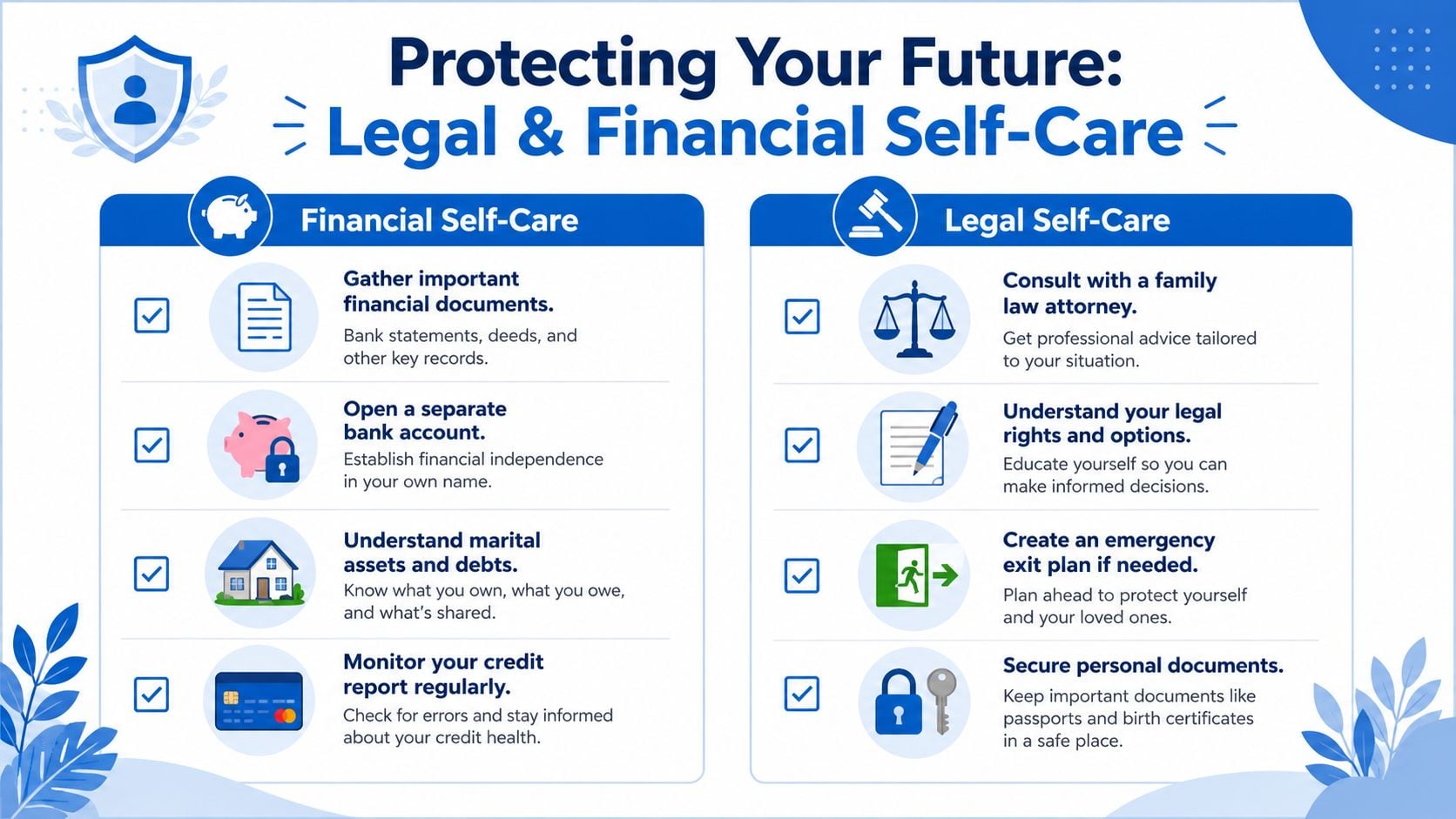
If you're dealing with threats, harassment, or fear for your physical safety, legal protection may need to be part of the plan. A local resource such as an Austin protective order lawyer can help you understand what protective orders are designed to do and when formal legal steps may be appropriate.
One more point that partners need permission to hear. You do not have to wait for a catastrophic event to make a safety plan. Repeated fear is enough.
Protecting Your Future Legal and Financial Self-Care
Emotional coping gets most of the attention, but financial destabilization is often what traps people. I've seen partners tolerate far more than they ever intended because they're afraid of losing housing, childcare, transportation, or access to shared money. That's why financial self-protection isn't a side topic. It's part of preserving your freedom to choose.
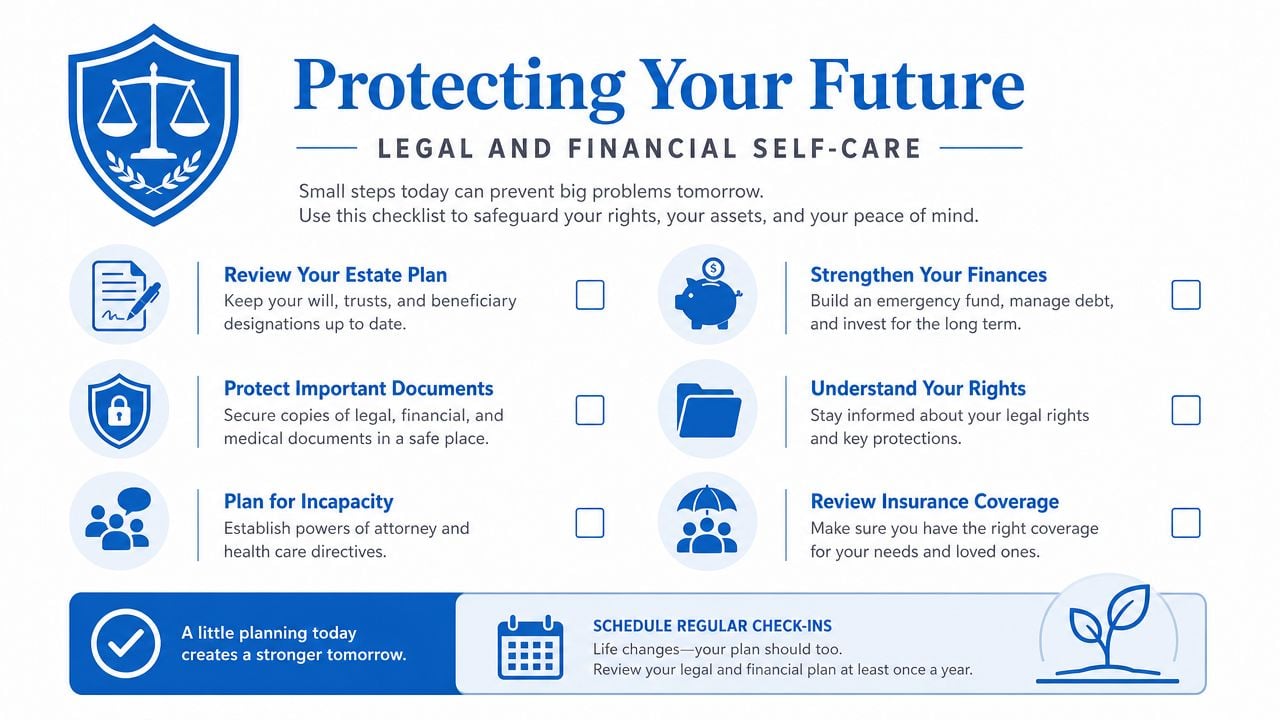
Expert guidance from Texas Health specifically emphasizes financial safety planning, including keeping a separate bank account, monitoring shared bills, and avoiding co-signing loans (Texas Health guidance on dealing with an alcoholic spouse). That advice deserves more attention than it usually gets.
Financial protection is part of safety
Alcohol-related instability doesn't always look dramatic. Sometimes it shows up as missed utility payments, cash withdrawals you can't explain, unpaid taxes, maxed credit cards, or “temporary” borrowing that never stops. Sometimes it crosses into financial abuse, where one partner hides accounts, creates debt, pressures the other to sign documents, or uses money to control movement.
If you're living with an alcoholic partner, think about financial safety in layers:
- Access to money today
- Protection of your credit
- Knowledge of debts and obligations
- Ability to leave if needed
A budget can help reduce some of the fog, especially if household money has become hard to track. If you need a simple framework, this guide on how to make budgeting can help you start with something practical rather than perfect.
Simple moves that reduce risk
Not every step fits every relationship, but these are often useful:
- Open an account in your own name. Use it for emergency savings, income, or essential bills.
- Monitor shared obligations. Check mortgage, rent, utilities, insurance, and minimum debt payments regularly.
- Review your credit. Make sure new debts or accounts haven't appeared without your knowledge.
- Avoid fresh entanglements. Don't co-sign loans, refinance to fix a crisis, or put your name on new alcohol-related damage control.
- Gather key records. Keep copies of IDs, bank statements, deeds, titles, insurance information, and tax documents in a secure place.
- Get legal advice early. If separation, custody, property, or safety may become issues, early information gives you more options.
Some of the strongest self-protection steps are quiet, boring, and private. That doesn't make them small. It makes them effective.
People often delay this work because it feels disloyal. It isn't. Preparing for instability is what responsible adults do when instability is already in the room.
Encouraging Treatment How to Help Without Enabling
You can care deeply about your partner and still stop participating in the cycle. That's the line between helping and enabling. Help points toward accountability and treatment. Enabling softens consequences so thoroughly that drinking can continue with less pressure to change.
What support looks like
Support often sounds like this:
- “I'll talk with you about treatment when you're sober.”
- “I'll help you make the call.”
- “I'll drive you to an assessment.”
- “I'm willing to attend family therapy.”
Enabling usually sounds more like this:
- covering for missed work
- lying to relatives
- paying for repeated alcohol-related fallout
- cleaning up every crisis while pretending it's manageable
- absorbing abuse to keep the peace
The hard part is that enabling can feel loving in the moment. It reduces immediate conflict. It may protect children from one scene tonight. But over time, it often protects the addiction more than the person.
How to start the conversation
Timing matters. Do not try to talk seriously when your partner is intoxicated, hungover, enraged, or rushing out the door. Pick a sober, relatively calm window. Stay concrete. Use recent examples. Keep the focus on impact and next steps, not a courtroom summary of every offense.
A workable structure is simple:
- State what you've observed. “You've been drinking most nights, and our home doesn't feel stable.”
- Name the impact on you. “I'm anxious, I'm not sleeping well, and I don't feel safe when the drinking escalates.”
- State your boundary. “I'm not willing to keep living like this without change.”
- Offer one clear next step. “I want you to schedule a treatment assessment this week.”
You do not need the perfect script. You need steadiness.
If they say yes, move fast. Help them contact a treatment provider before fear, shame, or withdrawal concerns take over. Depending on the severity, treatment may involve medically supervised detox with medication-assisted treatment, residential rehabilitation, or an Intensive Outpatient Program (IOP) in person or via telehealth. Different levels of care fit different needs. Someone who drinks heavily, has withdrawal symptoms, or has repeated failed attempts to stop may need more structure than weekly counseling alone.
If they say no, your next step is not to argue for three hours. Your next step is to follow through on your own boundary. That may mean sleeping elsewhere, separating finances further, pausing contact when they're drinking, or moving toward a higher level of protection.
A formal intervention can help in some families, especially when several loved ones can stay calm and unified. But it's not magic. Interventions work best when they are carefully planned, tied to real consequences, and focused on treatment access rather than emotional ambush.
Finding Your Own Support Resources for Partners and Families
Partners often spend so much time tracking the drinker that they lose track of themselves. Your recovery may not look like sobriety, but it still involves recovery. Recovery of sleep. Recovery of truth. Recovery of your confidence, your routines, your finances, and your relationships with people who make you feel sane again.
That's why your own support matters whether your partner enters treatment or not. For many people, the first useful step is a support group for loved ones such as Al-Anon. Others start with individual therapy, a trauma-informed counselor, a faith leader they trust, or one honest conversation with a friend they've been avoiding. You do not need to be in immediate crisis to deserve support.
A strong support system usually includes a few different kinds of help:
- Peer support: People who understand the dynamics of addiction in a family.
- Professional support: A therapist, counselor, or family specialist who helps you build boundaries and process fear, grief, and anger.
- Practical support: Someone who can help with rides, childcare, documents, or a safe place to stay.
- Medical support: Your primary care provider, especially if stress, sleep loss, anxiety, or depression are affecting your health.
If you're in Yuba City or Northern California and need local guidance, Addiction Resource Center LLC is available for both individuals and families navigating substance use. They're located at 1002 Live Oak Blvd., Suite A, Yuba City, CA and offer a 24/7 phone and text line at 530-625-7910. Their care includes medically supervised detox with MAT, residential rehabilitation through Ona Treatment Center in Browns Valley, and Intensive Outpatient Program options in person and via telehealth. They also support families who need help understanding options, planning next steps, and responding safely to a loved one's drinking. The center accepts most major insurance plans and TRICARE, which can make getting started more straightforward.
You don't need to have every answer before you reach out. You just need the next honest step.
If you need compassionate, practical help for yourself or a loved one, Addiction Resource Center LLC offers guidance, treatment options, and family support in Yuba City. You can call or text their 24/7 line at 530-625-7910, ask questions without pressure, and get clear direction on detox, residential rehab, IOP, and what to do next if you're living with an alcoholic partner.