The first call often happens in a kitchen, late at night, after a long day of trying to keep everything together. Someone is shaky, confused, vomiting, panicked, or just done pretending this can wait, and a family member is searching for the safest next step. Drug detox is that first step, but it helps to …

The first call often happens in a kitchen, late at night, after a long day of trying to keep everything together. Someone is shaky, confused, vomiting, panicked, or just done pretending this can wait, and a family member is searching for the safest next step. Drug detox is that first step, but it helps to know exactly what it does, and just as important, what it does not do.
When people ask how does drug detox work, the clearest answer is that it gives the body a controlled way to stop a substance without forcing the nervous system to absorb the shock all at once. Clinical guidance describes detox as the stabilizing phase of withdrawal management, not a complete treatment by itself, and the usual goal is to relieve symptoms while tapering the substance or using a similar medication in carefully measured amounts to lower withdrawal severity and prevent complications (NCBI Bookshelf). In supervised care, the team is not trying to “cleanse” the body. They're managing a predictable medical reaction to stopping a substance too quickly.
Table of Contents
- What Medically Supervised Detox Really Is
- Admission and Assessment on Day One
- Withdrawal Timelines by Substance Class
- Monitoring and Safety Protocols During Detox
- Medication-Assisted Options That Ease Withdrawal
- Why Transition Planning Is the Most Overlooked Step
- Matching the Right Setting to the Right Substance
- Choosing a Program and Taking the Next Step
What Medically Supervised Detox Really Is
A family member makes the call after hours of worry. The immediate question is where is the person safest right now? Medically supervised detox provides a structured answer: a short period in a licensed setting where clinicians manage withdrawal and watch for dehydration, seizures, delirium, and other complications. The person's body is adjusting to the absence of a substance, while trained staff respond if that adjustment becomes medically unstable (NCBI Bookshelf).
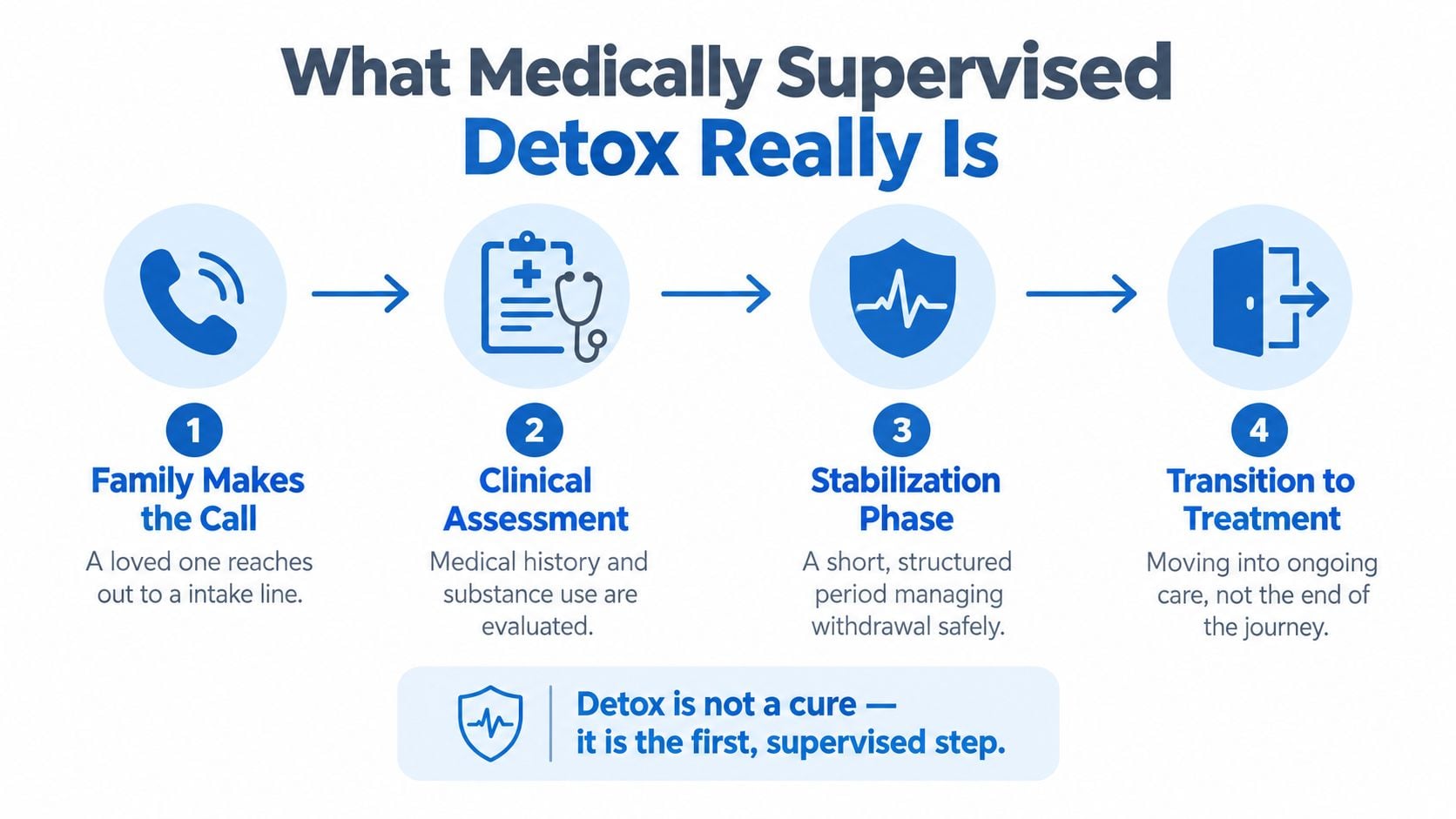
A stabilization phase, not a cure
“Getting through withdrawal” is accurate, but it leaves out the work involved. Repeated substance exposure can change how the brain and body regulate sleep, mood, movement, and automatic functions such as heart rate. During detox, the nervous system begins adjusting again. Clinicians track symptoms such as anxiety, insomnia, nausea, tremor, and excessive nervous-system activity. Some people also develop seizures or psychosis, sometimes within hours or days after their last use. As the body settles, the team adjusts care to keep the process safer and more tolerable (NCBI Bookshelf).
Practical rule: detox can make someone stable enough to begin recovery care. It does not provide that care by itself.
That boundary helps families set realistic expectations. Detox addresses the immediate physical risk. Rehab can then provide structured therapy, while medication-assisted treatment, or MAT, may support ongoing recovery for appropriate substance-use disorders. An intensive outpatient program, or IOP, can offer scheduled treatment while the person lives outside a residential facility. The handoff between these services should be planned before detox ends.
What the setting usually looks like
A supervised facility controls access to substances and gives the care team a clear view of changing symptoms. Nurses and physicians check the patient regularly, review vital signs, support hydration and sleep, and adjust medication when appropriate. Clinical observation during withdrawal management occurs at regular intervals, with the frequency shaped by the person's symptoms and risk.
The setting works like a monitored bridge between substance use and longer-term care. Its purpose is to carry the person through the medically unstable part of withdrawal, then connect them with the next appropriate service. Leaving without a clear handoff can leave the person physically improved but without therapy, MAT, rehab, or IOP support.
Admission and Assessment on Day One
The first hours are about gathering facts, not making a person tell their whole life story all at once. Intake staff usually start with paperwork and verification details, then the clinical team moves into the medical picture. That order matters because the team needs to know both who the patient is and what the body has been exposed to before they can choose the right withdrawal plan.
What happens during detox is usually less mysterious than families expect once the pieces are named out loud. The assessment is practical, and each step has a purpose.
What clinicians ask and why
They'll ask about the substance used, the last dose, how long use has been going on, and whether there have been past withdrawal episodes. They also ask about other medications, mental health symptoms, medical problems, and any history of seizures or hallucinations. Those details tell the team whether withdrawal is likely to be uncomfortable, dangerous, or both.
A physical exam follows, often with lab work that helps rule out medical issues and guides medication choice. Think of labs as a map, not a verdict. They help clinicians see whether the body needs fluids, whether there are electrolyte problems, and whether there are other issues that should change the detox plan.
The personal context matters too
A good assessment also includes a psychosocial interview. That means the team asks about housing, family support, work, legal stress, trauma, and co-occurring mental health concerns. Those questions may feel personal, but they're part of deciding whether the person should stay in a more intensive setting or move into a lower level of care.
By the end of the same day, the team should be able to name the level of support the patient needs and explain the next 24 to 72 hours in plain language. Families usually feel calmer once the unknowns are named, because the process stops feeling like a black box and starts looking like a plan.
Withdrawal Timelines by Substance Class
A person may arrive at detox expecting withdrawal to follow a fixed schedule. In practice, the substance, dose, duration of use, and the person's health all affect when symptoms begin and how long they last. Short-acting opioids such as heroin may begin within hours and last several days, while long-acting opioids such as methadone may take days to start and continue longer. Benzodiazepine withdrawal can last still longer, so stopping suddenly may require a planned taper over 8 to 12 weeks or more (NCBI Bookshelf).
The table gives broad ranges for expectation-setting, not a schedule for self-detox. The source material reports slightly different onset windows for some substances, so clinicians use the person's symptoms and history rather than the clock alone (NCBI Bookshelf).
| Substance Class | Onset | Peak Withdrawal | Total Acute Duration | Medical Risk Level |
|---|---|---|---|---|
| Alcohol | Often within hours after stopping | The most severe period commonly falls within 36 to 72 hours | About 2 to 10 days in many cases | High |
| Benzodiazepines | After abrupt stopping or rapid dose reduction, often over hours to days | Often rises over several days, sometimes longer with shorter-acting agents | May require a slow taper over 8 to 12 weeks or more | High |
| Short-acting opioids | Typically 6 to 12 hours after last use for short-acting opioids such as heroin, though some sources report up to 24 hours depending on the agent | Around 24 to 48 hours in the acute window | About 4 to 10 days | Moderate |
| Long-acting opioids | May not start for 2 to 4 days | Later than short-acting opioids | Can persist for about 10 days | Moderate |
| Stimulants | Often within hours, usually as a crash rather than medically complex withdrawal | Emotional and sleep disruption often dominate | Variable and often less medically acute | Lower medical risk, but still needs support |
For a fuller breakdown of opioid timing, see our guide to the opiate withdrawal time frame.
Alcohol and benzodiazepines carry particular danger because withdrawal can involve medical instability, not only discomfort. Opioid withdrawal is usually not life-threatening in the same way, yet vomiting, exhaustion, dehydration, and intense cravings can make it difficult to remain safe and increase relapse risk. Stimulant withdrawal more often resembles a crash, with low energy, sleep changes, and mood symptoms that still deserve attention.
The timeline should also shape the handoff after detox. A person may move to residential rehab, begin medication-assisted treatment for opioid use, or enter an intensive outpatient program when medical symptoms are stable. Detox clears the immediate withdrawal period, but transition planning connects that first stage to ongoing care.
Monitoring and Safety Protocols During Detox
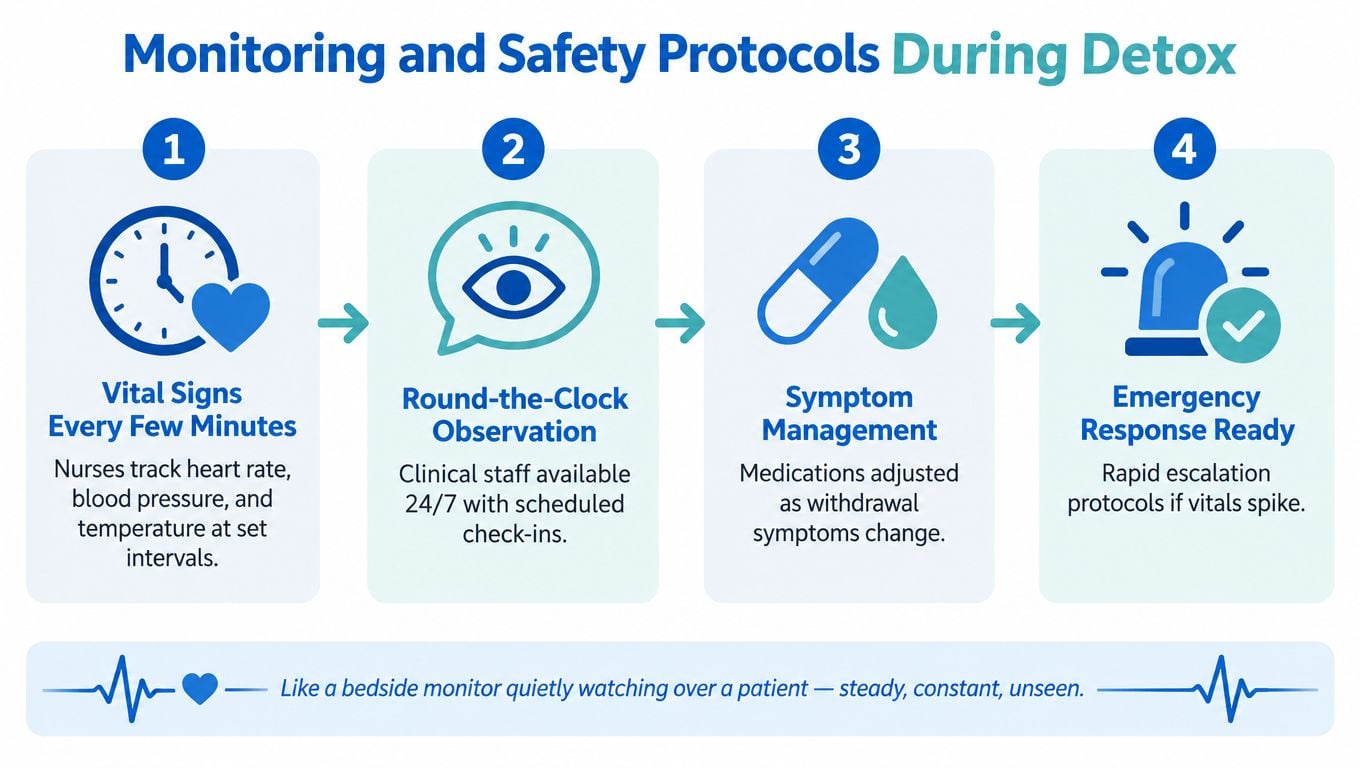
Inside a detox unit, good monitoring feels steady rather than dramatic. Nurses aren't hovering because something is wrong every minute, they're checking the body often enough to catch a change before it becomes a crisis. That might mean vital signs every few hours, symptom scoring tools, and overnight observation when symptoms can worsen while the patient is asleep.
What staff are actually watching
For alcohol and benzodiazepine withdrawal, the team may use a structured scale such as CIWA-Ar to track symptom severity. For opioid withdrawal, they may use COWS, which helps them adjust treatment based on the patient's current state instead of guessing. That's important because the plan should follow the body, not the clock.
Hydration, nutrition, and electrolyte correction are part of this too. If a patient is vomiting, not sleeping, or too anxious to drink enough, those issues get treated as part of withdrawal care. Seizure precautions are especially important in alcohol and sedative withdrawal, and fall-risk management becomes a bigger issue when a patient is weak, dizzy, or unsteady.
Why overnight observation matters
Withdrawal doesn't pause because the lights go out. Complications can surface overnight, so monitoring continues through sleep. Nurses, not orderlies, drive the decision loop, and physicians adjust medication daily based on scores, exam findings, and the overall trend.
Like a bedside monitor quietly watching over a patient, the system should be steady, constant, unseen.
Discharge from acute monitoring usually waits until the person's vitals are stable, they're eating and drinking, and the symptom trend is moving down rather than up. The point isn't to rush someone out once they look a little better. The point is to make sure the body has crossed the danger window safely.
Medication-Assisted Options That Ease Withdrawal
The right medication depends on the substance, the symptoms, and whether the goal is a short detox taper or ongoing treatment. A taper for benzodiazepines looks very different from opioid withdrawal management, and neither should be confused with a quick comfort measure. For opioids, the World Health Organization describes short-term medically supervised withdrawal using buprenorphine or methadone for a limited 3 to 21 day taper, often with clonidine or lofexidine and symptom-targeted medicines for nausea, pain, or insomnia (WHO overview).
Medication-assisted treatment basics are easier to understand when the purpose of each medicine is clear.
| Substance Class | First-Line Medication | Taper vs. Maintenance | Primary Purpose |
|---|---|---|---|
| Opioids | Methadone or buprenorphine | Can be used as a short taper or as maintenance | Reduce withdrawal, cravings, and relapse risk |
| Alcohol | Symptom-guided benzodiazepine taper in supervised care | Taper | Prevent seizures and stabilize withdrawal |
| Benzodiazepines | Gradual taper with a long-acting benzodiazepine | Taper | Prevent severe rebound symptoms |
| Sedative-hypnotics | Careful taper, sometimes with supportive medication | Taper | Lower withdrawal intensity and instability |
| Stimulants | No specific detox medication | Symptomatic support only | Manage sleep, mood, and agitation |
| Naltrexone | Starts after detox is complete | Maintenance or relapse prevention | Block opioid or alcohol effects after stabilization |
Methadone is a full agonist, while buprenorphine is a partial agonist. That difference matters because both can ease withdrawal, but they do it with different dosing profiles and supervision needs. Naltrexone fits after detox, not during active opioid use, because it doesn't treat acute withdrawal.
Supportive medications may be used for nausea, sleep, pain, or autonomic symptoms. The point of medication-assisted detox is not to swap one uncontrolled substance for another. It's to replace unpredictable street supply with measured, supervised dosing so the nervous system can settle safely.
Why Transition Planning Is the Most Overlooked Step
Detox can look finished from the outside when the shaking stops and the person starts eating again. That's exactly where families get misled. The key question is whether someone leaves detox with a same-week handoff into ongoing care, because a recent 2024 admissions report found that detox made up about 17% of treatment admissions, yet only 47.8% of detox discharges completed treatment and 17% transferred to further treatment (Detox.com 2024 admissions report).
What a real handoff includes
A transition plan should already be in motion before discharge day. That usually means a confirmed bed or intake date for residential rehab, an IOP schedule with evening or telehealth options, a follow-up appointment with a MAT prescriber, and written overdose-prevention steps for the family. If the program has only a brochure and a wish, the handoff is weak.
Warm handoffs matter because they reduce the gap between “I'm stable now” and “I know where to go next.” Peer recovery coaches, first meetings with a counselor, and introductions to 12-step or SMART Recovery can help a person feel like they're entering a path, not falling off a cliff.
Why the first week after detox carries so much weight
The body has lost tolerance, but the habits and triggers are still there. That's why continuity of care matters more than a dramatic discharge moment. Detox can reduce immediate withdrawal risk, but without follow-up care, it may not improve long-term outcomes and can leave people exposed to relapse and overdose risk.
Finishing detox is a milestone, not a finish line.
That's the clearest way to think about it. The clinical success is not just that someone got through withdrawal, it's that they crossed into the next level of care without losing momentum.
Matching the Right Setting to the Right Substance
Families often ask whether detox must happen in a hospital. The right setting depends on the substance, medical history, and current risk. Alcohol and benzodiazepine withdrawal require close monitoring and rapid medical response, since seizures, delirium, or sudden instability can develop quickly. Opioid withdrawal may fit residential or higher-intensity outpatient care when medication support is available. Stimulant and cannabis withdrawal usually call for symptom support and mental health observation rather than hospital containment.
| Substance Class | Recommended Setting | Home-Based Option? | Key Requirement |
|---|---|---|---|
| Alcohol | Hospital-based or highly monitored residential | Usually no | 24-hour nursing, seizure precautions, medication access |
| Benzodiazepines | Hospital-based or highly monitored residential | Usually no | Slow taper and close observation |
| Opioids | Residential, high-intensity outpatient, or supervised home model in selected cases | Sometimes, if stable and supported | Access to buprenorphine or methadone and follow-up care |
| Stimulants | Structured outpatient or IOP | Sometimes, for mild cases | Mental health monitoring and sleep support |
| Cannabis | Outpatient or IOP | Often yes | Symptom support and counseling |
| Polysubstance use with medical illness | Hospital or residential | No | Full medical oversight |
Home-based detox can suit some mild cases when housing is stable, a sober support person is present, and a prescriber is available by phone. It does not fit heavy alcohol use, high-dose benzodiazepines, or mixed substance use alongside medical problems. Convenience should not determine placement. The clinical risk should.
The setting should also connect to the next stage of care. Before discharge, families should know whether the handoff leads to residential rehab, a MAT prescriber, or IOP. That connection keeps the care pathway intact after withdrawal monitoring ends.
Choosing a Program and Taking the Next Step
Before you admit someone, check for 24/7 medical coverage, licensure and accreditation, on-site ability to administer the right withdrawal medications, and a written transition plan that names the next level of care before discharge. Ask whether the program can coordinate directly with residential rehab, IOP, or a MAT prescriber, because that handoff is where many families lose time.
For families who need a place to start, THERAPSY multilingual recovery support can be useful when language access is part of the barrier to care. A practical next move is simpler than people expect. Call the program, ask what substances they treat, what monitoring they provide, and what happens after detox ends.
If you're choosing a detox and recovery path in Northern California, Addiction Resource Center LLC offers medically supervised detox, MAT support, residential rehab through its partner facility, and IOP options in person and via telehealth. The hardest part is the first call, and the admissions team is there to walk families through it. Visit Addiction Resource Center LLC to take that step today.