Dual diagnosis means having a mental health disorder and a substance use disorder at the same time. About 21.2 million U.S. adults had both conditions in 2024. That number represents people who may be trying to manage depression with alcohol, calm trauma-related fear with opioids, or control overwhelming anxiety with stimulants. It also represents families …

Dual diagnosis means having a mental health disorder and a substance use disorder at the same time. About 21.2 million U.S. adults had both conditions in 2024.
That number represents people who may be trying to manage depression with alcohol, calm trauma-related fear with opioids, or control overwhelming anxiety with stimulants. It also represents families who have watched a loved one move between an addiction program and a mental health clinic, with neither service treating the whole picture.
The term dual diagnosis, also called co-occurring disorders, isn't meant to define a person. It describes a treatment reality: two conditions are interacting, and care needs to address both. The sections below explain why the systems became separated, how clinicians identify the conditions, which levels of care can work together, and what to ask when you're looking for help locally.
Table of Contents
- What Dual Diagnosis Actually Means
- Why Two Systems Failed One Person
- The Most Common Mental Health and Substance Use Pairings
- How Assessment and Screening Work in Practice
- Integrated Treatment Across the Continuum of Care
- Who Gets Left Out of Integrated Care
- Taking the First Step Toward Local Care
- The Big Picture on Dual Diagnosis
What Dual Diagnosis Actually Means
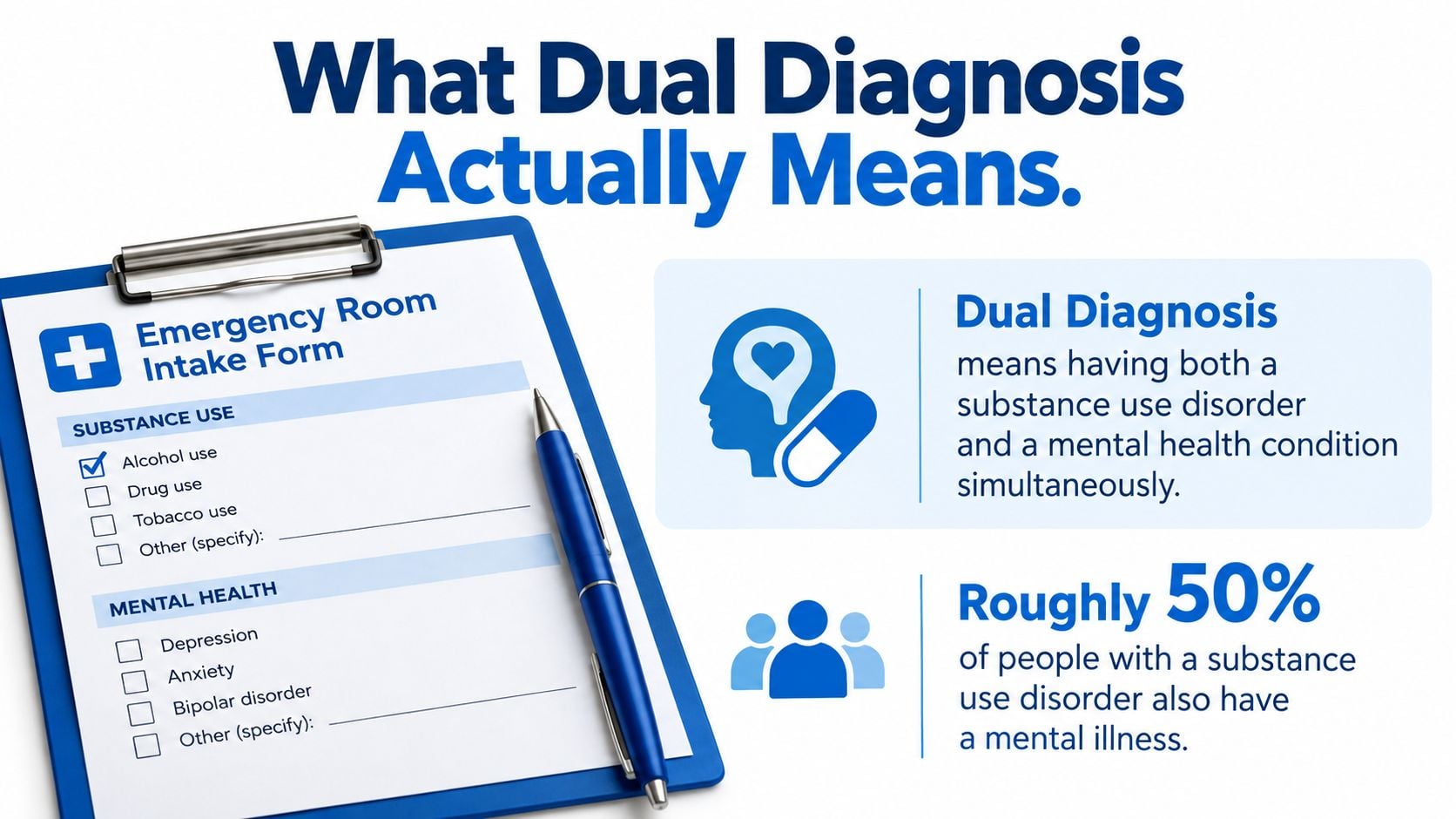
A person arrives in an emergency room after a night of heavy drinking. The intake form asks about alcohol, withdrawal, and prior treatment. Nobody asks about the depression that began months earlier, the panic that drives the drinking, or the trauma symptoms that surface whenever the person tries to stop. The immediate crisis gets attention, but the condition helping to sustain it stays invisible.
Dual diagnosis means that one person has at least one mental health disorder and at least one substance use disorder at the same time. Clinicians also use the term co-occurring disorders. The substance use may involve alcohol, opioids, stimulants, sedatives, cannabis, or another substance, while the mental health condition may include depression, anxiety, post-traumatic stress disorder, bipolar disorder, or another diagnosable condition.
The scale helps explain why this can't be treated as an unusual complication. SAMHSA reports that approximately 21.2 million U.S. adults had both a mental health condition and a substance use disorder in 2024 (SAMHSA's definition and treatment guidance). The two conditions often influence each other. Substance use can temporarily change mood or fear, while untreated psychiatric symptoms can make cravings, relapse, and avoidance harder to manage.
Why the label can mislead
A diagnosis isn't an explanation of everything that happened to someone. It doesn't tell a clinician which condition appeared first, whether trauma shaped the substance use, or what support the person has at home. It signals that assessing one side without the other may leave important risks untreated.
A person may stop drinking and then experience severe anxiety that had been muted by alcohol. Someone may begin treatment for depression but continue using stimulants that disrupt sleep and mood. Another person may receive help for opioid use while post-traumatic stress remains untreated. These situations require curiosity rather than assumptions.
Understanding what is dual diagnosis starts with one practical principle: ask about mental health and substance use together. From there, clinicians can examine the history, screen for both conditions, and build a plan that doesn't force the person to choose between separate systems.
Why Two Systems Failed One Person
A person arrives at an addiction clinic after years of heavy drinking. The clinic asks for sobriety before treating depression. At a mental health service, the person hears that active drinking makes therapy too difficult. Each rule may seem reasonable within its own system, yet together they leave the person without care.
Addiction treatment and mental health care grew along separate paths, with different clinics, professional roles, funding arrangements, and eligibility rules. One service focused on stopping substance use, while another addressed mood, anxiety, or trauma. The person had to carry information between appointments, repeat the same history, and manage symptoms while providers worked from incomplete pictures.
This setup works like two repair shops handling one connected machine. Each may fix its assigned part, but neither sees how the parts affect each other. A person may use alcohol to cope with depression, then experience worse sleep and mood as drinking continues. Treating only the alcohol use or only the depression leaves part of the cycle in place.
Historical data showed the limits of that model. A National Institute of Mental Health and NIH-linked review reported a 48% lifetime prevalence for any psychiatric or alcohol or other-drug disorder in the U.S. population. Only about 18% of addiction programs and 9% of mental health programs met criteria for dual-diagnosis-capable services. The review also found that more than half of people with co-occurring problems had received no treatment. One U.S. estimate found that only 10% of adults with co-occurring disorders received treatment for both conditions, while 42% received neither mental health nor substance use treatment in the prior year, as described in this review of the history and treatment gap in co-occurring disorders.
What siloed care can miss
- Relapse risk: Depression, trauma, or anxiety may continue driving substance use, so stopping the substance does not remove the reason the person depended on it.
- Medication concerns: Without a clear substance-use history, a prescriber may miss interactions, misuse risks, or symptoms caused by intoxication and withdrawal.
- Misdiagnosis: Substance effects can resemble depression, mania, panic, or psychosis. Repeated assessment after stabilization helps clinicians identify what persists.
- Poor coordination: Providers may give conflicting instructions when they do not share information.
Integrated care addresses the systems problem by connecting detox, medication-assisted treatment (MAT), residential care, intensive outpatient (IOP) services, and therapy under one coordinated plan. The person no longer has to prove that one condition is resolved before receiving help for the other. Locally coordinated care can close the gap that separate systems repeatedly leave open.
The Most Common Mental Health and Substance Use Pairings
No pairing proves that one condition caused the other. Clinicians use common patterns to guide questions, not to make assumptions. A person with depression may not drink, and a person with PTSD may not use opioids. The only reliable way to understand the individual situation is to screen for both conditions and examine symptoms over time.
| Mental Health Condition | Commonly Paired Substance | Typical Link |
|---|---|---|
| Depression | Alcohol | Alcohol may briefly numb sadness, isolation, or hopelessness, then worsen sleep and mood |
| Anxiety disorders | Benzodiazepines or stimulants | A person may use sedatives to quiet fear or stimulants to push through fatigue and avoidance |
| Post-traumatic stress disorder | Opioids or alcohol | Substance use may temporarily reduce hyperarousal, intrusive memories, or emotional pain |
| Bipolar disorder | Alcohol or stimulants | Alcohol may be used during intense distress, while stimulants can interact with impulsivity, sleep loss, or elevated mood |
| ADHD or chronic pain | Stimulants or opioids | Attention difficulties, pain, and substance exposure can overlap and complicate assessment |
How symptoms reinforce each other
Depression and alcohol commonly form a cycle of short-term relief followed by lower mood, disrupted sleep, shame, and renewed drinking. A person may describe the alcohol as the problem, while the untreated depression keeps making abstinence feel impossible. Guidance on the relationship between depression and substance abuse can help families recognize why treating only the drinking may not be enough.
Anxiety creates a different pattern. Someone might use a sedating substance to avoid panic or social fear, then experience rebound anxiety, impaired judgment, or growing dependence. Someone else might use stimulants to stay productive despite exhaustion, only to develop more agitation and sleep disruption.
PTSD can involve nightmares, hypervigilance, intrusive memories, and emotional numbness. Alcohol or opioids may seem to soften those experiences for a short time, but the underlying trauma remains. Bipolar disorder also requires careful assessment because sleep loss, intoxication, withdrawal, and mood episodes can resemble one another.
Clinicians also look beyond the familiar pairings. Stimulant use can overlap with ADHD symptoms, and opioid use can overlap with chronic pain, but neither connection establishes a diagnosis. The person needs a careful history that covers prescribed medication, nonmedical use, family history, trauma, sleep, mood changes, and symptoms during periods without substances.
How Assessment and Screening Work in Practice
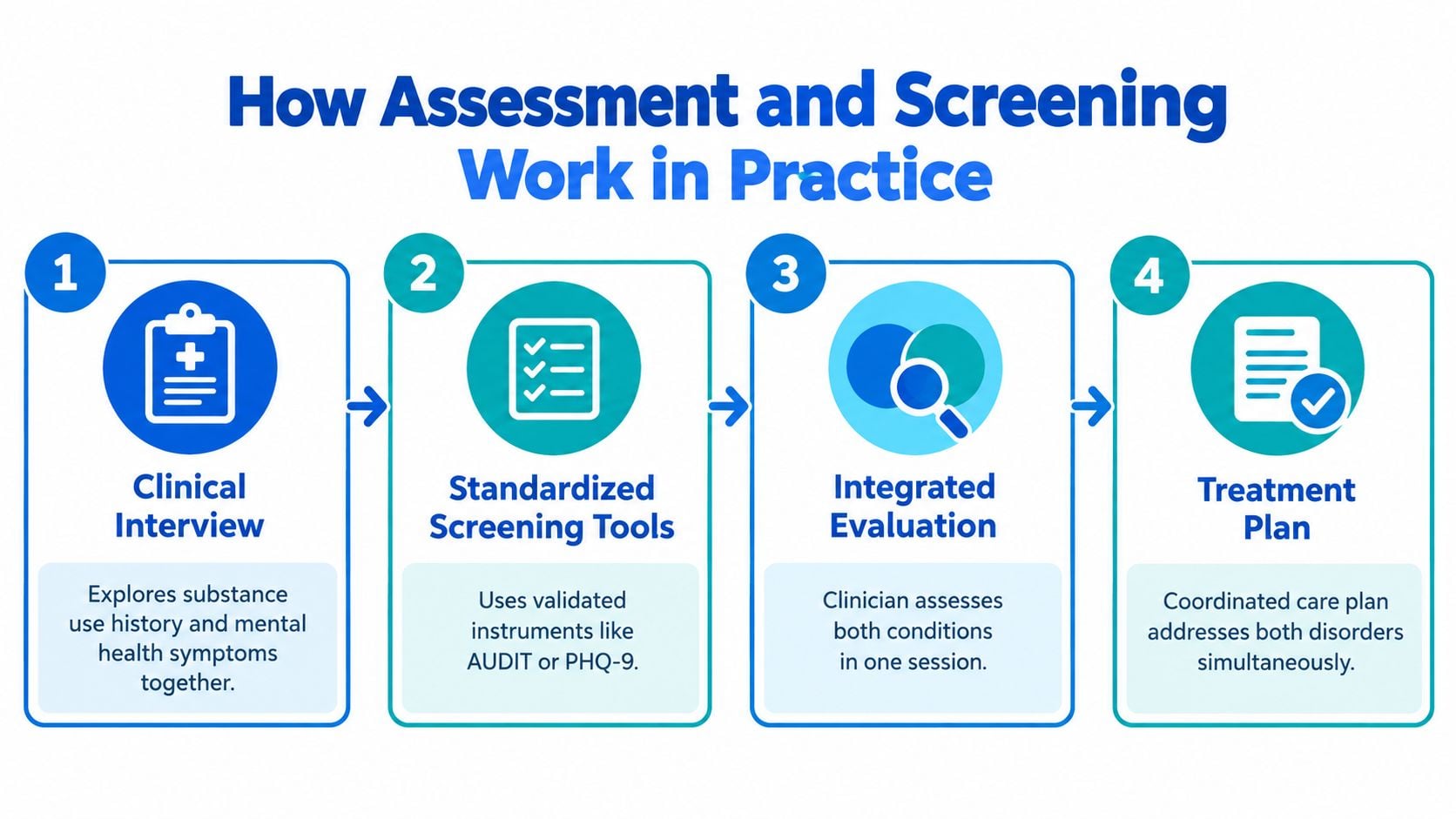
A thorough assessment begins with one conversation, not two disconnected forms. The clinician asks about substance use history and mental health symptoms together, including when each began, what makes each worse, and what changes during periods of sobriety or reduced use.
The first conversation may cover alcohol or drug quantity and frequency, cravings, withdrawal, prior treatment, mood, anxiety, trauma, sleep, self-harm thoughts, psychosis, medical conditions, medications, housing, relationships, and safety. A clinician may also speak with family members, with the patient's permission, because substance effects can make self-report incomplete.
What screening tools contribute
Standardized tools don't replace clinical judgment. They help clinicians ask consistent questions and identify areas that deserve a closer look.
- ASI: The Addiction Severity Index examines substance use alongside medical, employment, legal, family, and psychiatric concerns.
- DAST: The Drug Abuse Screening Test flags problematic drug use and its consequences.
- PHQ-9: This questionnaire screens for depressive symptoms and helps track changes over treatment.
- GAD-7: This tool identifies the severity of common anxiety symptoms.
- PCL-5: This trauma-focused measure screens for post-traumatic stress symptoms.
A medical evaluation may include laboratory testing, medication reconciliation, withdrawal monitoring, and a review of conditions that can resemble psychiatric symptoms. Clinicians should also ask about trauma and social conditions such as housing instability, food access, transportation, family safety, and employment. Those factors can determine whether a treatment plan is realistic.
If you want a low-pressure starting point before a clinical appointment, you can use this quick substance use check as an educational resource. It isn't a diagnosis, but it can help you organize concerns to discuss with a qualified professional.
Screening should continue as the person stabilizes. Intoxication and withdrawal can distort mood, concentration, sleep, and perception, so a clinician may need to revisit an initial impression rather than treating the first presentation as the complete picture. Trauma-informed care also matters because the way questions are asked affects whether a person feels safe enough to answer truthfully. The principles described in trauma-informed care offer a useful framework for respectful assessment.
Integrated Treatment Across the Continuum of Care
Integrated treatment means the mental health and substance use plans are built together. It doesn't require every person to receive the highest level of care. The right setting depends on withdrawal risk, psychiatric safety, medical needs, housing, support, motivation, and the person's ability to participate safely.
| Level of Care | Setting | Typical Duration | Best Suited For |
|---|---|---|---|
| Medically supervised detox | Medical or residential setting | Individualized | People who need monitoring during withdrawal or medication support |
| Residential or inpatient treatment | Structured live-in setting | Individualized | People needing continuous structure, psychiatric support, or distance from a high-risk environment |
| Partial hospitalization | Day treatment with home living | Individualized | People who need intensive clinical contact but can remain safe outside a facility |
| Intensive outpatient program | Community or telehealth setting | Individualized | People who can live at home while attending frequent therapy and recovery sessions |
| Outpatient therapy and medication management | Office, clinic, or telehealth | Ongoing as needed | People building long-term stability and relapse-prevention skills |
How the levels work together
Detox addresses immediate medical safety. A medical team can monitor withdrawal, evaluate psychiatric symptoms, and consider medication-assisted treatment, including medications such as buprenorphine or methadone when clinically appropriate for opioid use disorder. Detox alone isn't a complete dual-diagnosis treatment plan. It creates a safer starting point for the next stage.
Residential or inpatient care places medical, psychiatric, counseling, and recovery support in a coordinated environment. Daily therapy can address cravings and thought patterns while psychiatric care evaluates depression, anxiety, trauma, or mood instability. Group work gives people practice describing symptoms without hiding the substance use that may be connected to them.
PHP and IOP provide structure while allowing a person to live at home or in supportive housing. Sessions may include individual therapy, groups, medication management, relapse prevention, family work, and practical planning. IOP can also serve people who need continued care after residential treatment or who don't require round-the-clock supervision.
Across settings, clinicians may use CBT, DBT, motivational interviewing, trauma-informed methods, peer support, and MAT. CBT often focuses on the thoughts and behaviors that sustain distress or substance use, while DBT emphasizes emotional regulation, distress tolerance, and interpersonal skills. A practical explanation of the differences appears in this guide to comparing CBT and DBT.
The most effective continuum isn't a straight line for everyone. A person may move from detox to residential care, then to IOP and outpatient therapy. Another may begin with outpatient assessment and step up if safety or functioning worsens. SAMHSA identifies coordinated treatment as the evidence-based standard because addressing both conditions can improve quality of care, reduce or stop substance use, and improve psychiatric symptoms and functioning (SAMHSA's guidance on integrated treatment).
Who Gets Left Out of Integrated Care
A local program isn't automatically an integrated program. A facility may advertise addiction treatment while referring mental health care elsewhere, or offer therapy without psychiatric assessment and medication support. That distinction matters most for people who already face barriers to finding coordinated services.
Older adults may have depression, anxiety, sleep changes, or medication problems attributed to aging. Their alcohol or prescription medication use may go unquestioned. Rural residents may have limited transportation, few clinicians, and no nearby program that treats both conditions. Telehealth can reduce distance, but it doesn't solve every problem, particularly when someone needs medical withdrawal management or a safe living environment.
Low-income adults may face insurance restrictions, authorization delays, transportation problems, and a shortage of programs that accept their coverage. Black, Latino, and Indigenous patients can encounter disparities in assessment, medication access, and placement in specialty care. Veterans, LGBTQ+ people, and individuals involved in the justice system may have to coordinate with several agencies before finding a team that understands both behavioral health and social needs.
Psychiatric literature has identified low treatment uptake among older adults, minority groups, low-income people, and rural residents, while European guidance describes difficulty identifying, accessing, and navigating coordinated services because mental health and substance use systems remain separated (discussion of access disparities in dual-diagnosis care).
The overdose crisis makes missed mental health care especially serious. CDC reports that 37% of people who died from overdose in 2024 had evidence of a mental health diagnosis, while 20% were receiving mental health or substance use treatment at the time of death (CDC data on substance use and mental health). Integrated care must therefore include outreach, flexible access, culturally responsive assessment, and practical help with transportation, insurance, and follow-up.
Taking the First Step Toward Local Care
You don't need to know the correct diagnosis before making a call. You need to find out whether the program can evaluate substance use and mental health together, then explain what happens if both needs are identified.
What to check before enrolling
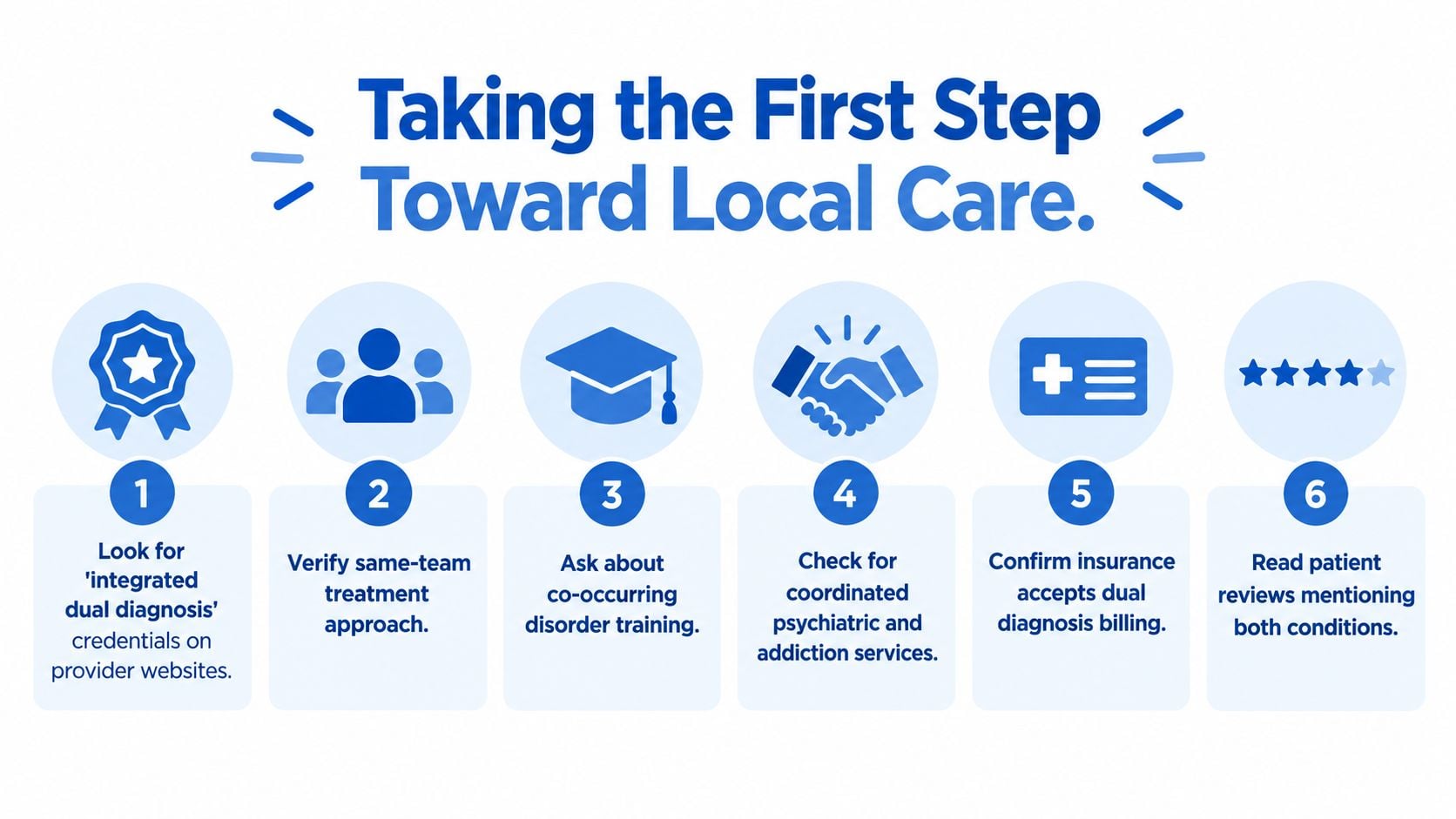
Look for clear language about integrated or co-occurring-disorder treatment, not only a general promise to support mental wellness. A credible program should be able to explain who evaluates psychiatric symptoms, who manages medications, how addiction counseling and medical care communicate, and what happens after detox or residential treatment.
Ask whether the same treatment team can coordinate:
- Psychiatric care: Find out whether a qualified prescriber can assess mood, anxiety, trauma, sleep, and medication risks.
- Addiction treatment: Ask about withdrawal management, cravings, relapse prevention, recovery education, and MAT.
- Family involvement: Clarify whether family sessions, education, and safety planning are available with the patient's permission.
- Step-down care: Confirm whether the program has pathways from detox to residential care, IOP, outpatient therapy, and peer support.
- Access options: Ask whether telehealth is available and whether the program serves people with transportation or work constraints.
- Payment: Verify accepted insurance, authorization requirements, self-pay options, and whether sliding-scale arrangements exist.
Questions that produce useful answers are direct: “Who treats the mental health condition?” “Do the therapist and prescriber share a treatment plan?” “What happens if withdrawal starts during an assessment?” “Can my family participate?” “What level of care do you recommend, and why?”
A local learning resource on co-occurring-disorders treatment centers can help you compare program features before contacting providers. Crisis lines, walk-in assessment clinics, and hospital bridge programs may offer faster evaluation when symptoms are urgent. If someone is in immediate danger, experiencing severe withdrawal, or having thoughts of suicide, call emergency services or go to the nearest emergency department.
Before intake, gather a medication list, recent discharge papers, insurance information, names of current providers, and a short description of substance use and mental health concerns. You don't need a perfect timeline. Write down what you know, what worries you most, and what support the person has at home.
The Big Picture on Dual Diagnosis
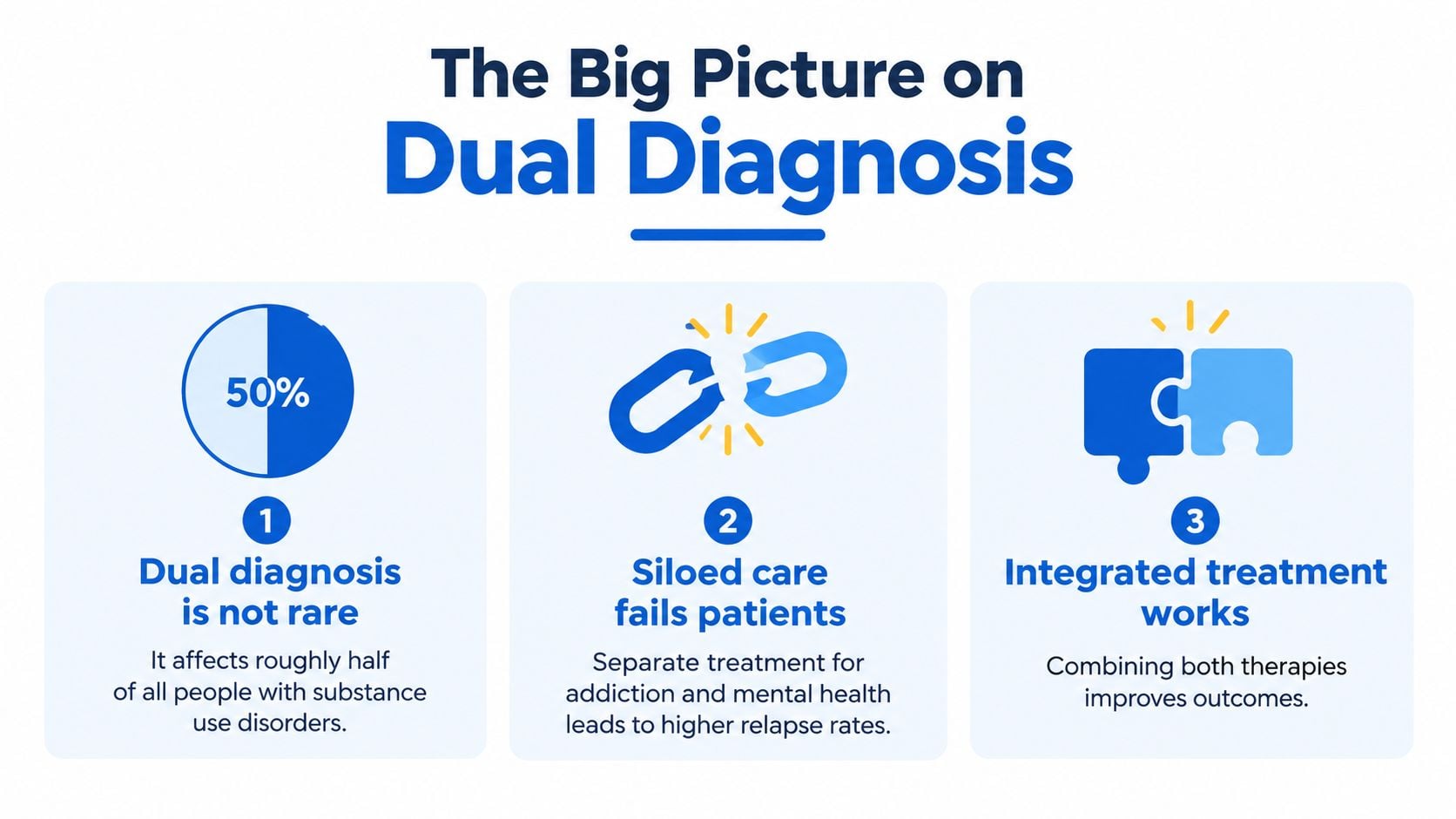
Dual diagnosis isn't a rare label added to an otherwise simple addiction problem. It describes the overlap between mental health and substance use conditions that many treatment teams encounter every day. Earlier U.S. research found that about 44% of people with an alcohol disorder and 64.4% of people with other drug-use disorders had a psychiatric disorder at some point in life, according to the historical evidence summarized by Cleveland Clinic (an overview of dual diagnosis and its prevalence).
That history changes the central question. Instead of asking which condition deserves treatment first, clinicians should ask what is happening between the conditions, what risks are present now, and which team can address both without making the patient coordinate the system alone.
What integrated care changes
Integrated treatment brings assessment, medication decisions, therapy, recovery planning, and follow-up into one coordinated process. It allows a clinician to ask whether a panic symptom is related to trauma, withdrawal, medication, or an anxiety disorder. It gives the team a chance to treat cravings without ignoring depression, and to treat depression without overlooking active substance use.
This model also makes room for different levels of care. Some people need medically supervised detox or residential structure. Others can begin with outpatient therapy, MAT, psychiatric care, and peer support while living at home. The setting can change as safety and stability change, but the plan should keep both conditions visible.
A low-pressure first step is to call a local program and ask three questions: Do you treat co-occurring disorders on site? Can mental health and substance use clinicians coordinate the same plan? Can you arrange an assessment promptly? You don't need to commit during that call. You only need enough information to decide whether the program understands the whole problem.
Addiction Resource Center LLC offers integrated support for adults with substance use and co-occurring mental health needs, including medically supervised detox with MAT, residential rehabilitation through a partner facility, and IOP in person or by telehealth. Visit Addiction Resource Center LLC to ask about local care, insurance, an assessment, or guidance for a loved one.