Yes, alcoholism can be genetic. About 49% to 60% of vulnerability to alcohol use disorder is inherited, but genes alone don't determine whether someone develops a drinking problem. The question often appears during an ordinary family moment. You notice that a parent couldn't control their drinking, a sibling entered treatment, or several relatives have struggled …

Yes, alcoholism can be genetic. About 49% to 60% of vulnerability to alcohol use disorder is inherited, but genes alone don't determine whether someone develops a drinking problem.
The question often appears during an ordinary family moment. You notice that a parent couldn't control their drinking, a sibling entered treatment, or several relatives have struggled with alcohol. Then you wonder whether the same risk is waiting for you, or whether your children have inherited it.
That worry makes sense, but family history isn't a prediction of an unavoidable future. Genes can raise susceptibility, while stress, trauma, mental health, drinking patterns, relationships, and access to support influence how that susceptibility unfolds. Two relatives can share a family history and still have very different experiences with alcohol.
The useful question isn't only, “Is alcoholism inherited?” It's also, “What does inherited risk mean for my choices, my family, and the care I might need?” The answer can help you replace fear with practical awareness. You can watch for early warning signs, discuss family health openly, protect mental health, and seek professional support before alcohol causes a crisis.
Table of Contents
- Introduction Understanding Why Families Ask About Genetic Risk
- How Genetics Influences Alcohol Use Disorder
- Key Genetic Markers and What Current Research Can and Cannot Explain
- Why Genes and Environment Together Shape Real World Risk
- Assessing Your Family History and Lowering Risk
- How Genetic Insights Guide Screening and Personalized Treatment Today
- Taking the Next Step With Addiction Resource Center in Yuba City
Introduction Understanding Why Families Ask About Genetic Risk
A person may begin asking about inherited risk after seeing a familiar pattern repeat. A parent drank to cope with stress. An older sibling started losing control in adulthood. Now the person notices that alcohol affects them strongly, or they're concerned about a teenager who has begun drinking. The family story creates uncertainty because it includes both biology and lived experience.
Alcohol use disorder, or AUD, describes a pattern in which alcohol use becomes difficult to control and continues despite harm. A family history can reflect inherited vulnerability, learned behavior, shared stress, easier access to alcohol, or several of these influences at once. It doesn't prove that a relative's drinking problem came from one specific gene.
The clearest scientific answer is that genetics contributes substantially to AUD risk, but it doesn't act as a destiny switch. The best twin-and-adoption evidence estimates heritability at about 49%, with a 95% confidence interval of 43% to 53% (twin and adoption evidence on alcohol use disorder heritability). Medical guidance from the National Institute on Alcohol Abuse and Alcoholism also describes inherited vulnerability as roughly 50% to 60% and emphasizes that AUD is polygenic rather than caused by one alcoholism gene (NIAAA overview of genetics and AUD).
A family history is a reason for informed care, not a sentence.
That distinction matters for prevention. Someone with increased vulnerability may choose to delay or avoid alcohol, build healthier ways to manage distress, and ask a clinician about screening. Someone already drinking heavily can seek care without blaming themselves or their relatives. Families looking for a clearer explanation may also benefit from this guide to whether addiction runs in the family.
How Genetics Influences Alcohol Use Disorder
Think of inherited risk as a volume dial, not an on-and-off switch. A person may inherit biological features that make alcohol feel more rewarding, make impulsive behavior more likely, or affect how the body processes alcohol. Those features can turn the dial upward, but the setting can change as a person moves through different environments and experiences.
Heritability describes populations, not personal fate
A heritability estimate doesn't mean that exactly half of one person's AUD is genetic. It describes how much inherited variation helps explain differences in risk across a population under particular conditions. The remaining variation reflects environmental influences and experiences that family members don't share, along with other factors researchers can't reduce to a single cause.
Twin and adoption studies help researchers separate these influences. Identical twins share more inherited DNA than fraternal twins, while adopted children can be compared with both their biological and adoptive relatives. When patterns of alcohol-related risk track with biological relatives even when environments differ, inherited influence becomes more plausible. Historical twin research also found that additive genetic factors explained 48% to 58% of variation in liability to alcohol abuse and dependence among male twins (population-based twin research).
Many small influences add up
There isn't one gene that switches alcoholism on. Polygenic risk means that many genetic variants can each make a small contribution. Some affect alcohol metabolism, while others may influence reward, stress response, impulse control, or vulnerability to psychiatric symptoms.
A liability-threshold model helps explain the process. Imagine many small weights placed on a scale. Genetic factors add some weight, while sleep disruption, trauma, social pressure, untreated depression, and repeated heavy drinking may add more. Protective relationships, stable routines, education, therapy, and early support can remove weight or keep the scale below the point at which alcohol use becomes a disorder.
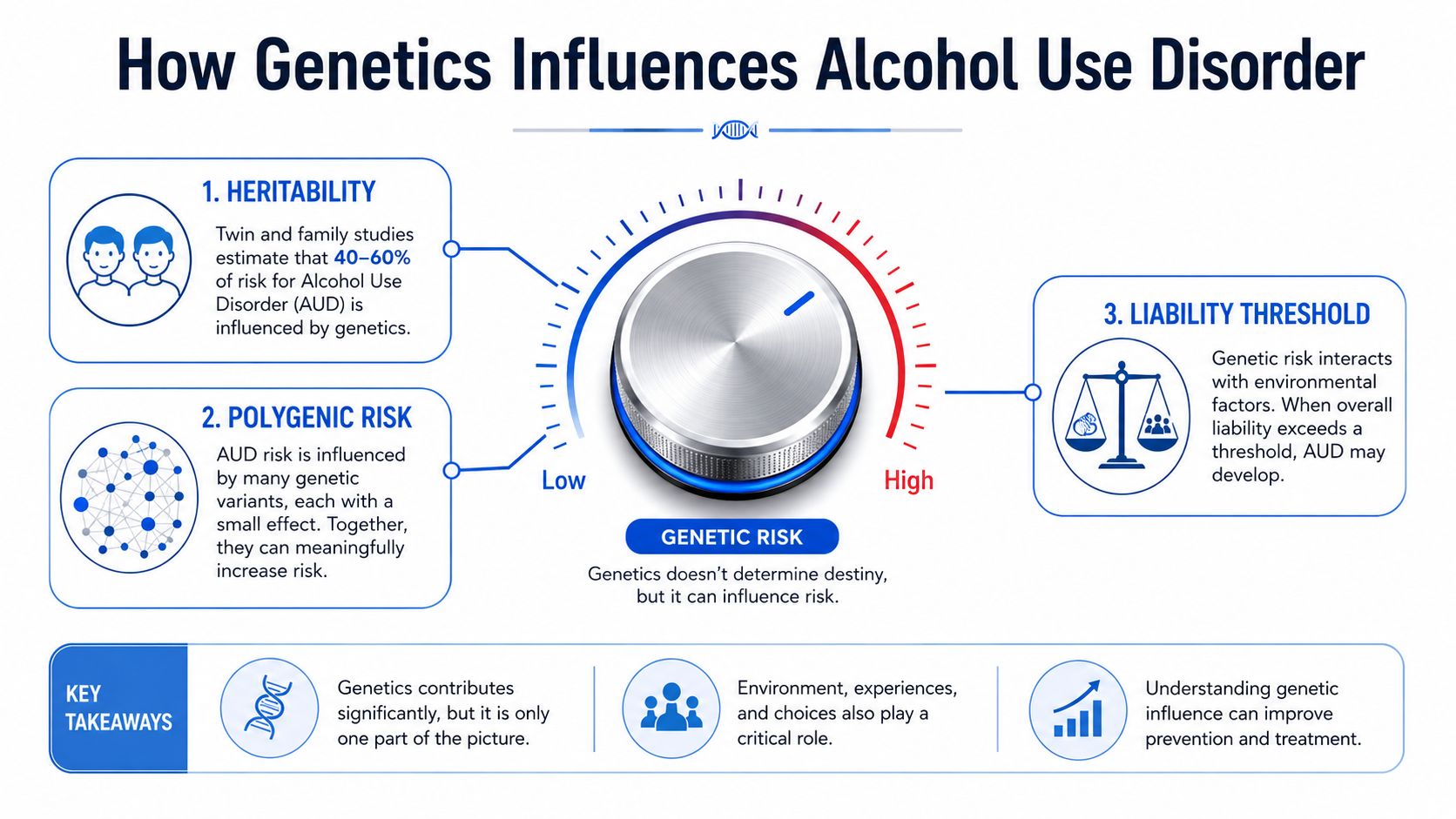
The practical meaning is straightforward. Inherited vulnerability can make certain environments more dangerous, but environmental changes can also reduce the likelihood that vulnerability becomes illness. That's why prevention remains worthwhile even when AUD affects several generations of a family.
Key Genetic Markers and What Current Research Can and Cannot Explain
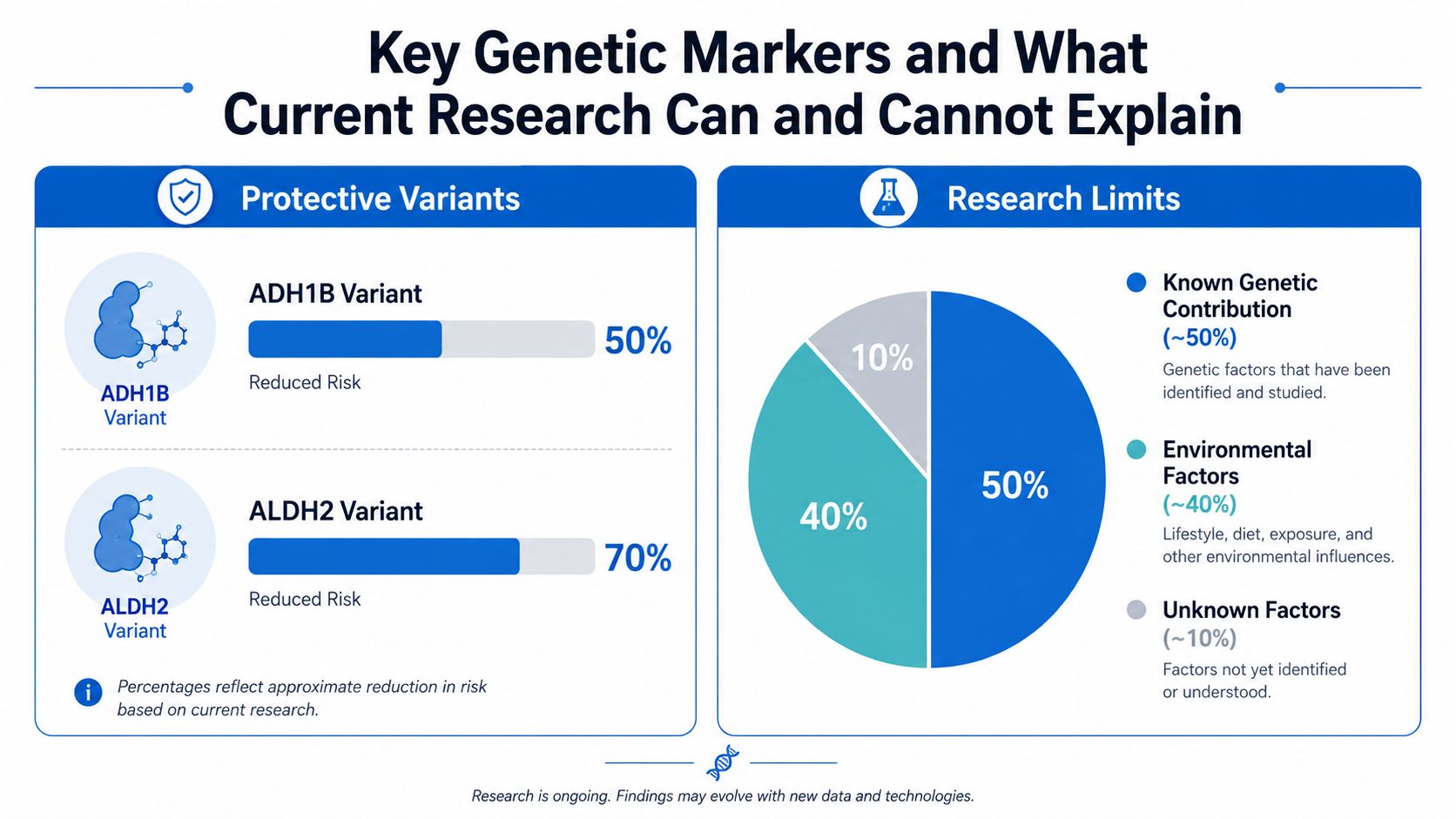
A family may carry alcohol-related genetic variants, yet relatives can have very different experiences with drinking. The clearest examples involve how the body processes alcohol. The ADH1B and ALDH2 genes help regulate alcohol metabolism and acetaldehyde handling. Functional variants can make alcohol feel less rewarding or more unpleasant, lowering the likelihood of problematic use for some carriers.
Review-level evidence reported protective odds ratios for functional ADH1B and ALDH2 variants in approximately the 0.2 to 0.4 range (research on alcohol-metabolizing genes and AUD risk). That range describes a strong protective association in the studied populations. It is not a guarantee of protection, and people without these variants are not destined to develop AUD. These genes can adjust the volume of risk, rather than act as an on or off switch.
What genome-wide studies add
Genome-wide association studies, or GWAS, scan genetic differences across many people instead of examining one gene at a time. One multi-ancestry study identified 85 independent risk variants in European ancestry and 110 across combined analyses. The findings support a polygenic model, in which many variants contribute small effects rather than one marker determining the outcome.
Other research identified 37 genome-wide significant loci, including seven novel AUD loci. Whole-exome analysis also found rare-variant evidence involving CNST and IFIT5 (recent AUD loci and exome findings). Results like these help explain why a genetic score may work differently across populations. A finding observed in one ancestry group may not predict risk equally well in another.
What a gene test can't promise
A consumer genetic report may identify selected variants, but it cannot reliably forecast whether someone will develop AUD, how severe it may become, or whether drinking will resume after treatment. Genes associated with clinical AUD also overlap poorly with genes associated with heavy drinking and alcohol-associated liver disease (research on genetic distinctions among AUD, drinking, and liver disease).
A result should therefore guide questions, not determine identity or treatment. Family history, current drinking, mental health, and clinical assessment usually offer more useful information than one genetic finding. Families should also remember that inherited mental health vulnerability can involve multiple conditions and pathways; learning how mental illness may be inherited can provide helpful context.
Why Genes and Environment Together Shape Real World Risk
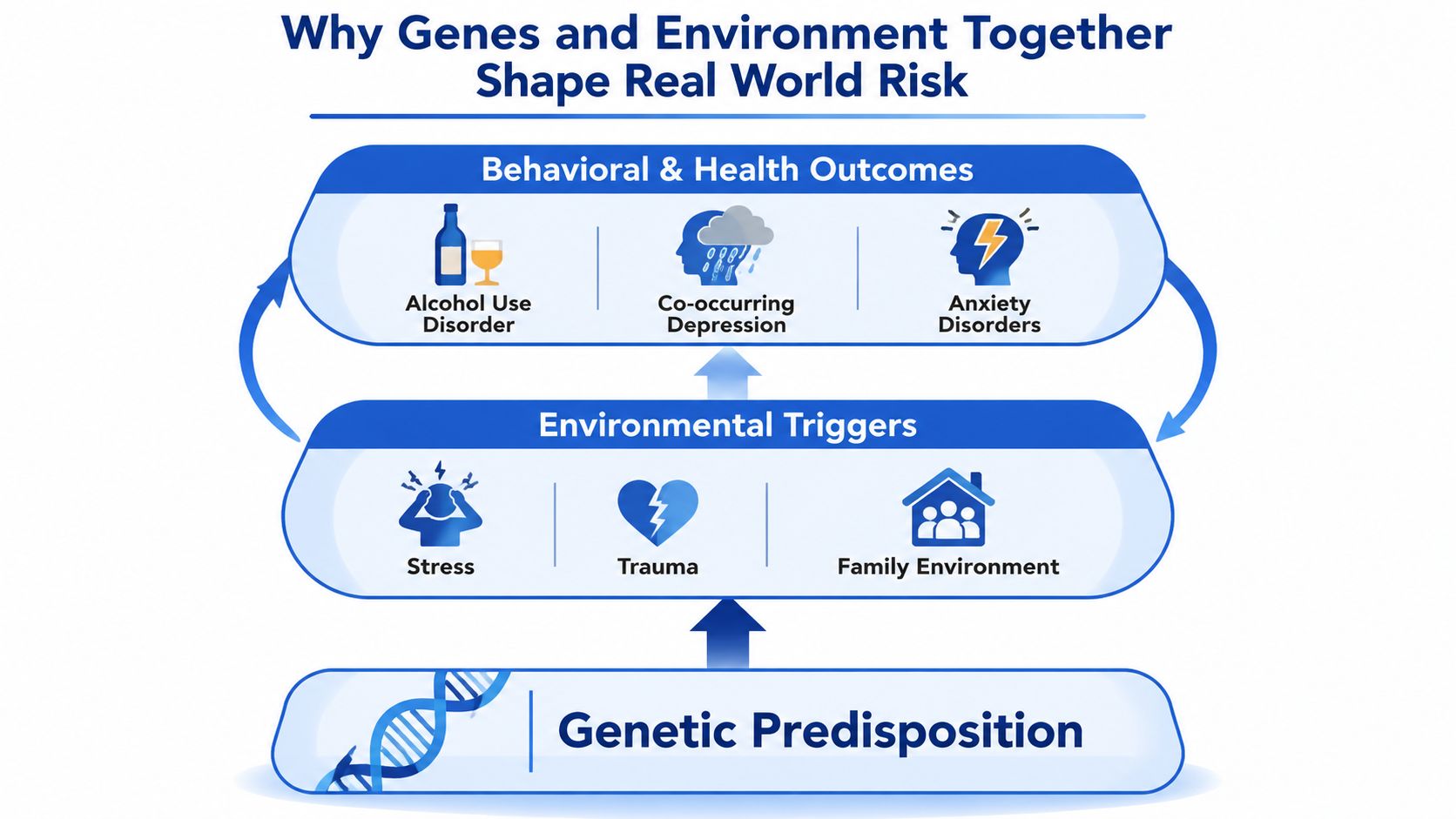
Genetic risk becomes meaningful through circumstances. A person may inherit sensitivity to reward, stress, or alcohol's effects, but that vulnerability can remain quiet in a supportive environment. Another person with a similar family history may face trauma, untreated anxiety, social isolation, or persistent stress that pushes alcohol toward becoming a coping tool.
Education can also interact with inherited risk. Yale reported that higher educational attainment moderated genetic risk among European-ancestry participants, illustrating that social and developmental conditions can change how inherited vulnerability appears (Yale report on genetic, psychiatric, and environmental factors). This doesn't mean education eliminates risk. It shows that genes operate within a broader setting.
Why relatives can have different outcomes
Consider two siblings raised in the same family. One develops a stable support network, learns to manage stress without alcohol, and receives treatment for anxiety early. The other experiences a traumatic relationship, works in a setting where heavy drinking is expected, and uses alcohol to sleep. Their family history may be similar, but their exposures and coping resources are not.
Even people who share many genes don't share every life experience. Friends, partners, workplaces, illnesses, opportunities, and private emotional experiences shape behavior in different ways. Early-life trauma may be particularly important for some stress-related genetic vulnerabilities, which helps explain why the same inherited background can lead to different outcomes.
Risk can change over time
Inherited biology doesn't change, but exposure and protection do. A person can reduce risk by treating depression, leaving an unsafe environment, strengthening relationships, learning emotional regulation, and avoiding alcohol-based coping. These actions don't deny biology. They change the conditions in which biology expresses itself.
You can't edit your genes, but you can change many of the conditions that turn vulnerability into harm.
Assessing Your Family History and Lowering Risk
Family history becomes more useful when you make it specific. Instead of recording only that “someone drank too much,” identify the relative, the pattern of use, the approximate life stage when problems began, and whether mental health concerns appeared alongside drinking. You don't need perfect information. A consistent pattern can still help a clinician understand vulnerability.
Build a practical family map
Start with biological relatives such as parents, siblings, grandparents, aunts, and uncles. Note whether anyone had difficulty stopping, repeated consequences from drinking, withdrawal, treatment, or long periods of recovery. Keep separate notes for alcohol and other substances because different patterns may point to overlapping but distinct vulnerabilities.
Also record context. Did alcohol become a way to manage grief, anxiety, pain, conflict, or sleep? Did relatives experience depression, anxiety, trauma, or other addiction concerns? A step-by-step medical history guide can help organize questions before a primary care or behavioral health appointment.
Turn information into protective action
You don't need genetic testing before taking sensible steps. Consider these practical choices:
- Delay or avoid alcohol: If family history concerns you, not drinking can remove a major source of uncertainty and avoid alcohol becoming a routine coping strategy.
- Track early warning signs: Pay attention to drinking more than intended, unsuccessful attempts to cut down, using alcohol for emotional relief, or continuing despite relationship, work, or health problems.
- Treat mental health concerns early: Therapy, psychiatric care, and trauma-informed support can reduce the pressure to self-medicate.
- Create a family conversation: Use neutral language such as, “Alcohol has caused problems in our family, so I want us to talk about coping and support.”
- Ask a clinician for screening: A primary care professional can discuss drinking patterns, family history, medications, mental health, and whether specialty addiction care would help.
The goal isn't to label every family member. It's to notice vulnerability early enough to respond with support rather than waiting for a crisis.
How Genetic Insights Guide Screening and Personalized Treatment Today
Clinicians usually don't need a genetic test to begin useful AUD care. They can ask about biological relatives, drinking patterns, mental health, trauma, medications, withdrawal history, and previous treatment responses. This information helps them decide whether someone needs brief intervention, outpatient therapy, medically supervised withdrawal management, residential care, or a more structured aftercare plan.
Genetic research can add context, but it doesn't currently function as a standalone diagnostic tool. A 2025 study found that polygenic risk scores influenced AUD symptom expression through a factor associated with symptom severity. Yale reported that these scores explained only 1.3% to 1.9% of AUD severity variance among African- and European-ancestry participants (study of polygenic risk and AUD symptom severity). That limited predictive power means clinicians shouldn't use a score alone to decide who will relapse, how severe symptoms will become, or which medication will work.
What personalized care means in practice
Personalized treatment means combining biology with the person's current needs. A clinician may consider:
| Clinical question | Information that can guide care |
|---|---|
| Is withdrawal medically risky? | Current alcohol use, prior withdrawal, health conditions, and clinical assessment |
| What supports recovery? | Therapy preferences, family support, work demands, housing, and transportation |
| What drives drinking? | Trauma, depression, anxiety, sleep problems, pain, or social pressure |
| What should follow initial care? | Craving patterns, triggers, progress, recovery goals, and available support |
Medication-assisted treatment can be part of an individualized plan when clinically appropriate. Medication decisions require a qualified prescriber who can review health history, interactions, symptoms, and treatment goals. Counseling, recovery mentoring, mental health care, monitoring, and relapse-prevention planning may work alongside medication.
For a plain-language overview of available approaches, explore MAT for alcohol use. Genetic findings may eventually help refine care, but today the strongest personalization comes from listening carefully to the person and adjusting treatment as their needs change.
Taking the Next Step With Addiction Resource Center in Yuba City
A family history of AUD can leave people feeling trapped between two fears. They may worry that treatment means admitting defeat, or that inherited risk makes recovery impossible. Neither conclusion is supported by the science. Genetic vulnerability can explain why alcohol affects someone differently, while treatment and environmental change can help that person regain stability.
Addiction Resource Center LLC offers care for adults with substance use and co-occurring mental health needs in Yuba City and Northern California. Its services include medically supervised detox with MAT, residential rehabilitation through partner facility Ona Treatment Center in Browns Valley, California, and an Intensive Outpatient Program available in person or through telehealth.
Support can match the person's level of need
The center's multidisciplinary team includes a medical doctor, registered nurse, licensed counselors, licensed marriage and family therapist, and recovery mentors. Care includes 24/7 wellness monitoring, individualized planning, education, accountability, coping-skills work, relapse prevention, and aftercare planning.
That range matters for families concerned about inherited risk. Someone may need medical oversight during detox, while another person may need flexible outpatient structure, therapy for trauma or depression, or continued support after residential care. The center accepts most major insurance plans and welcomes TRICARE beneficiaries.
You can visit the center at 1002 Live Oak Blvd., Suite A, Yuba City, California, or use its 24/7 phone and text line at 530-625-7910. A conversation can focus on your own drinking, a relative's needs, insurance questions, or whether a tour would make treatment feel more manageable.
The most important step doesn't require certainty about your genes. If alcohol is becoming difficult to control, or family history has raised concern, early guidance can help you choose a safer path before the problem grows.
Addiction Resource Center LLC provides medically supervised detox with MAT, residential rehabilitation through Ona Treatment Center, and in-person or telehealth IOP for adults needing structured support. Visit Addiction Resource Center LLC to learn about treatment options, schedule a tour, or connect with compassionate guidance for yourself or a loved one.