You may be sitting with a hard, ordinary worry. Maybe a partner is drinking more than they used to, sleeping late, snapping at everyone, and saying they're just tired. Maybe a parent has stopped calling back, or a friend keeps promising they'll cut down next week, but the next week never looks different. That mix …

You may be sitting with a hard, ordinary worry. Maybe a partner is drinking more than they used to, sleeping late, snapping at everyone, and saying they're just tired. Maybe a parent has stopped calling back, or a friend keeps promising they'll cut down next week, but the next week never looks different.
That mix of low mood and rising substance use can feel confusing because each problem seems to explain the other. Depression can look like laziness or withdrawal, while substance use can look like the reason someone seems flat, irritable, or unreachable. Clinically, those two patterns often sit on top of each other, and families usually feel the overlap before they can name it.
Table of Contents
- Why Depression and Substance Use So Often Travel Together
- How Common the Overlap Really Is
- The Shared Biology Behind Both Conditions
- Warning Signs and How Clinicians Screen for Both
- Which Condition Do You Treat First
- Integrated Treatment Across the Continuum of Care
- Relapse Prevention and Family Support Strategies
- How to Get Help Locally and What to Expect Next
Why Depression and Substance Use So Often Travel Together
A woman starts drinking wine every night after work because it takes the edge off her thoughts. At first, it seems practical, almost harmless, but within months she feels more tired in the morning, less interested in people, and more ashamed of how much she's relying on the drink. Her family notices the drinking, but they also notice the quiet, the tearfulness, and the way she no longer enjoys the things that used to anchor her.
That pattern is common because depression and substance use disorders rarely stay separate. National surveys have found that about half of people who experience a mental illness in their lifetime will also experience a substance use disorder, and vice versa, which is why modern care treats them as connected problems rather than unrelated diagnoses (SAMHSA 2024 data summary).
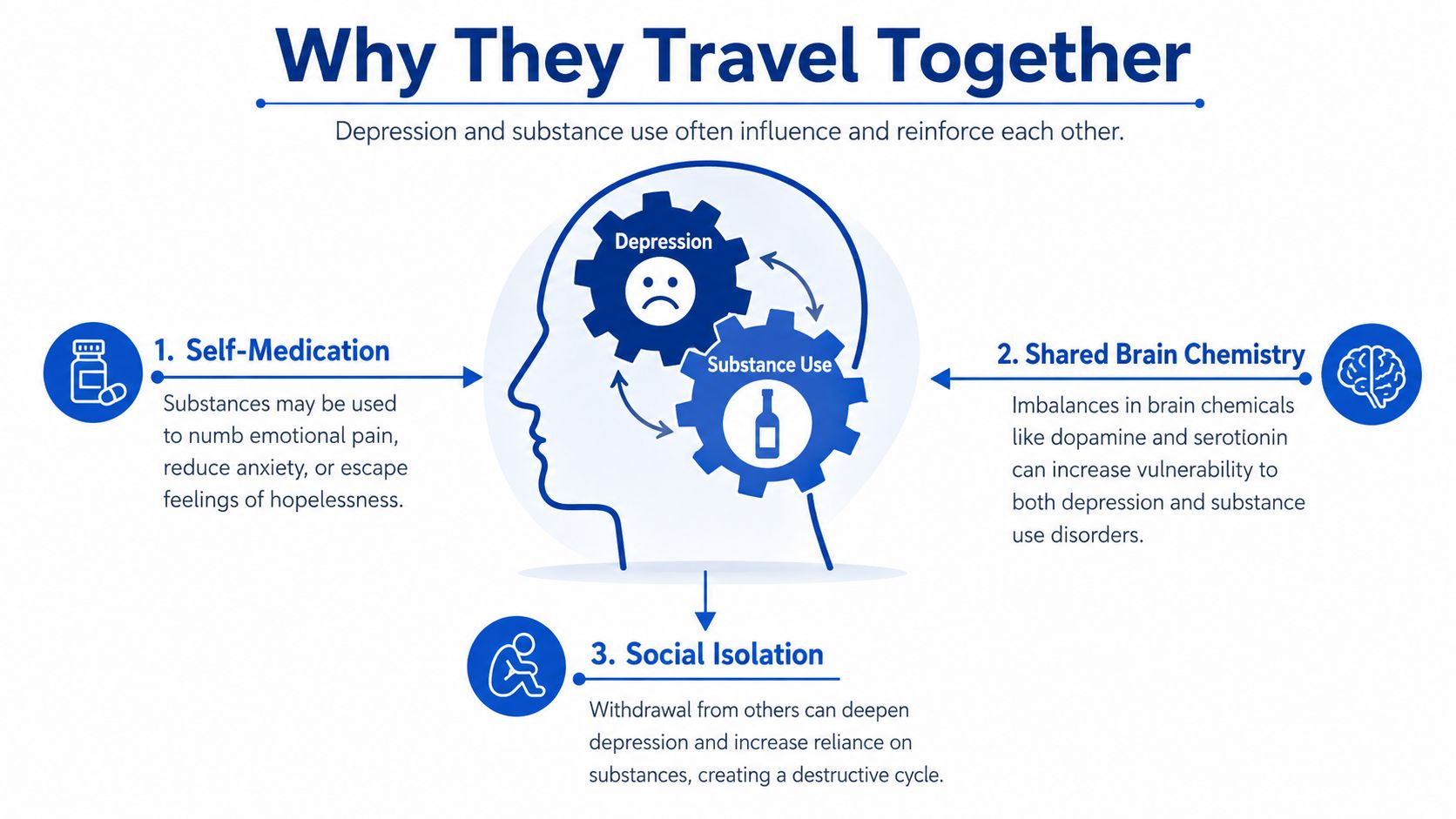
Four ways the cycle gets built
Sometimes substances temporarily mute depression, so the person thinks the drink, pill, or drug is helping when it's really just dulling symptoms for a few hours. Sometimes depression pushes a person toward self-medication because sleep, appetite, energy, and motivation all feel broken at once.
Shared stressors also matter. Trauma, chronic conflict, instability, and isolation can set both conditions in motion, which is why this isn't only a matter of personal choice. The brain and the environment are both part of the picture.
Practical rule: if a person feels better only while using and worse as the effect wears off, the substance may be functioning like a short-term anesthetic, not a solution.
The reason integrated care exists is simple. Treating the alcohol or drug problem while ignoring the depression can leave the same emotional pain in place, and treating the depression while ignoring the substance use can leave the person too unstable to benefit fully from therapy or medication.
How Common the Overlap Really Is
A worried family often first sees the pattern in everyday life. One person is missing work, drinking more, losing interest in meals or sleep, and pulling away from conversations. By the time anyone asks whether depression and substance use are both part of the picture, the two conditions may already be reinforcing each other.
The overlap is common in the general population. SAMHSA's 2024 data summary found that 16.8% of people age 12 or older, about 48.4 million people, met criteria for a substance use disorder in the past year, while 23.4% of adults age 18 or older, about 61.5 million, experienced any mental illness (SAMHSA 2024 data summary). On the depression side, 8.2% of U.S. adults, or 21.4 million people, had a past-year major depressive episode in 2024, and 5.6%, about 14.7 million, reported severe impairment from it. Those figures come from the same source, and they show how often a clinician may be working with both problems in the same patient.
Those numbers matter because they describe the baseline, not a rare exception. A clinician who sees depression and substance use together is usually seeing a familiar pattern, not an unusual one.
The treatment setting changes the picture
The rates are higher in treatment samples. A meta-analysis reported lifetime major depression at 24.3% among alcohol-dependent men and 48.5% among alcohol-dependent women, with lifetime co-occurrence in treatment samples ranging from 50% to 70% (PMC4864601). Another review reported a 12-month prevalence of comorbid major depressive disorder of 15.5% in the community, rising to 32.8% among people in treatment for alcohol use disorder and 44.3% among those in treatment for drug use disorder. The same source supports both findings, so the pattern is consistent across settings.
That gap helps explain why families are often startled by how quickly a mood problem turns into a substance problem, or the other way around. A person may enter care because of drinking or drug use and only then describe low mood, hopelessness, or loss of interest. Another may arrive because of depression and only later disclose that substances have become the main way they are getting through the day.
A useful way to read the numbers is this. Community data show how many people are living with these conditions. Treatment data show how often both problems show up in the same chair, at the same time.
The Shared Biology Behind Both Conditions
Depression and addiction are not the same diagnosis, but they share some of the same wiring problems. Both involve dysregulation in mesocorticolimbic reward circuitry and limbic and frontal-striatal systems, with shared changes in dopamine, serotonin, GABA, glutamate, and norepinephrine signaling, plus HPA-axis and inflammatory involvement (PubMed 33648671).
A simple analogy helps. Think of the brain's reward and stress systems like a thermostat that's stuck. One side keeps telling the body to chase relief, while the other side keeps telling it that nothing feels safe, rewarding, or settled. When that happens, a person can feel pulled toward substances and also trapped in the flat, hopeless feeling of depression.
Why willpower alone often fails
Willpower assumes the brain is starting from a neutral place. In co-occurring depression and substance use, it usually isn't. The person may be fighting cravings, poor sleep, low motivation, and a stress response that never fully turns off.
That shared biology also explains why mood can worsen after heavy use, even when the person started drinking or using to feel better. The substance may deliver short-term relief, but the brain often pays for that relief later with more emotional volatility and a stronger craving for the same escape.
If you want a deeper science-based explainer on the brain side of this, scientific research by Ayahuasca.com offers a useful overview of depression-related neurobiology in a way that's accessible without flattening the science.
The same logic shows up in family stories again and again. A person drinks to calm down, then wakes up more anxious. They feel worse, so they drink again. The cycle is biological, but it shows up as behavior.
One more point matters for readers trying to make sense of a loved one's sudden personality change. Brain chemistry doesn't erase responsibility, but it does change what effective help looks like. You can't coach someone out of a loop if their stress and reward systems are both misfiring.
For a family-level discussion of inherited vulnerability and mental health patterns, see Addiction Resource Center's mental illness inheritance resource.
Warning Signs and How Clinicians Screen for Both
A loved one doesn't need to hit a crisis point before the pattern becomes visible. The warning signs usually show up as a cluster, not a single dramatic event. Someone may be pulling away from family, missing work, sleeping at odd hours, or using more often to get through the day.
The signs families notice first
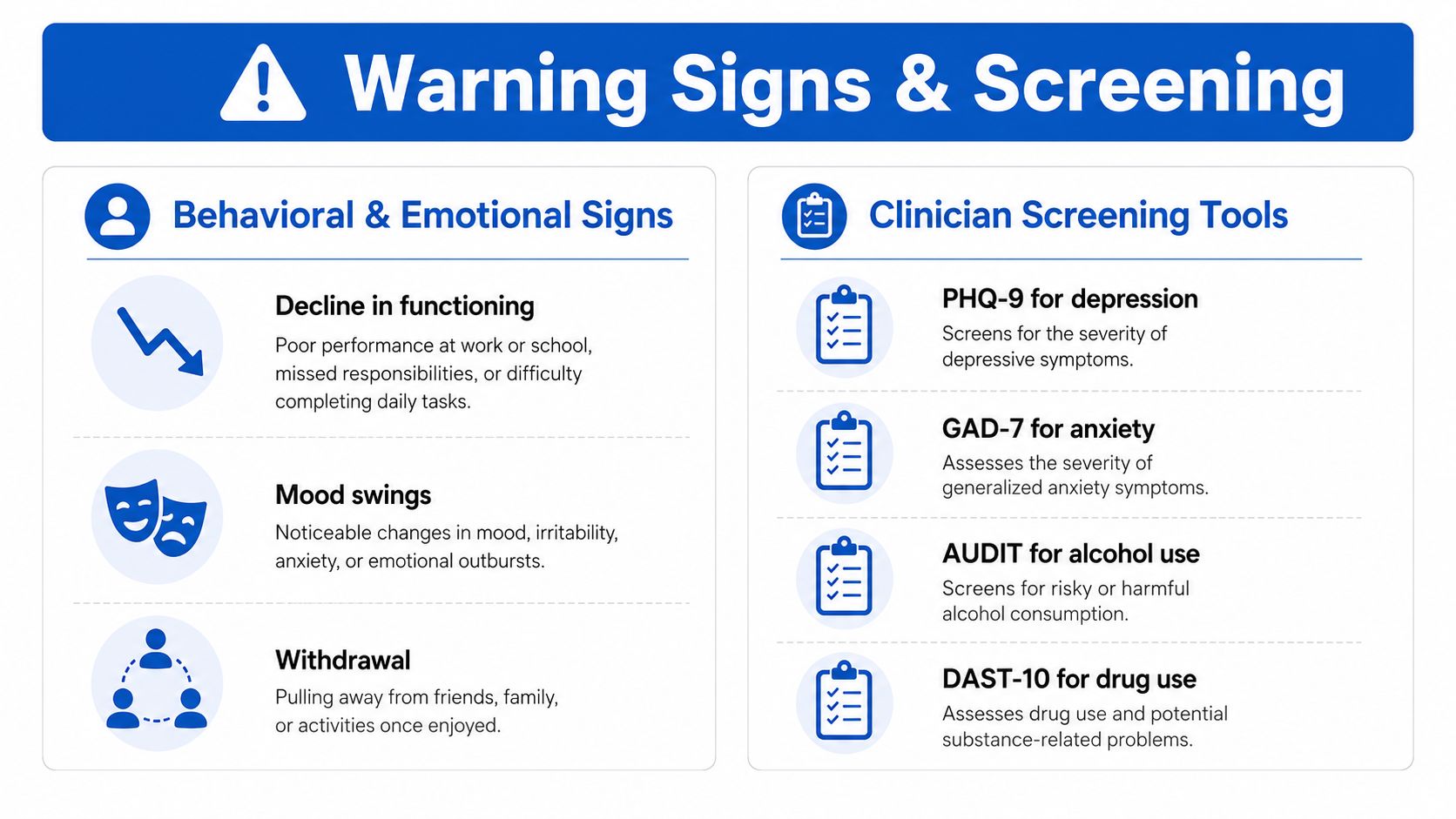
Depression often brings loss of interest, social withdrawal, irritability, and a sense that simple tasks have become too heavy. Substance use often adds secrecy, missed obligations, changes in sleep, and a pattern of brief abstinence followed by heavier use. When the two overlap, the person may seem to improve for a day or two and then slide right back.
A useful question is not “Are they drinking or sad?” It's “What are they using to get through the sadness, and what happens when they try to stop?”
A family member's job is not to diagnose. It's to notice patterns, name them calmly, and help the person get assessed.
Clinicians screen for both sides at once because treating only one can miss the core problem. Common tools include the PHQ-9 for depression, the AUDIT for alcohol use, the DAST for drug use, and integrated assessments such as the ASI. The point is not to hand someone a stack of forms. The point is to see the whole picture before picking a treatment plan.
For nurses and frontline clinicians, the SBIRT nursing guide on Premiere is a practical resource on how early screening and brief intervention can fit into real-world care.
What a thorough assessment looks at
A strong evaluation asks about mood, sleep, appetite, trauma, drinking or drug patterns, and safety. It also checks whether the substance use is hiding depression, or whether depression is making the substance use harder to stop.
- Functioning changes: missed work, missed school, missed family commitments.
- Mood changes: numbness, hopelessness, irritability, or sudden tearfulness.
- Use patterns: using alone, needing more to get the same effect, or drinking and using to cope with stress.
If these signs are showing up together, it's worth getting a professional assessment rather than trying to sort it out at home.
Which Condition Do You Treat First
This is the question families ask most often, and it is the one many consumer articles skip. Clinicians often stabilize substance use and withdrawal first, then reassess mood. Severe, independent, or suicidal depression may require immediate treatment alongside substance-use care. The order depends on withdrawal risk, suicidal thoughts, whether the depression seems substance-induced, and the findings of a careful clinical assessment.
That sequencing matters because some depressive symptoms are caused or intensified by alcohol or drugs. If drinking or drug use is driving the mood crash, reducing or stopping the substance can reveal what is still there after the body starts to settle.
When antidepressants should wait
A person who has been drinking heavily, using stimulants, or moving through withdrawal may look depressed, but the mood picture can change once the substance use is stabilized. In those cases, clinicians often watch closely, support sobriety, and reassess before adding another medication.
That does not mean the depression is being ignored. It means the team is avoiding a decision that could be wrong if the picture is still shifting.
When treatment should start immediately
If depression looks independent, long-standing, or severe, especially with meaningful suicidal thoughts, waiting can be unsafe. In those situations, guidance supports starting antidepressant treatment right away while substance-use care continues, because the risk of delay can outweigh the uncertainty about sequencing (PMC2722074).
Only a qualified clinician should decide whether to start, delay, or adjust antidepressants, especially during withdrawal or when suicidal thoughts are present. That caution matters because the same symptoms can mean different things in different people. One person may be in a temporary substance-related crash, while another may have depression that needs direct treatment now.
There is also a reason not to be too rigid. Untreated depression can still drive more substance use. The review cited above noted higher odds of later illicit drug use and prescription drug use among depressed patients with unmet mental health needs.
The answer is nuanced. Stabilize the substance use, reassess the mood, and move faster on antidepressants when the depression is clearly separate or dangerous. Good care uses judgment, not slogans.
Integrated Treatment Across the Continuum of Care
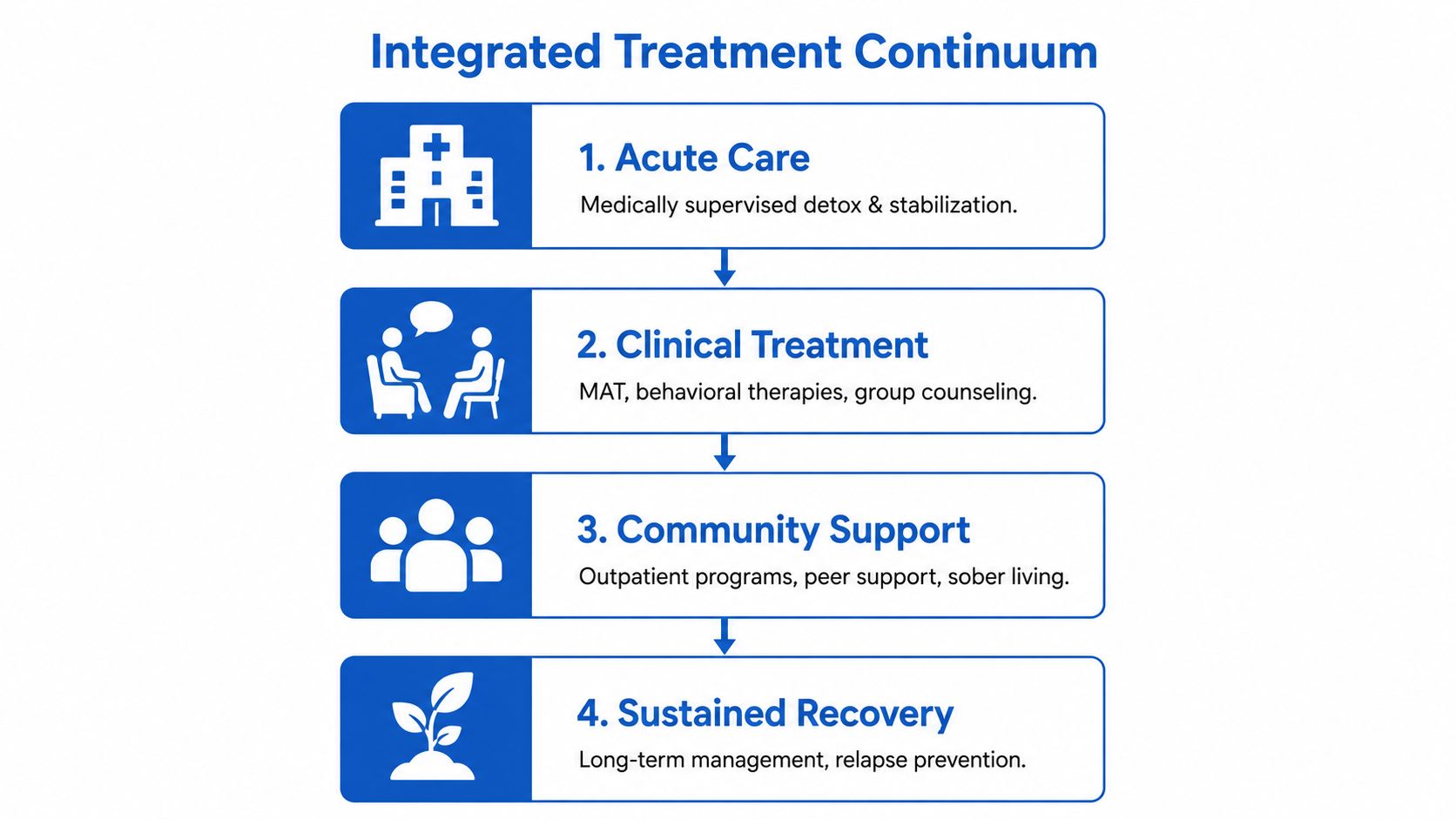
A person living with both depression and substance use may need more structure at the start than later on. Early care often begins with medically supervised detox when withdrawal is a concern, then moves into therapy, medication support, and step-down outpatient care as stability improves.
Some programs organize that full ladder in one place. Addiction Resource Center describes a continuum that includes medically supervised detox with MAT, residential rehabilitation through a partner facility, IOP in person and via telehealth, 24/7 wellness monitoring, and individualized treatment plans delivered by a multidisciplinary team. If you want a plain-language overview of how dual diagnosis care is put together, their dual diagnosis treatment basics and integrated care guide explains the model in more detail, and the sayarc.com homepage is the place to start if you are comparing services.
How the levels differ
Acute care focuses on stabilization. Safety, withdrawal management, and close monitoring come first.
Clinical treatment is where the deeper work begins. MAT, behavioral therapies, and group counseling can reduce cravings and help the person practice new coping skills while the brain is still recovering.
Community support includes outpatient programs, peer support, and sober living when needed. That level matters because recovery has to hold up inside ordinary life, not only inside a treatment setting.
Sustained recovery is long-term management. It means relapse prevention, ongoing therapy, and a plan for the next hard week, not just the next good one.
For a broader look at trainable mental fitness, it helps to think in terms of skills that can be practiced and strengthened over time. That framing is useful when depression and substance use have both worn down daily coping.
A multidisciplinary team often includes a physician, registered nurse, licensed counselors, an LMFT, and recovery mentors. That mix matters because one person may need medication oversight, another may need help with family dynamics, and another may need structure around triggers and sleep.
Integrated care works best when the team keeps adjusting the plan as the person changes. Early on, that may mean more monitoring and stronger supports. Later, it may mean fewer clinical hours, but more focus on daily routines, coping skills, and accountability. This stepwise model is part of the broader continuum of care for co-occurring disorders that links stabilization, therapy, and longer-term recovery support.
Relapse Prevention and Family Support Strategies
Relapse prevention starts before the first hard day comes back. The person and family need to know the likely triggers, the early warning signs, and the exact steps to take when mood drops or cravings rise. That might mean a morning routine, regular therapy, continued MAT when appropriate, or a written aftercare plan that spells out who to call first.
What helps on an ordinary Tuesday
The most useful plans are plain and specific. If isolation is a trigger, the person needs a contact list and a schedule that keeps them around people. If shame is a trigger, they need a way to tell someone they're struggling before they use.
Family support works best when it's firm and calm. Loved ones can say, “I'm worried about you, and I'll help you call for support,” instead of arguing about whether the problem is real. They can also set boundaries, like not covering missed work, not lending money for unclear reasons, and not pretending a slip didn't happen.
A slip is information, not a moral failure. The response should be faster support, not a panic spiral.
Boundary with care: support the person, don't protect the addiction.
Aftercare is not optional
Recovery gets harder when the structured hours end and daily stress returns. That's why aftercare planning matters so much, especially for people whose depression gets worse under pressure. The goal is to keep the person connected to treatment, support, and accountability long enough for the new habits to hold.
Families also need their own support plan. They burn out when they try to carry the whole recovery process alone, and burnout usually leads to resentment or enabling. Programs that include family education and relapse-prevention planning give everyone a better map.
For a family-focused framework, Addiction Resource Center's family relapse prevention guide is a useful next step.
How to Get Help Locally and What to Expect Next
The first call doesn't have to be perfect. Have the basics ready, like an insurance card, any TRICARE enrollment information if it applies, a short list of current medications, and recent medical history. If you're calling for someone else, it helps to note what substances are involved, how often they're used, and whether there are safety concerns.
Addiction Resource Center can be reached 24/7 by phone or text at 530-625-7910, and the Yuba City location is 1002 Live Oak Blvd., Suite A. You can ask about a tour, start the conversation for a loved one, or check whether a referral is needed before admission.
What to ask during the first contact
- Insurance coverage: ask whether the plan is accepted and how verification works for Anthem, Blue Cross, Blue Shield, Aetna, or United Healthcare.
- Military coverage: ask how TRICARE benefits are handled if you're a service member, veteran, or family member.
- Level of care: ask whether detox, residential, IOP, or telehealth IOP fits the current situation.
- Timing: ask how quickly the person can be assessed and what the first day usually looks like.
Here's a quick reference for common levels of care.
| Level of Care | Setting | Best Fit |
|---|---|---|
| Detox | Medically supervised | Withdrawal risk, immediate stabilization |
| Residential Rehab | Structured live-in setting | High-acuity needs, unstable home environment |
| IOP | In person or telehealth | Step-down care, work or family obligations |
| Outpatient Aftercare | Community-based | Ongoing support and relapse prevention |
Families often ask how fast someone can start, whether they can be involved from day one, and what telehealth IOP looks like. The honest answer is that it depends on safety, availability, and clinical fit, but a good intake team should explain the process clearly and without pressure.
If you're trying to sort out depression and substance abuse in your family, don't wait for the situation to become a crisis before you ask for help. Visit Addiction Resource Center LLC to explore detox, residential rehab, and outpatient options, then call or text 530-625-7910 to talk through the next step with a real person.