If you're reading this after a hard phone call, a late-night worry, or a quiet moment in the car outside a clinic, you probably want one thing, a clear answer on whether your loved one can get better without being judged, rushed, or turned away. MAT addiction medicine gives families that kind of answer, because …

If you're reading this after a hard phone call, a late-night worry, or a quiet moment in the car outside a clinic, you probably want one thing, a clear answer on whether your loved one can get better without being judged, rushed, or turned away. MAT addiction medicine gives families that kind of answer, because it treats opioid use disorder as a medical condition and pairs medication with counseling and behavioral health support. In Northern California, that matters even more, because getting care often depends on insurance rules, travel distance, language access, and whether a program can guide someone from detox into ongoing treatment.
Table of Contents
- Understanding MAT Addiction Medicine
- The Three Core Medications Used in MAT
- Clinical Benefits and Proven Outcomes
- The Patient Journey from Detox to IOP
- Overcoming Myths and Access Barriers
- Starting Treatment in Yuba City and Northern California
- Frequently Asked Questions About MAT
Understanding MAT Addiction Medicine
A mother sits at the kitchen table with a treatment brochure. Her son isn't asking for a lecture, he's asking whether withdrawal will end, whether he can keep a job, and whether treatment means giving up on recovery or finally starting it. That's the entry point for MAT addiction medicine, not abstract theory, but a practical, medical path that helps people regain stability.
Medication-assisted treatment for opioid use disorder is an evidence-based, long-term care model that combines FDA-approved medication with counseling and behavioral health therapy, according to the National Association of Counties overview of MAT. That definition matters because people often hear “medication” and assume the whole treatment is just pills. It isn't. The medication helps calm the biological side of opioid dependence, while therapy and behavioral support help a person build the routines, coping skills, and accountability that recovery needs.

Why families often feel stuck at the beginning
Many families expect treatment to look like a single event, one detox, one decision, one clean break. Opioid use disorder usually doesn't work that way. The brain and body have adapted to opioids, so treatment has to do more than remove the drug, it has to support the person while their system rebalances.
That's why it helps to think of MAT as ongoing medical care, not a temporary substitute. It's closer to treating a chronic condition than to “detoxing and hoping for the best.” Families in Yuba City and across Northern California often find this reassuring once they hear it explained in plain language, because it shifts the focus from shame to structure.
Practical rule: if a program talks only about stopping drug use but doesn't explain medication, counseling, and follow-up, it's not giving the full picture of modern opioid treatment.
The simplest takeaway is this. MAT addiction medicine is not about swapping one problem for another. It's about using a medically supervised plan to lower withdrawal, reduce cravings, and make recovery realistic enough to continue.
The Three Core Medications Used in MAT
The three FDA-approved medications used in opioid treatment don't all work the same way, and that difference matters when you're choosing care. One may fit a person who needs highly structured clinic-based dosing, another may fit someone who can do office-based treatment, and another may be appropriate after detox when the goal is blocking opioid effects. The right choice depends on medical history, level of stability, and treatment setting.
The Pew fact sheet on MAT delivery and regulation explains the operational differences clearly, methadone is dispensed through opioid treatment programs, buprenorphine is commonly used in office-based treatment, and naltrexone comes in oral or extended-release forms. Those logistics can shape everything from commute time to how a first appointment is scheduled.
Comparison of MAT Medications
| Medication | Type | Primary Function | Administration |
|---|---|---|---|
| Methadone | Full agonist | Reduces cravings and withdrawal by stabilizing opioid activity | Dispensed through opioid treatment programs |
| Buprenorphine | Partial agonist | Reduces cravings and withdrawal with a different receptor response | Commonly used in office-based treatment |
| Naltrexone | Antagonist | Blocks opioid effects in the body | Oral or extended-release formulations |
Methadone is often the most structured option. Because it's dispensed through opioid treatment programs, it can fit people who need close monitoring and a tighter routine. Buprenorphine is different, because office-based treatment can make access easier for some patients who need a more flexible setting.
Naltrexone works from yet another angle. It blocks opioid effects instead of activating receptors, which is why it's usually discussed after detox and stabilization. If you want a plain-language primer on that option, this internal resource on naltrexone for addiction is a useful starting point.
How to think about the medication choice
A patient doesn't choose based on abstract theory alone. Clinicians look at daily schedule, withdrawal risk, prior treatment history, and whether the person can reliably return for visits or medication follow-up. That's especially true in Northern California, where distance, work hours, and transportation can all shape what's practical.
Clinical shorthand: methadone usually means more structure, buprenorphine often means more flexibility, and naltrexone usually means a blocking strategy after detox.
The key point is that all three are part of the same evidence-based treatment family. They differ in how they're delivered, how they affect the brain, and how they fit into a person's life.
Clinical Benefits and Proven Outcomes
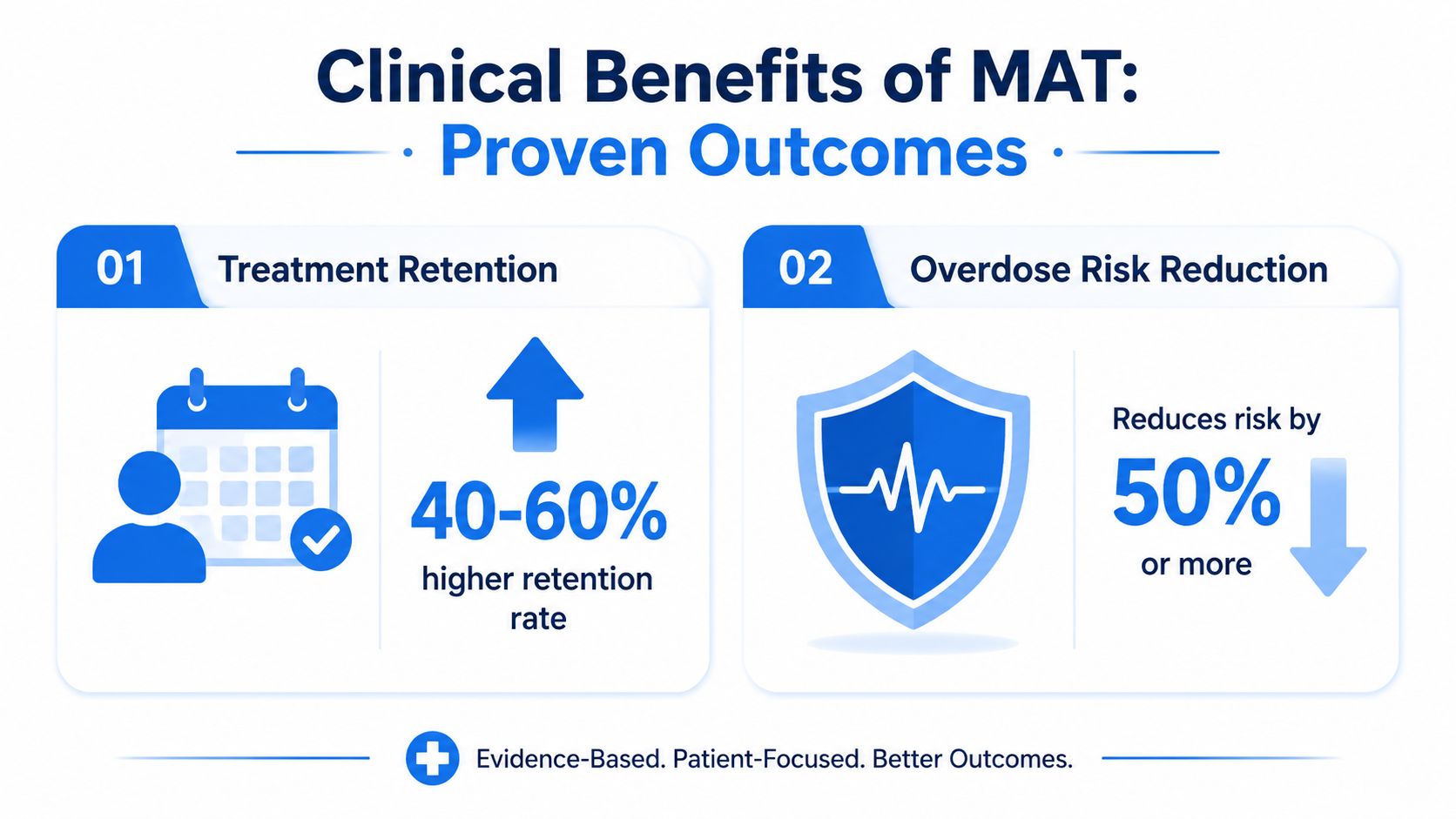
Families usually want proof before they want reassurance. That makes sense, because hope without evidence can feel careless. The main reason clinicians continue to recommend MAT is simple. It helps people stay in treatment and lowers opioid-related harm in real clinical settings, not just in theory.
A systematic review reported that MAT can reduce emergency department utilization by 51%, and the same review cited a randomized study showing 5-year heroin abstinence of 33.2% and 5-year abstinence from all opioids of 20.7% among patients treated with methadone or buprenorphine/naloxone, according to the review in PMC. Those numbers do not mean every patient will have the same result. They do show that treatment can support durable change over time, which is the kind of outcome worried families need to hear about.
What outcomes matter most in real life
Retention matters because people cannot benefit from treatment they do not stay in. In one clinical cohort study, 75% of participants were abstinent from opioid substances at 90 days, and 84% were abstinent at 365 days. The same study reported retention rates of 94% at 90 days and 58% at 365 days, which shows that continued engagement is part of the clinical picture, not a side issue, according to the same PMC review.
These are the kinds of measures families rarely hear when they first look for help. They should hear them. Recovery is not just one turning point. It is whether a person stays connected to care after the first hard week, the first difficult month, and the first year. That is also why program leaders who want to track whether care is working can use the approach outlined in wellness center ROI tracking tips, especially for retention, follow-up, and service use.
Why the evidence changes the conversation
A lot of skepticism comes from seeing detox fail without follow-through. MAT changes that picture because it gives people a way to remain medically supported while they rebuild daily stability. For people in Northern California, that matters in practical ways too. Insurance friction, transportation gaps, and cultural access barriers can interrupt care, so a treatment plan has to fit real life as well as clinical needs.
If someone keeps relapsing after short-term detox, that is not proof they are beyond help. It is often a sign they need a longer care model with medication and counseling together.
For a broader look at how outcomes are discussed in treatment planning, this internal overview of medication-assisted treatment effectiveness is a practical companion. The main point is straightforward. MAT works best when it is treated as an ongoing clinical process, not a one-time intervention.
The Patient Journey from Detox to IOP
The first days are often the hardest, because the body is asking for relief before the mind feels ready for change. In a well-run program, that's exactly when the team should be most active. Medically supervised detox, stabilization, counseling, and outpatient follow-up are not separate ideas, they're connected steps.
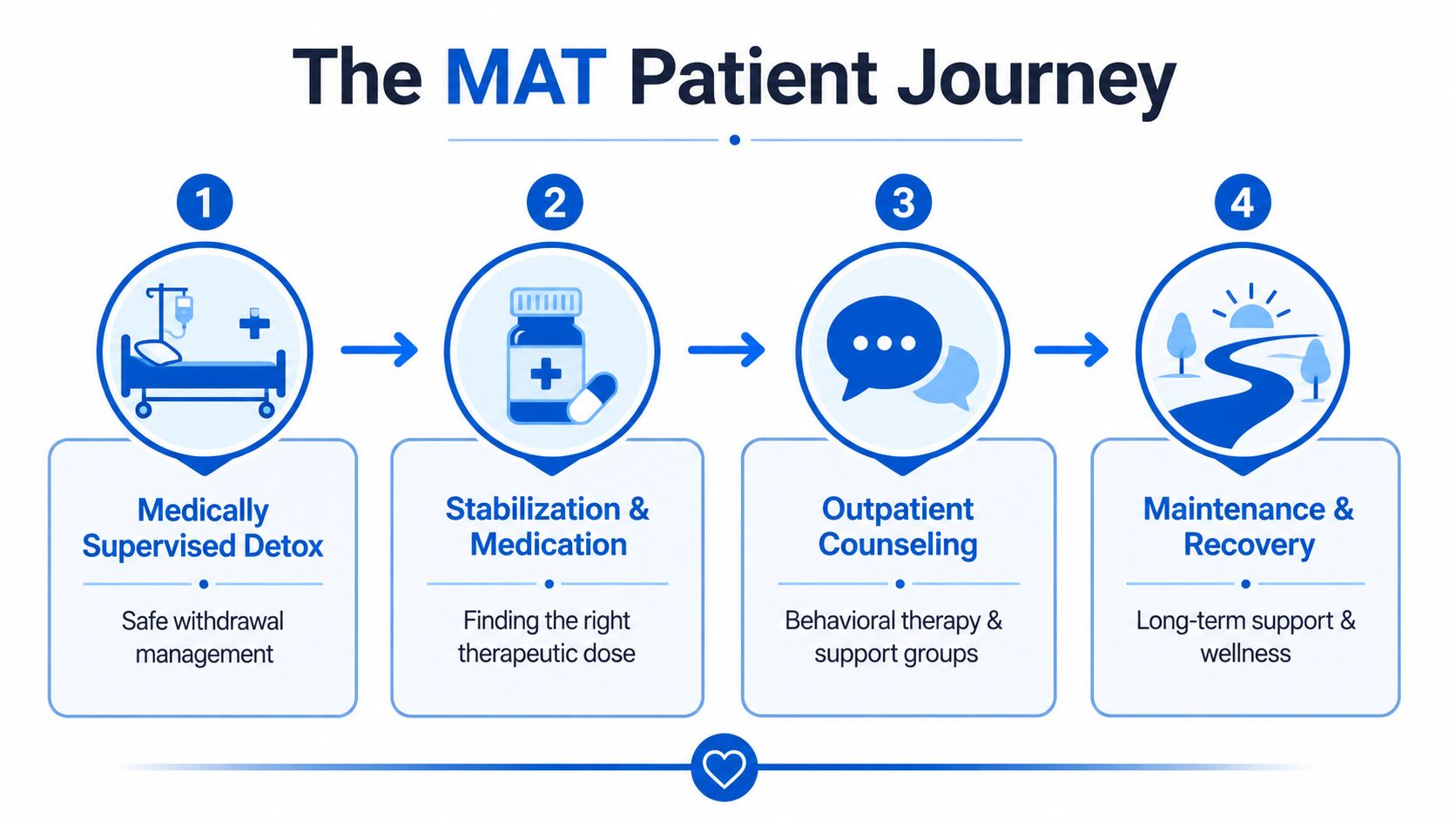
The VitzAi guide to detox safety is a useful reminder that withdrawal should be approached carefully, especially when someone has been using opioids for a long time. In practice, safe detox means monitoring symptoms, adjusting care quickly, and not leaving the person to manage discomfort alone.
What happens after detox
Detox is the beginning, not the destination. Once withdrawal is under control, the clinical focus shifts toward stabilization, the right medication plan, and a schedule the person can maintain. That's where a multidisciplinary team matters, because the medical provider, nurse, and counselor each handle a different part of the problem.
Residential care may come next for some people, especially if the home environment is unstable or relapse risk is high. Others step directly into Intensive Outpatient Program care, where therapy sessions, relapse prevention work, and accountability become the daily structure. The setting depends on safety, support, and how much structure the person needs right away.
Why therapy still matters when medication is working
Medication can reduce cravings, but it doesn't teach someone how to handle conflict, boredom, grief, or old triggers. That's why counseling and coping-skill work stay central throughout the journey. People often do better when they learn to notice their trigger patterns before the pressure builds.
A simple way to think about it is this. Medication makes recovery possible, and therapy makes it sustainable. A patient may start by learning how to get through the day without spiraling, then move on to rebuilding sleep, routines, family communication, and relapse-prevention habits.
Plain truth: the medication helps with the biology, the counseling helps with the behavior, and both are needed for long-term recovery.
In Northern California, that combination also has to be accessible in real life. If the program can't support the transition from detox into outpatient care, families end up doing the coordination themselves, and that's where people often get stuck.
Overcoming Myths and Access Barriers
One of the biggest myths is that MAT is just “trading one addiction for another.” That idea sounds neat, but it leaves out how treatment works. The goal is stability, lower craving, and a safer return to daily life.

A 2025 California report says access disparities persist for American Indian/Alaska Native, Black/African American, and Latine populations, and it also flags barriers for immigrants and people with low English proficiency, according to MAT in California statewide analysis. That matters because access is not just about whether medication exists. It is about whether people can understand it, trust it, and get through the system to receive it.
What access barriers look like in practice
Insurance friction is one of the most common stumbling blocks. A family in a rural Northern California county might learn that the clinic is in network, but then hit a prior authorization delay, a billing question, or confusion about whether the prescriber is covered under the plan. Even when treatment is approved, the first call can still feel like a maze.
Language and culture can create a different kind of barrier. If the front desk, intake forms, or counseling style does not match the patient's needs, the person may disappear before care starts. That is why culturally responsive treatment is part of access, not an extra feature.
Rural distance adds another layer. People in Northern California may be eligible for care but still face transportation problems, long drives, or scheduling gaps. Telehealth can help bridge some of that distance, but only if the program is set up to use it well and keeps follow-up simple. For families comparing options, a practical checklist like how to select a residential or outpatient alcohol rehab program in Yuba City can make the first conversation clearer.
How to judge whether a program is accessible
- Ask about language support: A program should be able to explain treatment in language the patient and family can understand.
- Ask how insurance is handled: Someone should be able to verify coverage and explain any steps before the first appointment.
- Ask how follow-up works: If the plan ends at the first visit, the care path is incomplete.
- Ask who is involved: Medical staff, counselors, and recovery support all matter when the goal is retention.
A program's quality often shows up in how it handles friction. If the team can guide a person through forms, scheduling, and next steps without judgment, that is a strong sign they understand MAT as practical care, not just theory.
Starting Treatment in Yuba City and Northern California
The first helpful move is often the smallest one, a call, a text, or a short visit to confirm what the program offers. In Yuba City and nearby communities, families should ask whether the provider can support medically supervised detox, residential referral, and outpatient follow-up under one coordinated plan. If the answer is yes, the next question is how they handle insurance, telehealth, and family communication.
For people comparing local options, this guide on selecting a residential or outpatient rehab program in Yuba City is a useful checklist. It can help families ask better questions before they commit to care.
What to ask before the first appointment
Start with insurance. Ask whether the office accepts the plan, whether prior authorization is needed, and whether TRICARE beneficiaries are welcome. If the program says it works with most major insurance plans, ask what that means for your specific policy, because coverage details still matter.
Then ask about continuity. A good program should be able to explain what happens after detox, how medication follow-up works, and whether IOP is available in person or through telehealth. That matters in rural or semi-rural parts of Northern California, where a workable schedule can make the difference between staying engaged and dropping out.
How families can prepare for the conversation
Keep the first conversation calm and short. Focus on the next appointment, not every regret from the past. A worried loved one usually hears two things most clearly, whether the plan is practical and whether the people involved sound respectful.
If the person is ready, offer to help with the logistics. That might mean making the call, sitting in on the tour, or writing down questions about medication, counseling, and aftercare. If they're not ready, leave the door open and keep the tone steady.
What a strong local program should be able to do
A reliable Northern California provider should be able to explain the care path in plain language, coordinate medication and counseling, and keep the person supported beyond the first few days. In this area, that kind of continuity is not a bonus, it's the difference between a plan and real treatment.
Addiction Resource Center LLC in Yuba City provides medically supervised detox with MAT, residential rehabilitation through its partner facility, and an IOP available in person and via telehealth, so families can ask one team about the next step instead of piecing it together alone.
Frequently Asked Questions About MAT
How long does MAT treatment last?
There isn't one fixed timeline. MAT is often long-term care, and the length depends on the person's stability, goals, and medical needs. The best question isn't “How fast can we stop?” it's “How long does this person need support to stay safe?”
Is MAT confidential?
Yes, treatment should be handled with privacy and respect. Families usually want to know who can see the information, how appointments are scheduled, and how the clinic communicates. Asking those questions up front is normal and appropriate.
Can I still work while in an IOP?
Often, yes, if the program schedule is built to support it. Many people need treatment that fits around work, school, or family responsibilities, not the other way around. That's one reason telehealth and evening scheduling matter so much in Northern California.
What if my loved one refuses help?
Start with one clear, nonjudgmental conversation and keep the offer practical. People are more likely to accept care when they feel less cornered and more understood. If they're not ready today, being ready to respond quickly later still helps.
Who is MAT for?
It's for people with opioid use disorder who need evidence-based care that addresses both medication and behavior. Some people need more structure, some need more flexibility, and some need a mix of detox, residential support, and outpatient follow-up. The right path depends on the person, not on a one-size-fits-all rule.
If you're ready to talk through treatment options, Addiction Resource Center LLC can help you understand detox, MAT, residential rehab, and IOP in one conversation. Reach out if you want a confidential next step for yourself or someone you love, and let a local team help you sort out the practical details without pressure.