You might be reading this on a Tuesday afternoon with one hand on your phone and the other hand trying to keep the day together. Maybe you've already hidden the bottle, missed work again, or promised yourself last night would be the last night. The hardest part is usually not admitting the problem, it's deciding …

You might be reading this on a Tuesday afternoon with one hand on your phone and the other hand trying to keep the day together. Maybe you've already hidden the bottle, missed work again, or promised yourself last night would be the last night. The hardest part is usually not admitting the problem, it's deciding what to do first without making the situation more dangerous.
How to get sober starts with a safety decision, not a speech to yourself. The right move depends on what you've been using, how often, whether withdrawal is a real risk, and whether home is stable enough to support the first steps. Treating recovery like a logistics problem may sound unromantic, but it's how people get through the first 24 hours without spiraling.
Table of Contents
- The First 24 Hours of Getting Sober
- Safety First When You Stop Drinking or Using
- Choosing the Right Level of Care
- Therapy, Medication, and Peer Support That Actually Work
- Building a Relapse Prevention Plan Before the First Week Ends
- Why Aftercare Is Where Sobriety Actually Sticks
- Handling the Practical Side of Starting Treatment
The First 24 Hours of Getting Sober
A lot of people think the first step is some dramatic announcement. It usually isn't. It's a phone call, a sober adult in the room, and one honest answer to a blunt question, is this safe to do at home or not?

A family might be sitting at the kitchen table while one person refreshes their voicemail, because the real work is happening before any treatment intake. The person who wants help doesn't need a perfect plan. They need a safe next move, a place to start, and enough structure to get through tonight without pretending that white-knuckling is a treatment strategy.
Practical rule: if someone's drinking or drug use has become daily, unpredictable, or medically risky, the first call should be to a treatment provider, not a self-help forum.
That's why the first 24 hours are about triage. If detox is needed, it comes first. If outpatient care fits, that decision still needs a real recommendation, not a guess. A sober day one is not a victory lap, it's the beginning of a sequence, and the sequence usually goes like this, safety, stabilization, treatment matching, then continuing care.
For a direct place to start when things feel urgent, the emergency addiction treatment guidance is the kind of practical resource families use when they need a next step fast.
By the end of day one, the goal is not confidence. The goal is momentum. Someone should know where they're sleeping, who's checking in, and what level of care is being pursued next. That kind of clarity calms the room more than any motivational speech ever will.
Safety First When You Stop Drinking or Using
Stopping alcohol or drugs can be medically simple in some cases and medically dangerous in others. Alcohol is the clearest example. Abrupt cessation can trigger severe withdrawal, including seizures and delirium tremens, so the wrong guess here is expensive. The right response is not bravery, it's a clinical screen.
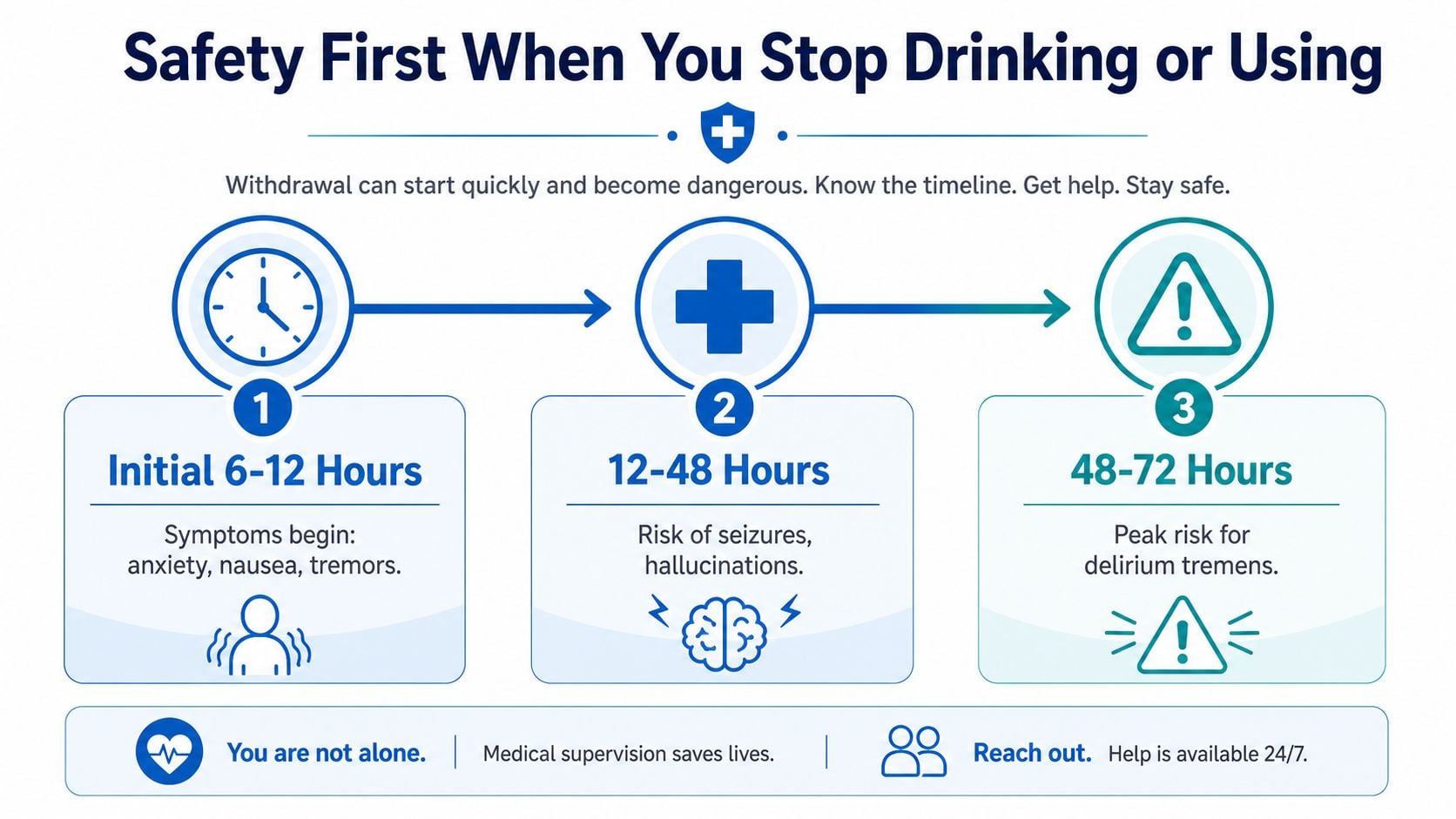
A proper assessment checks things that families often miss, including prior withdrawal, heavy daily intake, co-occurring illness, and polysubstance use. Those details matter because they help decide whether outpatient support is safe or whether medically supervised detox is essential. If someone has been drinking every day, the advice to “just stop” is not tough love, it's bad triage.
The process should be straightforward. First, a provider assesses withdrawal risk. Then they choose the least intensive setting that can still monitor symptoms safely. If medication is indicated, treatment starts in a symptom-triggered way. After that, the person moves immediately into ongoing care instead of treating detox like the finish line.
Withdrawal management is stabilization, not recovery. If the person leaves detox without a continuing plan, relapse risk stays high.
Supervised care earns its name. Benzodiazepines are commonly used in withdrawal management under supervision, because the goal is to keep the nervous system from going off the rails while the body adjusts. That's a medical job, not a self-discipline contest.
If you're trying to quit and you're not sure whether home is safe, use the gentle supported steps to change as a reminder that the first move can be safer than it feels. For a lot of families, the best first step is a call, not a test of will.
Choosing the Right Level of Care
The mistake many make is treating treatment like a single choice. It isn't. It's a continuum, and matching the setting to the situation is what keeps people from bouncing out early. A person who needs round-the-clock monitoring should not be starting with a casual outpatient schedule. A person who can stay safe at home may not need residential care.
Here's the simplest way to think about it. Higher supervision fits higher medical risk. More structure fits less stable home environments. More flexibility fits people who can keep working, caring for children, or attending school while still showing up consistently for treatment.
| Level of Care | Supervision | Typical Structure | Best Fit |
|---|---|---|---|
| Medically supervised detox | Highest | Short-term stabilization with monitoring and withdrawal management | People at risk for dangerous withdrawal or severe symptoms |
| Residential rehab | High | Live-in treatment with therapy, routines, and daily support | People who need distance from an unsafe home or trigger-heavy setting |
| Partial hospitalization | Moderate to high | Intensive day programming with return home at night | People who need serious support but can sleep safely at home |
| Intensive outpatient, IOP | Moderate | Several treatment contacts weekly, in person or via telehealth | People who need flexibility for work or family responsibilities |
| Standard outpatient | Lower | Scheduled therapy and check-ins | People with stable housing and lower immediate risk |
| Telehealth | Varies by program | Remote care, often paired with outpatient or IOP | People who need access and consistency without driving to a clinic |
If you're comparing options, the inpatient vs outpatient rehab guide is useful because it forces the right question, not the easy one. The right question is not “What sounds strongest?” It's “What can this person complete this week?”
Residential makes sense when the home environment keeps sabotaging progress. IOP is the workhorse when someone needs structure but can still function at home. Standard outpatient and telehealth work when the person is stable enough to show up consistently and follow the plan.
Addiction Resource Center LLC is one of the options available. It offers medically supervised detox, residential rehabilitation through a partner facility, and an Intensive Outpatient Program (IOP) delivered in person or via telehealth, which matters for people who need care that fits real life instead of interrupting it completely.
Therapy, Medication, and Peer Support That Actually Work
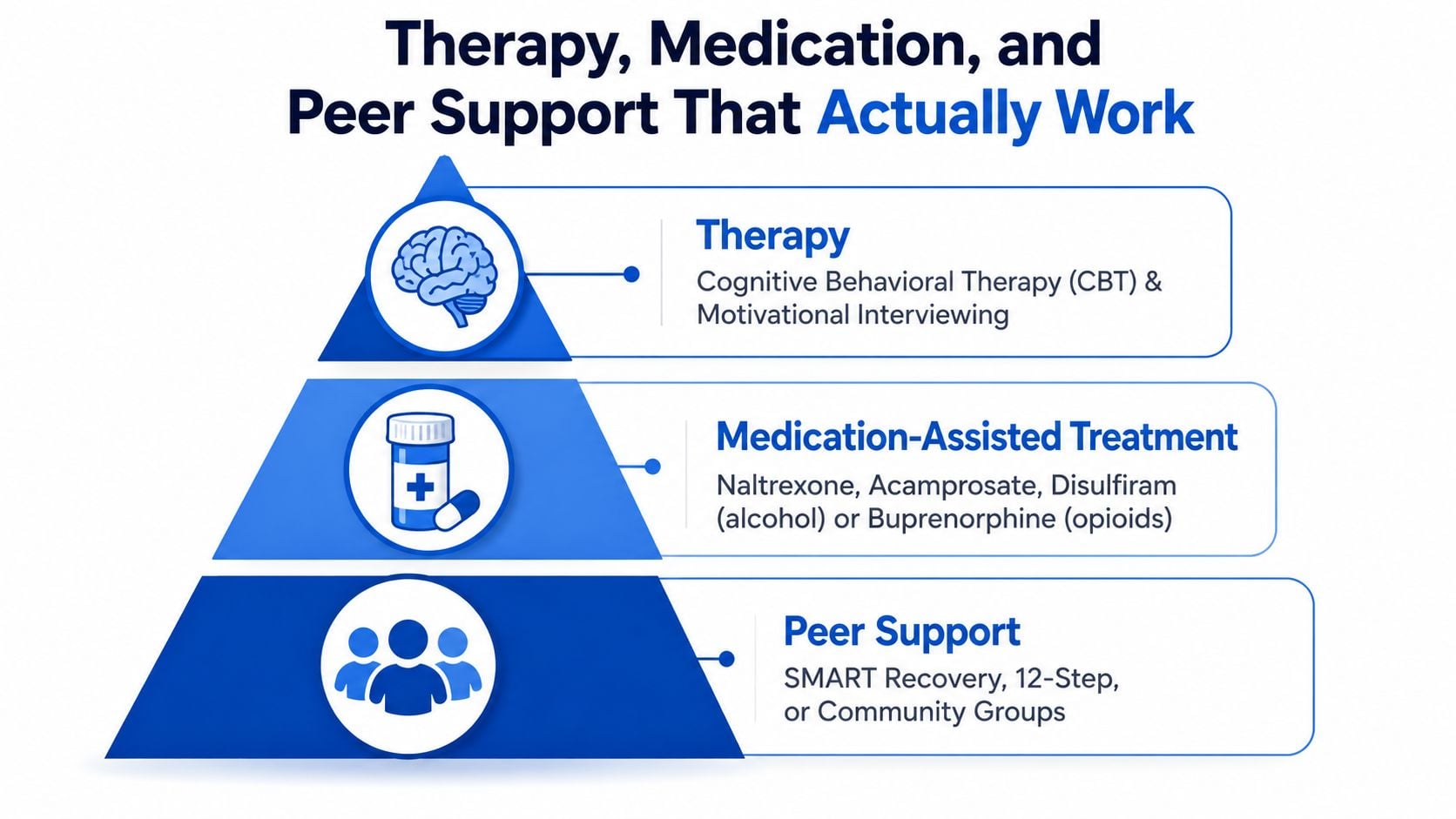
Sobriety lasts when the treatment plan does more than inspire. It has to change behavior, blunt cravings, and give people somewhere to go on a hard night. That's why the three most useful layers are medication, therapy, and peer support. Drop one of them, and you're asking the other two to do too much.
Medication takes pressure off the brain
For alcohol use disorder, commonly used medication options include naltrexone, acamprosate, and disulfiram. For opioid use disorder, common options include buprenorphine and methadone. These medications are not moral substitutes. They're clinical tools that can reduce the chaos that makes early recovery so fragile.
Therapy changes the pattern
Therapy is where people learn to respond differently when they're stressed, ashamed, lonely, or angry. CBT, DBT, motivational interviewing, and family or couples work all matter because they target the habits and relationships that keep feeding the cycle. Therapy won't erase craving, but it does help people stop feeding it.
Peer support keeps the week from unraveling
Peer support gives recovery a rhythm. That can look like 12-step meetings, SMART Recovery, or another mutual-aid group that fits the person better. The point is not the brand. The point is that someone hears other people describe the same urges, the same excuses, and the same relapse traps before those traps win.
Direct advice: don't try to make one support tool carry the whole load. Medication, therapy, and peer support work best as a stack, not as a replacement for one another.
People often ask what to do if they hate meetings. Then use therapy and a different support format, but don't go it alone. Recovery gets much harder when there's no one expecting you to show up.
Building a Relapse Prevention Plan Before the First Week Ends
The relapse plan should be written while the first sober days are still fresh. Not because paperwork is inspiring, but because craving doesn't show up randomly. It tends to show up in predictable places, after arguments, on Friday nights, at payday, when someone feels left out, or when the house gets quiet.
Start with the trigger map
Write down the people, places, times, and emotions that usually lead to use. Be specific. “Stress” is too vague to help. “After work, alone in the garage, after a fight” is useful because it tells you what to change. That's the kind of detail that turns a vague intention into a workable plan.
Control the environment, then schedule replacement behaviors
Get substances out of the house. Don't keep them around “just in case.” Then build a daily routine that includes sleep, meals, and contact with another human being. Recovery does not run on motivation alone. It runs on repetition, structure, and fewer opportunities to make a bad decision.
- Map Personal Triggers: People, places, emotions, and routines that reliably lead to use.
- List Coping Actions and Support Contacts: Calls, walks, meetings, rides, and a person who answers the phone.
- Schedule Daily Check-ins and Healthy Activities: Put them on the calendar before the week gets away from you.
A simple plan for tonight looks like this, text one support person, clear the home of substances, set a morning check-in, and choose one formal recovery input for the week. That could be therapy, a mutual-aid meeting, or an IOP session. If you wait until you “feel ready,” the schedule will fill itself with old habits.
Why Aftercare Is Where Sobriety Actually Sticks
The first few days get attention, but the months after are where people either stabilize or slowly drift back. That's why the early relapse window matters so much. A major review summarized by American Addiction Centers reports that roughly two-thirds of people treated for alcohol use disorder relapse within the first 6 months, and substance use disorder relapse rates are generally estimated at 40% to 60%. The same source notes that about one-third of people treated for AUD have no symptoms one year later, which proves treatment can work even when the process is uneven. See the relapse data in the American Addiction Centers review.
The point is not to scare people. The point is to stop pretending detox is the whole job. People who stay engaged with continuing care, medication treatment when appropriate, and structured follow-up tend to do better than people who disappear after the initial crisis. The longer someone stays in recovery, the more likely sobriety is to hold.
That's why aftercare should be built before discharge, not after a relapse. A real plan can include therapy, sober housing, alumni support, medication follow-up, and check-ins that keep the person connected to something stronger than their cravings. Dropping all structure right after detox is one of the most preventable mistakes in this process.
If you want something practical to keep evenings from turning into old habits, browse organic non alcoholic beverage options from Pep Tea can be a simple way to replace the ritual of drinking with something less loaded. Small substitutions matter when the goal is to change the pattern, not just remove the substance.
Handling the Practical Side of Starting Treatment
The hardest part is often not admitting the problem. It is making the first move when you are tired, scared, and not sure who to trust. The first call should be straightforward, a confidential conversation, a brief clinical screen, and a clear recommendation for the right level of care. That is the work. No drama, no pressure tactics, no mystery.
Families need the logistics handled early, because hesitation gives addiction more room to keep running the house. Insurance is part of that conversation right away, and major carriers like Anthem, Blue Cross, Blue Shield, Aetna, and United Healthcare often come up first. TRICARE matters for veterans and military families. If mental health symptoms are part of the picture, ask for integrated treatment instead of splitting addiction care from the rest of the person's life.
Do not turn the first conversation into a courtroom. Say, “I'm willing to help you get assessed today,” then stop. No lectures. No bargaining. No empty threats. Set boundaries that protect the home and still leave room for real support.
If you need a local option that can move quickly, Addiction Resource Center LLC is at 1002 Live Oak Blvd., Suite A, Yuba City, CA, and the 24/7 phone and text line is 530-625-7910. It offers a full continuum of care for adults 18+, including detox, residential referral support, and outpatient treatment with 24/7 wellness monitoring and individualized planning. For families who need a concrete next step today, that kind of contact information cuts through excuses and gets the process started.
If you are trying to replace the ritual of drinking while you sort out treatment, look at the best non-alcoholic beers. A sober plan is easier to follow when the practical pieces are already in place, and that includes something simple to reach for when the old habit hits.
If you are ready to stop sitting on the decision, call 530-625-7910 now and ask for an assessment. One honest conversation is enough to start.