You might be reading this after a rough night, a scary phone call, or one more promise to yourself that this time will be different. Maybe someone suggested AA and your first reaction was, “That's for older people,” or “I'm not doing the church-basement thing,” or “I need help, but not that kind of help.” …

You might be reading this after a rough night, a scary phone call, or one more promise to yourself that this time will be different. Maybe someone suggested AA and your first reaction was, “That's for older people,” or “I'm not doing the church-basement thing,” or “I need help, but not that kind of help.” Those reactions make sense.
Young people often feel torn between two truths at once. They know drinking is hurting them, and they don't want to walk into a space that feels like it was built for another generation. That tension is real. It's also one reason this topic deserves a more honest conversation than “AA works” or “AA doesn't.”
The need for support is hard to ignore. According to the 2024 National Survey on Drug Use and Health summary from NIAAA, 16.6 million young adults ages 18 to 25, representing 47.5% of this age group, reported drinking alcohol in the past month. That was the highest recent alcohol use rate among adult age groups in the United States. This struggle is indeed common within this age group.
Support also doesn't have to mean doing recovery alone. Many people start by learning how peer support in recovery works alongside therapy, medical care, and family support.
Table of Contents
- Is AA Still Relevant for Young People Today
- Why a Young Person's Recovery Is Different
- How AA Works for Young Adults and Where It Falls Short
- What to Expect at Your First AA Meeting
- Modern Alternatives and Youth-Focused Support
- When Professional Treatment Becomes Necessary
- Building Your Personalized Recovery Plan
Is AA Still Relevant for Young People Today
AA is still relevant for some young people. It's just not relevant in the simple way older recovery stories often describe it.
A lot of young adults don't reject help itself. They reject a format that feels slow, overly formal, or disconnected from how they live. If your world runs through group chats, private DMs, streaming, telehealth, and carefully managed social identity, walking into a traditional AA meeting can feel like stepping into someone else's language.
That doesn't mean AA has nothing to offer. It means the useful part may be different from what people assume.
Why the question keeps coming up
For many young adults, drinking is wrapped into nearly everything. First apartments. Campus life. Shift work after midnight. Dating. Concerts. Friend groups that don't know what to do if someone stops drinking. Recovery at this age isn't just about removing alcohol. It often means rebuilding social life from the ground up.
Practical rule: If a support option helps you stay sober but leaves you isolated, it may not last. Young adults usually need both sobriety support and social replacement.
AA can still matter because it offers repetition, structure, and people who understand obsession, denial, relapse, and shame. Those basics haven't gone out of date. But the way a young person connects to them may look very different from the classic image of AA.
What relevance looks like now
For a young adult in 2026, “relevant” usually means practical. Can I find a meeting on my phone? Can I attend online if I'm anxious? Will anyone there understand what it's like to be sober at 22, dating, scrolling, and trying to keep friends? Can I take what helps and leave the parts that don't fit?
Those are fair questions. They're often better questions than “Do I believe in AA?”
Some young people use AA as their main recovery community. Others use it as one support among several, along with therapy, medication, family work, or online groups. That flexible approach is often what makes young people and AA a workable match.
Why a Young Person's Recovery Is Different
Young adulthood sits in a strange middle ground. People may expect you to act fully independent, but you're still building judgment, identity, routines, and relationships. That matters in recovery.
Alcohol problems at this age often look less settled than they do later in life. A young person may still be going to school, changing jobs, moving apartments, dating unpredictably, or switching friend groups fast. From the outside, it can look like “normal experimentation.” From the inside, it can feel chaotic and frightening.
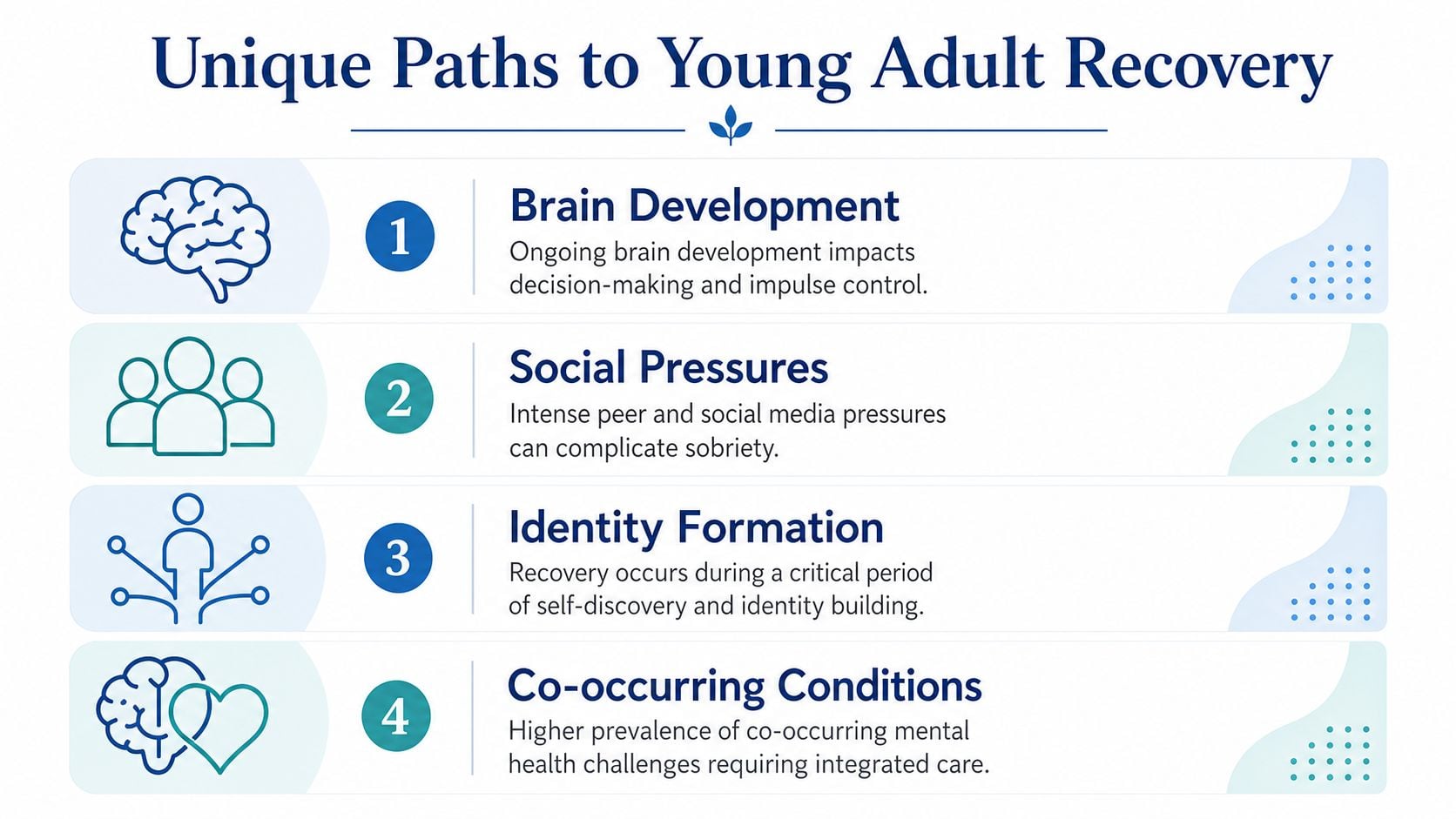
Why the risk peaks in young adulthood
There's a paradox here. Underage drinking has dropped over time, but the highest-risk patterns still cluster in young adulthood. The underage drinking statistics summary from Responsibility.org notes that 4.3 million people aged 18 to 25 reported binge drinking in the past month, and 861,000 reported binge drinking on five or more days. So even with progress among younger teens, the danger doesn't disappear. It shifts.
This age window often combines more freedom with less structure. Parents may step back. School schedules change. Work can be unstable. Sleep gets worse. Social pressure gets more intense, not less. A person can go from “I party hard sometimes” to “I can't stop once I start” before anyone around them calls it a problem.
If you want a helpful overview of how age affects addiction treatment, this guide from Capo Canyon Recovery explains why developmental stage changes what support tends to work.
What makes recovery feel harder at this age
Young people often tell me the hardest part isn't only quitting alcohol. It's figuring out who they are without it.
A few pressures show up again and again:
- Identity pressure: Recovery can feel like social exile when your image, humor, friendships, and weekend plans all revolve around drinking.
- Digital pressure: Social media keeps alcohol visible. Every scroll can bring party clips, drinking jokes, and the fear of missing out.
- Emotional swing: Young adulthood can bring anxiety, depression, loneliness, and uncertainty. Alcohol often gets used as a fast social tool, not just a private escape.
- Low trust in old systems: Many young adults don't want to be preached at. They want honesty, autonomy, and options.
Recovery for a young adult usually has to answer two questions at the same time: “How do I stop hurting myself?” and “How do I still belong somewhere?”
That's why young people and AA can be complicated. AA may offer belonging, but only if the person can picture themselves inside that culture.
How AA Works for Young Adults and Where It Falls Short
AA helps many people, but the reason it helps young adults is more specific than people often realize.
A secondary analysis published through ScienceDirect found that for young adults, AA's effectiveness is primarily mediated by two pathways: reducing pro-drinking social networks and building self-efficacy in social situations. The same analysis found that mechanisms involving coping with negative emotions or spiritual practices showed less significance in this demographic.
That finding clears up a lot of confusion. A young person may attend AA, dislike some of the language, feel uncertain about the spiritual tone, and still benefit in a major way. Why? Because the meeting gives them sober people to text on a Friday night and helps them practice being around others without drinking.
What AA often helps with first
Think of AA less as a lecture and more as a social reset.
For many young adults, the first practical benefits look like this:
- A new contact list: You stop relying only on drinking friends for company, rides, celebration, or crisis support.
- A script for awkward moments: You get better at saying no, leaving early, or showing up sober without feeling exposed.
- Regular places to go: Meetings create routine during hours that used to be dangerous.
- Proof that sobriety isn't social death: Seeing other young sober people matters. It changes what feels possible.
That social piece is often the engine. If you've ever said, “I don't even know what I'd do with my friends if I wasn't drinking,” you're describing exactly the area where AA can help.
Why many young adults bounce off traditional AA
The mismatch is cultural as much as clinical.
A review in the National Library of Medicine notes that young adults under 30 attend AA at less than 5% of the rate of older adults, and that many areas now host Young People in AA, or YPAA, meetings designed to feel more relatable. That gap isn't just about denial or immaturity. It often reflects the fact that traditional meetings can feel built around older norms of community, communication, and identity.
A young adult may struggle with:
| Barrier | What it can feel like |
|---|---|
| Age mismatch | “Everyone here is old enough to be my parent.” |
| Language mismatch | “The slogans sound canned or too absolute.” |
| Spiritual mismatch | “I'm not religious, so maybe this isn't for me.” |
| Format mismatch | “I connect better through messages, online groups, or smaller spaces.” |
That doesn't make AA outdated for everyone. It means fit matters.
If AA helps you change your people, your routines, and your confidence in sober settings, it may be a strong tool even if you don't connect with every tradition or phrase.
YPAA meetings, hybrid meetings, and online meeting formats can narrow that gap. So can a simple shift in expectations. You don't have to love all of AA to get value from some of it.
What to Expect at Your First AA Meeting
The first meeting usually feels bigger in your head than it does in real life. Most rooms are more ordinary than people expect. Folding chairs. Coffee. People talking before the meeting starts. Nobody checking whether you “belong enough” to be there.

Before you go
Try to keep the first goal small. You are not deciding your whole future. You're visiting one meeting.
A few basics help:
- Look for YPAA first: If there's a Young People in AA meeting nearby or online, start there. It may feel less alien.
- Check whether it's open or closed: Open meetings usually allow anyone interested in learning. Closed meetings are for people who identify as having a drinking problem and want help.
- Bring an exit plan: Drive yourself if you can, or tell yourself you can leave after listening. Knowing you're not trapped reduces anxiety.
- Don't rehearse a perfect story: You don't have to arrive with a dramatic speech or a clear label for yourself.
One of the easiest ways to calm fear is to see the format ahead of time. This short video gives a helpful preview of the tone many newcomers experience.
What actually happens in the room
Most meetings start with a reading, a welcome, and some explanation of the format. Then one person may speak, or the group may read from AA literature and invite sharing. Some meetings are discussion-based. Others are more structured.
You do not have to share if you don't want to. You can usually say, “I'm just here to listen.” That's normal.
People also worry about anonymity. In practice, it means members are expected to respect privacy and not treat your presence there like gossip material. No system is perfect, but the culture strongly values discretion.
Common fears that deserve straight answers
Here's what many young people ask before going:
- Will I be judged? Usually no. Many in the room remember being new, scared, defensive, or unsure.
- Will I be the only one my age? Maybe at some meetings, yes. That can feel awkward. It doesn't mean the meeting is useless, but it may mean you should try a different one too.
- Do I have to agree with everything? No. Many people use a “take what helps” approach.
- Is it religious? AA includes spiritual language, and that turns some people off. Some members are religious. Others are not. You don't have to settle that question on day one.
Newcomer advice: Try more than one meeting before deciding AA isn't for you. One room is not the whole program.
Modern Alternatives and Youth-Focused Support
AA isn't the only path, and that matters. Some young adults need a support style that feels more skills-based, more secular, more private, or more compatible with online life.
At the same time, it's worth being fair to AA. A Recovery Research Institute summary on Alcoholics Anonymous participation reports that for adolescents and young people, AA and Twelve-Step Facilitation are associated with 30% lower healthcare costs than Cognitive Behavioral Therapy, with a specific cost reduction of US$3,678 per patient over two years. The same summary states that every meeting attended corresponded to two additional days of sobriety. That doesn't mean everyone should choose AA first. It means it remains a serious option, not a relic.
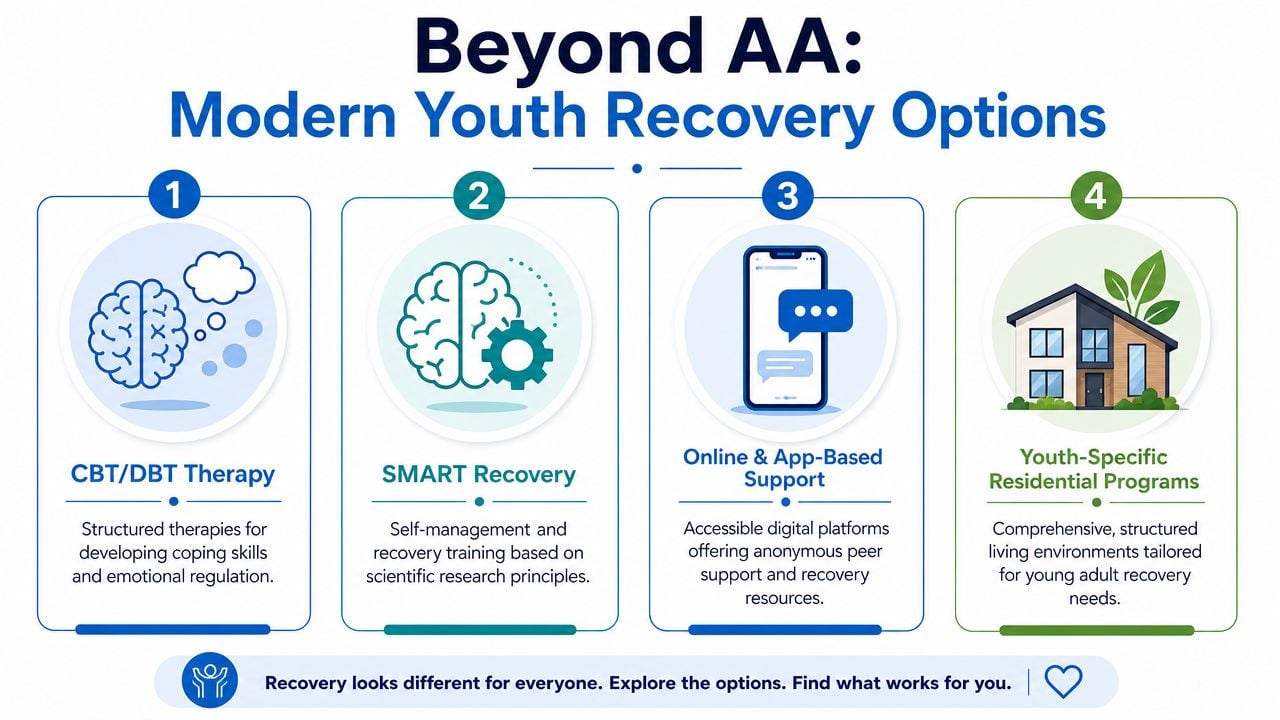
A side-by-side look at common options
| Option | Core style | Best fit for | Spiritual emphasis | Access style |
|---|---|---|---|---|
| AA | Peer fellowship and step-based recovery | People who want community, routine, and sober social replacement | Often present, but interpreted differently by members | In-person, hybrid, online in many areas |
| SMART Recovery | Skills-based, self-management approach | People who want practical tools and more direct behavioral language | Secular | In-person and online |
| Digital or app-based communities | Chat, forums, virtual support, accountability tools | People who need privacy, flexibility, or low-pressure entry | Varies widely | Phone-first and online |
| Therapy and structured programs | Clinical treatment, coping skills, mental health support | People with heavy use, relapse cycles, trauma, or co-occurring concerns | Depends on provider | In-person, telehealth, or residential |
Some young adults combine these rather than choosing only one. A person might attend SMART Recovery weekly, use a recovery app daily, and still drop into AA when they need sober community.
If alcohol use is tied to anxiety, depression, family conflict, or identity stress, getting connected with broader youth mental health services can also help clarify what kind of support fits best.
How to choose without overthinking it
You don't need a perfect philosophy. You need a support system you'll use.
A simple way to decide is to ask:
- Where do I open up more easily? In groups, one-on-one, or online?
- Do I want tools, fellowship, or both?
- Does spiritual language motivate me, annoy me, or just not matter much?
- What can I access consistently when I'm stressed, lonely, or tempted?
For people who need more structure than weekly meetings but still want to stay connected to work, school, or home, an online intensive outpatient program can bridge the gap between peer support and formal treatment.
When Professional Treatment Becomes Necessary
Peer support can be powerful. It can also be too light for what's really going on.
Some situations call for medical or clinical care, not just more determination. If someone keeps trying meetings, keeps relapsing, and keeps ending up in danger, the answer isn't “try harder.” The answer may be a higher level of support.
Signs peer support may not be enough
Watch for patterns like these:
- Unsafe withdrawal concerns: If stopping alcohol brings severe physical symptoms or feels medically risky, don't handle it alone.
- Mental health symptoms that complicate recovery: Panic, severe depression, trauma reactions, suicidal thoughts, or intense mood instability can overwhelm a peer-only plan.
- Repeated inability to stay sober: If motivation is there but drinking keeps breaking through, more structure may be needed.
- Life is collapsing fast: School loss, job loss, legal trouble, family rupture, or dangerous situations can signal that outpatient peer support alone isn't enough.
Sometimes alcohol use overlaps with obsessive thinking, compulsive behaviors, or conditions that need careful assessment. For readers looking for a clinical overview of that overlap, this guide on UK assessment for OCD and alcoholism can help frame what to discuss with a provider.

What higher levels of care can look like
Treatment isn't one thing. It's a continuum.
Here are the common levels, in plain language:
- Medical detox: This is for people who may need supervised withdrawal and symptom management.
- Medication-assisted treatment: Some people benefit from medications as part of alcohol recovery, especially when cravings or relapse risk stay high.
- Residential rehab: A live-in setting can remove daily triggers and create full immersion in recovery.
- Intensive outpatient care: This gives more treatment hours and accountability while allowing a person to live at home or in supportive housing.
The right question isn't “Am I bad enough for treatment?” It's “What level of support gives me the best chance to get stable and stay safe?”
If meetings feel helpful but not sufficient, that doesn't mean you've failed. It means you've learned something important about the level of care you need.
Building Your Personalized Recovery Plan
The strongest recovery plans are rarely pure. They usually mix supports.
A young adult might need detox first, then therapy, then a few months of structured outpatient care, plus one peer group that feels tolerable enough to keep showing up to. Another person may start with therapy and a digital support community, then add YPAA once they're less defensive. A third may do well with AA right away because they've been desperate for sober friends.
A plan that fits real life
A useful plan usually includes a few separate functions:
- Stability: Something that reduces immediate risk and chaos.
- Connection: People you can contact when cravings, shame, or loneliness hit.
- Skill-building: Therapy, coaching, or groups that teach coping and relapse prevention.
- Structure: Routines for evenings, weekends, and social events.
- Review: A way to adjust the plan if it stops working.
If you want a practical framework for that kind of mix-and-match approach, this guide to personalized recovery plans shows how treatment can be customized instead of forced into one mold.
What families can do right now
Families often swing between panic and overcontrol. Neither helps much.
A steadier approach works better:
- Be direct and calm: Name what you're seeing without a lecture.
- Offer choices, not ultimatums right away: A meeting, an assessment, therapy, or a medical consult can all be starting points.
- Stop debating labels: Focus on consequences and safety.
- Support action, not promises: Help schedule the next step instead of relying on emotional talks alone.
For the young person reading this, you don't have to commit to “forever” today. You only need a next step that is honest enough to match the problem.
If you're unsure whether AA, therapy, detox, or a higher level of care makes the most sense, Addiction Resource Center LLC can help you sort that out without pressure. Their team provides compassionate drug and alcohol treatment for adults 18+ in Yuba City and Northern California, including medically supervised detox with medication-assisted treatment, residential rehab through Ona Treatment Center, and in-person or telehealth IOP. They also support people with co-occurring mental health needs, accept most major insurance plans, and welcome TRICARE beneficiaries. You can call or text 530-625-7910 any time, or visit the website to learn more and take the first step toward a recovery plan that fits your life.