A family in California often starts the same way. One person is in crisis, the phone is open, and every program claims to treat addiction, depression, trauma, or anxiety. The hard part is figuring out which center treats both conditions as one clinical problem instead of splitting care across separate tracks. That distinction affects safety, …

A family in California often starts the same way. One person is in crisis, the phone is open, and every program claims to treat addiction, depression, trauma, or anxiety. The hard part is figuring out which center treats both conditions as one clinical problem instead of splitting care across separate tracks.
That distinction affects safety, pace of recovery, and the odds that someone stays in treatment. A program may advertise mental health services, but you still need to verify whether psychiatric care, addiction treatment, medication management, and discharge planning are coordinated by one team. If you want a clearer picture of how mental health treatment should function inside rehab, this guide to mental health care in rehabilitation settings is a useful reference point.
Use this article as an evaluation framework, not just a directory. The centers below span Northern California, Southern California, and the Bay Area. They also represent different service models, including nonprofit, private, and hospital-based care. That matters because the best program is not always the most expensive or the closest to home. It is the one whose clinical strengths, level of care, and payment structure match the patient in front of you.
I tell families to screen every center against five practical questions:
- Accreditation and licensing. Is the program licensed at the right level of care, and who provides psychiatric oversight?
- Integrated clinical care. Does the same team address substance use and mental health together, including medication-assisted treatment when appropriate?
- Levels of care. Can the center handle detox, residential treatment, partial hospitalization, or intensive outpatient care if needs change?
- Insurance and total cost. What is covered, what is private pay, and what costs show up after admission?
- Location and daily environment. Will the setting support attendance, family involvement, and step-down planning after discharge?
Marketing can make weak differences sound large. If you're comparing centers online, Up North Media's rehab SEO guide helps explain why some programs rank well in search even when the harder question is clinical fit.
Table of Contents
- 1. Addiction Resource Center LLC
- 2. Alta Mira Recovery Center
- 3. Bayside Marin
- 4. Tarzana Treatment Centers
- 5. UCLA Health Resnick Neuropsychiatric Hospital Dual Diagnosis IOP
- 6. Sharp McDonald Center
- 7. Duffy's Napa Valley Rehab
- Top 7 California Dual Diagnosis Centers Comparison
- FAQs and Your Next Step to Recovery
1. Addiction Resource Center LLC

Addiction Resource Center LLC stands out because it covers the part of treatment that often breaks down for families: transitions. A person may need detox first, then outpatient support, then residential stabilization, then aftercare. When those steps happen across disconnected providers, people drop out. This program is built to reduce that friction.
Based in Yuba City, the center serves adults facing substance use and co-occurring mental health needs with medically supervised detox, medication-assisted treatment, in-person and telehealth IOP, and residential rehabilitation through its partner, Ona Treatment Center in Browns Valley. That makes it one of the more practical options for people in Northern California who need flexibility without losing clinical continuity.
Why this program stands out in Northern California
The strongest feature here is the continuum of care. Detox with MAT is available for people who need withdrawal management and medical oversight. If residential treatment is the right next step, the handoff goes through a partner program rather than forcing the family to start from scratch with a new search.
The outpatient side is also unusually usable. Telehealth IOP matters for people in smaller Northern California communities, for working adults, and for family caregivers who can't easily relocate for treatment. If you want a plain-language overview of co-occurring care, the center's dual diagnosis addiction treatment resource is worth reviewing before you call admissions.
Practical rule: Ask whether the same team, or at least the same treatment plan, follows the client from detox into the next level of care. Smooth handoffs often matter more than amenities.
Staffing is another strength. The program describes a multidisciplinary team that includes a medical doctor, registered nurse, CADC counselors, an LMFT, and recovery mentors. For dual diagnosis care, that mix matters because clients often need medication review, psychotherapy, substance use counseling, and practical accountability at the same time.
Best fit and trade-offs
This center makes sense for adults who want care that feels grounded and accessible rather than polished for luxury marketing. It also appears veteran-aware and insurance-friendly, with major commercial plans and TRICARE welcomed. For many families, that alone makes the first phone call easier.
The trade-off is that residential care isn't on-site. Some clients won't mind that, especially if the transition is well coordinated. Others want a single-campus model from start to finish. You'll also need to ask directly about cost, timeline, and any outside verification details, because published pricing, patient outcome data, and third-party distinctions aren't prominent on the site.
A short list of practical pros and cons:
- Strong access options: In-person care and telehealth IOP widen access for people across Northern California.
- Good clinical range: Detox, MAT, outpatient care, residential coordination, relapse prevention, and aftercare planning work well together.
- Supportive tone: Privacy, calm surroundings, and accountability are helpful for clients who shut down in more institutional settings.
- Residential transition required: Longer-stay treatment means moving to a partner facility.
- More phone verification needed: Families should confirm insurance, psychiatric fit, medication protocols, and scheduling by speaking with admissions.
2. Alta Mira Recovery Center
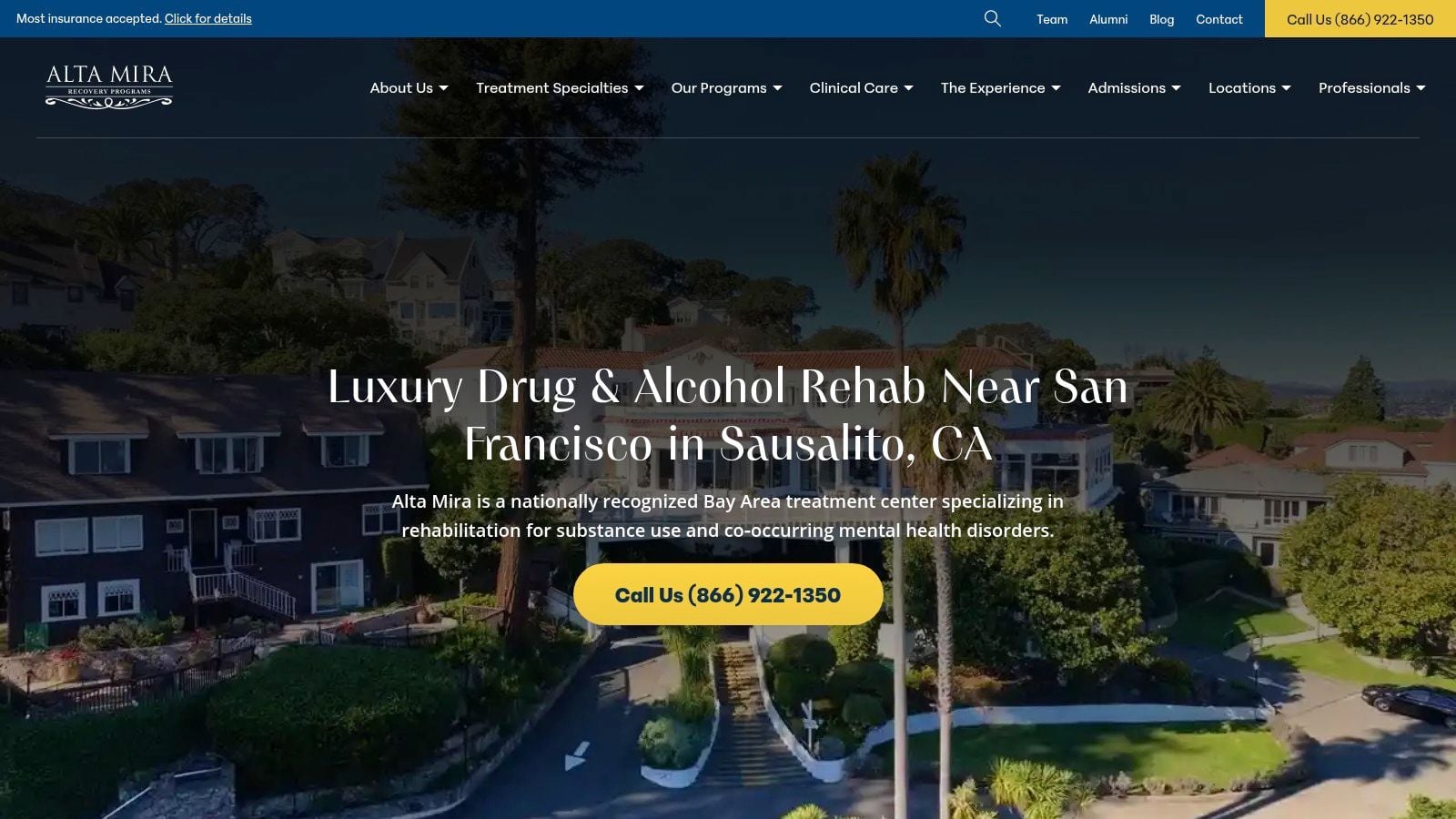
Alta Mira Recovery Center is a private residential program in Sausalito that fits people looking for high-touch, clinically intensive care in a quiet Bay Area setting. Its appeal isn't just privacy. It's the way the program combines psychiatry, medical oversight, trauma treatment, and broad diagnostic workup at the front end.
For dual diagnosis cases with diagnostic uncertainty, that matters. Someone may arrive thinking the main issue is alcohol, opioids, or stimulants and only later learn that trauma symptoms, mood instability, or another mental health condition are driving the cycle.
Where Alta Mira fits best
Alta Mira is strongest for clients who want a deeper residential assessment process and a wider therapeutic menu, including CBT, DBT, EMDR, family work, and step-down planning. That's especially relevant when previous treatment has failed because care was too narrow or too focused on substance use alone. Families trying to understand the mental health side of rehab may also benefit from this overview of mental health in rehabilitation.
The setting is another practical advantage. Sausalito is close enough to Bay Area population centers to make family participation realistic, but removed enough to feel separate from daily triggers. That balance works well for professionals and adults who need privacy without flying out of state.
The quietest setting isn't always the best setting. What matters is whether the program can manage the client's psychiatric symptoms and addiction treatment at the same time.
The main drawback is access. Alta Mira tends to fit private-pay clients or people with out-of-network benefits they understand well. Before admission, ask very direct questions about what insurance will cover, what clinical services are billed separately, and how continuing care is handled after residential discharge.
3. Bayside Marin
A Bay Area family often starts here after a familiar pattern. Outpatient therapy helped somewhat, detox addressed the immediate substance use crisis, but the depression, anxiety, trauma symptoms, or mood swings kept pulling the person back into relapse. Bayside Marin is one of the centers families look at when they want residential care that presents co-occurring disorders as part of the core job, not an add-on.
Bayside Marin is based in Marin County and offers residential and outpatient services. For readers using this article as a decision guide rather than a simple directory, the key question is fit. Bayside Marin may fit adults who want privacy, a calmer setting, and a treatment environment that openly addresses substance use and psychiatric symptoms together.
The location matters, but not for the reason brochures usually imply. A secluded campus can reduce exposure to day-to-day triggers and give clients room to stabilize. It can also make logistics harder if family members work full time, live farther away, or need frequent in-person involvement. That trade-off is worth discussing before admission.
Where Bayside Marin fits best
Bayside Marin tends to make the most sense for privately insured or self-pay clients who want care close to the Bay Area without staying in a dense urban setting. It may also appeal to families who value structured family programming and want clear expectations around participation.
The stronger question is not whether a center uses the phrase "dual diagnosis." Ask how integrated the care is. A good program should be able to explain who manages psychiatric evaluation, how medication decisions are communicated to the therapy team, what happens if symptoms intensify during residential care, and how discharge planning accounts for both addiction and mental health treatment.
That level of detail separates marketing language from clinical capacity.
Before choosing Bayside Marin, ask these questions:
- Who leads psychiatric care? Confirm whether medication management and mental health treatment are handled on site as part of the main treatment plan.
- How are clinical updates shared? Ask how therapists, psychiatric staff, and addiction counselors coordinate care during the stay.
- What is the outpatient path after residential treatment? Clarify whether step-down care is available through the same program or arranged elsewhere.
- How much family involvement is expected? Get specific about session frequency, education, and whether participation is optional or built into treatment.
- What will this cost in practice? Ask for a plain breakdown of insurance coverage, out-of-pocket costs, and any services billed separately.
The biggest limitation is access. Bayside Marin is not the option families usually choose when Medi-Cal coverage or lower-cost entry points are the deciding factor. If finances are tight, that issue can outweigh every other strength.
For the right client, though, Bayside Marin can be a reasonable Bay Area choice: private, structured, and clinically focused enough to deserve a careful screening call.
4. Tarzana Treatment Centers
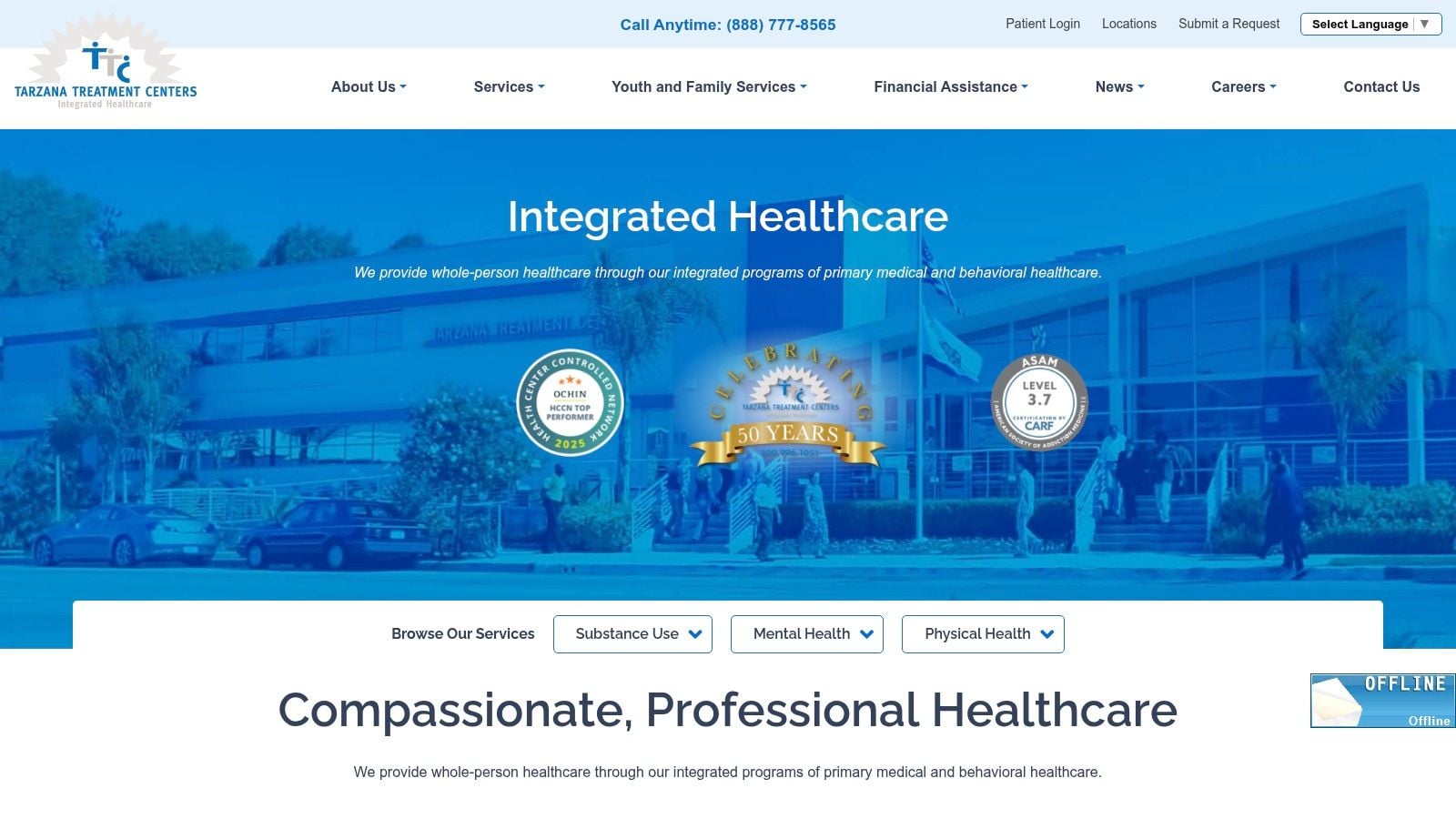
Tarzana Treatment Centers is the opposite of a boutique rehab model. That's not a weakness. For many people, it's the reason to call.
Tarzana is a large nonprofit system in Los Angeles County with multiple sites and a broad continuum that includes detox, psychiatric hospital services, residential treatment, and outpatient programs. If the person you're helping has unstable psychiatric symptoms, limited finances, complicated medical needs, or public insurance, this kind of infrastructure can be more useful than a smaller private center.
Why the nonprofit model matters here
Dual diagnosis treatment often fails at the access point, not because families don't want help, but because the level of care they need isn't available in a financially realistic format. Research on co-occurring disorders points to service availability as a primary barrier for vulnerable groups, including veterans, people with low socioeconomic status, and those involved in the criminal justice system. That gap is discussed in this co-occurring disorder access review.
Tarzana's advantage is that it operates more like a safety-net health system than a resort-style treatment campus. Broad payer acceptance, including Medi-Cal and Medicare, can make it one of the more practical California options for families who need integrated care without a private-pay budget. The system scale also helps when a client may need movement across levels of care.
If someone needs hospital-level psychiatric backup, don't let aesthetics decide the placement. Choose the system that can keep the person safe and engaged.
The trade-off is predictability of experience. Large systems can feel busy, less personalized, and more administrative. Amenities are functional. The environment may not feel serene. But for clients who need access, medical backup, and continuity inside one larger system, Tarzana is often a stronger real-world fit than a more polished private program.
5. UCLA Health Resnick Neuropsychiatric Hospital Dual Diagnosis IOP
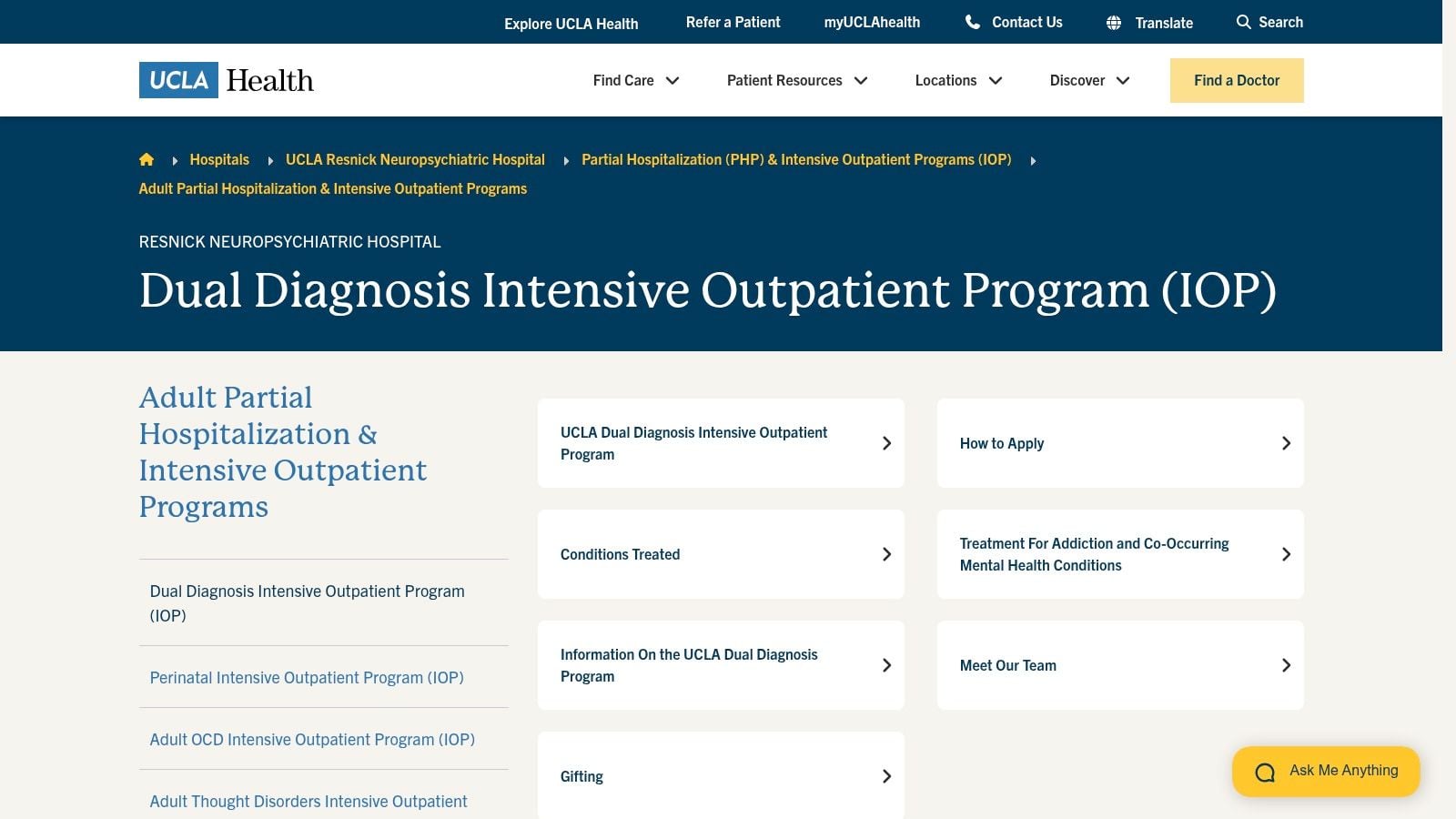
UCLA Health's Resnick Neuropsychiatric Hospital Dual Diagnosis IOP is a strong option for adults who need integrated psychiatric and addiction treatment but don't need residential placement. That distinction matters. Too many families compare all programs as if they're interchangeable. They aren't.
This program is structured as an eight-week intensive outpatient track with daily groups during the week, weekly individual therapy, and medication management. For someone who is stable enough to live outside a facility but still needs close psychiatric oversight and intensive support, that's a serious level of care.
Who should consider this level of care
UCLA's biggest advantage is clinical governance. The program sits within an academic psychiatric hospital, which usually means cleaner intake protocols, clearer psychiatric referral pathways, and easier access to specialty consultation if a case becomes more complicated. That's especially useful when the mental health diagnosis is active and medication management can't be treated as an afterthought.
This is best for people who have housing, some outside support, and enough day-to-day stability to attend a demanding outpatient schedule. It's not a substitute for detox, and it's not a residential containment setting. If a person is medically unstable, acutely impaired, or unable to stay safe outside treatment hours, another level of care is probably the better first step.
A practical way to consider this:
- Best for structured outpatient care: Good for adults who need daily treatment without overnight admission.
- Strong psychiatric integration: Useful when medication management and specialty mental health follow-up are central needs.
- Less suitable for crisis containment: Not ideal if the person needs detox or a locked, highly supervised environment.
The usual challenge is access. Insurance authorization, intake timelines, and fit assessment can affect how quickly someone starts.
6. Sharp McDonald Center
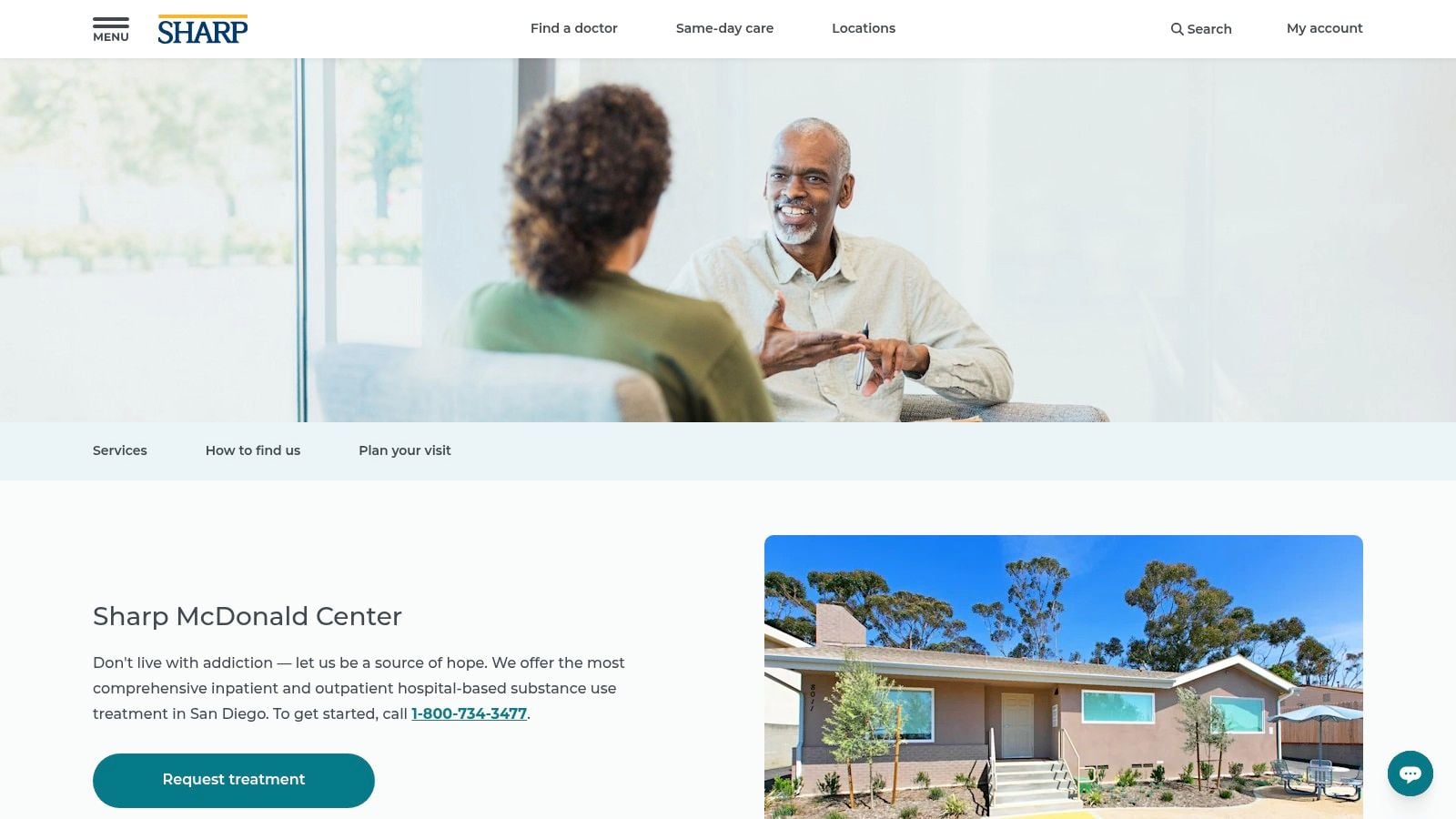
Sharp McDonald Center works best when medical and psychiatric complexity are part of the picture. As part of Sharp HealthCare Behavioral Health in San Diego, it offers medical detox, residential and acute rehab services, and a Dual Recovery Program coordinated with the wider Sharp network.
That hospital affiliation changes the equation. For clients with medication issues, physical health concerns, or mental health symptoms that may need rapid escalation to a higher level of care, a hospital-connected program usually has an operational advantage over a standalone rehab.
Where Sharp has an edge
Sharp's continuity is one of its strongest features. Clients can move through detox, rehab, and ongoing support with less fragmentation than they might experience across unrelated providers. The center also offers aftercare groups for graduates, which is useful because discharge is often where momentum slips.
If you're comparing outpatient intensity with residential care, it helps to understand what an intensive outpatient program for adults can and can't do. Sharp is appealing because it can connect people across levels rather than forcing a separate search every time clinical needs change.
The limitations are straightforward. It's in San Diego, so geography alone may rule it out for many Northern California families. Cost also depends on level of care, insurance authorization, and length of stay, so you'll need a direct benefits review rather than relying on assumptions.
Choose a hospital-affiliated dual diagnosis program when safety, medication complexity, or rapid psychiatric backup could become part of the case.
7. Duffy's Napa Valley Rehab
Duffy's Napa Valley Rehab is a useful option for families who value clinical transparency. Many centers say they treat co-occurring issues, then leave you guessing about what psychiatric presentations they can realistically manage. Duffy's is more explicit about scope.
Located in Calistoga, the program offers residential treatment with dual diagnosis support for people whose co-occurring conditions are stable enough for that setting, along with longer-stay possibilities and step-down options such as PHP or IOP. It also notes medication-assisted treatment availability and support with insurance billing and financing.
When Duffy's is a strong fit
The clearest benefit here is fit screening. If a center explains its inclusion and exclusion criteria, families can make faster decisions and avoid mismatched admissions. That's especially helpful when psychiatric symptoms are present but don't appear to require hospital-level stabilization.
The Napa setting also appeals to people who need a lower-stimulus residential environment within reach of Northern California communities. For some clients, a calmer setting supports sleep, routine, and early sobriety. For others, the environment matters less than the center's ability to manage mood instability, psychosis, or severe trauma symptoms. Duffy's own scope matters more than the scenery.
The main caution is simple. This isn't the best match for severe or unstable psychiatric presentations. If someone may need hospital monitoring first, don't force a residential rehab to do a job it wasn't built to do.
A quick fit check:
- Good fit: Stable co-occurring conditions, need for residential structure, desire for clear clinical boundaries.
- Possible mismatch: Severe psychiatric instability, need for hospital-level monitoring, or symptoms outside the center's residential scope.
- Worth asking about: MAT protocols, psychiatric consultation, and what happens if the client needs a higher level of care after admission.
Top 7 California Dual Diagnosis Centers Comparison
| Provider | 🔄 Implementation Complexity | Resource Requirements | ⚡ Speed / Efficiency | ⭐ Expected Outcomes / 📊 Impact | 💡 Ideal Use Cases / Key Advantages |
|---|---|---|---|---|---|
| Addiction Resource Center LLC | Moderate, coordinated MAT, IOP (telehealth + in‑person) and partner residential transitions | Multidisciplinary staff (MD, RN, CADC, LMFT), telehealth platform, insurance verification | ⚡ Good access via 24/7 intake and telehealth; partner residential may add transition time | ⭐⭐⭐⭐, strong continuity of care, relapse prevention focus, individualized plans | 💡 Best for Northern CA adults seeking insurance‑friendly MAT + telehealth; call 24/7 line to confirm pricing/residential specifics |
| Alta Mira Recovery Center | High, intensive private residential dual‑diagnosis track with comprehensive assessments | High clinician‑to‑client ratio, psychiatry, neuropsych testing, trauma modalities | ⚡ Intensive but slower intake and private‑pay arrangements can delay admission | ⭐⭐⭐⭐⭐, high‑quality outcomes for complex/co‑occurring cases with trauma focus | 💡 Ideal for professionals or those seeking private, intensive residential dual‑diagnosis care; verify insurance/out‑of‑network costs |
| Bayside Marin | Moderate, integrated dual‑diagnosis programming across residential and outpatient settings | Secluded campus, family programming, dedicated insurance team | ⚡ Reasonable throughput; campus setting supports immersive care but may require travel | ⭐⭐⭐⭐, individualized clinical menus and regional reputation support good outcomes | 💡 Suited to Bay Area residents seeking residential care with family involvement; often private‑pay or in‑network commercial plans |
| Tarzana Treatment Centers | High, large nonprofit system offering psychiatric hospital, detox, residential and outpatient continuity | Hospital resources, inpatient psychiatry, broad payer enrollment including Medi‑Cal/Medicare | ⚡ High access efficiency for publicly insured clients; system scale expedites referrals | ⭐⭐⭐⭐, strong safety‑net access and capacity for medically complex presentations | 💡 Best for low‑income/publicly insured or medically complex clients in LA County needing hospital‑level services |
| UCLA Health – Resnick Dual Diagnosis IOP | Moderate, structured 8‑week IOP embedded in academic psychiatry | Daily group therapy, weekly individual therapy, on‑site medication management, specialty referrals | ⚡ High intensity (daily) without residential stays, faster return to community | ⭐⭐⭐⭐, evidence‑based care with strong clinical governance and specialty links | 💡 Good for insured adults needing intensive nonresidential integrated psychiatric/addiction care; expect insurance authorization steps |
| Sharp McDonald Center (Sharp HealthCare) | Moderate‑High, hospital‑affiliated dual recovery with medical detox and residential options | Hospital integration, medical/psychiatric teams, aftercare network, accepts Medicare/Medi‑Cal | ⚡ Efficient transitions within the Sharp network; lifetime no‑cost aftercare supports long‑term engagement | ⭐⭐⭐⭐, solid management of medical/psychiatric complexity and structured discharge planning | 💡 Appropriate for clients needing hospital‑level SUD/psychiatric care; geographically centered in San Diego |
| Duffy's Napa Valley Rehab | Low‑Moderate, 30‑day residential foundational track with clear inclusion/exclusion | Residential facility, MAT options, PHP/IOP step‑down, insurance billing/financing support | ⚡ Standard 30‑day course with clear step‑down pathways; straightforward admission for eligible clients | ⭐⭐⭐, effective for stable co‑occurring conditions; transparent scope aids matching | 💡 Best for Northern CA clients with stable dual‑diagnosis who want clear clinical criteria and insurance support |
FAQs and Your Next Step to Recovery
Navigating dual diagnosis treatment isn't just about picking the nicest campus or the nearest address. It's about finding a program that can treat substance use and mental health symptoms in one coordinated plan, at the right level of care, with a payment path you can sustain. The good news is that California does offer meaningful options across private, nonprofit, hospital-based, residential, and outpatient models.
The hardest part is often the first call. Families worry they'll ask the wrong question, commit too fast, or misunderstand what a center can really do. Those concerns are reasonable. A careful admissions conversation should make things clearer, not more confusing.
What is integrated treatment
Integrated treatment means the program addresses addiction and mental health together instead of treating one as primary and the other as secondary. In practical terms, that usually means the same treatment team, or one closely coordinated team, handles therapy, psychiatric review, substance use counseling, medication questions, and discharge planning.
What doesn't work well is a setup where the rehab handles sobriety, then tells the client to find outside mental health treatment later. That split often creates gaps right when support should be strongest.
How long does dual diagnosis treatment take
There isn't one standard timeline. Some people need detox followed by residential care and then outpatient support. Others are appropriate for IOP from the start. The right duration depends on withdrawal risk, psychiatric stability, relapse history, housing, motivation, and what support exists at home.
A better question to ask is whether the center can explain the likely sequence of care. Good programs can tell you what the first step is, what would trigger a step up or step down, and how aftercare is handled.
How can I pay for rehab
Start with an insurance verification call. Ask whether the center is in-network, out-of-network, or private pay. Then ask what services are included, whether physician visits or psychiatric services are billed separately, and what happens if authorization changes during treatment.
If you have Medi-Cal, Medicare, TRICARE, or a commercial plan, don't assume all centers accept it just because they mention insurance on their website. Verify directly. For some families, payer fit will narrow the list immediately.
What questions should I ask before admission
You don't need a perfect script, but you do need a focused one. Ask whether the center treats your specific mental health concern within the program rather than by outside referral. Ask what level of psychiatric support is available, whether MAT is offered, and how family communication works.
Then ask the questions many people skip:
- Who manages medications: Confirm whether a prescriber is actively involved.
- What happens after discharge: Ask about IOP, therapy referrals, alumni support, and relapse planning.
- What would make this a poor fit: A trustworthy admissions team should answer that plainly.
If you feel ready to take the next step, reach out to a center directly, verify insurance, and describe the current situation accurately. Confidential help is available around the clock, and recovery is possible even when things feel tangled right now.
If you're looking for practical, compassionate dual diagnosis care in Northern California, Addiction Resource Center LLC is a strong place to start. The program offers medically supervised detox with MAT, in-person and telehealth IOP, coordinated residential rehab through its partner facility, and individualized support from a multidisciplinary team. Families can call or text the admissions line any time to ask questions, verify insurance, or talk through next steps with a real person.