You get the email, text, or call. A job offer is waiting on a urine screen. Probation requires a test. A family court case suddenly feels more fragile. Or you're already standing in a clinic bathroom, anxious, unable to pee, trying not to panic. If you're searching for how to pass a urine test, you …

You get the email, text, or call. A job offer is waiting on a urine screen. Probation requires a test. A family court case suddenly feels more fragile. Or you're already standing in a clinic bathroom, anxious, unable to pee, trying not to panic.
If you're searching for how to pass a urine test, you probably want one thing. A safe way through this without making your situation worse. That's the right goal.
I'm going to be direct. Most online advice about “beating” a urine test is reckless. It pushes panic decisions that can damage your health, trigger an invalid result, or create legal trouble you didn't have before. What helps is knowing what urine tests measure, what they don't, what your rights are, and when it's smarter to stop trying shortcuts and get support. Over 90% of workplace drug tests in the United States use urine screening, and those tests generally capture recent use within a 1 to 7 day window, not exact dose or current intoxication, according to this review of urine testing limits and detection windows. If your stress is tied to court or supervision, it also helps to understand the legal side of navigating consequences of a failed drug test.
Table of Contents
- Facing a Urine Test What You Need to Know First
- Understanding Detection Windows and What Tests Find
- Safe and Medically Sound Ways to Prepare
- Myths and Dangerous Methods to Avoid
- Know Your Rights and How to Handle Results
- Finding Support and Moving Forward in Yuba City
Facing a Urine Test What You Need to Know First
Urine testing is common because it's practical, cheap to administer, and good at detecting metabolites, which are the byproducts your body leaves behind after using a substance. That matters because a urine test usually doesn't answer the question people think it does. It usually doesn't show whether you're impaired right now, and it doesn't tell the lab exactly how much is actively circulating in your body.
That gap creates a lot of confusion. Someone may feel “fine” and still test positive, while another person may be impaired from something not captured the same way. If you're trying to pass a urine test, stop treating it like a judgment of how you feel today. Treat it as a screening process with very specific rules.
Practical rule: Don't make decisions based on how sober you feel. Urine tests aren't measuring your confidence, your energy, or your current level of impairment.
A few basic detection windows provide context. The same source noted above explains that urine tests can detect opioids for 1 to 3 days, stimulants for 2 to 3 days, and benzodiazepines for up to 4 days after last use, while still failing to show exact dose or intoxication level. Those numbers are useful, but they are not a loophole. They are rough windows, not promises.
Here's the part I want you to take seriously:
- Don't chase internet hacks. Panic drives bad choices.
- Don't assume one clean-feeling day means you're clear. Biology doesn't care what forum advice told you.
- Don't confuse “I need to get through this test” with “I need to hide a bigger problem.” Those are different issues, and they need different solutions.
If you're under legal pressure, employment pressure, or family pressure, the smartest move is to protect your health and your rights at the same time.
Understanding Detection Windows and What Tests Find
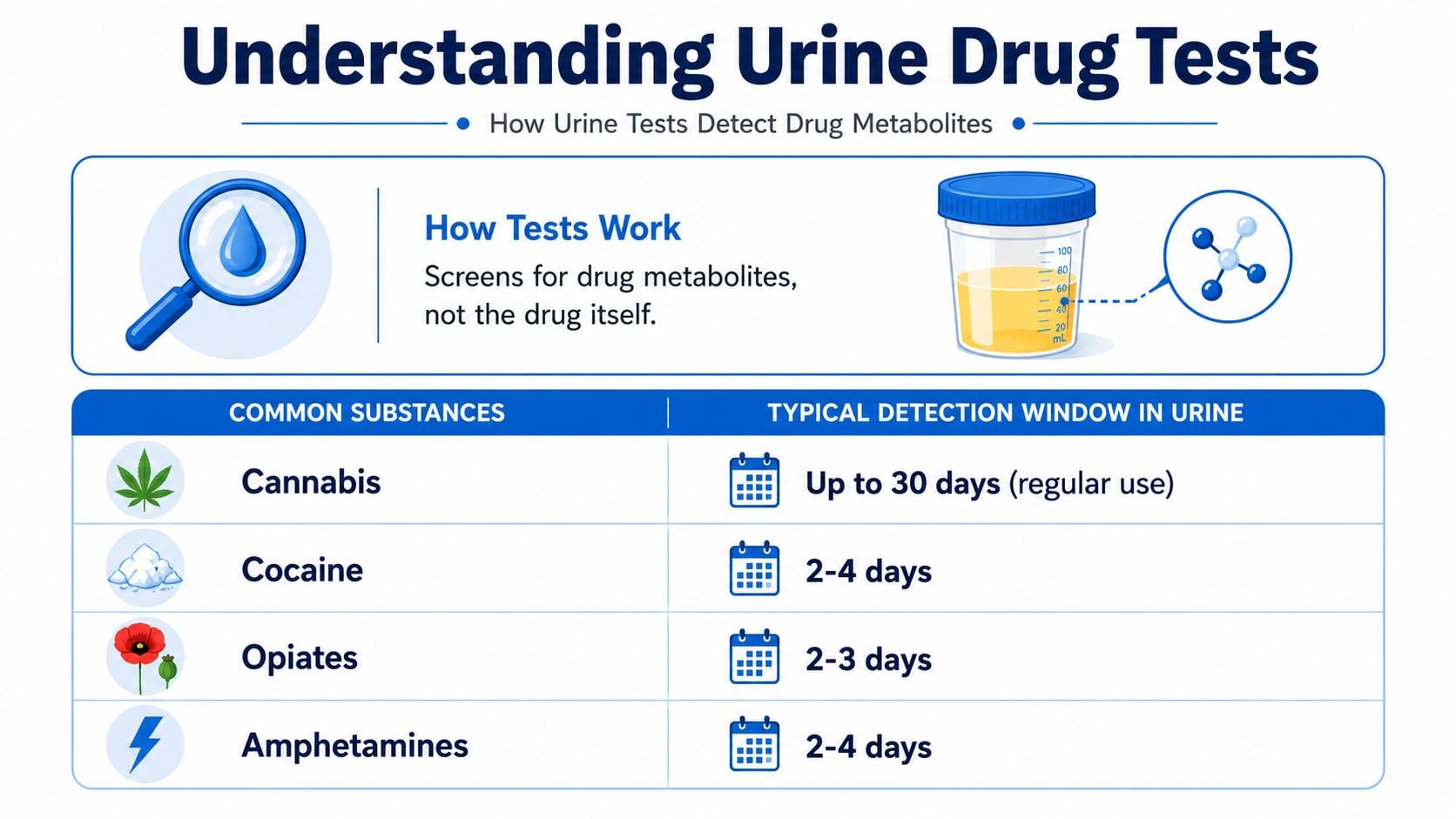
Urine tests look for metabolites, not the original drug in the simplistic manner often assumed. That's why timing gets messy. The substance may be gone from the way you feel, but the metabolic evidence can still be present in urine.
What a urine test is actually measuring
If you want to pass a urine test, you need a realistic view of the target. You're not trying to “look normal.” You're trying to produce a valid sample that doesn't contain prohibited metabolites above the lab's cutoff.
That's why the same substance can produce very different timelines in different people. Frequency of use matters. Body processes matter. Most of all, cannabis is routinely underestimated. For heavy daily users, THC can remain detectable in urine for up to 30 days after cessation, according to guidance discussing heavy-user THC detection timelines and shy bladder procedures.
A casual user and a heavy daily user are not playing by the same timeline. Treating them as if they are is one of the biggest mistakes people make.
Estimated urine drug detection windows
Use this table as a reality check, not a guarantee.
| Substance | Single Use / Infrequent User | Chronic / Heavy User |
|---|---|---|
| Cannabis | Often shorter than heavy-use timelines | Up to 30 days |
| Opioids | 1 to 3 days | Can vary |
| Stimulants | 2 to 3 days | Can vary |
| Benzodiazepines | Up to 4 days | Can vary |
| Alcohol | Within 24 hours | Still generally short compared with many drugs |
A few important takeaways come out of that table.
First, cannabis deserves the most caution. Heavy use changes the math. If you built your plan around the kind of detox timeline you see repeated on social media, you may badly misjudge your window.
Second, some drugs clear relatively fast in urine compared with cannabis, but “faster” doesn't mean “safe by tomorrow.” If your test is close, you're gambling.
Third, urine testing is backward-looking. It tells a story about prior exposure. It is not a live impairment gauge.
If you're making a decision today, use the longest realistic interpretation, not the most optimistic one. That protects you better than wishful thinking ever will.
Safe and Medically Sound Ways to Prepare
Let's cut through the noise. The only guaranteed way to pass a urine test is to stop using substances and allow your body time to metabolize them naturally. Attempts to beat the process with dilution, substitution, or adulteration usually fail because collection sites and labs are built to catch exactly those moves.

The only reliable strategy
If you know a test is coming, your safest preparation plan is boring. That's why it works.
- Stop all non-prescribed substance use immediately. Time is what lowers risk.
- Keep your routine stable. Eat, sleep, and hydrate normally. Extreme last-minute behavior creates new problems.
- Bring required identification and paperwork. Administrative mistakes are avoidable stress.
- Show up ready to provide a valid sample. Labs are not looking for “almost normal.” They're looking for sample integrity.
According to this overview of specimen validity and natural metabolization as the only guaranteed method, a passing urine sample needs normal integrity, including a temperature range of 90 to 100°F (32 to 38°C) and no significant dilution or adulteration. The same source states plainly that the most reliable way to pass is allowing the body to metabolize substances naturally.
If your plan depends on hiding evidence instead of letting your body clear it, it's not a good plan.
If you take prescription medication
Don't hide legitimate prescriptions. Handle them correctly.
If a medication could affect your result, disclose it through the proper process and keep documentation available. In many testing situations, a Medical Review Officer (MRO) reviews non-negative results and checks whether a lawful prescription explains the finding. Your job is to be honest, organized, and responsive.
A clean approach looks like this:
- Keep records handy. Save your prescription label or pharmacy information.
- Answer MRO calls promptly. Ignoring that call can make a manageable situation worse.
- Disclose only through the proper channel. You usually don't need to debate your medical history with a collector on site.
When stopping on your own feels risky
Some people can stop and wait. Some can't. That isn't a character flaw. It's a sign you may need medical support.
If you're using alcohol, benzodiazepines, opioids, or multiple substances regularly, abrupt withdrawal can be dangerous or miserable enough to trigger relapse. A medically supervised detox can help you stop safely, manage symptoms, and move toward a result that doesn't depend on tricks. If the phrase “just stop” sounds simple but impossible in real life, that's a strong signal to seek treatment rather than gamble on shortcuts.
Myths and Dangerous Methods to Avoid
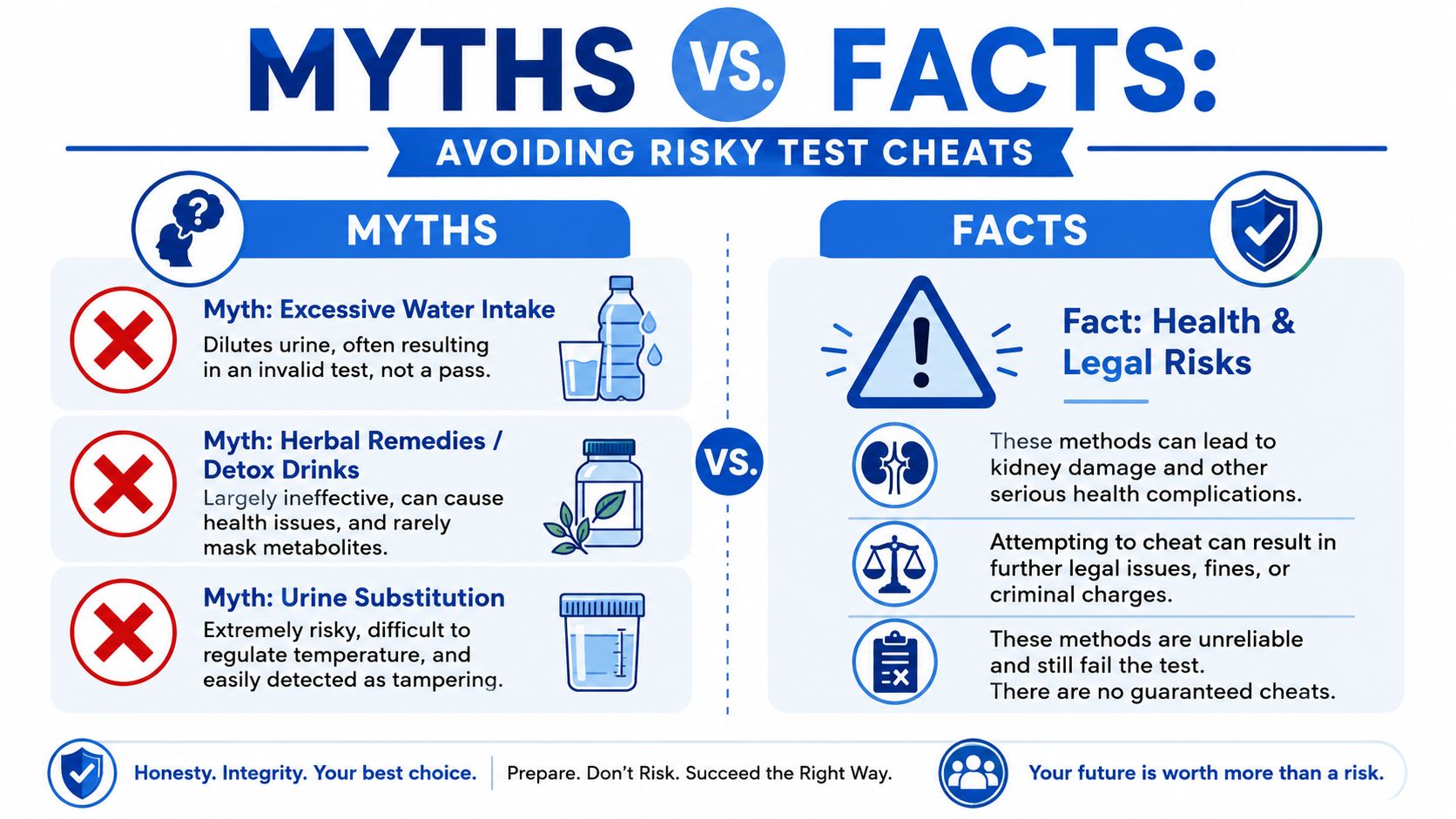
The internet is full of bad advice about how to pass a urine test. Most of it falls into three buckets. Drink absurd amounts of water. Add something to the sample. Use someone else's urine. All three are risky. None is smart.
Why dilution gets flagged
People love the water myth because it sounds harmless. It isn't harmless if you overdo it, and it often doesn't work anyway. Excessive water intake right before testing can push a sample into suspicious territory because labs look at indicators like creatinine and specific gravity.
If you want a plain-language explanation of the body side of overhydration, Zoe Behavioral Health on water drinking is worth reading. From a testing standpoint, dilution is unreliable because modern protocols are designed to identify samples that are too thin to trust.
Why adulterants and substitution fail
Labs and collectors aren't new to this. They know people try bleach, nitrites, household chemicals, synthetic products, and borrowed urine. They also check for signs of tampering.
According to this breakdown of adulterated specimens and invalid sample trends, the incidence of invalid urine specimens in the general U.S. workforce increased by 45.2% between 2022 and 2023. Federal guidelines define an adulterated specimen as one containing abnormal substances or endogenous substances at non-physiological concentrations, including pH less than 3 or greater than 11.
That means the “clever trick” you found online is probably a familiar lab pattern.
Consider what usually gives these methods away:
- Temperature problems: Substituted urine often fails because it doesn't present like a fresh sample.
- Chemical red flags: Additives can alter pH or introduce substances that specimen validity testing detects.
- Dilution markers: Overwatered urine can trigger an invalid or immediate retest instead of a pass.
The most common outcome of tampering isn't a magic negative. It's a result that raises suspicion.
There's also a practical truth people hate hearing. Once you move from “I hope I'm clean enough” to “I'm going to manipulate the sample,” you may be creating a bigger employment or legal problem than the original positive result.
Know Your Rights and How to Handle Results
A lot of fear around urine testing comes from not knowing the rules. That's fixable. You do have rights, and you should use them calmly.
If you have shy bladder
Paruresis, often called shy bladder, is real. If anxiety makes it difficult or impossible to urinate on command, don't assume you've automatically failed or refused. In many testing settings, there are procedures for this situation.
People with paruresis are entitled to multiple attempts, and collectors may require drinking up to 40 ounces of fluid within three hours or switch to an alternative specimen type such as oral fluid if urine collection fails. The Department of Transportation also provides accommodation pathways so a medical condition isn't automatically treated as a refusal to test. That point was discussed in the earlier section's linked source on detection windows and shy bladder.
If this applies to you, say so early and respectfully. Don't argue. Don't disappear. State the problem clearly and ask what the site's procedure is.
A simple script works:
- At check-in: “I have difficulty urinating under observation or pressure.”
- If time is passing: “Can you explain the shy bladder procedure for this test?”
- If you're panicking: “I'm trying to comply. I may need the available accommodation process.”
If your result comes back positive
Don't melt down in the lobby and don't start inventing explanations. Handle it like an adult protecting their future.
Start with these steps:
- Ask whether an MRO review is pending or complete. That matters if prescription medication is involved.
- Gather documentation fast. Prescriptions, pharmacy records, or treatment records can be relevant.
- Ask about confirmatory testing or retesting procedures. You want to know the formal process, not a rumor from a coworker.
- Get legal advice if the potential outcomes are severe. Employment loss, probation issues, and DWI-related testing all deserve a careful response.
If your testing issue intersects with refusal laws or implied-consent questions in a driving case, Texas DWI breath test refusal is a useful example of how testing decisions can carry legal consequences beyond the test itself.
Stay professional. The person collecting the specimen didn't create your problem, and arguing with them won't solve it.
Finding Support and Moving Forward in Yuba City
A urine test can feel like a threat. Sometimes it's also a turning point.
If you're terrified of every random screen, if you keep trying to calculate detection windows instead of addressing your use, or if stopping on your own keeps failing, that's important information. It may mean the underlying problem isn't the test. The underlying problem is that substances have started running your schedule, your work, your relationships, or your legal risk.
That's where support matters. Not punishment. Not shame. Support.

If you're in Yuba City or elsewhere in Northern California, practical help can include:
- Medically supervised detox with MAT: This is the right move when withdrawal risk, cravings, or relapse cycles make “just stop” unrealistic.
- Intensive outpatient treatment: Good for people who need structure and accountability while still managing work, family, or court obligations.
- Telehealth and in-person counseling: Useful when transportation, privacy, or scheduling makes traditional care harder.
- Relapse prevention and aftercare planning: Passing one test isn't the same as building stability.
People often wait until a failed test forces action. That's backwards. The stronger move is to act before the next crisis. If you already know your use is putting housing, work, custody, probation, or your health at risk, don't keep bargaining with chemistry. Get help and reduce the chaos at the source.
Recovery support also helps with the emotional part that online testing guides ignore. Shame, secrecy, and panic keep people isolated. Structure, medical oversight, and counseling give people a way forward that doesn't depend on hiding.
If you need confidential help now, Addiction Resource Center LLC offers compassionate care in Yuba City for adults facing substance use, withdrawal, relapse risk, or co-occurring mental health needs. Services include medically supervised detox with medication-assisted treatment, residential rehab through its partner facility, intensive outpatient care in person and by telehealth, counseling, relapse prevention, and individualized aftercare. The team includes medical and behavioral health professionals, accepts most major insurance plans and TRICARE, and serves Northern California with a 24/7 phone and text line at 530-625-7910. You can also visit them at 1002 Live Oak Blvd., Suite A, Yuba City, CA.