You may be searching for virtual IOP programs near you late at night, between work emails, school pickups, or after another hard conversation about drinking or drug use. That search usually comes from a very specific kind of pressure. You know something more structured than weekly therapy may be needed, but stepping away for residential …


You may be searching for virtual IOP programs near you late at night, between work emails, school pickups, or after another hard conversation about drinking or drug use. That search usually comes from a very specific kind of pressure. You know something more structured than weekly therapy may be needed, but stepping away for residential treatment feels impossible right now.
That doesn't mean help is out of reach. It often means you need a level of care that fits real life while still taking recovery seriously. For many adults and families, a virtual intensive outpatient program can offer that middle path.
If you're in California, the question isn't just whether online treatment exists. What matters is whether you can legally attend from where you live, whether the program treats substance use, and whether the schedule works with your life. Those are the questions that matter most when families start looking for a practical next step, including local options such as Addiction Resource Center LLC.
Table of Contents
- The Search for Flexible Addiction Treatment
- What Exactly Is a Virtual Intensive Outpatient Program
- Who Can Benefit from a Virtual IOP
- Virtual IOP vs In-Person IOP What Are the Differences
- How to Find and Evaluate Virtual IOP Programs Near You
- Start Your Recovery at Addiction Resource Center
- Frequently Asked Questions About Virtual IOPs
The Search for Flexible Addiction Treatment
A father in San Diego is searching after midnight because he cannot miss more work. A daughter in Fresno is looking for help for her mother, but she also needs a program her mother can attend from home. A college student in Los Angeles wants treatment that fits around classes and does not require stepping away from daily life all at once.
That is the reason many families type in "virtual IOP programs near me."
They are not looking for something casual. They are looking for treatment that is serious enough to help, but realistic enough to start now.
For many people, the problem is not willingness. It is logistics. Childcare, work shifts, school schedules, transportation, privacy at home, and fear of falling behind can all delay care. Weekly therapy may not feel like enough support when substance use is starting to shape the whole household. A higher level of care may help, but families often need an option that fits into real life instead of putting life fully on hold.
That is why the phrase "near me" matters even in virtual treatment. Online care is not available everywhere just because it happens on a screen. In addiction treatment, "near me" often means "licensed to treat people in my state." A provider may offer virtual sessions, but if the clinical team is not allowed to treat someone where they live, the program is not available to that person.
A simple way to think about it is this: virtual care works like a local service delivered through video. The screen makes treatment easier to attend. It does not erase state rules.
For California families, that changes the search. Instead of stopping at "Do they offer virtual IOP," ask, "Can they legally treat someone who lives in California?" Then ask what the admissions process looks like, whether the program treats substance use and mental health together when needed, and how scheduling works for work and family obligations. Those questions turn a broad internet search into a short list of real options.
This is also where a local provider can make the process less confusing. Addiction Resource Center serves California residents, so the "near me" part has a practical answer. It means a program based in your state, familiar with treating people here, and able to explain eligibility clearly before you commit to anything.
When the search becomes urgent
Families rarely start this search on a calm, ordinary day. It usually happens after something shifts. A missed shift at work. A binge that scared everyone. A close call while driving. A moment when home starts to feel organized around substance use instead of normal routines.
In that moment, clear information matters more than marketing language. Ask direct questions. Are you licensed to treat me where I live? How quickly can an assessment happen? What are the treatment hours? What technology do I need? What happens if my loved one also has anxiety, depression, or trauma symptoms?
Good programs answer those questions plainly. That kind of clarity helps families move from fear to a workable next step.
What Exactly Is a Virtual Intensive Outpatient Program
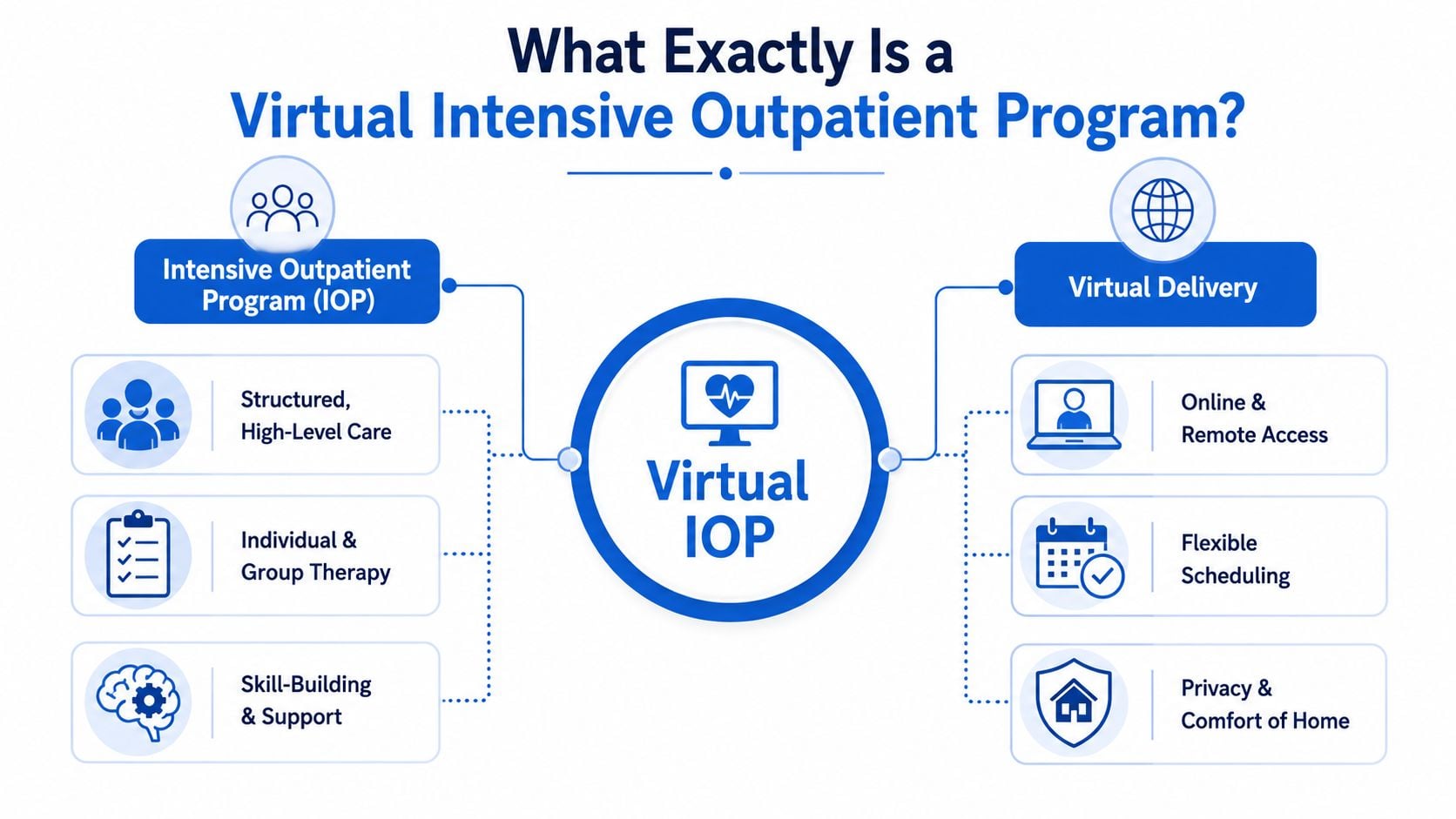
A virtual intensive outpatient program is often easiest to understand if you think of it as a part-time job for recovery. It has a schedule. It has expectations. It asks for real participation. But it still leaves room for work, parenting, school, and home life.
A level of care with real structure
The phrase "IOP" tells you the level of care. It sits between standard outpatient counseling and a more intensive setting such as residential treatment. That middle level is important for people who need more support than a weekly appointment but don't require around-the-clock supervision.
One description of the model notes that a virtual IOP is typically a structured behavioral-health dose of about 9 to 12 hours per week for 9 to 12 weeks, delivered through secure video sessions that may include group therapy, individual therapy, family therapy, and psychiatry when clinically indicated, as outlined by Charlie Health's explanation of IOP care.
That means this isn't a casual check-in. It's a treatment schedule with enough repetition and support to help people practice coping skills, address triggers, and build recovery habits in real time.
What happens in the virtual format
The word "virtual" only describes how the treatment is delivered. It doesn't mean the care is watered down. A secure video platform becomes the meeting space. Licensed clinicians lead groups, provide therapy, and guide the same kinds of treatment work many people expect from in-person programs.
A typical experience may include:
- Group therapy sessions where participants talk through cravings, setbacks, communication patterns, and relapse prevention.
- Individual counseling that focuses on your personal history, goals, and barriers to recovery.
- Family involvement when it makes clinical sense and can support healing at home.
- Psychiatric support if a provider determines medication or further mental health evaluation is needed.
Virtual treatment should still feel organized, clinical, and accountable. If it sounds like a loose support call, keep asking questions.
The best way to think about it is simple. Recovery work still happens. It just happens through your phone, tablet, or computer instead of in a clinic room.
Who Can Benefit from a Virtual IOP
Not everyone needs the same setting, and not everyone does well with the same routine. Virtual IOP tends to work best when a person needs solid structure but can still participate safely from home.
Life situations that often fit
Some people look into virtual care after completing detox or residential treatment. They don't want to lose momentum, but they also need to return home, go back to work, or reconnect with family responsibilities. A virtual schedule can help them stay engaged in treatment during that transition.
Others are trying to get help without blowing up the rest of their lives. Common examples include:
- Parents and caregivers who can't leave children or dependents for long stretches.
- Working adults who need treatment outside standard office hours.
- Students who need support while staying enrolled in classes.
- People in rural areas who would rather not spend hours traveling to a facility.
For these people, the appeal isn't convenience for convenience's sake. It's the ability to attend treatment consistently.
Clinical fit matters too
A virtual IOP also depends on whether the person's current needs match the setting. In general, this level of care makes the most sense when someone is medically stable, can participate in regular sessions, and needs more than occasional therapy to manage relapse risk, emotional distress, or co-occurring mental health symptoms.
Home environment matters too. The person needs a place where they can log in with reasonable privacy and focus. That doesn't mean home has to be perfect. It means there should be enough stability to attend sessions, speak openly, and follow through with the program.
A few questions can help clarify fit:
- Can the person attend several treatment sessions each week without constant interruption?
- Is there a private space for sessions, even if it's just a bedroom or quiet corner?
- Does the person need structure and support, but not 24-hour supervision?
- Is the program equipped to address substance use, mental health concerns, or both?
If the answer to most of those is yes, a virtual IOP may be worth exploring.
Virtual IOP vs In-Person IOP What Are the Differences
People often assume in-person treatment is automatically stronger and virtual treatment is automatically easier. Real life is more nuanced than that. The better format is usually the one a person can attend, engage in, and sustain.
The biggest trade-offs
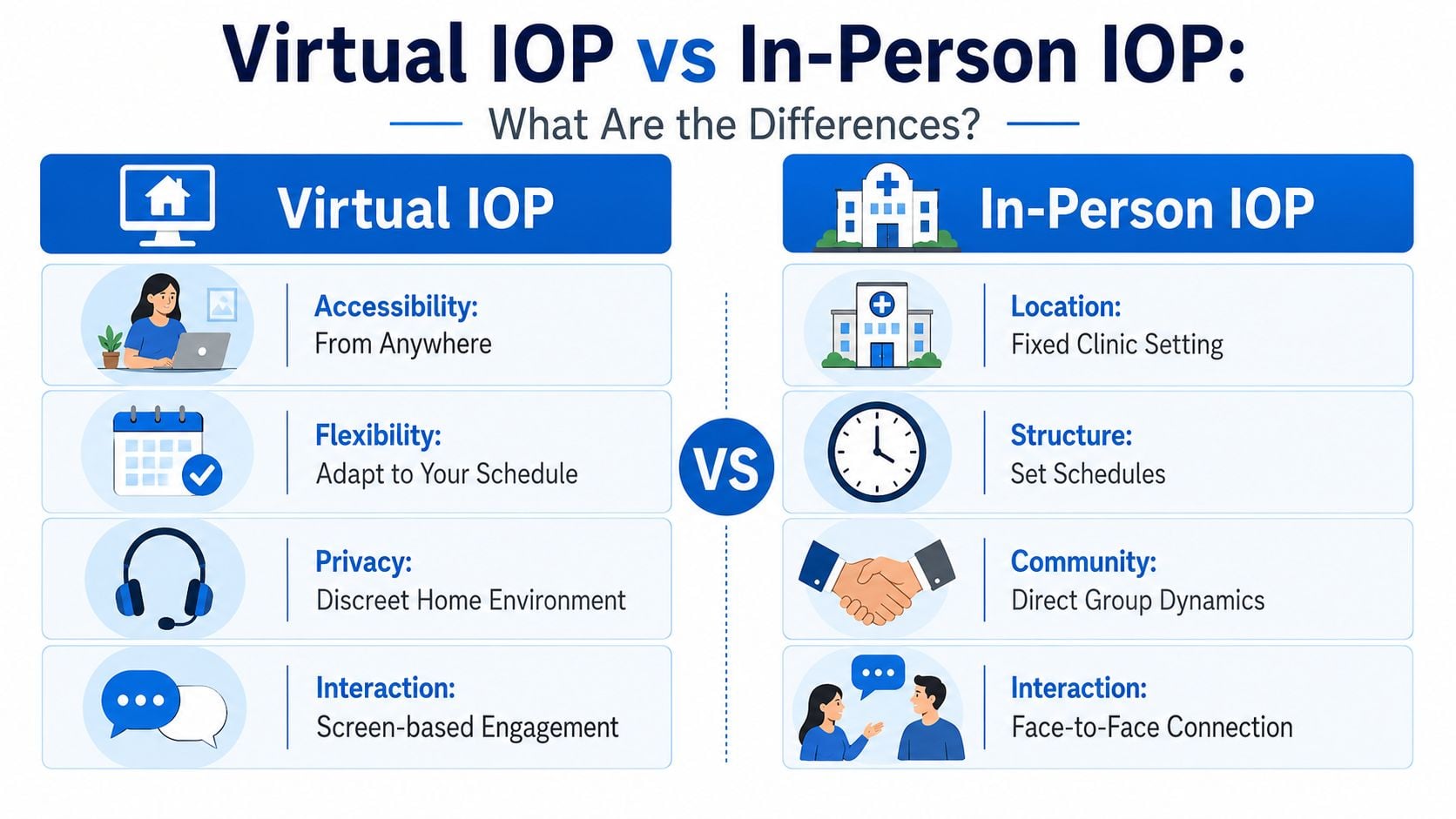
Virtual IOP removes the drive to treatment, the waiting room, and much of the scheduling friction that keeps adults from following through. For some people, that's the difference between joining treatment and putting it off again.
In-person IOP gives people a dedicated treatment environment outside the home. That can help when home feels chaotic, distracting, or closely tied to substance use. Some people also feel more connected in face-to-face group settings.
One reported outcome found that virtual IOP participants had a 21% higher completion rate than those in traditional in-person models, according to Apex Recovery's virtual IOP summary. That doesn't mean virtual is always better for everyone. It does show that online treatment can support strong retention for some patients.
The format matters less than the match. A good fit usually beats a perfect-looking program that someone can't realistically attend.
A simple side-by-side view
| Consideration | Virtual IOP | In-person IOP |
|---|---|---|
| Access | Attend from home if eligible in your state | Requires travel to a physical site |
| Scheduling | Often easier for work, school, and caregiving | More fixed around location and commute |
| Treatment setting | Home-based, which can feel private and practical | Separate clinical space with fewer home distractions |
| Peer experience | Group connection happens through video | Face-to-face interaction in the room |
| Best fit for | Adults needing flexibility and consistent attendance | People who benefit from leaving home for treatment |
Questions that make the choice clearer
Ask yourself, or ask your loved one, a few plain questions:
- Will getting to a clinic be a barrier every week?
- Does home feel private enough for honest participation?
- Would a physical treatment setting create more accountability?
- Is the biggest risk avoiding treatment altogether because the logistics feel too hard?
Those questions usually tell you more than a generic pro-and-con list.
How to Find and Evaluate Virtual IOP Programs Near You
The phrase virtual IOP programs near me sounds simple, but many families find this aspect confusing. "Near me" in virtual care doesn't always mean the provider is physically close. It often means the provider can legally treat you where you are.
What near me really means for virtual care
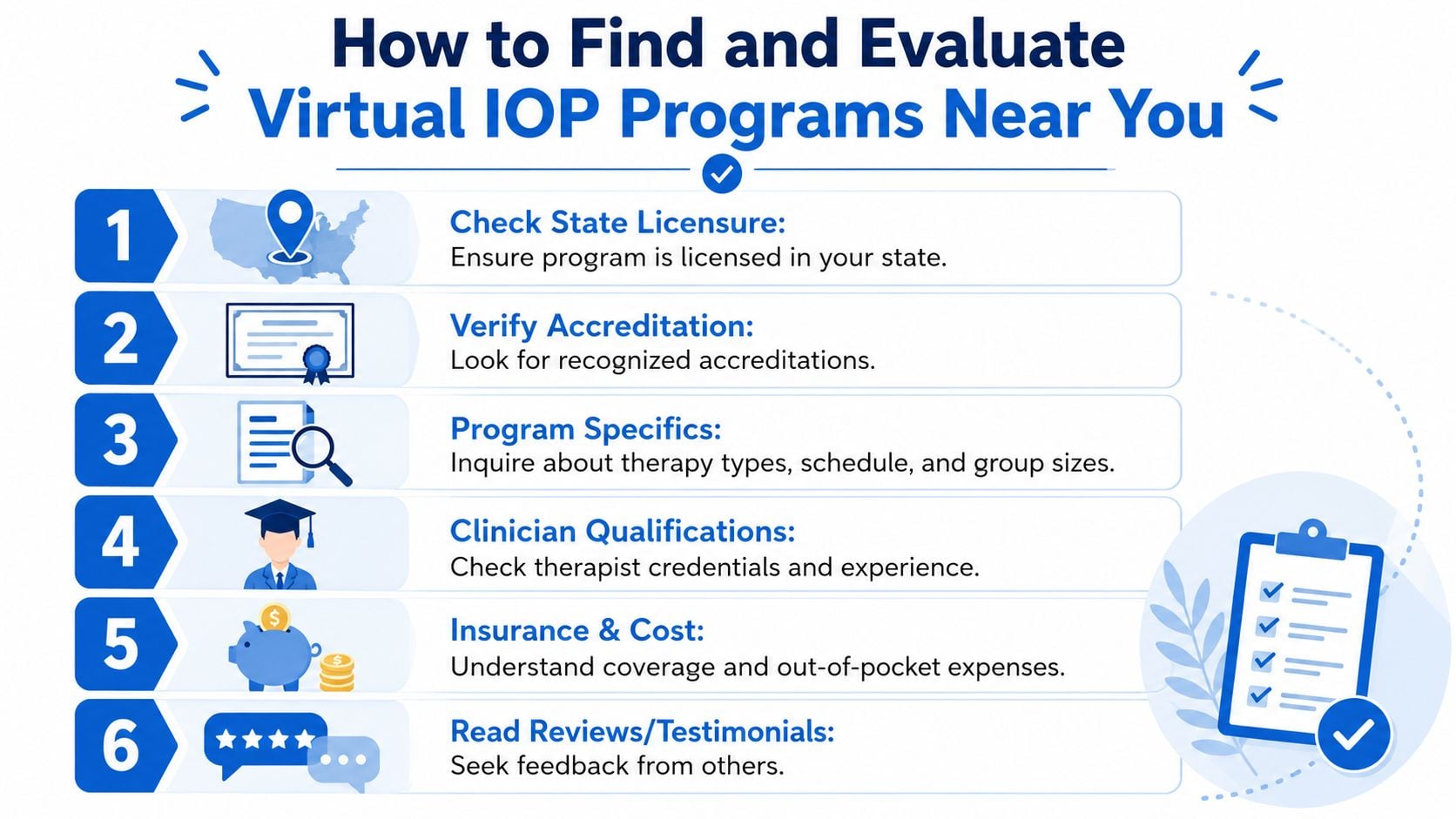
A virtual program may still be limited by state licensure rules. One clear example comes from Compass Health Center, which states that participants in its virtual PHP and IOP must be physically located in Illinois during each day of treatment, as described on Compass Health Center's virtual program page. That catches many people off guard.
If you're in California, the first question isn't "Do they offer Zoom groups?" It's "Can you legally treat me while I'm in California?" If the answer is unclear, keep asking until you get a direct answer.
Ask these questions early:
- State eligibility: "Are you licensed to provide virtual IOP to someone physically located in California?"
- Daily location rules: "Do I need to be in California during every session?"
- Substance use focus: "Is this program specifically for addiction treatment, mental health treatment, or both?"
- Age range: "Do you treat adults, adolescents, or both?"
A practical checklist for comparing programs
Once eligibility is clear, the search becomes more useful. You're no longer looking at every online program. You're narrowing to the ones you can attend.
Use this checklist when you call or fill out an intake form:
- Confirm the level of care. Ask how many days per week you attend and what kinds of sessions are included. A true IOP should sound structured.
- Ask who leads treatment. Find out whether licensed counselors, therapists, nursing staff, or medical providers are involved.
- Clarify what conditions they treat. Some programs focus mostly on anxiety or depression. If you're seeking addiction treatment, ask that directly.
- Discuss co-occurring needs. If depression, trauma, or another mental health issue is part of the picture, ask how the program handles both.
- Review the technology. The basic need is a secure video platform, but you should also ask what device works best and what happens if internet problems come up.
- Check insurance before enrolling. Ask whether the provider accepts your plan and whether telehealth IOP is processed differently. If you're military-connected, ask plainly whether they work with TRICARE.
Some families also like to understand how records, session notes, and care communication are managed behind the scenes. If you're comparing providers, resources on Healthcare documentation solutions can help you understand why accurate, secure clinical documentation matters in behavioral health settings.
If a program can't answer basic eligibility, schedule, and clinical questions clearly, keep looking.
For people in Northern California, one practical option to ask about is a Yuba City provider that offers in-person and telehealth intensive outpatient care for adults with substance use and co-occurring mental health needs. The important part is not the name first. It's whether the provider can legally serve you, treat the issues you're dealing with, and offer a schedule you can maintain.
Start Your Recovery at Addiction Resource Center
A family in Northern California often reaches this point after a long week of searching. You find a virtual program that looks promising, then one practical question stops everything. Can this provider legally treat someone in my part of California?
That is what "near me" often means for virtual addiction care. It is less about driving distance and more about whether the clinical team is licensed to serve you in your state, whether the schedule fits your life, and whether the program can handle substance use along with mental health concerns if both are part of the picture.
For adults in the Yuba City area and surrounding parts of California, Addiction Resource Center offers substance use treatment for adults 18 and older, including intensive outpatient care delivered in person and through telehealth. The program also addresses co-occurring mental health needs, which can matter if alcohol or drug use is tied to anxiety, depression, trauma, or another condition that needs attention at the same time.
A simple way to think about admissions is this. It works like checking whether a doctor takes your insurance and practices in your state before you book the visit. The first call helps confirm fit, eligibility, and logistics so you are not guessing.
What to ask when you call
You do not need to tell your whole story perfectly. Start with a few clear questions.
- "Am I eligible for virtual IOP where I live in California?"
- "Is this program for substance use, mental health, or both?"
- "What does the weekly schedule usually look like?"
- "Can you check my insurance, including TRICARE if that applies to me?"
- "What are the first steps in intake?"
If the intake process feels unfamiliar, it can help to read about digital patient information collection. Many programs now use online forms to gather history, insurance details, consent forms, and other basics before treatment begins.
Sometimes the hardest part is making contact. If you are considering this option, you can call or text 530-625-7910 for a confidential conversation and ask the practical questions first. That alone can make the next step feel more manageable.
Frequently Asked Questions About Virtual IOPs
Do I need special technology
Usually, no. The main technical requirement for remote addiction care is a secure video-conferencing platform, and the practical benefit is that it removes travel time and scheduling friction for adults who can't commit to inpatient treatment, according to Farley Center's telehealth IOP overview.
In plain terms, participants need a phone, tablet, or computer with internet access, plus a quiet place to join sessions.
How is privacy handled online
Programs generally use secure video systems and ask participants to join from a private setting. You can ask what platform they use, whether headphones are recommended, and what group expectations exist around confidentiality.
If privacy at home is tricky, say that directly. Admissions staff hear that concern all the time, and they can help you think through options.
Will insurance cover virtual treatment
Coverage depends on your plan and the provider. The fastest way to get a useful answer is to ask the program to verify your benefits and explain any expected out-of-pocket costs before you start.
If you're using TRICARE or another major insurance plan, mention that at the start of the call so the team can guide you more efficiently.
What if I'm not sure virtual care is enough
That's a valid question. A quality admissions conversation should help determine whether virtual IOP fits your current needs or whether you may need detox, residential care, or another level of support first.
You don't need to solve that alone. Your job is to be honest about what's happening. The provider's job is to help match the level of care to the situation.
If you or someone you love is looking for a practical next step, Addiction Resource Center LLC offers confidential guidance for adults in Northern California who may need detox, residential support, or in-person or virtual IOP. You can call or text 530-625-7910 anytime to ask questions, check insurance, and find out what level of care may fit your situation.