You may be reading this between work emails, while waiting in the school pickup line, or late at night after everyone else has gone to bed. A lot of people start looking into treatment at exactly that kind of moment. They know something has to change, but they also can't see how they could possibly …

You may be reading this between work emails, while waiting in the school pickup line, or late at night after everyone else has gone to bed. A lot of people start looking into treatment at exactly that kind of moment. They know something has to change, but they also can't see how they could possibly step away from their job, kids, home, or daily obligations to get help.
That tension is real. You might need more support than a weekly therapy appointment can offer, but the idea of residential treatment may feel impossible right now. That's where an online intensive outpatient program can make sense. It gives people a structured level of care while letting them keep living at home and stay connected to the responsibilities that still matter.
If you're trying to figure out whether online treatment is a good fit, the biggest question usually isn't “Is this real treatment?” It's “Will this work for someone like me?” That's the question that matters most, and the answer depends on your symptoms, your home environment, your support system, and how much supervision you need to stay safe and engaged.
Table of Contents
- A Flexible Path to Recovery You Can Start Today
- Understanding Online Intensive Outpatient Programs
- The Structure and Clinical Components of an Online IOP
- How Online IOP Compares to Other Treatment Levels
- Is an Online IOP the Right Choice for You
- Navigating Enrollment Insurance and Cost
- Your Local Partner for Recovery Addiction Resource Center
- Frequently Asked Questions About Online IOP
A Flexible Path to Recovery You Can Start Today
Some people spend months trying to “manage it on their own.” They promise themselves they'll cut back after the weekend. They switch routines, hide how bad things feel, and keep functioning just well enough that nobody asks too many questions. On the outside, life still looks intact. On the inside, it's getting harder to hold together.
A common situation looks like this: someone works during the day, comes home to family responsibilities, and drinks or uses just to get through the evening, sleep, or quiet their thoughts. They know they need help, but every treatment option they imagine seems to require pressing pause on their whole life. That can make recovery feel out of reach before they even make the first call.
An online intensive outpatient program offers a different path. It's still treatment. It's still structured. It still asks for real participation and honesty. But it's designed for people who need significant support and also need to keep living at home.
Why this option feels possible
Online care removes some of the barriers that stop people from starting. You don't have to commute to every session. You don't have to explain frequent absences from work in the same way. You can often stay close to your family while still getting consistent clinical support.
That doesn't mean it's the right fit for everyone. Some people need in-person monitoring, a more controlled environment, or a higher level of medical support. But for the right person, online IOP can be the difference between delaying help and beginning it now.
Practical rule: If your main obstacle is logistics, not willingness, virtual treatment may be worth serious consideration.
What people often get wrong
Many people assume online treatment is just a lighter version of care. It isn't. The better way to think about it is this: the location changes, but the clinical work stays serious. You're still expected to attend sessions, participate in group, meet with a therapist, learn skills, and apply them in daily life.
That's what makes this level of care useful. You aren't only talking about recovery. You're practicing it while real life is still happening around you.
Understanding Online Intensive Outpatient Programs
The phrase sounds clinical, so it helps to break it into parts.
Intensive means treatment happens several times a week, not just once in a while.
Outpatient means you live at home instead of staying overnight in a facility.
Online means services are delivered through secure telehealth rather than in a physical office.
Put together, an online intensive outpatient program is a structured treatment model for people who need more than standard weekly therapy but don't need, or can't attend, residential care.
What makes IOP different from weekly therapy
Weekly therapy can be helpful, but it may not be enough when substance use is disrupting your ability to function, when cravings are strong, or when relapse keeps happening. IOP adds repetition, accountability, and peer support. You're not waiting a full week between contacts. You're building momentum.
A simple analogy helps. Residential treatment is like stepping into a full-time recovery environment. IOP is more like a demanding part-time commitment with clinical structure built around your life. It still requires effort and consistency, but you return home after sessions and practice what you're learning in real time.
Why online IOP is not a “lesser” version
Intensive outpatient programming has been part of addiction treatment for decades. In fact, by 2011, 44% of all addiction treatment facilities in the U.S. offered IOPs, serving over 141,000 patients annually, which shows IOP was already a mainstream level of care before telehealth expanded access through virtual delivery, according to this national overview of intensive outpatient treatment.
That history matters. Telehealth didn't invent IOP. It changed how some people can access it.
For many patients, access is a major issue. Transportation, distance, disability, scheduling, and digital usability can all affect whether someone can realistically engage in care. If that's part of your concern, this overview of healthcare accessibility gives helpful context for why treatment design matters, especially online.
Online IOP works best when convenience supports engagement, not when convenience replaces clinical fit.
What “online” should include
A real online program should use a HIPAA-compliant platform and be run by licensed clinicians with experience in substance use treatment and group work. It should feel organized and therapeutic, not casual. If a program can't clearly explain who leads sessions, how privacy is handled, or what the weekly structure looks like, that's a sign to ask more questions.
The Structure and Clinical Components of an Online IOP
When people hear “virtual treatment,” they often picture a loose support meeting or a video check-in. A real online IOP is much more organized than that. It has a weekly schedule, defined clinical goals, and a treatment team guiding the process.
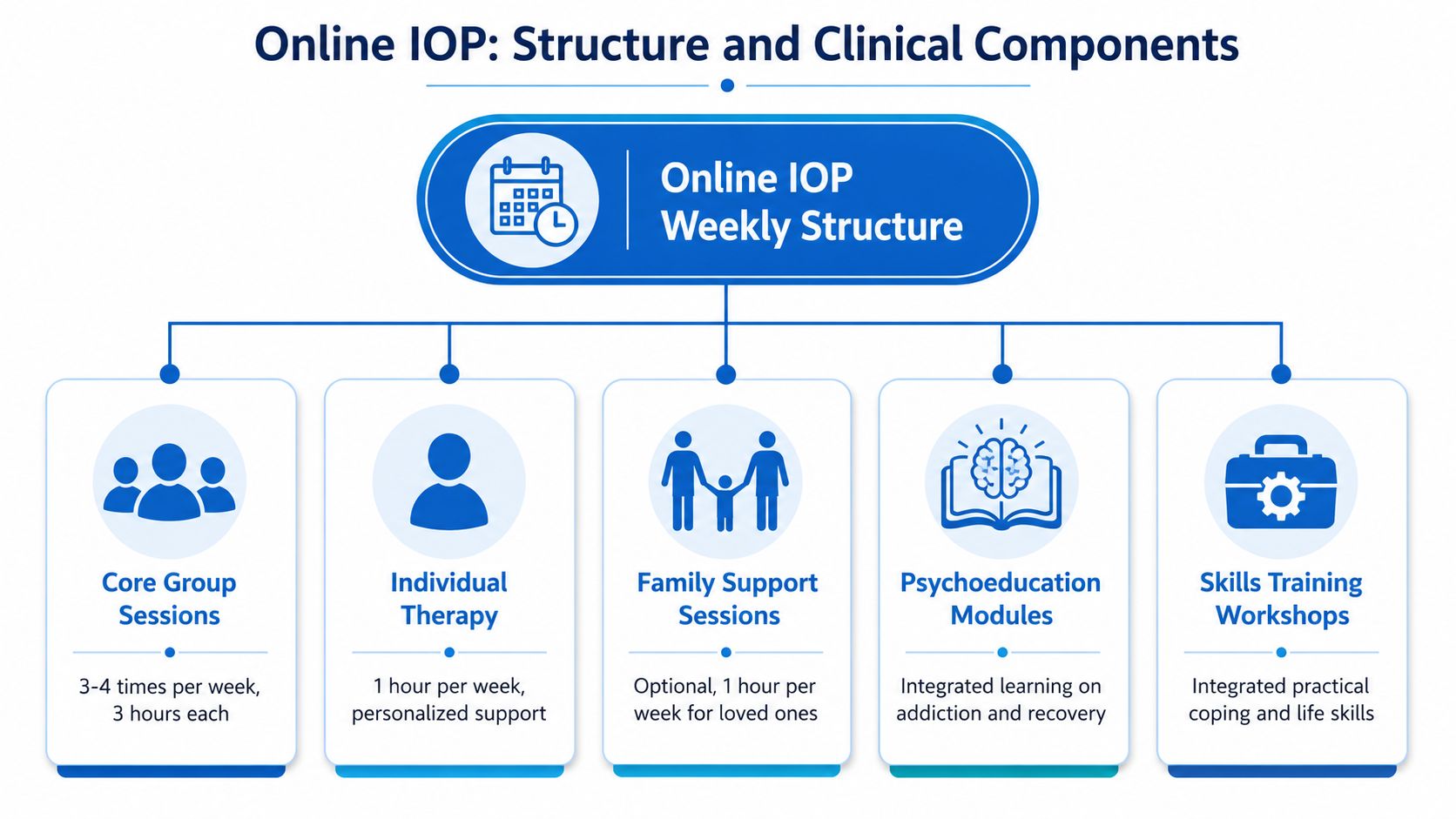
One telehealth substance use disorder IOP model used three weekly group sessions of three hours each, plus one 50-minute individual therapy session each week, along with asynchronous skills coursework. That same model used CBT, DBT, and motivational interviewing through a HIPAA-compliant video platform, delivered by licensed therapists with substance use and group-treatment expertise, as described in this telehealth IOP study.
What a typical week can include
A good online program usually combines several pieces rather than relying on one long group alone.
- Group therapy sessions help you hear how other people handle cravings, conflict, shame, stress, and setbacks. Group isn't passive listening. You're expected to reflect, respond, and practice new ways of thinking.
- Individual counseling gives you private space to talk about relapse patterns, trauma, family stress, motivation, or goals that you may not want to share in a group.
- Skills work between sessions helps turn ideas into habits. That may include worksheets, journaling, coping practice, or recovery planning.
- Family support, when appropriate can help loved ones understand boundaries, communication, and how to support recovery without controlling it.
What the therapies actually do
These treatment terms can feel abstract at first, so it helps to translate them.
| Clinical approach | What it helps with |
|---|---|
| CBT | Identifying thought patterns that lead to substance use and replacing them with more useful responses |
| DBT | Building distress tolerance, emotion regulation, and safer ways to handle intense feelings |
| Motivational interviewing | Strengthening your own reasons for change instead of arguing with you about what you “should” do |
What sessions feel like in practice
A group session might begin with check-ins. One person talks about a trigger from the night before. Another describes feeling emotionally numb and wanting to leave treatment. The therapist guides the group to slow down, notice patterns, and work through choices before substance use happens.
An individual session might focus on a different layer. Maybe you keep relapsing after arguments with your partner. Maybe you can stop for a few days but panic when cravings return. That one-on-one time is where treatment gets specific to you.
Recovery skills become more useful when you practice them the same week you learn them.
Why the schedule matters
The point of a structured weekly schedule is not to fill your calendar. It's to create enough contact to interrupt old habits and reinforce new ones. Repetition matters in early recovery. So does rhythm. When treatment is spread across the week, you have more chances to process what's happening before it turns into another crisis.
A strong online IOP should leave you with a clearer routine, better insight into your triggers, and practical tools you can use the same day.
How Online IOP Compares to Other Treatment Levels
Choosing a treatment level can feel confusing because the names sound similar while the experience can be very different. Online IOP, in-person IOP, and residential treatment all help people recover, but they serve different needs.
One useful benchmark is the treatment “dose” associated with IOP. Established programs commonly describe IOP as 9 to 12 hours per week for 9 to 12 weeks, often combining group, individual, and sometimes family therapy to stabilize symptoms and reduce relapse risk without requiring residential placement, according to this overview of IOP structure and care.
Treatment level comparison finding your fit
| Feature | Online IOP | In-Person IOP | Residential Treatment |
|---|---|---|---|
| Where you live | At home | At home | At the treatment facility |
| How care is delivered | Secure video sessions | On-site at a clinic | Full-time live-in treatment |
| Weekly commitment | Often several sessions across the week | Often several sessions across the week | Daily structured care |
| Supervision level | Moderate, with scheduled contact | Moderate, with on-site presence | Highest level of day-to-day support |
| Best for | People who need structure and can safely engage from home | People who need structure and benefit from leaving home for treatment | People who need a controlled environment or more intensive support |
| Main trade-off | More flexibility, less physical oversight | More routine outside the home, but requires travel | Most support, least flexibility |
Online IOP versus in-person IOP
These two levels are often closer than people expect. Both are structured outpatient care. Both usually include group therapy, individual therapy, and recovery education. The main difference is where treatment happens and how much environmental support you need.
Online IOP works well when home is stable enough for treatment. In-person IOP may fit better if your house is chaotic, if privacy is limited, or if getting physically to a program helps you stay accountable. Some people focus better when they walk into a clinical setting and leave home distractions behind.
IOP versus residential care
Residential treatment is a better fit when someone needs a more contained setting. That may include severe instability, unsafe substance use patterns, repeated inability to remain sober outside a controlled environment, or the need for closer supervision.
Online IOP can be a strong option when a person is medically and emotionally stable enough to participate without round-the-clock oversight. One advantage is that you practice recovery in the same environment where your triggers exist. You're not waiting until discharge to apply skills. You're using them while real life is still unfolding.
A practical way to think about it
Ask yourself which problem is bigger right now.
- If the biggest problem is access, online IOP may open a door that would otherwise stay closed.
- If the biggest problem is distraction or poor follow-through, in-person IOP may give you more structure.
- If the biggest problem is safety or severe instability, residential treatment may be the better starting point.
No format is automatically “better.” The best level of care is the one that matches your actual risk, not the one that sounds easiest or most appealing.
Is an Online IOP the Right Choice for You
This is the question of greatest concern. Not whether online care exists, but whether it fits their situation.
The reassuring part is that virtual treatment has real outcome support. Hazelden Betty Ford's preliminary outcomes research found that virtual IOP patients were just as likely as in-person patients to report abstinence at one month and to report both abstinence and AA attendance at three months. The same page also notes another study reporting 85% session attendance for virtual IOP versus 78% for in-person programs and 58% six-month abstinence for virtual IOP versus 56% for in-person IOP, which you can review in this virtual intensive outpatient outcomes summary.

Signs online IOP may be a good fit
Online treatment tends to work best when a person can engage consistently and has a home setting that supports participation.
- You need treatment that works around real responsibilities. Work schedules, parenting, caregiving, or transportation limits can make virtual care far more realistic.
- You have a private place to join sessions. This matters for confidentiality, focus, and honest participation.
- You can use basic technology. You don't need to be an expert, but you do need to log in reliably and stay engaged.
- You're stepping down from a higher level of care. Many people do well when online IOP follows detox, residential treatment, or another structured setting.
- You have some support at home. Even one supportive person can make a difference.
Red flags that point toward in-person or higher care
Virtual flexibility can be a strength, but it can also expose problems that are harder to manage from home.
Here are situations that deserve careful screening:
- Unstable or unsafe housing
- Frequent relapse with poor impulse control
- Serious medical or psychiatric concerns needing closer observation
- No privacy at home
- Severe isolation or very limited support
- A pattern of dropping out when structure depends mostly on self-motivation
A good assessment doesn't try to sell you a format. It tries to match you to the safest useful level of care.
Some people worry that needing in-person care means they've failed. It doesn't. It means your treatment plan should match your current needs, not your preferred schedule.
Questions to ask yourself honestly
A short self-check can help clarify fit:
- Can I safely live at home while working on recovery?
- Do I have a private place for sessions?
- Will I attend consistently without someone physically expecting me in the building?
- When cravings hit, do I usually reach out, or do I disappear?
- Would I benefit from being in a room with people, not just on a screen?
For a clearer sense of how online programs are presented and where patient-fit concerns often come up, this overview of virtual IOP considerations and limitations is useful background.
A brief video can also help make the experience feel more concrete before you decide whether to ask for an assessment.
Navigating Enrollment Insurance and Cost
Once someone decides to explore treatment, the next obstacle is often paperwork, insurance, and fear of cost. That part can feel overwhelming, especially if you're already tired, stressed, or worried about being told no. The good news is that enrollment is usually more straightforward than people expect.
What the first steps usually look like
Most programs start with a confidential phone call or inquiry. You share what's going on, ask basic questions, and learn whether the program treats substance use, co-occurring mental health needs, or both.
After that comes a clinical assessment. During this assessment, the provider looks at substance use patterns, withdrawal risk, mental health symptoms, living situation, and safety concerns. That screening matters because patient matching matters. As noted earlier in the article, online care isn't the right fit for every person in every circumstance, especially when someone needs more supervision.
How insurance verification usually works
Insurance verification means the provider checks your benefits and tells you what may be covered before you start. You don't have to decode the policy on your own.
A few practical questions to ask:
- What level of care is being recommended
- Is telehealth covered under my plan
- Do you accept private insurance
- Do you accept TRICARE
- What out-of-pocket costs should I expect
- What happens if authorization is delayed or denied
If you've ever been confused by behavioral health billing, it helps to understand why claims can get rejected and what can be done about it. This guide on how providers resolve behavioral health claim denials gives useful context in plain language.
What to expect from a quality intake process
A good intake team won't rush you, pressure you, or promise that one format works for everyone. They should be able to explain:
| Intake question | Why it matters |
|---|---|
| Can you safely participate from home? | Online treatment requires stability and privacy |
| Do you need detox first? | Some people need medical support before outpatient care |
| What insurance do you have? | Coverage can shape timing and next steps |
| What does your schedule look like? | Practical fit affects attendance and outcomes |
For military members and families, this question matters a lot: many providers, including Addiction Resource Center LLC, accept TRICARE in addition to a range of private insurance plans. That can make treatment more accessible and remove one of the biggest reasons people delay asking for help.
Your Local Partner for Recovery Addiction Resource Center
A lot of people reach this point with the same question. “I want help, but do I really need to drive to a clinic several days a week, or can I do this from home?”
For people in Yuba City and across Northern California, that decision often gets easier when a local team can explain the options in plain language. A provider nearby can look at your schedule, your safety needs, your home environment, and your insurance, then help you choose the format that fits instead of pushing one answer for everyone.
Addiction Resource Center LLC treats adults with substance use disorders and co-occurring mental health concerns. Services include medically supervised detox with medication-assisted treatment, residential rehabilitation through Ona Treatment Center in Browns Valley, and intensive outpatient care offered both in person and through telehealth. Care is delivered by a multidisciplinary team that includes a medical doctor, registered nurse, licensed counselors, a licensed marriage and family therapist, and recovery mentors.
Why local telehealth can help
Online IOP works best when home is a workable treatment setting. That usually means you can attend sessions privately, stay medically stable outside a hospital or detox unit, and follow through with regular appointments. If those pieces are in place, telehealth can make care easier to continue, especially for people living outside city centers, balancing work shifts, or caring for children or family members.
In-person care may still be the better fit if travel is manageable and your home setting is too chaotic, unsafe, or distracting for group therapy. Some people also do better with face-to-face structure, especially early in recovery. A good intake team should help you sort through that trade-off clearly.
For Northern California residents, Addiction Resource Center LLC gives patients both options. You do not have to treat telehealth and local care as opposites. In some cases, the right plan is online treatment for access and consistency, with the support of a nearby provider that can step care up or down if your needs change.
Insurance fit matters too. Addiction Resource Center LLC works with insured patients, including TRICARE beneficiaries. For veterans, active-duty families, and others using military benefits, that can remove a major barrier and make it easier to start care without delaying the decision.
Recovery often begins with a clear next step, not a perfect plan.
Contact details
If you want to reach out directly, here are the key details for Addiction Resource Center LLC:
- Address: 1002 Live Oak Blvd., Suite A, Yuba City, CA
- Phone and text: 530-625-7910
- Availability: 24/7 support for questions, next steps, and guidance
Frequently Asked Questions About Online IOP
What technology do I need
You usually need a reliable internet connection, a phone, tablet, or computer, and a private place where you can talk openly. You don't need fancy equipment. If technology feels intimidating, ask the provider how they help new patients get set up before the first session.
Is online group therapy private
It should be. A legitimate program uses a secure platform and gives clear expectations about joining from a private space, not from a car, public setting, or room where other people can overhear. You should also be told how confidentiality is handled in group.
What if I miss a session
That depends on the program and the reason. If you miss because of work, illness, or a personal emergency, the team will usually talk with you about how to stay on track. Missing often can be a sign that the schedule, level of care, or format needs to be reconsidered.
What happens if I relapse during treatment
Relapse should be addressed, not hidden. In a good program, the team looks at what happened, checks safety, and decides what support is needed next. Sometimes that means adjusting the treatment plan. Sometimes it means stepping up to a higher level of care.
Can online IOP treat both addiction and mental health concerns
Often, yes. Many people dealing with substance use also struggle with anxiety, depression, trauma, or mood instability. Ask whether the program is equipped to treat co-occurring conditions and how those needs are addressed in both group and individual sessions.
How do I know if I should start with online IOP or something more intensive
The best answer comes from a real assessment. If you're unsure, tell the intake team exactly what worries you most: cravings, withdrawal, depression, housing instability, privacy, family stress, or relapse history. The more honest you are, the better the recommendation will be.
If you're considering treatment and want a straightforward conversation about whether telehealth, in-person IOP, detox, or a higher level of care makes sense, Addiction Resource Center LLC is a practical next step. Their team in Yuba City offers compassionate addiction treatment, telehealth options across Northern California, and support with private insurance and TRICARE so you can figure out what fits and start moving forward.