You may be waking up each day already scanning for trouble. Is your partner answering their phone? Did your son make it to work? Should you hold their debit card, check their texts, call the counselor, hide the pills, or smooth things over one more time with the rest of the family? A lot of …

You may be waking up each day already scanning for trouble. Is your partner answering their phone? Did your son make it to work? Should you hold their debit card, check their texts, call the counselor, hide the pills, or smooth things over one more time with the rest of the family?
A lot of loving people live in that state for months or years. They become the alarm system, the calendar, the excuse-maker, the emotional shock absorber, and the cleanup crew. It feels like love. It feels responsible. It may even feel necessary.
But if your help leaves you exhausted, resentful, and more anxious than ever, you may be caught in codependency in recovery. That isn't a character flaw. It's a pattern many families fall into when addiction, fear, trauma, and uncertainty take over the home. The good news is that patterns can change. You can learn how to support someone in recovery without carrying their life on your back.
Navigating Codependency in Recovery: Your Guide
- The Fine Line Between Helping and Hurting in Recovery
- What Is Codependency in Addiction Recovery
- Recognizing the Signs of Codependent Behavior
- How Codependency Increases Relapse Risk
- Breaking the Cycle A Practical Guide for Change
- The Connection Between Codependency and Trauma
- Finding Professional Support for Lasting Change
The Fine Line Between Helping and Hurting in Recovery
Maria keeps her husband's car keys in her purse because she doesn't trust his judgment yet. She checks his eyes when he comes home. She reminds him about meetings, talks to his boss when he's late, and handles the money because she says it's safer that way. By the end of the week, she's angry, scared, and barely sleeping. He feels watched, ashamed, and treated like a child.
That kind of arrangement often begins with a loving motive. Someone is trying to keep the family afloat. Someone is trying to prevent the next disaster. But recovery doesn't grow well in a relationship where one person becomes the manager and the other becomes the managed.

The hard part is that codependent behavior can look responsible from the outside. Paying the rent so your loved one doesn't get evicted. Calling in sick for them. Monitoring every move. Threatening, rescuing, pleading, and then rescuing again. These acts don't come from cruelty. They usually come from fear and attachment.
Healthy support says, "I care about you." Codependent support quietly adds, "so I must control what happens next."
Families often get confused here. They think the only two options are total detachment or total rescue. There is a third option. You can stay caring, involved, and compassionate while stepping out of the role of fixer, coverer, and emotional bodyguard.
That shift matters for both people. The person in recovery needs room to practice honesty, accountability, and self-direction. The family member needs room to breathe, feel, rest, and stop living in permanent emergency mode.
What Is Codependency in Addiction Recovery
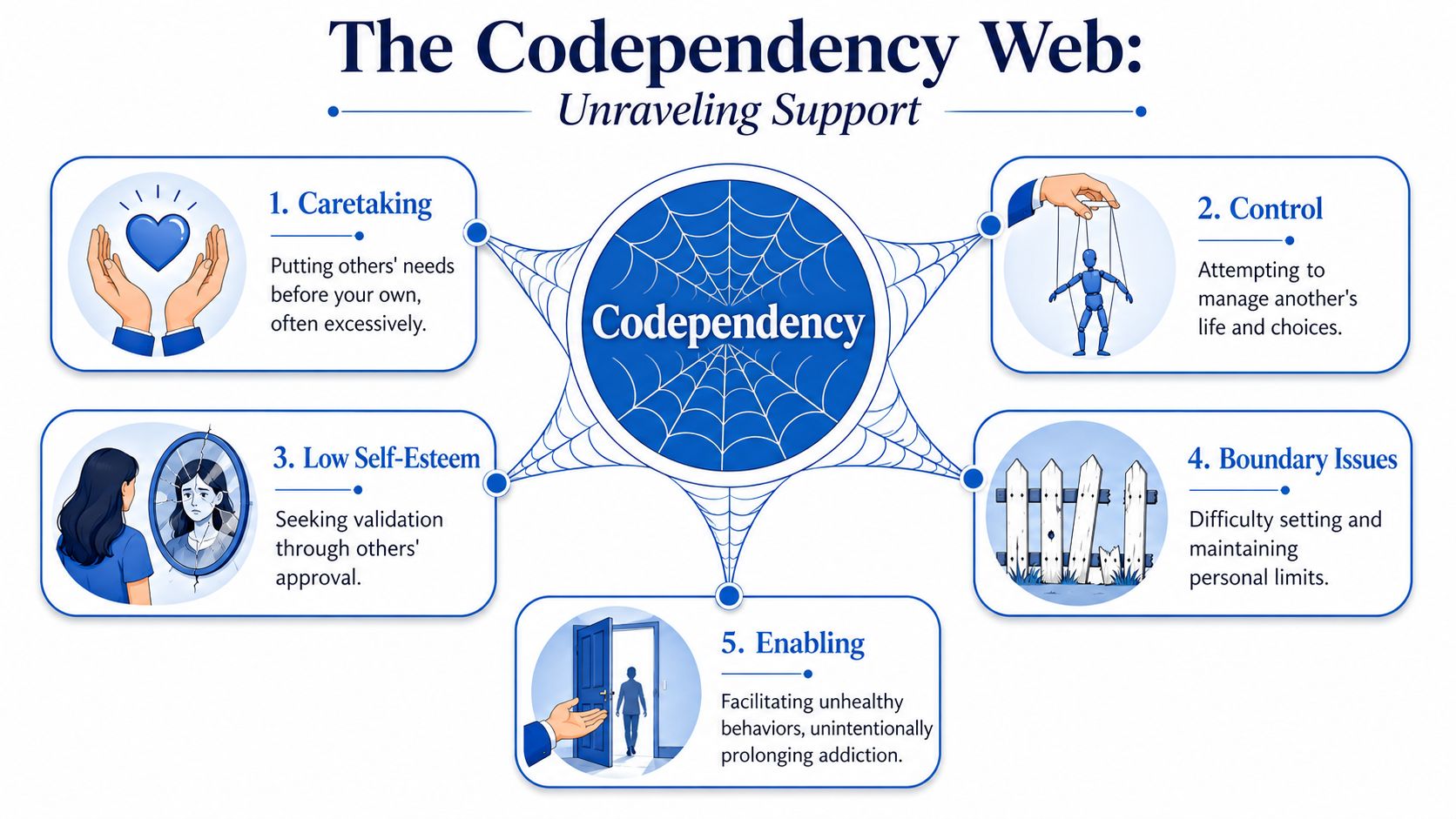
Codependency is a relationship pattern where your focus gets pulled so far toward another person's moods, choices, and stability that you start losing track of your own needs, limits, and inner life.
A simple way to understand it
Think of a codependent family member as an air traffic controller for someone else's life. They try to guide every landing, prevent every crash, monitor every signal, and clear every obstacle from the runway. The problem isn't caring. The problem is that the "pilot" never gets to develop the skills to fly.
In recovery, this can sound like:
- Monitoring instead of trusting process: checking bags, phones, and conversations instead of letting treatment, meetings, or agreed accountability systems do their job
- Managing consequences: paying fines, repairing conflicts, or explaining away behavior so the person avoids the impact of their choices
- Basing your mood on their status: feeling calm only when they seem stable, and falling apart whenever they struggle
Why this pattern develops
This pattern didn't appear out of nowhere. According to Mental Health America's overview of co-dependency, the concept was first identified after years of studying interpersonal relationships in families of alcoholics. Mental Health America also describes it as a learned emotional and behavioral condition that can be passed down through generations and can interfere with healthy, mutually satisfying relationships.
That history matters. It tells us codependency in recovery isn't just "being too emotional" or "loving the wrong way." It's often a learned adaptation to chaos. In homes shaped by addiction, people may learn early that staying alert, predicting problems, smoothing conflict, and sacrificing their own needs helps everyone survive the day.
Some people also confuse codependency with intense attachment. If you've ever wondered whether you can become emotionally dependent on a relationship itself, this piece on addiction to a person explained can help clarify the overlap between longing, attachment, and unhealthy reliance.
The question isn't "Do I love them too much?" The better question is "Have I organized my life around managing them?"
Mental Health America notes that treatment for co-dependency often includes education, experiential groups, and individual and group therapy. That makes sense. You don't just stop a learned pattern by deciding harder. You learn to notice it, name it, and practice a different way of relating.
Recognizing the Signs of Codependent Behavior
It's common for individuals not to identify codependency because they're too busy surviving it. They say, "I'm just trying to help," or "If I don't do it, everything falls apart." Recognition usually starts when you notice that your support regularly crosses into overfunctioning.
Common patterns families miss
Some signs are obvious. Others hide behind good intentions.
- Enabling: This isn't only giving money or ignoring substance use. It can also mean calling a probation officer with a story, finishing tasks your loved one agreed to handle, or repeatedly cleaning up messes that belong to them.
- Extreme self-sacrifice: You stop sleeping well, cancel your plans, neglect your health, and put your whole life on hold because their crisis always comes first.
- Control dressed up as protection: You track appointments, hold medication, monitor contacts, or script conversations because you're terrified of what might happen if you stop.
- Poor boundaries: You say yes when you mean no. You answer every late-night crisis call even when you're depleted. You share money, space, or time in ways that leave you resentful.
- Denial of your own feelings: You tell yourself you're fine when you're angry. You insist you're not hurt when you are. You minimize your own fear to keep the relationship steady.
One of the clearest distinctions comes from CoDA's Patterns of Recovery materials, which note that codependents often minimize, alter, or deny their true feelings to protect the relationship. Healthy support starts with knowing what you feel and what your limits really are.
If your mind races all day with "what if" thinking, it can help to learn more about breaking the overthinking cycle. Overthinking doesn't create codependency by itself, but it often fuels the constant monitoring and second-guessing that keep the pattern going.
Healthy support versus codependent behavior
A practical way to sort this out is to compare the action with its effect.
| Healthy Support (Encourages Autonomy) | Codependent Behavior (Creates Dependency) |
|---|---|
| Offers a ride to therapy when asked and agreed on | Cancels your own plans to monitor whether they attend |
| Says, "I hope you go to your meeting" | Calls the sponsor, rearranges the schedule, and argues until they go |
| Listens with empathy when they're upset | Absorbs their emotions and feels responsible for fixing them |
| Gives money only within clear limits, or not at all | Repeatedly pays bills to prevent natural consequences |
| Says, "I love you, and I won't lie for you" | Calls employers, family, or friends to cover for them |
| Notices your own stress and takes a break | Pushes through exhaustion because you believe rest is selfish |
| Supports treatment recommendations | Becomes the main treatment plan by monitoring everything personally |
Practical rule: If your help makes you less honest, more anxious, or more responsible than the person in recovery, it probably isn't support anymore.
A good self-check is simple. After helping, ask yourself: Did this action support their recovery work, or did it replace it? That single question can cut through a lot of confusion.
How Codependency Increases Relapse Risk
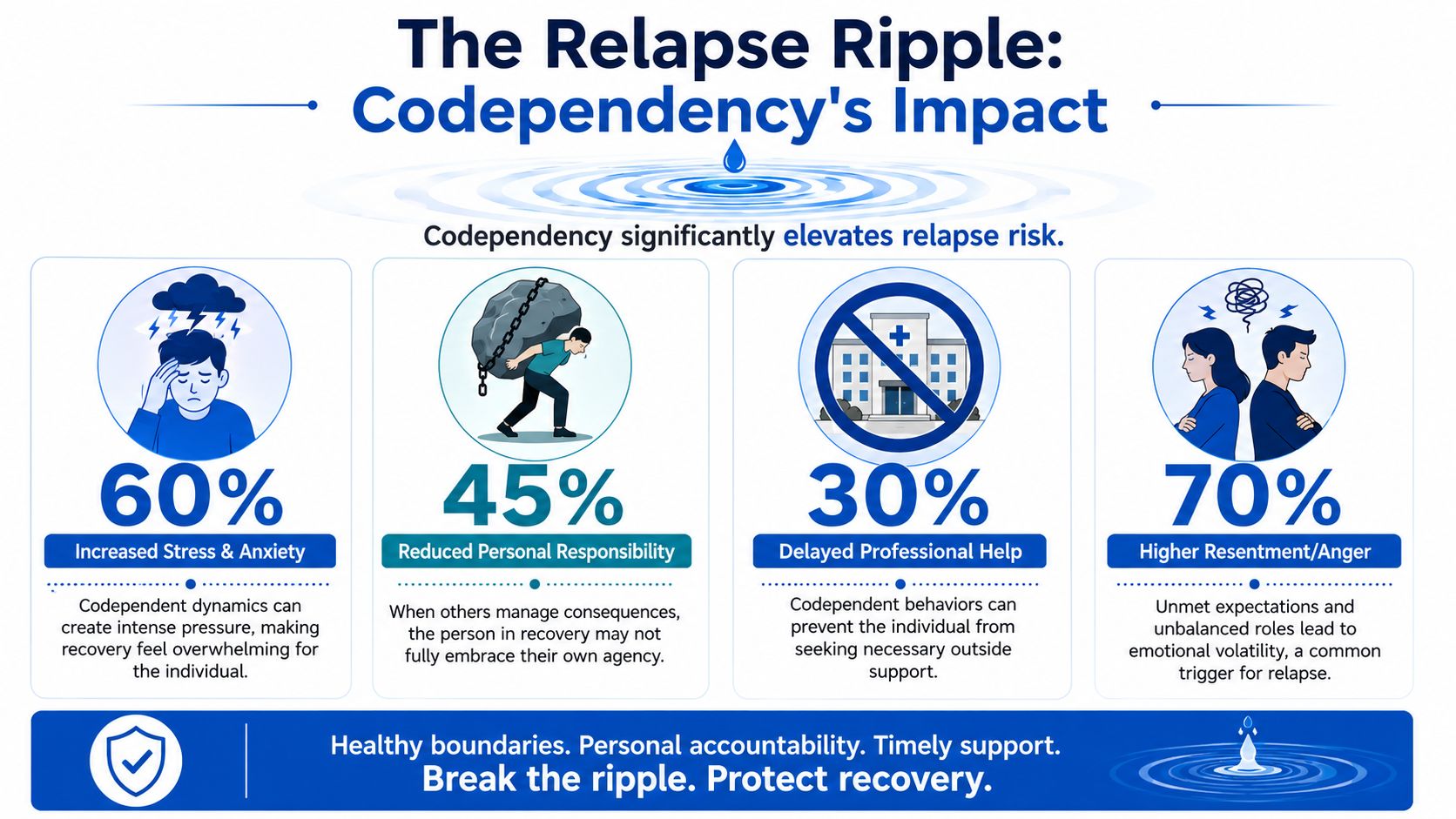
Codependency doesn't just wear families out. It can interfere with recovery itself.
When help blocks recovery skills
Recovery asks a person to build muscles they may not have used in a long time. Honesty. Tolerance for discomfort. Follow-through. Repairing damage. Asking for help directly. Accepting consequences. When a loved one jumps in too quickly, those muscles don't get trained.
A clinical study available through PubMed Central found that spouses of addicted men had significantly higher codependency scores than other women, with mean scores of 55.7 versus 51.0 (P < 0.05). The same study found a strong positive correlation between codependency and neuroticism among drug users' wives, with |r| = 0.62, compared with |r| = 0.35 in wives of non-drug users. The researchers also reported that codependency was significantly influenced by being an addict's wife and by personality traits including neuroticism, openness, and agreeableness.
Those numbers don't mean a family member causes addiction. They do show that codependent dynamics are measurable and closely tied to the family system around substance use. In practical terms, the relationship environment matters. It shapes stress, responsibility, communication, and how recovery unfolds at home.
Why family stress matters
When one person overfunctions and the other underfunctions, both people feel trapped. The helper grows resentful. The person in recovery feels scrutinized, ashamed, or rebellious. Small setbacks become power struggles. Conversations turn into interrogations.
That atmosphere can become risky. Shame often drives secrecy. Resentment weakens connection. Constant tension makes it harder for anyone in the house to regulate emotions well. If relapse prevention is about building steadier routines and honest responses to stress, codependency pushes the family in the opposite direction.
Recovery works better when support increases responsibility, not when it removes it.
This is why healthier support isn't "doing less because you don't care." It's doing the kind of help that leaves room for accountability.
Breaking the Cycle A Practical Guide for Change
Change usually starts with a painful realization. The old way isn't working. You can love someone and still need a new system.
A useful recovery framework points to boundary-setting, self-assessment, and individual therapy as the highest-yield interventions. The Recovery Village's guide to codependency describes recovery as a process of developing self-awareness, learning new relationship skills, and addressing underlying trauma or mental health issues. It also emphasizes that boundaries have to be practiced consistently, with ongoing self-assessment, or people slide back into familiar roles.
Start with a quick visual overview, then use the steps below to make it real.
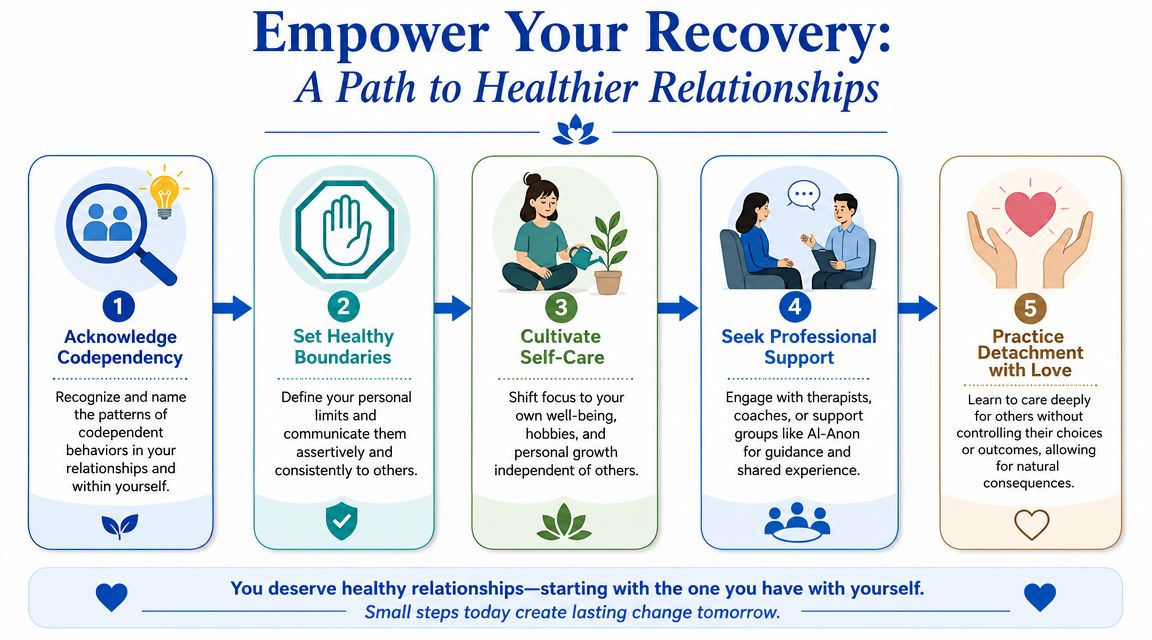
Start with self-assessment
Before you set a boundary, ask what your current behavior is doing for you. Does it reduce panic? Help you avoid guilt? Make you feel needed? Protect you from conflict?
Write down a few recent moments when you rushed to fix, rescue, or monitor. For each one, answer these questions:
- What happened right before I stepped in
- What feeling came up in me
- What was I afraid would happen if I didn't act
- Did my action support recovery, or control uncertainty
That exercise can feel uncomfortable, but it gives you your footing. You stop reacting on autopilot.
A short video can help reinforce these ideas in everyday language.
Use boundaries that are clear and repeatable
A boundary isn't a lecture. It's not a threat either. It's a statement of what you will do to protect your health, honesty, and stability.
Good boundaries are plain:
- About money: "I won't give cash. I can pay directly for groceries if I choose."
- About lying: "I won't call your employer or make excuses for missed responsibilities."
- About the home: "I won't stay in a conversation when you're intoxicated. I'll leave the room and talk later."
- About transportation: "I won't drive you if you're refusing treatment requirements we already agreed on."
Many people get stuck because they think a boundary must change the other person. It doesn't. A boundary changes your participation.
Say the boundary once, calmly. Then repeat your action, not your argument.
Build a life that isn't organized around crisis
This is often the hardest part because codependency can consume so much space that your own identity feels thin. Recovery for the family means rebuilding that space.
Try a few concrete shifts:
- Protect regular routines: keep your sleep, meals, work, exercise, and spiritual or social practices as steady as possible
- Reclaim one neglected part of yourself: a hobby, friendship, class, or quiet activity that isn't about monitoring anyone
- Pause before responding: if a crisis text comes in, wait long enough to ask, "Is this mine to solve?"
- Get your own support: individual therapy, a family recovery group, or a trusted clinician can help you stay aligned when guilt pulls hard
You don't need to do this perfectly. You need to practice it often enough that your nervous system learns a new job description.
The Connection Between Codependency and Trauma
For many people, codependency isn't just a bad habit. It's a survival style.
When caretaking began as survival
If you grew up with addiction, rage, neglect, unpredictability, or untreated mental illness in the home, you may have learned to scan constantly for danger. You may have learned to keep the peace, read the room, stay useful, and ignore your own needs. Later in life, those same skills can show up as people-pleasing, hypervigilance, rescuing, or self-erasure in adult relationships.
A more nuanced recovery view describes codependency as a learned survival strategy often shaped by trauma. Arista Recovery's discussion of healing from codependency highlights why this matters, especially as recovery care increasingly includes people with co-occurring trauma, anxiety, or depression. Without that lens, families may judge themselves harshly for behaviors that once helped them endure unsafe environments.
This distinction matters in everyday life. A spouse may look "controlling" when they are terrified by past instability. A parent may look "overinvolved" when their nervous system has learned that letting go feels dangerous. That doesn't make the behavior healthy. It does make it understandable.
Questions that bring compassion and clarity
When trauma and co-occurring disorders are present, ask different questions than "Why can't I just stop doing this?"
Try these instead:
- What danger does my body think it's preventing right now
- Did I learn that love means constant vigilance
- Am I responding to today's situation, or to an older wound
- What kind of support helps me feel safe without taking over
You may be dealing with relationship dysfunction, trauma responses, or both. Healing works best when you don't force those into a false choice.
This trauma-informed view softens shame. It also points toward deeper care. Sometimes the goal isn't just "set better boundaries." It's "heal the part of me that believes everyone falls apart if I stop holding everything together."
Finding Professional Support for Lasting Change
Some families need more than insight. They need structure, accountability, and a place to sort out what's theirs and what isn't.
What kind of help actually helps
Different forms of support fit different needs:
- Individual therapy: useful when you need help identifying patterns, tolerating guilt, and learning practical boundary and communication skills. Approaches such as CBT or DBT may be part of that work, depending on the clinician.
- Family therapy: helpful when everyone keeps getting pulled into the same conflict loops and needs a safer way to communicate.
- Peer support groups: groups such as CoDA or Al-Anon can reduce isolation and help you hear your own story more clearly through other people's experiences.
- Dual-diagnosis aware care: important when substance use overlaps with trauma, anxiety, or depression, because support decisions get more complicated in those situations.
When family support needs structure
If you're unsure whether your involvement is helping or enabling, professional guidance can create decision rules that are much clearer than "be supportive" or "set boundaries." For example, a therapist may help you sort actions into three buckets:
| Support it | Step back from it | Bring in a professional |
|---|---|---|
| rides to treatment, honest encouragement, agreed childcare | covering up, repeated rescue, managing adult responsibilities | suicidal talk, safety concerns, severe mental health symptoms, return to substance use |
That kind of structure can lower chaos inside the home. It can also reduce the exhausting guessing game that codependency thrives on.
Change is possible, even if these patterns have been in your family for a long time. You don't have to become cold, detached, or uncaring. You can become steadier. More honest. Less consumed. That's often what real support looks like.
If you or someone you love needs help navigating addiction, recovery, and the family patterns that grow around them, Addiction Resource Center LLC offers compassionate care in Yuba City for substance use and co-occurring mental health needs. Their team includes a medical doctor, registered nurse, CADC counselors, an LMFT, and recovery mentors, with services that include medically supervised detox with MAT, residential rehabilitation through Ona Treatment Center, and an Intensive Outpatient Program available in person and via telehealth. They serve adults 18+, accept most major insurance plans, welcome Tricare beneficiaries, and offer a 24/7 phone and text line at 530-625-7910. If you want guidance, a tour, or help figuring out the next step, reaching out can make the process feel much more manageable.