You may be reading this late at night, after another promise to quit, another argument at home, or another frightening moment when it became clear that this isn't just a bad habit anymore. You typed “how many days to break an addiction” because you want something solid. A date on the calendar. A finish line. …

You may be reading this late at night, after another promise to quit, another argument at home, or another frightening moment when it became clear that this isn't just a bad habit anymore. You typed “how many days to break an addiction” because you want something solid. A date on the calendar. A finish line.
That wish makes sense. When someone you love is hurting, or when you're exhausted from fighting your own cravings, a simple number feels comforting. But addiction rarely works like a countdown timer. Recovery is closer to healing after a serious injury. The pain changes first, then strength returns, then daily life slowly becomes manageable again.
The good news is that this doesn't mean recovery is random. It means the better question isn't “How many days?” It's “What stage am I in, and what kind of help do I need right now?”
Navigating the Journey: A Roadmap of Recovery Stages
- Why "How Many Days" Is a Complicated Question
- The Myth of the Magic Number Debunking 21 66 and 90 Days
- The Real Recovery Timeline Four Key Phases
- Withdrawal Timelines A Look at Different Substances
- Factors That Influence Your Personal Recovery Timeline
- How Professional Treatment Shapes Your Recovery Journey
- Taking the First Step How and When to Seek Help
Why "How Many Days" Is a Complicated Question
A father drives his daughter home from detox and thinks the hardest part is over. A husband sees his wife reach three weeks sober and cannot understand why she still seems anxious, irritable, or exhausted. The person in recovery often has the same fear. “If I stopped days ago, why do I still feel pulled toward it?”
That question makes sense. It also points to a common misunderstanding.
Addiction recovery does not move like a kitchen timer. It works more like healing after a serious injury. The bleeding may stop first. Strength returns later. Trusting the injured part again can take even longer. In the same way, the body, brain, emotions, and daily habits do not settle on the same schedule.
One person may get through the first physical symptoms and still feel mentally foggy. Another may sleep better but struggle with stress, boredom, or sudden cravings. A family may see sobriety on the outside and expect stability right away, while the person inside still feels shaky and raw.
That is why “How many days does it take?” can be the wrong starting question.
A more helpful question is, “Which part of recovery are we talking about?”
For example, you might be asking about the period when withdrawal begins to calm down. You might be asking when cravings become less intense and less frequent. Or you might be asking when sober living starts to feel natural. Those are different milestones, and each one matters.
This reframing can lower a lot of shame. Reaching one milestone does not mean the whole process is finished. It means you have cleared one stretch of road and entered the next. Detox can end while emotional healing is still in its early days. Early sobriety can feel steadier while old triggers still need work.
Families often need this reminder as much as the person recovering. Someone can be honest, committed, and substance-free, yet still be moody, discouraged, or easily overwhelmed. That does not always mean treatment is failing. It can mean the nervous system is still settling and the person is still learning how to live without the substance.
So instead of chasing a magic number, it helps to follow a map. Recovery is usually easier to understand in phases, with milestones that show what is improving now and what still needs time.
The Myth of the Magic Number Debunking 21 66 and 90 Days
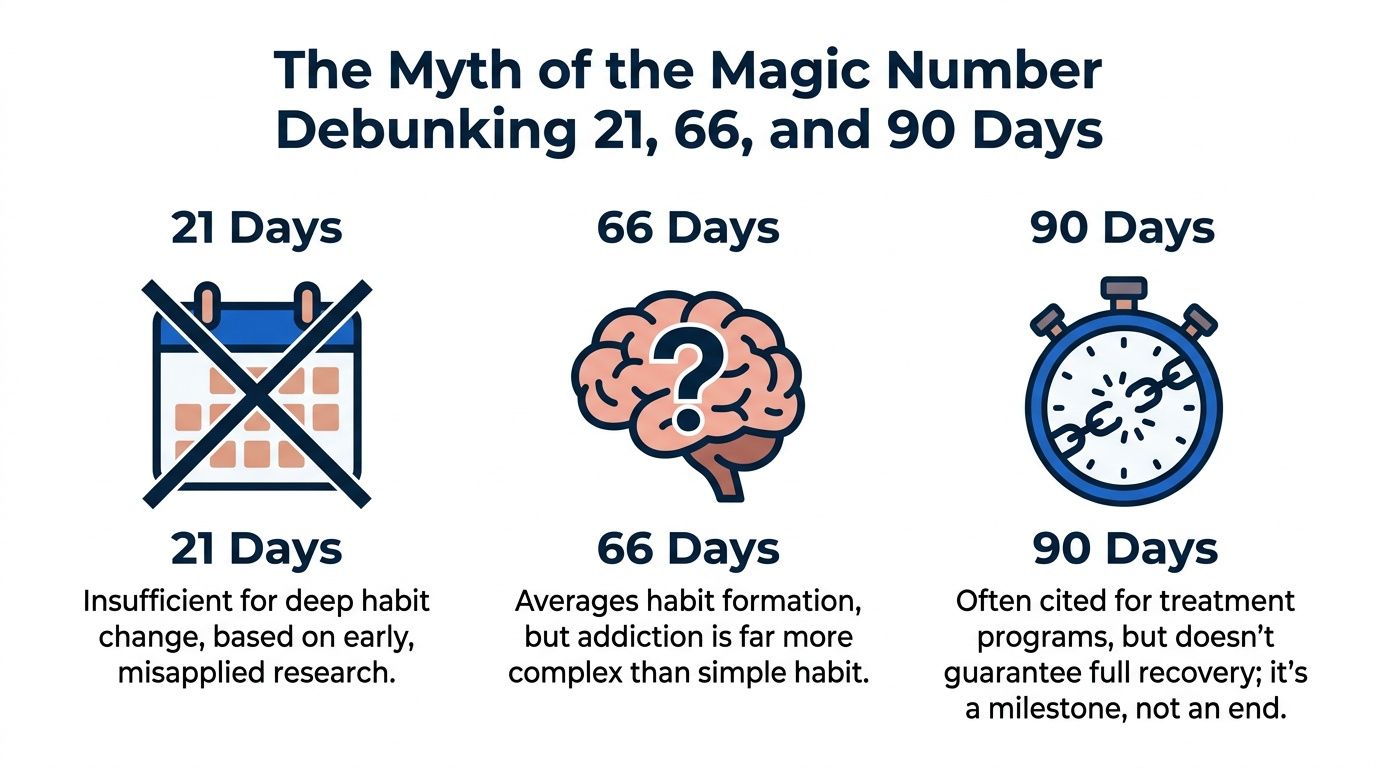
A family member marks day 21 on the calendar and hopes life will snap back into place. Someone else hears 90 days in treatment and assumes that must be the finish line. These numbers can sound comforting because they promise order. Recovery rarely works on a countdown.
Why 21 days sounds appealing
The 21-day idea sticks because it feels manageable. Three weeks is long enough to seem serious and short enough to feel hopeful.
But addiction is not a simple routine reset. It affects the body, the brain, stress tolerance, sleep, relationships, and the habits built around using. Early days of sobriety are often spent getting physically and emotionally steadier, not finishing the whole job. So if cravings, irritability, or sadness are still present after 21 days, that does not mean recovery is failing. It usually means the person is still in an early stage of healing.
A broken ankle offers a useful comparison. The cast may come off at one point, but strength, balance, and confidence take longer to rebuild. Addiction recovery often works in a similar way.
What 66 days actually tells us
The 66-day number came from research on habit formation, not from addiction treatment. Even in habit research, people did not all change at the same pace. One person may settle into a new pattern fairly quickly. Another may need much more time and repetition.
That matters because addiction is bigger than habit alone.
It can involve physical dependence, cue-based cravings, emotional pain, learned rituals, and a social world tied to substance use. Stopping is only one part of the process. Staying stopped often requires learning new ways to handle stress, boredom, conflict, loneliness, and celebration. That is why a single habit number does not work well as an addiction deadline.
Key idea: Habit change is one piece of recovery. Addiction recovery can also include withdrawal, craving management, emotional healing, and rebuilding daily life.
What 90 days means in treatment
The 90-day number is more useful, but it is still easy to misunderstand. In treatment settings, 90 days is often used as a benchmark because a longer period of care gives people more time to stabilize, practice skills, and build support. It is a marker for engagement in treatment, not a promise that someone is cured on day 90.
Research summarized in a peer-reviewed review of addiction recovery patterns also shows that many people make more than one serious recovery attempt before change holds. Families can find that discouraging at first, but it is often a normal part of the process. A setback does not erase progress. It shows that the plan may need stronger supports, different coping tools, closer follow-up, or treatment that fits the person better.
So which number should you trust? Use all three carefully, and only as rough context. Recovery works better when you track stages and milestones instead of waiting for a magic day when everything is suddenly fixed.
The Real Recovery Timeline Four Key Phases
Recovery makes more sense when you track phases instead of waiting for a single day that is supposed to change everything.
If a family member asks, “So when are they better?”, the kindest honest answer is usually, “They may be in a different stage now.” That shift in thinking matters. It gives you a map. A map is more useful than a magic number.
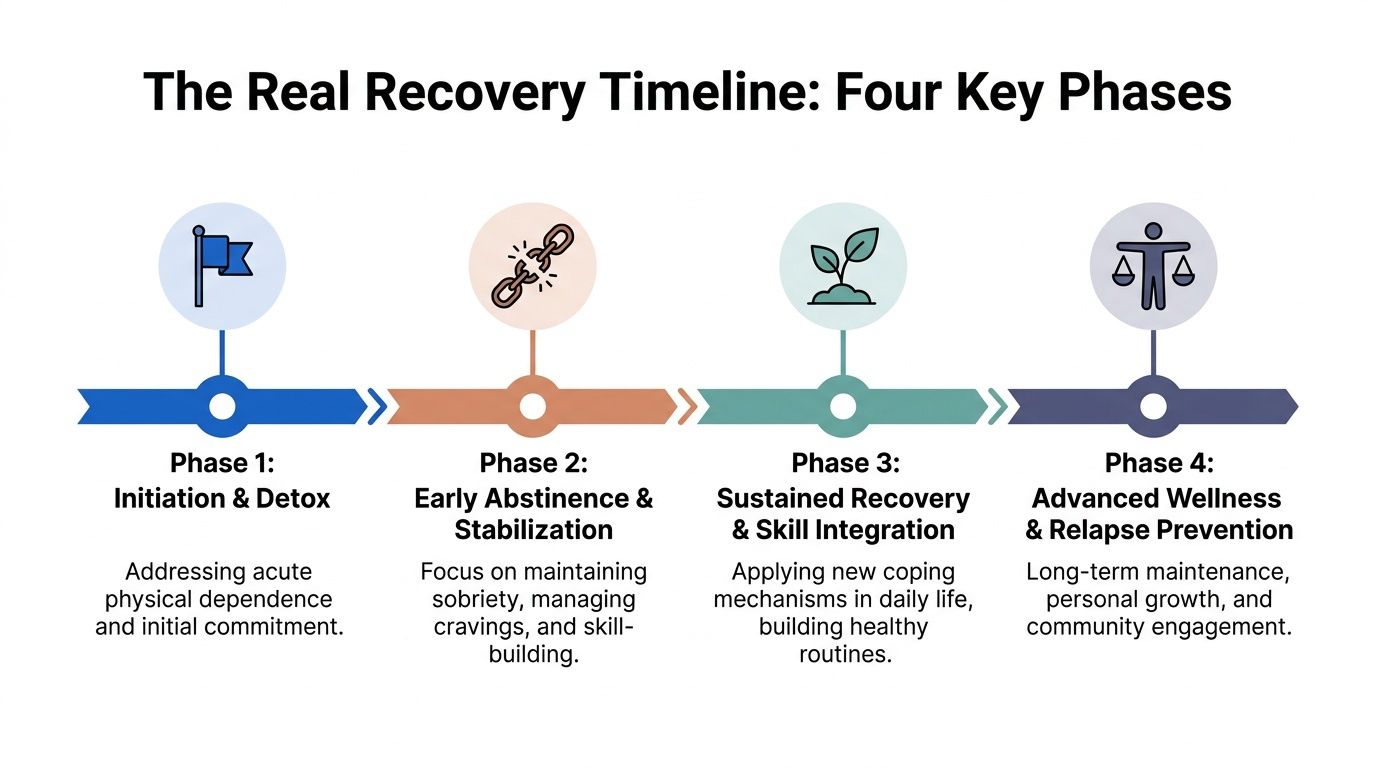
Phase 1 Acute withdrawal
This phase begins after stopping or sharply reducing the substance. The body is adjusting to its absence. Symptoms can include sweating, shaking, nausea, poor sleep, anxiety, irritability, low mood, and a strong urge to use again for relief.
A useful comparison is a plane landing in rough weather. The immediate goal is stability and safety. Big life changes come later.
For some substances, this period is uncomfortable. For others, it can be dangerous. Medical support matters most here, especially when alcohol or benzodiazepines are involved, or when there is a history of severe withdrawal, seizures, or major health problems.
A short video can help make the stages easier to picture in real life:
Phase 2 Early stability and fragile confidence
After the first crisis settles, many people feel relief. Sleep may improve. Thinking may feel clearer. Hope often comes back.
That is good news, but it can also create false confidence.
This stage works like taking a cast off a healing leg. You can move more freely, but the injury has not fully healed. A person may say, “I'm fine now,” while still being highly vulnerable to stress, conflict, boredom, certain places, or certain people.
Support in this phase often focuses on simple, repeatable habits:
- Daily structure: A planned day reduces idle time and lowers the chance of impulsive use.
- Trigger awareness: People begin to spot the situations, emotions, and relationships that pull them toward relapse.
- Basic coping skills: Calling someone, leaving a risky setting, eating regularly, sleeping on schedule, and using therapy tools can make a difficult day survivable.
Phase 3 The uneven middle
This is often the most confusing stage.
The emergency is over, but steady recovery still does not feel natural. Cravings can show up without warning. Mood can swing. Motivation can drop. A person may look much better on the outside while still fighting hard on the inside.
Families often misread this phase. They see improvement and assume the struggle should be finished. The person in recovery may also judge themselves harshly and wonder, “Why is this still hard?”
Because healing is not linear.
This part of recovery is less about dramatic breakthroughs and more about repetition. Go to treatment. Keep routines. Practice the same coping skills again and again. Return after a hard day. Rebuild trust slowly. The progress can feel boring compared with the intensity of early withdrawal, but stability starts to take shape during this time.
Recovery often feels hardest after the emergency passes, because that's when daily life starts asking more from you.
Phase 4 Long-term rebuilding
Long-term recovery is about more than avoiding a substance. It is about building a life that makes return to use less likely.
That can include repairing relationships, setting boundaries, finding steady work, reconnecting with parenting, returning to school, managing mental health symptoms, and learning how to handle joy and stress without reaching for the old escape. The brain and body may continue healing over a long period, and improvements in focus, motivation, emotional balance, and stress tolerance can continue to unfold gradually. A longer perspective on that process appears in this overview of longer neurobiological recovery.
In this phase, success usually looks quieter than people expect. It looks like showing up. Paying bills. Sleeping at night. Telling the truth. Asking for help early. Leaving risky situations before they become crises.
Long-term rebuilding often includes:
- Healthy routine: regular sleep, meals, exercise, and downtime
- Relationships: rebuilding trust and protecting recovery with clear boundaries
- Meaning: work, service, faith, creativity, family, or community
- Relapse prevention: noticing early warning signs and responding quickly
If you remember only one point from this section, make it this one. Recovery is better measured by phases and milestones than by counting down to day 21, 66, or 90.
Withdrawal Timelines A Look at Different Substances
When people ask how many days to break an addiction, they're often really asking a narrower question first: “How long will withdrawal last?” That's an important question, but it's only one piece of recovery.
Why the substance matters
Different substances create different withdrawal patterns. Some tend to produce more intense physical symptoms early on. Others create a more psychological crash, with fatigue, anxiety, depression, or agitation. Some withdrawals cause intense discomfort. Others can be dangerous.
The most important safety point is simple. Alcohol and benzodiazepine withdrawal can require medical supervision. If there's a history of heavy use, seizures, severe withdrawal, confusion, or major medical issues, trying to “tough it out” alone can put someone at serious risk.
A practical comparison table
The table below is intentionally general. It's a guide for orientation, not a home diagnosis tool.
| Substance | Typical Onset | Peak Symptoms | Average Duration |
|---|---|---|---|
| Alcohol | Often begins soon after stopping | Often strongest in the early withdrawal window | Commonly lasts several days, but some symptoms can continue longer |
| Opioids | Often begins within the first stretch after last use | Often peaks early, with strong flu-like and craving symptoms | Often lasts days to over a week depending on the opioid |
| Benzodiazepines | Can begin after stopping or reducing, sometimes with delayed escalation | Can intensify over time and may be medically risky | Can be prolonged and often needs a supervised taper |
| Stimulants | Often starts with a “crash” rather than classic physical detox | Mood symptoms, sleep disruption, and fatigue can hit hard early | Symptoms vary and may shift from acute crash to lingering mood changes |
Common symptom patterns also differ:
- Alcohol: Tremors, sweating, anxiety, nausea, insomnia, and in some cases severe complications.
- Opioids: Body aches, diarrhea, chills, restlessness, insomnia, and intense cravings.
- Benzodiazepines: Anxiety, panic, tremors, insomnia, perceptual changes, and seizure risk.
- Stimulants: Exhaustion, depression, irritability, sleep changes, and strong psychological cravings.
If you're helping a loved one, don't assume “withdrawal” means the same thing across substances. One person may need comfort and monitoring. Another may need urgent medical care. If there's any doubt, call a treatment provider, physician, or emergency service rather than guessing.
Factors That Influence Your Personal Recovery Timeline
Two people can use the same substance and still have very different recoveries. One person stabilizes fairly quickly with support. Another struggles with cravings, sleep, and emotional swings for much longer. That difference doesn't always mean one person is trying harder.
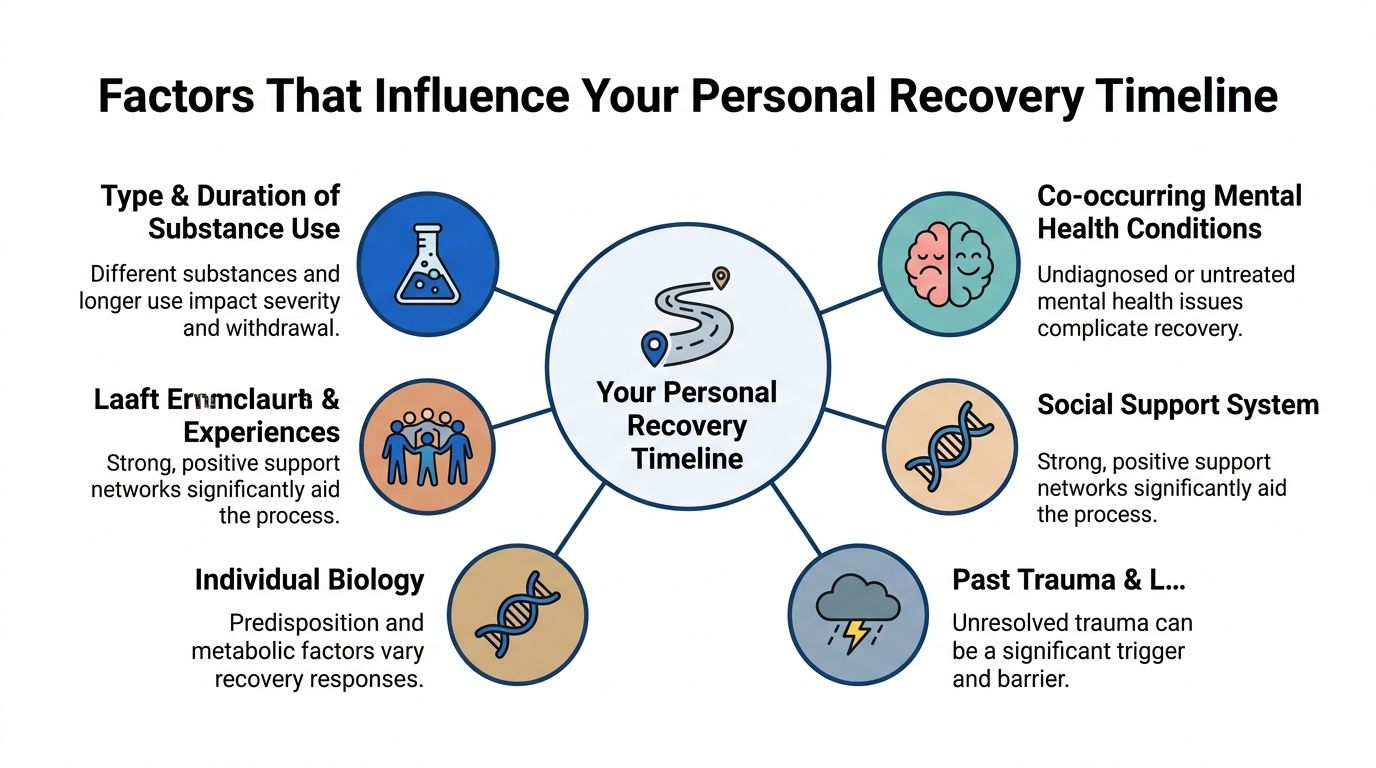
The same substance can lead to different recoveries
Recovery timing is shaped by a mix of biology, history, mental health, and environment. Addiction behaves less like a stopwatch and more like a road trip. The route changes based on traffic, weather, vehicle condition, and whether anyone is helping you find your way.
Here are some of the biggest influences:
- Type and history of use: Longer, heavier, or more frequent use usually creates a tougher stopping point and a more demanding stabilization period.
- Mental health: Anxiety, depression, trauma, or mood instability can make cravings harder to manage if they aren't treated alongside substance use.
- Physical health: Sleep problems, pain, liver issues, and other medical conditions can complicate withdrawal and early recovery.
- Social environment: Living with conflict, easy access to substances, or people who still use can keep recovery in a constant stress state.
- Past attempts: Previous recoveries can teach useful lessons, but repeated setbacks can also leave someone discouraged or ashamed.
What often speeds recovery and what complicates it
People sometimes compare themselves harshly to others. “They quit faster than I did.” “He was back at work sooner.” “She seemed stronger.” Those comparisons usually miss the hidden factors.
Counselor's reminder: Don't measure your recovery by someone else's outside appearance. You can't see the cravings they fight, the support they have, or the pain they carry.
A few examples make this clearer:
- Someone with stable housing, family support, and access to therapy may gain traction faster.
- Someone with untreated trauma may feel flooded once the substance is gone.
- Someone who used mainly to numb grief may struggle most in quiet moments.
- Someone with chronic pain may need a careful medical plan, not just motivational advice.
This is why self-compassion matters. A longer timeline doesn't mean failure. It often means your situation has more layers that need real treatment, not blame.
How Professional Treatment Shapes Your Recovery Journey
A good treatment plan works like a road map with rest stops, guardrails, and people who know the route. Recovery has phases. The help that fits the first week is often different from the help that supports month two or month six.
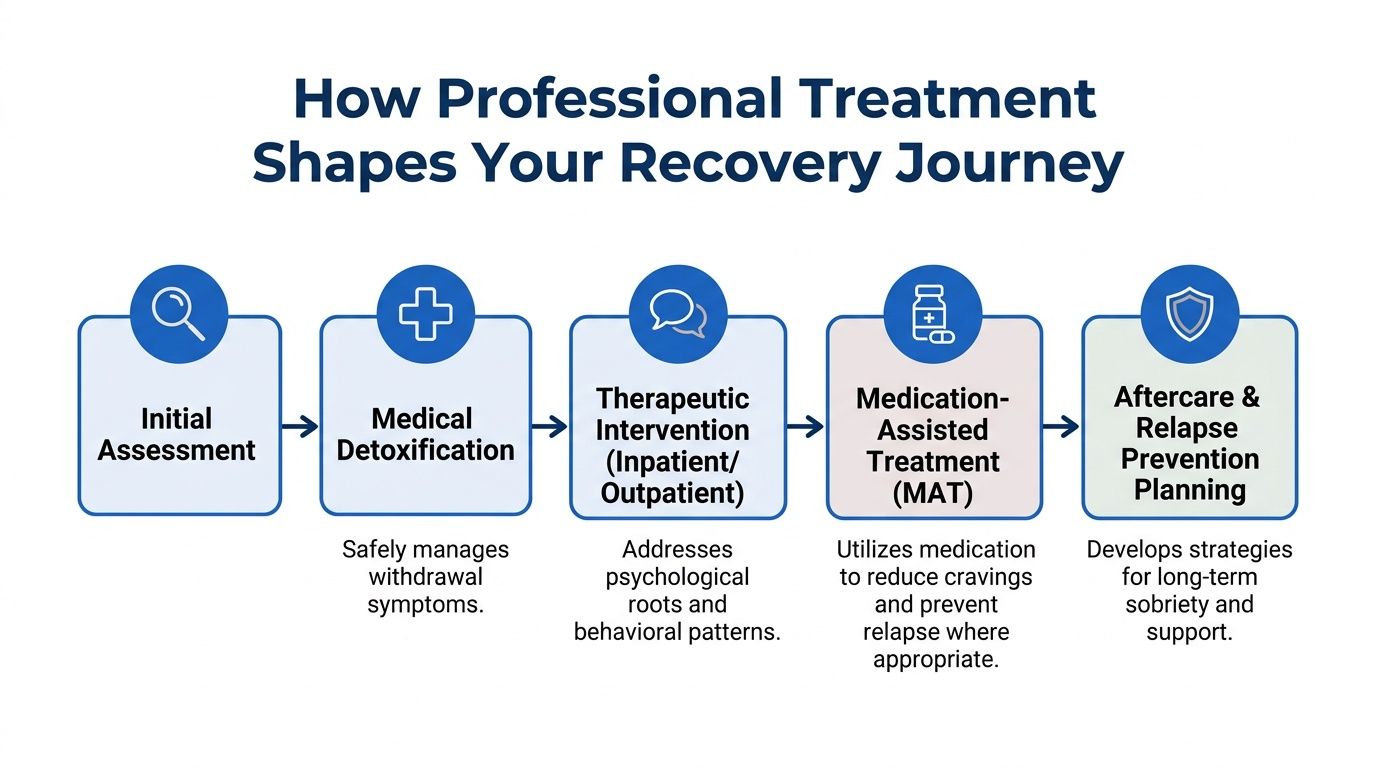
Professional care matters because addiction rarely affects just one part of life. It can involve the body, the brain, daily habits, stress, relationships, sleep, and mental health at the same time. Treatment helps sort that out in an organized way instead of leaving a person to fight every problem at once.
Different kinds of help for different stages
One reason the “how many days” question causes confusion is that people often talk about recovery as if it were a single event. It is closer to rebuilding after a storm. First you make the situation safe. Then you repair the structure. After that, you learn how to protect it over time.
That is why treatment often includes more than one level of care.
- Medical detox: used when withdrawal may be dangerous, intensely uncomfortable, or hard to manage safely at home
- Residential treatment: offers distance from triggers, daily structure, and time to stabilize in a protected setting
- Medication-assisted treatment: uses approved medication to reduce cravings and lower relapse risk for some substance use disorders
- Outpatient and intensive outpatient care: gives ongoing counseling and accountability while a person practices recovery in everyday life
Some people also need care that fits around work, parenting, transportation problems, or privacy concerns. In that case, resources on online treatment for opioid dependence can help families see how remote support may fit into a larger recovery plan.
Why structure matters more than motivation alone
Families often ask a painful question: “If they really wanted to stop, wouldn't they just stop?” The honest answer is that desire helps, but desire by itself is often too fragile. Cravings, stress, withdrawal, loneliness, and old routines can all hit at once.
Treatment adds support at the exact moments people tend to slip. It creates appointments to keep, people to answer to, skills to practice, and a plan for the hours when judgment gets cloudy. As noted earlier, recovery tends to go better when people stay engaged in care long enough to build new patterns, not just survive the first burst of motivation.
Professional care usually helps with four practical needs:
- Assessment: identifying medical risk, mental health concerns, and the patterns driving substance use
- Therapy: learning how to handle cravings, conflict, shame, grief, and triggers without returning to use
- Accountability: regular check-ins that catch problems early, before a lapse turns into a full return to use
- Aftercare planning: preparing for weekends, celebrations, family stress, boredom, and other high-risk moments
Families benefit too. They often need clear guidance on boundaries, communication, and what support helps recovery. Love alone can feel like trying to steer a car with no training. Professional treatment gives everyone a steadier set of hands and a clearer path forward.
Taking the First Step How and When to Seek Help
Many people wait too long because they think they need to hit bottom first. They don't. If substance use is hurting your health, relationships, work, safety, or peace of mind, that's enough reason to ask for help now.
When to reach out
Consider reaching out if any of these sound familiar:
- You've tried to stop and can't stay stopped: even when you mean it
- Withdrawal scares you: especially if you've had severe symptoms before
- Life is shrinking: work, parenting, sleep, finances, or relationships keep getting worse
- You're hiding it: lying, minimizing, or using in secret has become normal
- A loved one is worried: sometimes family sees the danger before the person using does
You don't need to know exactly what level of care you need before making contact. That's part of what professionals help sort out.
How to make the call feel easier
People often freeze because they think the first call has to be a big declaration. It doesn't. You can start small. You can say, “I'm not sure what I need.” You can say, “I'm calling for my son.” You can say, “I want help, but I'm scared.”
If you're supporting someone from a distance or trying to understand counseling options in another area, guides like Interactive Counselling's Vernon guide can be useful examples of what to look for in a local support resource.
A first conversation is not a lifetime contract. It's just the next right step. And often, that one step breaks the paralysis that keeps addiction in charge.
If you or someone you love needs help in Northern California, Addiction Resource Center LLC offers compassionate, down-to-earth support for detox, MAT, residential rehab through its partner facility, and intensive outpatient care in person or via telehealth. The team serves adults 18+, accepts most major insurance plans including Tricare, and offers a 24/7 phone and text line at 530-625-7910. If making the first move feels hard, start with a question, a tour request, or a simple text. You don't have to have the whole recovery plan figured out before you reach out.
Produced via Outrank