Addiction is considered a disease because repeated substance use can produce measurable, persistent changes in brain systems that control reward, stress, judgment, and impulse control. In 2015, approximately 20.8 million Americans, nearly 8% of the adolescent and adult population, had a substance use disorder. If addiction changes the brain, does that mean a person has …

Addiction is considered a disease because repeated substance use can produce measurable, persistent changes in brain systems that control reward, stress, judgment, and impulse control. In 2015, approximately 20.8 million Americans, nearly 8% of the adolescent and adult population, had a substance use disorder.
If addiction changes the brain, does that mean a person has no responsibility for recovery? And if it's a disease, does “chronic” mean the damage can never improve? These questions expose the limits of the usual choice-versus-disease debate. Addiction involves biology, but it also involves learning, trauma, mental health, relationships, living conditions, and access to care.
A person may make an initial decision to use alcohol or another drug, yet repeated exposure can gradually make continued use harder to control. That distinction matters. It helps explain why someone might promise to stop, sincerely mean it, and still return to use when cravings, stress, withdrawal, or familiar cues become overwhelming.
Table of Contents
- Why Does the Disease Model Matter for Understanding Addiction?
- How Addiction Changes the Brain and Why That Matters
- What Factors Increase Your Risk of Developing Addiction
- How Does Addiction Compare to Other Chronic Diseases
- What Does the Disease Model Mean for Treatment Options
- Is the Disease Model Controversial or Incomplete
- What Can You Do With This Knowledge About Addiction as a Disease
Why Does the Disease Model Matter for Understanding Addiction?
A person may try to quit several times, hide the extent of their use, and feel intense shame after each return to alcohol or drugs. Their family may see the consequences clearly and ask, “If you know this is hurting you, why don't you just stop?” The question is understandable, but it treats addiction as though knowledge and willpower are the only forces involved.
The disease model offers a different interpretation. The National Institute on Drug Abuse defines addiction as a chronic, relapsing brain disease involving compulsive drug seeking and use despite harmful consequences. That definition doesn't say a person has no agency. It says repeated substance use can alter the systems that make self-control, judgment, and resistance possible.

From blame to clinical understanding
A moral explanation asks whether someone is strong or weak. A medical explanation asks what symptoms are present, what mechanisms contribute to them, and which treatments may help. That shift can change how families respond. Instead of relying only on confrontation or punishment, they can encourage assessment, safety planning, counseling, medication when appropriate, and continuing support.
The disease model also clarifies what addiction isn't. It doesn't mean every person who drinks or uses a drug has a substance use disorder. It doesn't mean behavior has no consequences. It doesn't guarantee recovery will follow one treatment episode, and it doesn't mean a person is permanently damaged.
A compassionate view is not the same as an excusing view. Understanding reduced control helps people choose more effective care and respond to harmful behavior with appropriate boundaries.
In 2015, about 1 in 10 people with a substance use disorder received treatment, according to the Surgeon General's report. That gap between illness and care shows why language matters. If addiction is treated only as a character problem, people may delay seeking medical and behavioral help. If it's understood as a treatable health condition, families have a clearer path toward action.
How Addiction Changes the Brain and Why That Matters
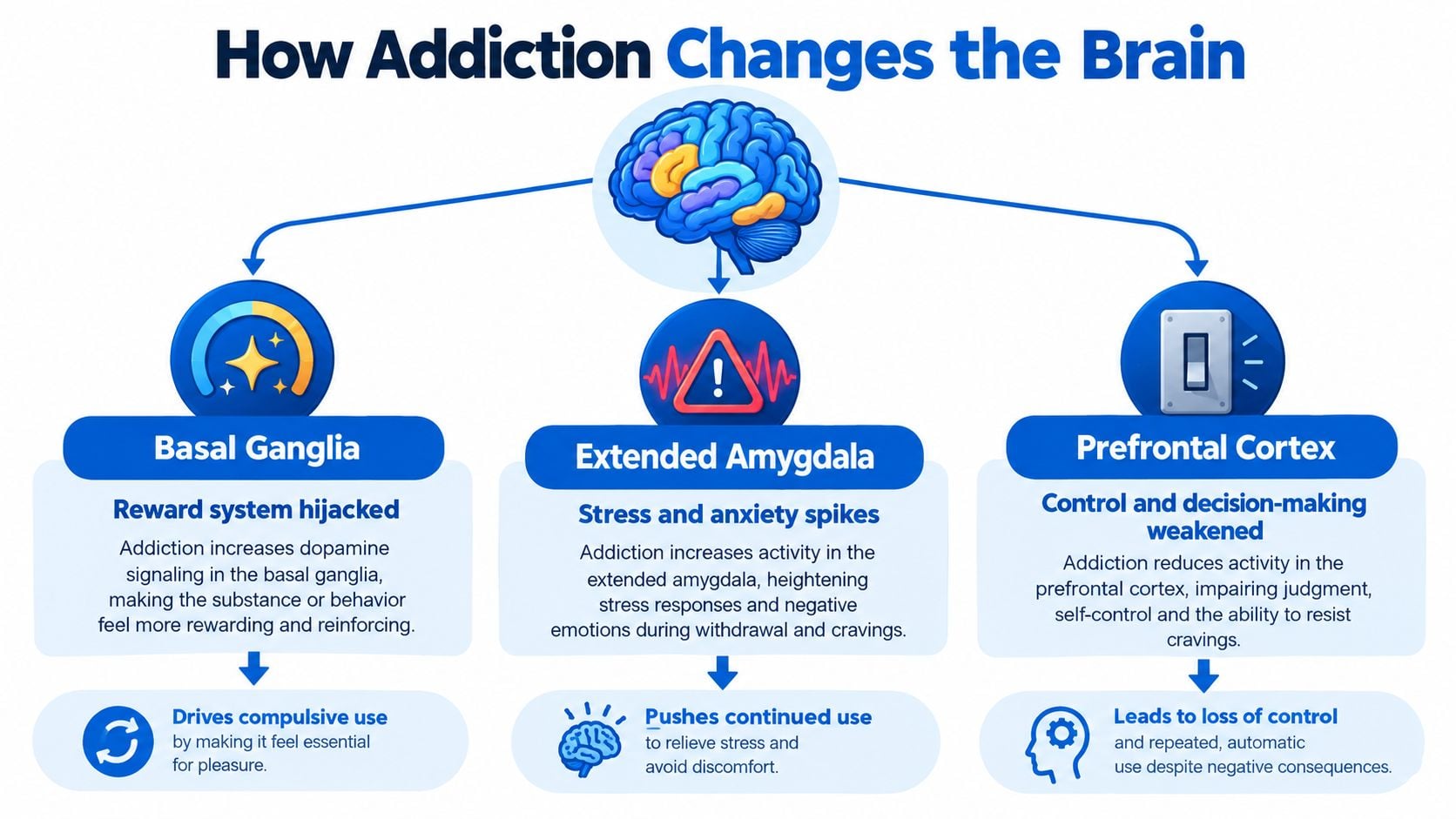
Repeated substance exposure affects several brain systems at once. The Surgeon General's explanation identifies three important regions: the basal ganglia, the extended amygdala, and the prefrontal cortex.
The basal ganglia helps reinforce rewarding behavior. During addiction, substance-related rewards can gain unusual motivational power, while ordinary sources of pleasure may feel less satisfying. The extended amygdala contributes to stress and withdrawal, helping explain why a person may use not to feel euphoric, but to escape anxiety, discomfort, irritability, or emotional pain.
The prefrontal cortex supports judgment, planning, and self-control. As addiction develops, the ability to weigh long-term consequences against an immediate urge can become less reliable. The person may understand the risks intellectually while still struggling to interrupt the behavior in the moment.
A volume knob for craving
A useful analogy is a volume knob. Repeated substance use can turn craving signals up while turning down the salience of everyday rewards and the brain's ability to pause before acting. A familiar bar, argument, neighborhood, smell, emotional state, or person may then act like a cue that raises the volume quickly.
This isn't a perfect biological model, but it illustrates why stopping can remain difficult after the substance leaves the body. NIDA notes that brain changes may persist after use stops, leaving a person vulnerable to intense cravings and renewed use even after a long period of recovery. Detox can end acute intoxication or withdrawal management, but it doesn't automatically erase learned associations or stress sensitivity.
The persistence of vulnerability explains why recovery requires more than removing the substance for a short time.
Treatment therefore targets more than abstinence alone. Clinicians may use medically supervised withdrawal when physiological dependence is present, medications that stabilize affected systems, behavioral therapy to weaken cue-response loops, and planning around sleep, stress, triggers, and social context. People managing substance use alongside depression, anxiety, trauma, or another psychiatric concern may benefit from dual-diagnosis treatment at Reflections. Families can also learn more about the effects of alcohol addiction on the mind, body, and relationships.
For a visual explanation of these brain systems, watch this educational video:
What Factors Increase Your Risk of Developing Addiction
Not everyone who uses alcohol or drugs develops an addiction. Risk depends on how several influences interact, not on one personal defect or one unavoidable biological destiny.
Genetic factors account for approximately 40% to 60% of vulnerability to substance use disorders, according to a review in the National Library of Medicine. Vulnerability isn't the same as certainty. Genes can influence sensitivity to reward, stress response, impulse control, and other traits, but a person's development and surroundings also shape whether repeated use becomes clinically significant.
Risk comes from interaction
Developmental exposure, mental health, trauma, and social environment can alter the path from use to disorder. Someone coping with untreated anxiety may use alcohol to quiet fear. Someone exposed to trauma may use drugs to blunt memories or emotional distress. A person living around heavy substance use may encounter more opportunities, pressure, or normalization of risky behavior.
These influences can compound one another:
- Inherited vulnerability: A family pattern may indicate increased susceptibility, not a guaranteed outcome.
- Trauma and chronic stress: Ongoing threat or unresolved pain can make short-term relief especially reinforcing.
- Mental health conditions: Untreated symptoms may make substances seem like immediate coping tools.
- Social environment: Isolation, unstable housing, conflict, or easy access can make recovery harder.
- Developmental experiences: Early exposure and learned patterns can affect how the brain responds to reward and risk.
The important question isn't whether someone is “born an addict.” It's whether identifiable factors are increasing their risk and whether support can be added early. Prevention may involve mental-health treatment, safer relationships, stable routines, education, and careful monitoring of substance use.
People who want to understand family patterns can review whether addiction runs in the family. That information should guide awareness and early help, not stigma. A family history can encourage honest conversations about risk, while protective relationships and treatment can change the direction of a person's life.
How Does Addiction Compare to Other Chronic Diseases
Could a condition be chronic without making recovery impossible? Yes. In medicine, chronic usually means a condition may require continuing attention because symptoms can return as biology, stress, or surroundings change. It does not automatically mean constant symptoms, permanent damage, or a lack of personal responsibility.
Addiction shares this pattern with hypertension, asthma, and diabetes. Treatment may improve a person's health, yet follow-up care, medication, daily adjustments, or renewed support may still be needed. The comparison describes how the condition behaves over time, not that addiction has the same causes or treatment as those illnesses.
Recurrence is not proof of failure
NIDA reports relapse rates of 40% to 60% for substance use disorders, comparable to recurrence rates for hypertension and asthma, as described in Drugs, Brains, and Behavior: The Science of Addiction. The illnesses remain different in their symptoms, mechanisms, treatments, and recovery paths. The practical lesson is that recurrence does not show that treatment was useless or that a person lacked willpower.
A return to use can show that care needs adjustment. A clinician might review medication, cravings, withdrawal, mental health, housing, social support, and exposure to triggers. Families can focus first on safety and renewed care rather than interpreting the event as proof that the person never wanted recovery.
| Common misunderstanding | More accurate interpretation |
|---|---|
| “One treatment episode should solve the problem.” | Some people need continuing care or changes to their plan. |
| “Relapse proves the person didn't try.” | Recurrence can reflect persistent vulnerability or unmet treatment needs. |
| “Chronic means recovery is impossible.” | A chronic condition can enter remission and remain manageable. |
| “Medical treatment removes responsibility.” | Treatment can improve a person's ability to make healthier choices and follow through on them. |
The analogy has limits. Addiction is not diabetes of the brain, and recovery cannot be reduced to medication or monitoring. Social connection, trauma care, housing, family support, and personal meaning may also affect recovery. The comparison gives clinicians and families a more useful response: treat recurrence as information that calls for attention, not as a reason for moral condemnation.
What Does the Disease Model Mean for Treatment Options
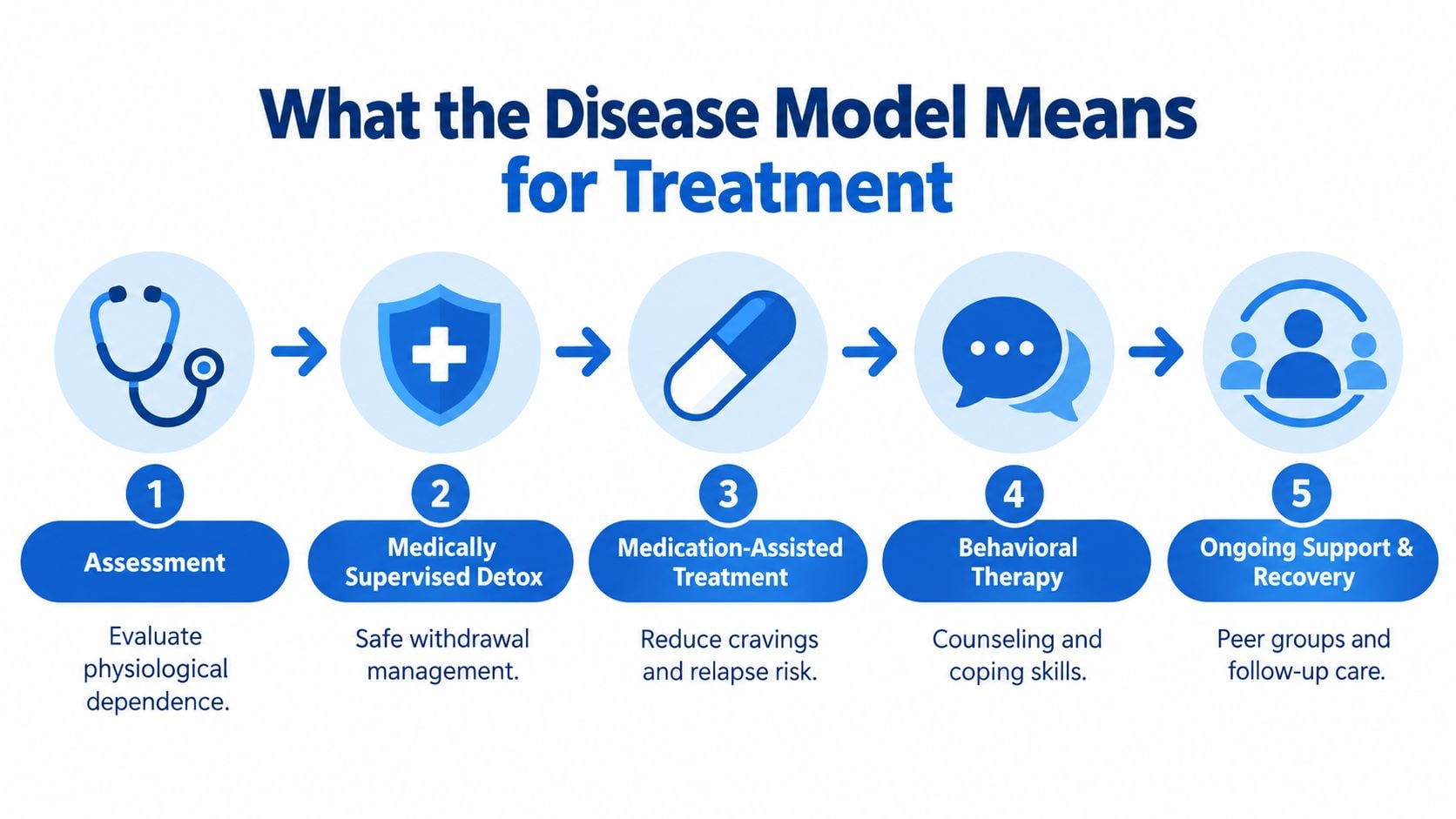
The disease model changes the practical question from “How can we force this person to stop?” to “What assessment and support does this person need now?” Treatment should address biological dependence, psychological distress, learned habits, environmental pressures, and the person's goals.
A clinician may begin with an assessment of substance use, withdrawal risk, medical conditions, mental health, medications, safety, and available support. If physiological dependence is present, medically supervised withdrawal may be appropriate. Withdrawal management can improve safety, but it's only one part of care.
Treatment responds to different needs
Medication-assisted treatment may help stabilize affected neurochemical systems and reduce cravings or the risk of returning to use when clinically indicated. People considering this approach can read about medication-assisted treatment effectiveness and discuss options with a qualified healthcare professional.
Behavioral care addresses the patterns that medication alone can't change. Therapy may help a person identify cues, practice coping strategies, examine beliefs, repair relationships, manage emotions, and build routines that support recovery. Cognitive behavioral approaches, motivational interviewing, family counseling, and peer support can serve different purposes depending on the person's needs.
Treatment settings may include medically monitored withdrawal, residential rehabilitation, partial or intensive outpatient care, standard outpatient counseling, and mutual-support programs. The right level depends on safety, medical needs, housing, work, family responsibilities, transportation, and the person's ability to remain engaged.
Continuing care protects progress
Relapse prevention should be specific rather than inspirational. A plan might identify people to call, places to avoid, warning signs, sleep disruptions, stressful situations, medication appointments, and steps to take after a lapse. Co-occurring depression, anxiety, trauma, or other psychiatric symptoms should be assessed and treated rather than left in the background.
Resources on psychology, psychiatry, and addiction treatment can help readers understand why integrated care matters. The central principle is simple: addiction treatment should be individualized, medically informed, and flexible enough to respond when circumstances change.
Is the Disease Model Controversial or Incomplete
The disease model is useful, but it isn't a complete description of every person's experience. A 2025 review argued that evidence for treating addiction specifically as a brain disease remains weak and that the disease framing hasn't been shown reliably to reduce stigma, as discussed in the review available through the University of York research repository.
That criticism matters. If people hear “brain disease” and conclude that addiction is purely biological, they may overlook trauma, learning, relationships, poverty, discrimination, mental health, and access to treatment. If they hear “chronic” and assume recovery is impossible, the label can produce hopelessness instead of support.
Biology and agency can coexist
The strongest explanation is biopsychosocial. Biology helps explain vulnerability, craving, withdrawal, and reduced control. Psychology helps explain learning, coping, motivation, trauma, and emotional regulation. Social conditions influence exposure, stress, safety, treatment access, and the practical options available during recovery.
This framework avoids two damaging extremes:
- Pure choice: This view treats repeated use as a simple decision and can turn symptoms into blame.
- Pure biology: This view can imply that a person has no agency or that recovery is impossible.
- Biopsychosocial understanding: This view recognizes brain adaptations while keeping room for learning, relationships, treatment, responsibility, and change.
There's also reason not to interpret brain changes as permanent damage. NIDA has reported that longitudinal imaging studies show structural and functional recovery in several brain regions during treatment and recovery. Disease status doesn't require irreversible injury. A person can have a real medical disorder and still experience improvement, remission, and renewed capacity for self-direction.
The same caution applies to substances that may be perceived as harmless. Someone asking is CBD addictive still needs an individualized answer that considers the product, its ingredients, use pattern, effects, and personal health context. Broad labels should encourage careful assessment, not automatic conclusions.
What Can You Do With This Knowledge About Addiction as a Disease
Understanding addiction as a disease should lead to clearer action, not helplessness. Three ideas deserve to stay together:
- The brain changes are real. Repeated substance use can alter reward, stress, judgment, and impulse-control systems, making continued use increasingly difficult to manage.
- Recovery remains possible. Persistent vulnerability doesn't mean permanent damage or lifelong incapacity. Treatment and recovery can accompany biological adaptation.
- Compassion should guide care. Compassion doesn't erase consequences. It replaces shame-based reactions with safety, boundaries, assessment, and evidence-based support.
What families can do
Start with observable facts rather than labels. Describe missed responsibilities, health concerns, changes in mood, unsafe situations, or attempts to stop. Ask what kind of help the person might accept, and avoid promising that one conversation will solve the problem.
If immediate medical danger, severe withdrawal, overdose, or a risk of self-harm is present, seek urgent professional help. Otherwise, encourage an assessment with an addiction specialist or qualified healthcare provider who can evaluate withdrawal risk, medications, mental health, and the appropriate level of care.
A person in recovery can also make the plan more practical by identifying triggers, protecting sleep, attending appointments, building supportive relationships, and deciding what to do after a lapse. A family member can offer transportation, help organize questions for a clinician, reduce access to substances where safe, and maintain boundaries around money, violence, driving, and childcare.
Hope is medically realistic when it's paired with a plan. Recovery may require adjustment, but the need for continued care is not evidence that change is impossible.
Addiction Resource Center LLC offers medically supervised detox with medication-assisted treatment, residential rehabilitation through a partner facility, and an Intensive Outpatient Program available in person or through telehealth. If you're in Yuba City or Northern California, or you're supporting someone who needs structured help, visit Addiction Resource Center LLC to learn about assessment, treatment options, insurance, and recovery planning.