IOP treatment typically lasts 4 to 12 weeks, with adults receiving at least 9 hours of structured programming per week, though many clinicians recommend a 90-day threshold to support sustained behavior change. The right length depends on how steadily you progress, how safe and stable your daily life is, and whether your care team believes …

IOP treatment typically lasts 4 to 12 weeks, with adults receiving at least 9 hours of structured programming per week, though many clinicians recommend a 90-day threshold to support sustained behavior change. The right length depends on how steadily you progress, how safe and stable your daily life is, and whether your care team believes you're ready to step down.
At midnight, a parent may sit at the kitchen table scrolling through treatment options, trying to understand whether a loved one needs a month of care, a full season, or something longer. A person considering treatment may have a different concern: “Can I keep my job, care for my children, or attend appointments without putting my life on hold?”
Those questions make sense. Intensive outpatient treatment, or IOP, is structured enough to provide frequent support but flexible enough for many patients to live at home. Sessions commonly include group therapy, individual counseling, family education, skills training, relapse-prevention planning, and case management. You'll attend treatment regularly, then return to your home and practice what you've learned in daily life.
The most useful way to understand duration is to think of IOP as a therapeutic dose, not a fixed expiration date. Weekly hours, participation, symptom stability, coping skills, recovery supports, and safe transition planning all matter. A calendar can tell you how long you've attended, but it can't by itself show whether treatment has done what you needed it to do.
Table of Contents
- What to Expect From IOP Treatment Duration
- Clinical Benchmarks That Define IOP Length
- How IOP Compares to Other Levels of Care
- A Week-by-Week Look at the IOP Experience
- Factors That Change How Long You Stay in IOP
- Knowing When IOP Is Complete or Needs Adjustment
- Starting IOP at Addiction Resource Center
What to Expect From IOP Treatment Duration
IOP usually sits between standard outpatient therapy and more restrictive care. You don't typically stay overnight, but you do commit to a recurring schedule that creates accountability and gives clinicians regular opportunities to assess your progress. For adults, SAMHSA describes IOP as a prearranged schedule totaling at least 9 hours per week, while adolescent requirements can differ. State rules and health-plan policies may also affect how a program is organized, as described in SAMHSA's clinical guidance.
A program may schedule those hours across several evening or daytime sessions. One person might attend after work, while another may use daytime programming because evenings are needed for family responsibilities. The schedule can change as needs change, but reducing attendance should be part of a clinical plan, not an informal decision to stop showing up.
Why the calendar varies
A shorter episode may be appropriate when someone enters IOP already medically stable, engages consistently, develops practical coping strategies, and has reliable support outside treatment. Another person may need a longer period because cravings remain intense, mental health symptoms are still active, housing is unstable, or a relapse has interrupted progress.
A consensus recommendation described in the NIH and NCBI chapter Intensive Outpatient Treatment and the Continuum of Care identifies 90 days as a commonly cited minimum duration for the IOT phase. That doesn't mean every patient must remain in the same schedule for exactly that long. It means families should be cautious about assuming that brief stabilization automatically equals durable recovery.
Practical rule: Ask, “What milestones will show that I'm ready for less intensive care?” rather than asking only, “What date will I finish?”
Your treatment team should explain the expected schedule, how progress will be reviewed, what could extend care, and what follow-up will look like. If you're paying for treatment or using insurance, ask for the authorization period and renewal process early. Financial and administrative limits can influence timing, but they shouldn't replace a clinical conversation about safety and readiness.
Clinical Benchmarks That Define IOP Length
The clearest clinical benchmark for adult IOP is the weekly treatment dose. SAMHSA guidance describes adult IOP as providing at least 9 hours per week, while Medicare describes outpatient IOP services within a broader range of approximately 9 to 19 hours of weekly structured programming. The Medicare explanation of outpatient IOP services helps clarify why IOP requires more engagement than an occasional therapy appointment.
That weekly floor creates enough contact for clinicians to identify patterns, reinforce skills, monitor risk, and respond when symptoms change. It also preserves a level of independence that allows many patients to continue living at home, working, attending school, or caring for family members. The number isn't a promise that treatment will work for everyone. It's a way to distinguish intensive outpatient care from ordinary outpatient counseling.
Weekly hours are only one part of the dose
Programs often distribute treatment across several sessions rather than placing every service into one long appointment. A session may include a process group where participants discuss triggers, a skills group focused on emotional regulation, an individual check-in, or family work that addresses communication and boundaries.
The calendar length matters because behavior change usually needs repeated practice. The NCBI clinical chapter notes a consensus range of 6 to 30 programming hours based on client needs and identifies 90 days as a frequently cited minimum duration for the IOT phase. That framework supports a practical conclusion: IOP is generally measured in weeks and months, not as a brief intervention that ends as soon as a crisis has passed.
Why clinicians use milestones
A rigid discharge date can create the wrong incentive. Someone may attend for the expected number of weeks while still avoiding difficult situations, missing medication follow-up, or lacking a safe aftercare plan. Conversely, another patient may be ready to reduce treatment intensity sooner because they're engaging reliably, using coping skills, and maintaining stability in the community.
Clinicians may review attendance, participation, cravings, mood symptoms, recovery supports, medication response, and progress toward treatment goals. They'll also consider whether you can manage a difficult day without immediately returning to substance use or losing contact with care.
For a practical overview of the program requirements that shape scheduling and participation, review IOP requirements and treatment expectations. The central question remains consistent: Are you receiving enough support to make meaningful change, and can you safely maintain progress with less support?
How IOP Compares to Other Levels of Care
IOP makes more sense when you compare it with the rest of the treatment continuum. Detox focuses on withdrawal and medical stabilization. Residential care provides a controlled living environment. PHP offers a heavier daytime treatment schedule, while standard outpatient care provides less frequent contact.
The exact duration and schedule depend on the person, diagnosis, facility, payer, and clinical recommendations. The table below offers a planning framework using the ranges and commitments commonly described for these levels.
| Level of Care | Typical Duration | Weekly Hours | Living Arrangement | Best Suited For |
|---|---|---|---|---|
| Medical detox | Short stabilization period, based on withdrawal and medical needs | Varies by medical needs | Usually monitored setting | People who may need medical support during withdrawal |
| Residential or inpatient | Varies by clinical progress and program design | High structure, often daily | Live at the facility | People who need continuous supervision or separation from immediate risks |
| Partial hospitalization program | Often more intensive than IOP, with 20 or more weekly hours in many program models | 20+ hours | Usually live outside the facility unless another setting is required | People who need substantial daytime treatment but not full residential care |
| Intensive outpatient program | Commonly 4 to 12 weeks, with some programs extending longer | Adults receive at least 9 structured hours weekly | Live at home | People who are stable enough for community living but need frequent treatment |
| Standard outpatient | Ongoing and individualized | Often 1 to 2 hours per week | Live at home | People who can maintain recovery with lower-intensity support |
The distinction between inpatient vs outpatient rehab can help families think through supervision, daily independence, and environmental risk. A person may enter IOP after detox, residential treatment, or PHP as a step down. Someone already attending standard outpatient therapy may move up to IOP if cravings, relapse risk, or instability requires more contact.
Transitions aren't failures
Moving between levels is normal clinical care. A step down means the team sees enough stability for greater independence. A step up means the current setting may not provide enough protection or support right now. Neither decision should be treated as a moral judgment.
IOP can also serve as a bridge rather than an endpoint. Once the intensive schedule is no longer necessary, standard outpatient counseling, medication management, peer support, family services, and aftercare can keep recovery work active.
For California readers comparing program structures and access considerations, California IOP treatment information offers another way to frame the decision around local care options.
A Week-by-Week Look at the IOP Experience
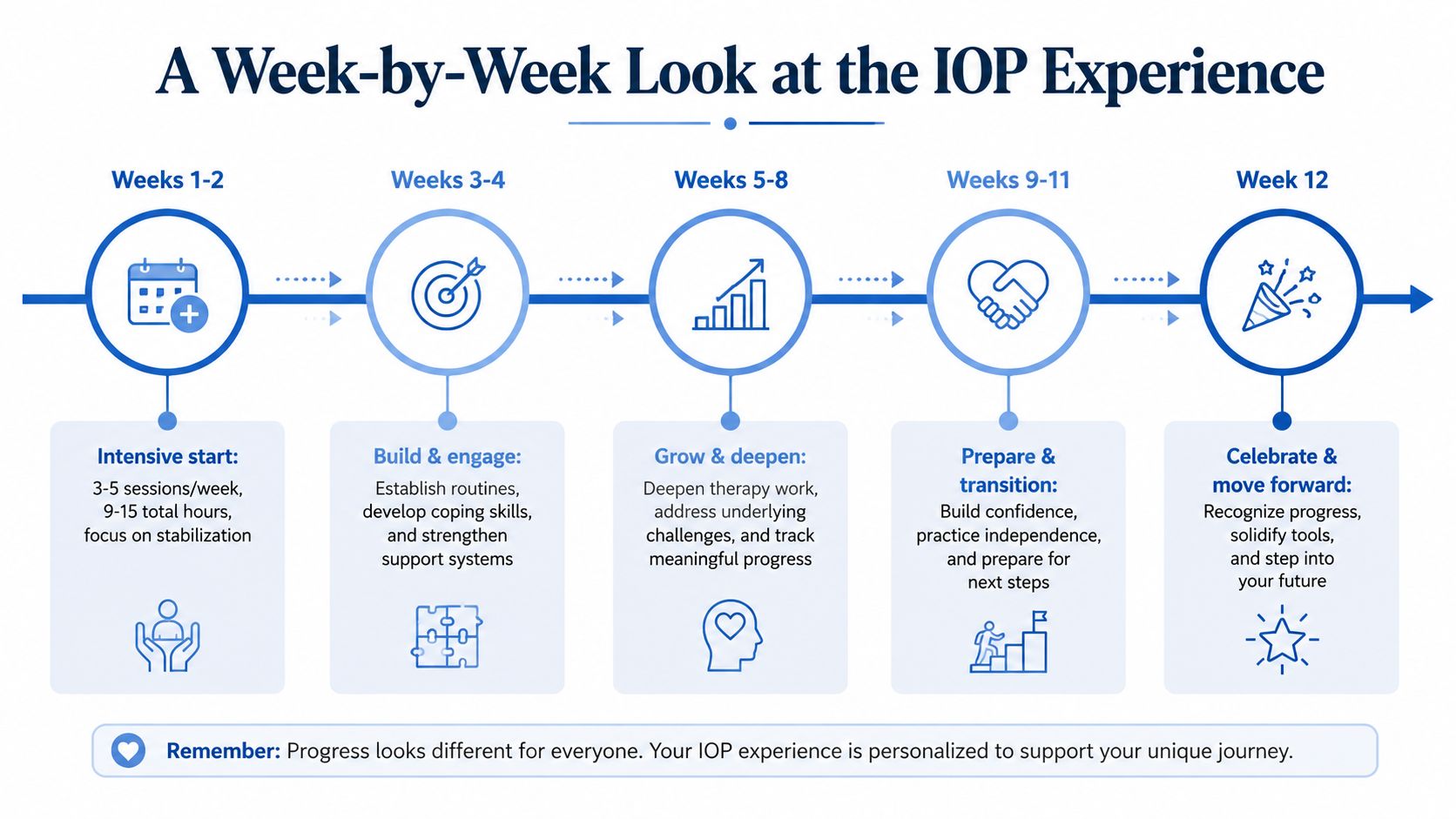
A typical IOP episode can feel different from week to week. Early treatment often emphasizes stabilization and orientation. The middle phase focuses on practicing new responses. Later sessions shift toward independence, relapse planning, and continuity of care.
The following example uses an 8- to 12-week arc as a planning model, not a promise about what every patient will experience. A person's actual schedule may change because of symptoms, attendance, work, family responsibilities, or clinical recommendations.
Weeks 1 to 2 focus on stabilization
Early sessions may include an intake review, psychiatric or medical assessment, medication discussion, safety planning, and an introduction to group expectations. The patient learns how confidentiality works, meets members of the care team, and begins identifying triggers, cravings, emotions, and routines connected with substance use.
A Tuesday evening could include a group focused on recognizing high-risk thoughts and a skills exercise for managing urges. A Thursday check-in might give the counselor time to review sleep, medication concerns, attendance, and what happened between sessions.
The early goal isn't to solve every problem immediately. It's to establish enough structure for honest assessment and consistent participation.
Weeks 3 to 6 build practical recovery skills
The core phase often includes cognitive behavioral therapy groups, relapse-prevention planning, individual counseling, and family sessions when appropriate. Patients begin testing skills outside the program, such as delaying an impulsive response, calling a support person, leaving a triggering environment, or using a written coping plan.
A patient might report that a difficult conversation with a partner triggered cravings. The group can help examine what happened, identify the first warning signs, and rehearse a different response. The following individual session can turn that discussion into a specific plan for the next high-risk situation.
The IOP schedule guide can help families understand how recurring sessions may fit around employment, school, and home responsibilities.
Here's a short video introduction to the kind of structure patients may encounter in intensive outpatient care:
Weeks 7 to 10 increase accountability
As stability improves, clinicians may examine whether the patient can manage more responsibilities with fewer treatment contacts. Sessions may address employment, relationships, routines, communication, transportation, or other life skills that affect recovery outside the program.
This phase can expose gaps that weren't visible during the early weeks. A person may do well in treatment but struggle when a work conflict, family disagreement, or weekend trigger appears. The team may maintain the current schedule, adjust goals, or extend IOP rather than reducing support too quickly.
Weeks 11 to 12 prepare the next step
Later treatment often centers on aftercare planning, medication follow-up, community supports, warning signs, and a response plan for renewed cravings. The patient and care team may discuss a transition to standard outpatient counseling or another appropriate service.
Completion can include a formal review or personal closing ritual, but the important outcome is continuity. A safe transition includes clear appointments, accessible supports, and an understanding of what to do if symptoms worsen.
Factors That Change How Long You Stay in IOP
Two people can attend the same program and need different amounts of time. Clinicians consider the person's substance-use history, current symptoms, mental health, living situation, response to treatment, and ability to participate consistently.
Clinical severity often shapes the starting point. A longer substance-use history, repeated relapse pattern, or multiple substances may require sustained structure. Co-occurring depression, trauma-related symptoms, anxiety, or other mental health concerns can also complicate treatment because the team must address more than substance use alone.
Daily life can determine whether the schedule is workable
A patient who has stable housing, dependable transportation, and supportive family may find it easier to attend regularly. Someone facing unsafe housing, childcare responsibilities, a demanding job, or limited transportation may need evening sessions, telehealth, or another schedule adjustment.
These barriers aren't evidence that someone lacks motivation. They're practical conditions that clinicians should address during treatment planning. A schedule that looks manageable on paper may be impossible if the patient can't reliably access it.
Insurance affects the administrative timeline
Health plans may authorize care in stages and request clinical documentation before extending coverage. The specific authorization process varies by plan, so patients should ask the admissions or billing team how reviews work, what services are covered, and what out-of-pocket responsibilities may apply.
Coverage limits can create pressure to reduce care before a person feels ready. If that happens, ask the clinical team about lower-cost continuity options, step-down services, medication follow-up, and a written safety plan instead of ending treatment without support.
Telehealth can reduce location barriers
Telehealth and hybrid IOP can help some patients remain connected when distance, transportation, work, or family obligations interfere with in-person attendance. It still requires privacy, reliable technology, active participation, and a plan for urgent concerns.
Policy changes can also affect continuity. In January 2026, a federal rule permanently extended telehealth addiction-prescribing flexibility, allowing buprenorphine prescribing through telehealth for up to six months without an in-person visit, as reported by Pew's coverage of the federal telehealth rule. Prescribing flexibility doesn't determine IOP length, but it may make ongoing medication care easier for eligible patients who face geographic disruption.
Knowing When IOP Is Complete or Needs Adjustment
Completion should follow a clinical review, not the arrival of a planned date. The patient, therapist, prescriber, and other members of the care team can compare current functioning with the goals established at intake.
Signs that step-down may be appropriate
A patient may be ready for standard outpatient care when they're participating consistently, using coping skills during real-life stress, and maintaining a workable recovery routine. The team may also look for stable housing, dependable support, improved management of cravings, and progress with medication or mental health treatment.
Some programs consider sustained negative drug screens over 30 or more days as one part of the review, but screening results are not the only measure of readiness. Honest reporting, safety, behavior change, and the ability to respond to warning signs matter too.
Recovery is not proved by completing a calendar. It's demonstrated through the choices and supports you can maintain after the schedule becomes lighter.
Reasons to extend the current level
An extension may make sense after a recent relapse, emerging psychiatric symptoms, worsening cravings, or a major life stressor. The team may adjust goals, increase family involvement, change medications, or preserve the current schedule while the patient rebuilds stability.
A step up to PHP or residential care may be considered when substance use escalates, sessions are repeatedly missed, the home environment is unsafe, or there are significant safety concerns. Asking for more support early can prevent a manageable problem from becoming a crisis.
Before leaving IOP, request a written aftercare plan. It should identify follow-up appointments, medication responsibilities, recovery supports, warning signs, and who to contact if you begin struggling.
Starting IOP at Addiction Resource Center
Addiction Resource Center LLC serves adults in Yuba City and Northern California who need support for substance use disorders or co-occurring mental health needs. Its IOP is available in person and through telehealth, which can give eligible patients more practical ways to maintain treatment while managing work, family, transportation, or distance.
The program uses a multidisciplinary team that includes a medical doctor, registered nurse, licensed counselors, licensed marriage and family therapist, and recovery mentors. Treatment may include education, accountability, relapse prevention, coping-skills development, individualized planning, and aftercare preparation. The center also provides a broader continuum that includes medically supervised detox with medication-assisted treatment and residential rehabilitation through its partner facility, Ona Treatment Center in Browns Valley, California.
What the first call can cover
The admissions conversation can help determine whether IOP is an appropriate starting level or whether another service is safer. Patients and families can discuss current substance use, mental health concerns, medications, safety, scheduling needs, telehealth access, and the transition from another program.
The center accepts most major insurance plans and welcomes TRICARE beneficiaries. Its team can assist with benefits verification and explain expected financial responsibilities before treatment begins. The location is 1002 Live Oak Blvd., Suite A, Yuba City, California, and the 24/7 phone and text line is 530-625-7910.
Treatment duration is individualized. Rather than promising that everyone will finish on the same date, the care team can review participation, progress, stability, and next-step needs throughout the episode. That approach fits the central answer to how long IOP treatment lasts: enough time to receive a meaningful therapeutic dose and build a safe path forward.
Addiction Resource Center LLC offers in-person and telehealth IOP, individualized treatment planning, relapse-prevention support, and help with insurance and benefits questions. Visit Addiction Resource Center LLC or call or text 530-625-7910 to ask about scheduling, program fit, and what duration of care may make sense for you or your loved one.