You may be holding a prescription bottle in one hand and searching “how to stop benzodiazepines safely” with the other. Perhaps your clinician warned you not to stop suddenly, while online advice made detox sound like a short, standardized event. You may also be unsure whether you need inpatient care, whether a taper can happen …

You may be holding a prescription bottle in one hand and searching “how to stop benzodiazepines safely” with the other. Perhaps your clinician warned you not to stop suddenly, while online advice made detox sound like a short, standardized event. You may also be unsure whether you need inpatient care, whether a taper can happen at home, or what to do if anxiety and insomnia return before the medication is fully discontinued.
Medical detox for benzodiazepines is a structured clinical process, not a quick reset. The safest plan accounts for the specific medication, dose, duration of use, previous withdrawal experiences, seizure risk, other substances, physical health, and mental health. A careful clinician may recommend outpatient tapering, medically managed care, or inpatient treatment, depending on those factors.
This guide focuses on what is well established, what still depends largely on clinical judgment, and what recovery can look like after the acute phase. It also includes practical questions for people seeking care in Northern California.
Table of Contents
- Why Medical Detox for Benzodiazepines Requires Careful Planning
- Understanding Benzodiazepine Withdrawal and Seizure Risk
- How Gradual Tapering Works During Benzodiazepine Detox
- Substitution Strategies and Medications Used in Medically Supervised Detox
- Inpatient Versus Outpatient Medical Detox for Benzodiazepines
- What to Expect After Acute Detox and How to Plan Next Steps
Why Medical Detox for Benzodiazepines Requires Careful Planning
A typical first consultation starts with uncertainty. A patient may say, “I only want to stop,” while also describing daily alprazolam, lorazepam, clonazepam, or diazepam use over an extended period. Another person may have reduced the dose independently and then developed severe anxiety, shaking, insomnia, or frightening changes in perception. In both situations, the next step isn't just choosing a detox date. It's establishing how to reduce exposure without creating avoidable instability.
Medical detox for benzodiazepines usually means assessment, dose management, monitoring, and continuing support. The clinician reviews the prescription history, current schedule, missed doses, alcohol or opioid use, other sedating medications, seizure history, medical conditions, and access to a safe recovery environment. The plan then changes as the patient responds. A taper that looks reasonable on paper may need to slow if withdrawal symptoms interfere with sleep, daily function, or safety.

Why speed isn't the main measure of success
A short detox episode can provide immediate structure and observation, but it may not complete the entire taper. Benzodiazepine dependence often requires continuity between medical assessment, dose reductions, treatment for anxiety or insomnia, and relapse prevention. A program that promises the same schedule for every patient is ignoring the central clinical problem, which is individual tolerance.
Patients and families can also benefit from understanding what medically supervised detox involves. The purpose of supervision isn't to make every symptom disappear. It's to identify dangerous changes early, adjust the plan, and provide support while the nervous system adapts.
Practical rule: Don't stop a regularly used benzodiazepine abruptly unless a qualified clinician has directed you through an appropriate medical plan.
The right question is often not “Can I finish detox quickly?” It's “What level of monitoring and what taper pace give me the best chance of staying medically and psychologically stable?” That cautious approach may feel slower, but it creates room for clinical decisions rather than forcing the body through a rigid schedule.
Understanding Benzodiazepine Withdrawal and Seizure Risk
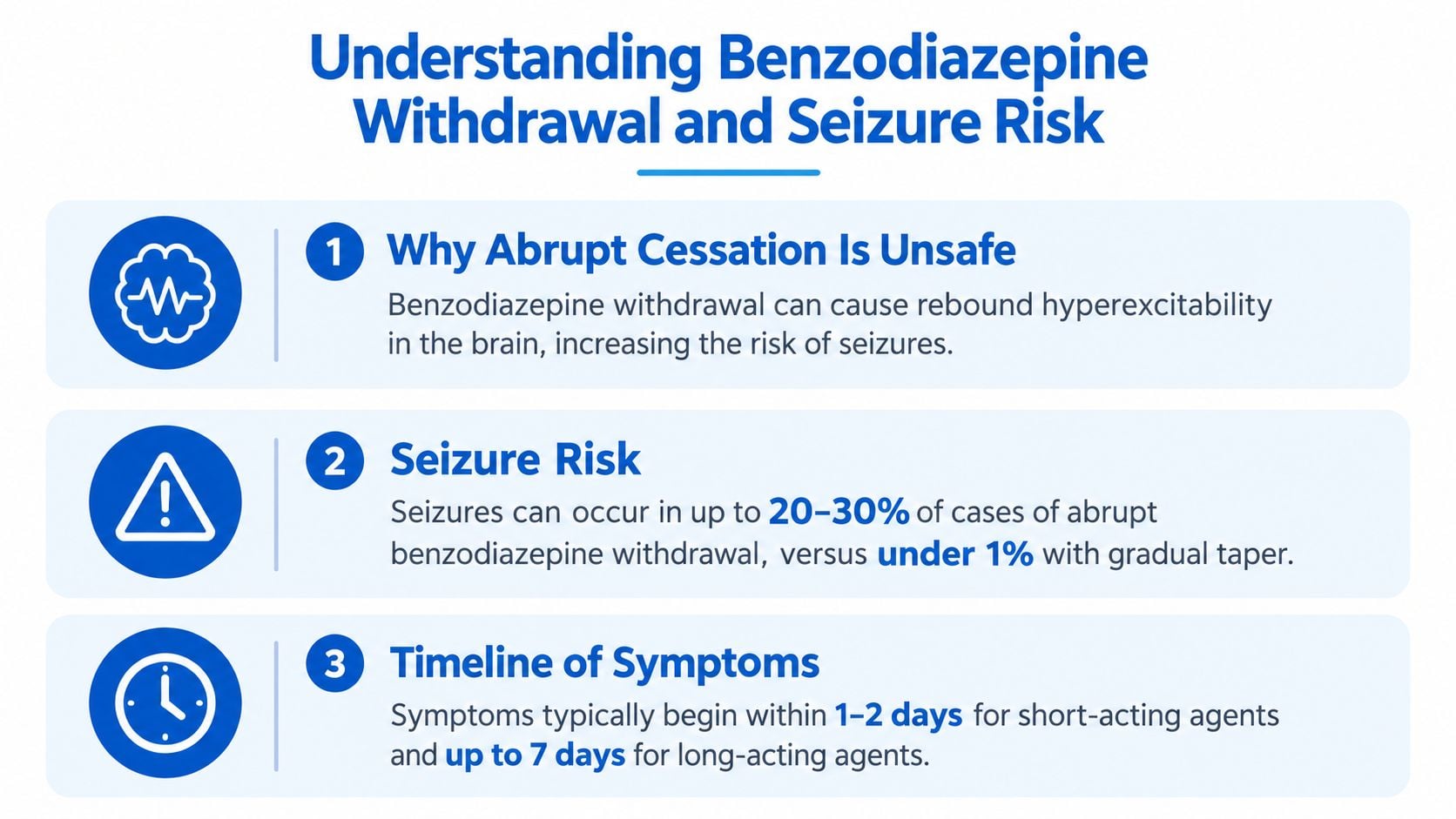
A patient who has taken a benzodiazepine daily for months may feel stable until a dose is delayed. Anxiety, tremor, insomnia, sensory sensitivity, agitation, or confusion can then appear. Sudden discontinuation can make these symptoms severe because the brain has adapted to the medication's inhibitory effects. In some cases, withdrawal includes seizures.
Duration of use matters. Among people who have taken a benzodiazepine for more than 6 months, about 40% experience moderate to severe withdrawal symptoms. Other guidance reports withdrawal in roughly 30% to 45% of long-term users, as summarized in the clinical review of benzodiazepine withdrawal. These are population-level estimates, not a personal forecast. They support a careful assessment of dose, duration, prior withdrawal, medical conditions, and current mental health.
Why abrupt discontinuation creates a safety problem
Clinical guidance generally favors gradual dose reductions over sudden cessation. Common approaches reduce the dose by 5% to 10% every 1 to 2 weeks or every 2 to 4 weeks, depending on the guideline and the patient's response. The appropriate schedule remains individualized, and a person with marked symptoms or a previous failed taper may require slower adjustments. A UK medicines review from 1980 also recommended gradual withdrawal for benzodiazepine patients, showing that this principle is longstanding.
The risks extend beyond discomfort. In a large observational study published in JAMA Network Open, 60,297 people, or 20%, discontinued benzodiazepines during the one-year follow-up. Among people without opioid exposure, the adjusted one-year cumulative incidence of death was 5.5% for discontinuers and 3.5% for nondiscontinuers, an absolute difference of 2.1 percentage points. The analysis also linked discontinuation with higher risks of mortality, nonfatal overdose, emergency department use, and suicidal ideation. These findings do not establish that stopping caused each outcome. They show that discontinuation may occur during a period of substantial medical and psychiatric vulnerability. The full study is available in JAMA Network Open.
Clinicians monitor for escalating withdrawal, severe agitation, confusion, suicidal thoughts, and seizures while checking for other causes of symptoms. Risk information is not a reason to continue benzodiazepines indefinitely. It is a reason to establish an individualized plan and decide whether outpatient monitoring is adequate or a higher level of care is safer.
Patients and families can review what happens during detox to understand the practical process.
How Gradual Tapering Works During Benzodiazepine Detox
A taper replaces abrupt discontinuation with planned dose reductions. Before setting the schedule, the clinician confirms the actual daily exposure: tablet strength, number of doses, timing, missed doses, and use of more than one benzodiazepine. This medication history matters because the same tablet count can represent very different pharmacologic exposure.
Current clinical guidance commonly suggests initial reductions of about 5% to 10% every 2 to 4 weeks, with reductions generally not exceeding 25% every 2 weeks, as described in Cleveland Clinic Journal of Medicine guidance. These figures are starting parameters rather than a universal protocol. A patient with pronounced withdrawal, long-term use, or previous unsuccessful tapers may need smaller reductions and longer intervals. The exact pace remains individualized and is partly based on clinical consensus, because research does not define one schedule that fits every patient.
How clinicians estimate risk
Providers may convert different benzodiazepines into diazepam equivalents. This allows a rough comparison of exposure across medications and helps identify patients who may need closer monitoring. Approximate higher-risk daily equivalents include:
- Diazepam: More than 15 mg per day
- Clonazepam: More than 1.5 mg per day
- Lorazepam: More than 3 mg per day
- Alprazolam: More than 2 mg per day
These thresholds guide assessment, not automatic placement in inpatient care. Equivalent-dose conversions are approximate, and patients can respond differently to the same calculated exposure. The clinician also considers prior withdrawal, seizure history, alcohol or other sedative use, medical illness, psychiatric stability, and whether reliable follow-up is available.
The taper may reduce one scheduled dose first, distribute reductions across the day, or change dose timing to protect sleep and daytime functioning. If symptoms intensify, the provider may hold the current dose and resume at a slower pace after stabilization. A pause reflects an adjustment to the patient's response, not a failed treatment.
What a useful taper plan contains
A workable plan specifies the medication, dose, timing, reduction amount, review date, symptoms that require a call, and emergency instructions. It should also address the condition that led to the prescription. Persistent anxiety or insomnia can overlap with withdrawal and make the response difficult to interpret.
Clinical perspective: The safest taper is one the patient can follow consistently while the treatment team can identify problems early and change the pace.
A rapid schedule may seem efficient, but it can produce severe withdrawal, rebound symptoms, and loss of confidence. A slower plan requires patience and repeated reassessment. It also leaves room to distinguish acute withdrawal from symptoms that persist after the acute phase, which may require continued clinical support rather than repeated dose changes.
Substitution Strategies and Medications Used in Medically Supervised Detox
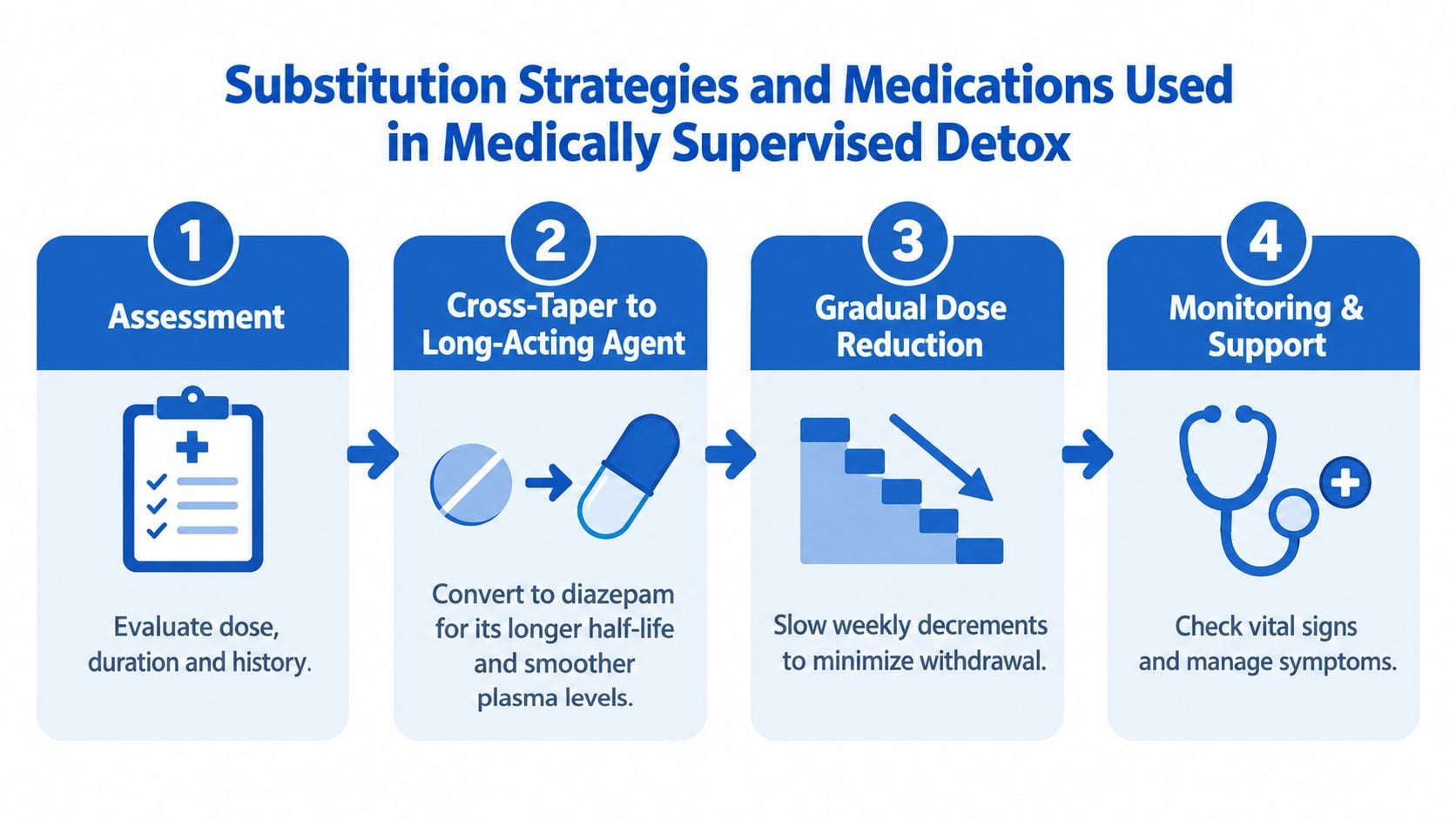
A clinician may taper the benzodiazepine a patient already takes or transition them to a longer-acting medication, most commonly diazepam. Diazepam's longer half-life can smooth changes in blood levels and reduce withdrawal between doses. The choice is individualized. Liver disease, age, pregnancy, medication interactions, sensitivity to sedation, and the original benzodiazepine can all change the risk-benefit balance.
A common substitution plan changes one dose at a time, often starting with the nighttime dose, with transitions reviewed at approximately weekly intervals. Once the diazepam-equivalent dose is below 20 mg per day, some guidance recommends reducing by 1 to 2 mg per week, as described in the Oregon benzodiazepine tapering guidance. The prescriber must calculate the conversion, assess sedation and withdrawal, and adjust the plan. Patients should not make this switch independently.
Comparing the main medication approaches
Continuing the current benzodiazepine can be reasonable when the dose is stable, the formulation permits accurate reductions, and symptoms do not fluctuate substantially between doses. This approach avoids adding a second medication and may make the patient's response easier to interpret.
Switching to diazepam may be useful when a shorter-acting drug causes repeated interdose symptoms or makes small dose reductions difficult. Its longer action can smooth the taper, but the conversion may cause sedation or other adverse effects and requires clinical observation.
Adjunctive medications do not replace the benzodiazepine taper. A clinician may use symptom-focused treatment for sleep, anxiety, nausea, pain, or another diagnosed condition after reviewing interactions, sedation, and misuse potential. The main strategy remains a controlled reduction of benzodiazepine exposure.
The plan must also account for symptoms that continue after acute withdrawal. Persistent insomnia, anxiety, or sensory symptoms may need follow-up care rather than repeated medication substitutions.
Abrupt cessation or overly rapid reductions can cause severe withdrawal, including potentially life-threatening seizures. A slower schedule can be inconvenient, but it reduces avoidable risk and gives the clinician time to respond when symptoms change. A patient whose symptoms become difficult to monitor safely may need medically managed support, where closer observation allows faster clinical decisions.
Inpatient Versus Outpatient Medical Detox for Benzodiazepines
The decision about setting should begin with clinical risk, not with the label “detox.” Outpatient care may be suitable for a stable patient who can take medication exactly as prescribed, attend regular reviews, communicate changes promptly, and recover in a supportive environment. Inpatient or medically managed care becomes more appropriate when the clinician expects serious withdrawal, needs frequent observation, or can't rely on the home setting to support safe dosing.
The evidence also calls for humility. The 2025 joint guideline from the American Society of Addiction Medicine and partner organizations contains only a small number of recommendations supported by graded evidence, while many others rely on clinical consensus, as reflected in the ASAM benzodiazepine tapering guideline. That doesn't make the guidance useless. It means clinicians should explain uncertainty and adjust care rather than present one protocol as universally proven.
What changes the level-of-care decision
A provider may recommend a higher level of care when the patient has:
- Severe withdrawal risk: Factors such as high exposure, abrupt interruptions, prior severe withdrawal, or seizure history require closer planning.
- Medical instability: Significant physical illness or symptoms that need observation can make routine outpatient follow-up insufficient.
- Psychiatric danger: Suicidal thinking, severe confusion, psychosis, or inability to manage medications safely calls for urgent evaluation.
- Multiple substances: Alcohol, opioids, or other sedating drugs can complicate assessment and increase the need for coordinated medical care.
- Failed outpatient attempts: Repeated destabilization despite good adherence may indicate that the patient needs more structure or monitoring.
A short inpatient stay can stabilize the immediate situation, but it doesn't always finish the taper. A patient may still need outpatient dose reductions, psychotherapy, primary care, psychiatric treatment, and recovery support after discharge.
Inpatient and outpatient considerations
| Consideration | Outpatient tapering | Inpatient or medically managed care |
|---|---|---|
| Monitoring | Scheduled clinical reviews with instructions for urgent contact | More frequent observation and rapid response to changing symptoms |
| Environment | Patient remains at home, with family, work, or other responsibilities | Structured setting with medication administration and clinical support |
| Taper flexibility | Adjustments occur through planned appointments and communication | Team can reassess more closely during acute instability |
| Best fit | Stable patients with reliable support and safe medication management | Patients with severe risk, instability, unsafe surroundings, or failed prior attempts |
| Long-term plan | Can continue directly into ongoing treatment | Must include discharge planning and continuity after the supervised phase |
The JAMA study discussed earlier found that discontinuation can coincide with serious medical and psychiatric outcomes, including emergency department use and suicidal ideation. That finding reinforces a practical point: the care plan should extend beyond the last observed dose. Good medical detox connects the patient to the next clinician, confirms medication instructions, and identifies who to call if symptoms return.
What to Expect After Acute Detox and How to Plan Next Steps
Finishing the acute withdrawal phase can bring relief, but symptoms may continue after the last supervised dose. A 2025 scoping review found signals of protracted symptoms in a subgroup after benzodiazepine discontinuation, while also noting that many studies show overall benefit from stopping benzodiazepines. The evidence is mixed. Some patients improve steadily; others have lingering neurologic or psychiatric symptoms that call for patience, monitoring, and reassessment. The review is available through the published scoping review.
Persistent symptoms can resemble the condition that led to the prescription. Anxiety, insomnia, irritability, low mood, concentration problems, and sensory sensitivity may result from withdrawal, an underlying disorder, medication effects, or several factors together. Clinical review should account for each possibility. A symptom does not automatically indicate relapse or permanent injury.
A practical post-detox plan
Keep medical follow-up active. The prescriber should know whether symptoms are improving, fluctuating, or worsening. If symptoms become difficult to manage, tapering may pause, slow, or extend over weeks to months. ASAM's 2025 guidance recommends small reductions such as 5% to 10% every 2 to 4 weeks and notes that people who have used benzodiazepines for years may need much longer tapers. These recommendations are clinical guidance, not a schedule that fits every patient.
Treat the original problem. A taper is more sustainable when anxiety, panic, insomnia, trauma symptoms, or depression receive appropriate care. Depending on the diagnosis and medical history, the plan may include therapy, psychiatric evaluation, behavioral sleep strategies, and non-benzodiazepine options. The treatment team should also review other prescriptions and substances that could affect sedation, sleep, or withdrawal symptoms.
Track patterns rather than reacting to one difficult day. Record the dose, sleep, anxiety, mood, physical symptoms, and possible triggers. That information helps the clinician distinguish a temporary fluctuation from a persistent problem. Do not make extra dose changes after a single bad night without contacting the treatment team.
Build continuity in Northern California. A patient in Yuba City or nearby communities can ask whether a provider offers medically supervised detox, medication management, residential rehabilitation, intensive outpatient treatment, telehealth, and aftercare coordination. Families should ask how prescriptions are secured, who provides support around the clock, how emergencies are handled, and where the patient goes after discharge. Guidance for keeping recovery on track outlines practical aftercare questions.
For adults in Northern California, Addiction Resource Center LLC in Yuba City offers medically supervised detox for substance use disorders, residential rehabilitation through its partner facility, Ona Treatment Center in Browns Valley, and an Intensive Outpatient Program in person or by telehealth. Its team includes medical and nursing staff, licensed counselors, a licensed marriage and family therapist, and recovery mentors. Plans are individualized, with ongoing wellness monitoring.
Call emergency services for a seizure, severe confusion, dangerous agitation, breathing problems, or immediate risk of self-harm. For non-emergency planning, prepare the medication name, strength, schedule, duration of use, other substances or prescriptions, prior withdrawal history, and insurance information. Those details help the treatment provider decide whether outpatient tapering, medically managed care, or inpatient evaluation is the safest starting point.
If you are in Yuba City or elsewhere in Northern California and need help planning benzodiazepine detox, Addiction Resource Center LLC can assess your needs and discuss medically supervised detox, residential care, IOP, telehealth, and aftercare options. Visit the center's website or call or text 530-625-7910 to discuss the next appropriate step.