You're at the table again, and the same fight is circling back. One person feels criticized, another feels ignored, somebody walks away, and the rest of the house goes quiet in that tense, unfinished way that makes even ordinary conversations feel loaded. How to handle family conflict starts there, not with perfect communication, but with …

You're at the table again, and the same fight is circling back. One person feels criticized, another feels ignored, somebody walks away, and the rest of the house goes quiet in that tense, unfinished way that makes even ordinary conversations feel loaded. How to handle family conflict starts there, not with perfect communication, but with a clear read on what's happening and what kind of response will change it.
The hard truth is that families don't usually break because one argument was especially bad. They get stuck because the same pattern keeps replaying, and nobody names the pattern soon enough to interrupt it. That's why the useful question isn't “How do I win this conversation?” It's “Do we need repair, firmer boundaries, or more distance so the damage stops repeating?”
Table of Contents
- Why Family Conflict Keeps Repeating
- Spotting Triggers and Conflict Patterns Early
- De-Escalation Techniques That Land
- Repair Behaviors That Prevent the Next Fight
- Setting and Enforcing Healthy Boundaries With Family
- When Substance Use Is Part of the Conflict
- Involving Professional Support and Building a Family Plan
Why Family Conflict Keeps Repeating
The kitchen-table fight looks new every time. One night it is dishes, the next it is money, then it is who remembered whose birthday, but the emotional sequence is often the same. A comment lands, somebody reacts fast, the conversation turns personal, and the household resets without really repairing what happened.
The loop behind the argument
I have watched families call this “just how we talk.” Usually it is a loop, not a personality flaw. The trigger shows up, the same hot thought follows, and then the same move gets made, such as lecturing, withdrawing, sarcasm, or a sharp defensive explanation. Afterward, everyone acts as if the issue is over, but the relationship never fully recovers, so the next disagreement starts with less patience and more suspicion.
That is why family conflict is not only the shouting match. It also includes the low-grade tension that makes people avoid each other in the hall, keep score, or rewrite their expectations to stay safe. Cornell's reporting on family estrangement shows how far unresolved conflict can go, noting that 27% of Americans age 18+ had cut off contact with a family member, which Cornell translated as at least 67 million people (Cornell). Repair matters because avoiding disagreement is not the same as restoring trust.
Practical rule: if the same conversation keeps returning with the same ending, you are not dealing with a single disagreement anymore. You are dealing with a pattern.
Choosing the outcome
Families usually have two workable goals. One is to repair the relationship. The other is to change how contact happens so the harm does not keep spreading. Guidance from UC Berkeley on family conflict emphasizes that the repair process itself matters, not just staying polite or avoiding open disagreement.
That distinction matters because “communicate better” is too vague to help a family that is already exhausted. A better starting point is to ask whether the relationship can be repaired now, repaired later, or kept on a narrower footing for safety and sanity. If the answer is unclear, the next step is not another round of arguing. It is learning to read the pattern before it takes over the whole evening.
A practical example helps. If one parent keeps pushing for an apology and the other keeps shutting down, the goal may not be to force a perfect conversation in the moment. It may be to name the pattern, pause before it escalates, and choose a calmer environment for children that lowers the odds of repeating the same blowup.
Spotting Triggers and Conflict Patterns Early
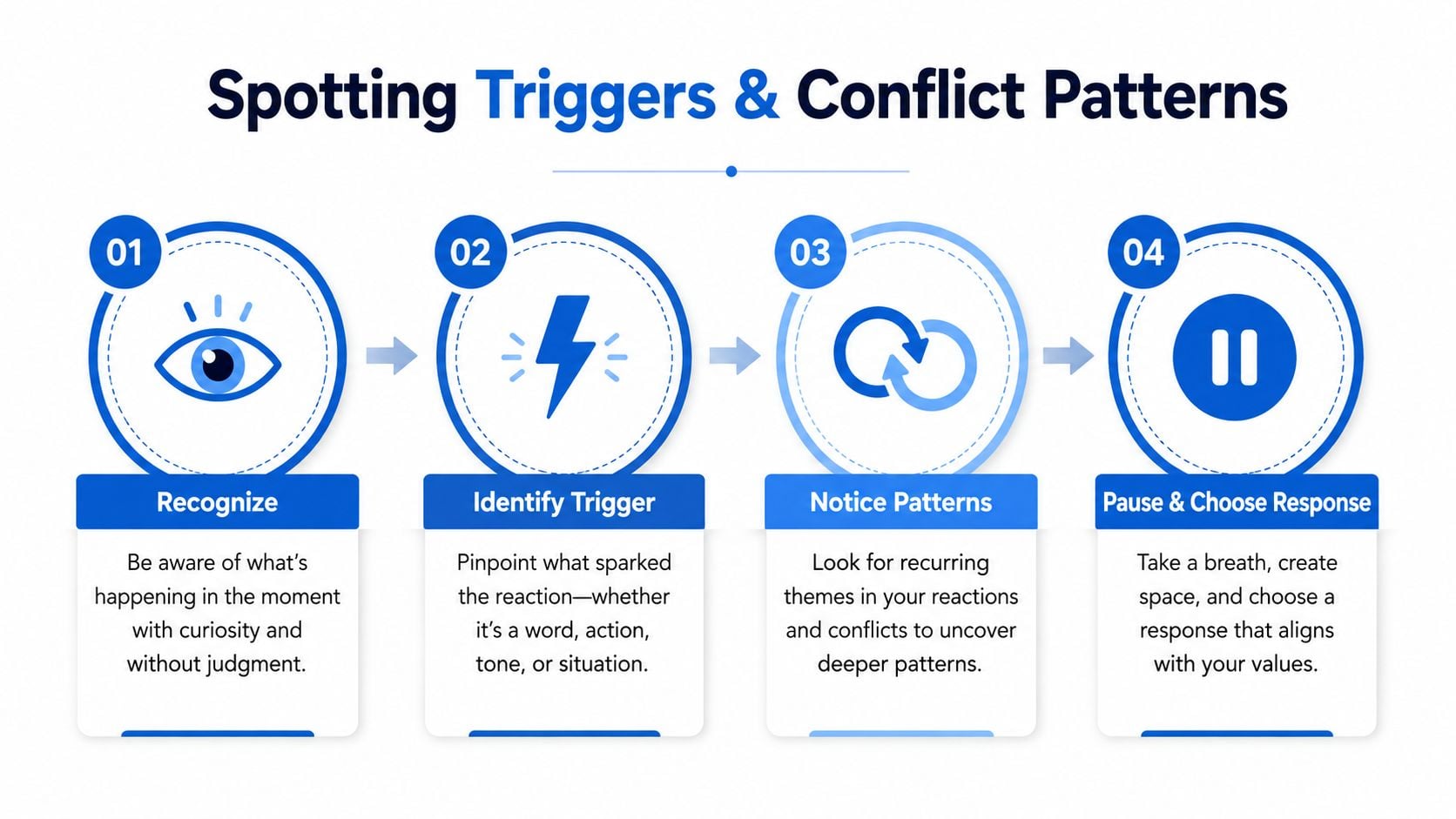
The fastest way to shrink family conflict is to notice it earlier. Most arguments don't begin at full volume, they build from a trigger that was already there, like a tone of voice, an unpaid bill, a late arrival, or one person bringing up an old grievance that never got resolved. If you can name the trigger before you react, you've already reduced the size of the fight.
Read the pattern before you react
A simple conflict log can help. Write down what happened, when it happened, who was present, and what changed right before the mood shifted. Keep it plain and factual. Over time, the repeating themes become obvious, money, parenting, household standards, loyalty, in-law pressure, or the same person feeling dismissed every time the conversation gets hard.
I often see two roles emerge. One family member chases, pushing for immediate answers. Another withdraws, goes quiet, or leaves the room. That pairing can look like one person is “too much” and the other is “impossible,” when really the household has fallen into a predictable rhythm.
Simple triage question: is this worth addressing now, later, or not at all?
That question is useful because not every disagreement deserves an immediate response. Cleveland Clinic family guidance recommends deciding whether the issue is worth addressing, staying calm, setting boundaries for the discussion, listening and compromising, and escalating to family therapy if the conflict persists (Cleveland Clinic). Minor irritations often get bigger when they're forced into a late-night confrontation.
Know when it's a one-off and when it's a pattern
A one-off problem usually has a clear start and end. A pattern keeps resurfacing with the same emotional charge. If the same issue keeps returning, ask three questions. What triggered it. What did I assume it meant. What did I do next. If those answers sound familiar every time, you're looking at a pattern, not just a bad day.
When children are in the home, trigger awareness matters even more. A calmer environment for children often starts with adults tracking what sets off conflict and changing the response sooner, which is why practical guidance on calmer environment for children can be helpful when the household keeps reacting on autopilot. The goal is simple. Fewer reactive minutes, fewer damaged conversations, and fewer scenes that children have to carry around later.
De-Escalation Techniques That Land
The first job in a tense family moment is not resolution. It is keeping the argument from causing more damage. If people are flooded, tired, hungry, or already defensive, even a fair point can land badly. The practical move is to lower the temperature before trying to solve the problem.
Start with timing and tone
Calm timing beats perfect wording. If everyone is heated, call a pause and come back later. That is not avoidance, it is strategy. Families often treat urgency like honesty, when it usually means nobody is regulated enough to listen well.
Use a neutral opening instead of a charged one. Try, “I want to talk about the grocery budget when we can both stay focused,” or, “I am not trying to fight, I want to sort out what happened this afternoon.” Those phrases lower the threat level without pretending the problem does not exist.
For more practical phrasing around relationship tension, useful expert guidance on relationship conflicts can help you shape the conversation around the issue instead of the insult. The point is to speak to the problem, not to the person's character.
If your voice is getting louder, your message is already weaker.
Make ground rules visible
Some families need a rule set as much as a conversation. No interrupting. No name-calling. No bringing in three unrelated grievances from last month. Those rules are not stiff, they are protective. They stop the discussion from becoming a pileup.
A useful script sounds like this, “I am willing to talk, but not if we start blaming each other. I will stay for ten minutes, and if we cannot keep it on today's issue, I am taking a break.” That kind of sentence does two things at once. It sets a limit and keeps the door open.
When a meeting is already high-conflict, cross-talk is the problem to solve first. A facilitator, a written note, or a turn-taking structure can help people stop talking over each other. That is especially useful when everyone feels misunderstood and nobody is hearing the other person's words.
If the same argument keeps circling back and nobody can stay regulated, the next step may be support outside the room. In families dealing with substance use or early recovery, de-escalation can mean changing the setting, shortening the exchange, or using a planned response instead of improvising while emotions are high. A calm sentence like, “I want to respond carefully, so I am going to read this instead of arguing off the cuff,” can keep a fragile conversation from tipping over. For moments that involve relapse, what to say when someone relapses gives language that is steadier than blame and more useful than silence.
Repair Behaviors That Prevent the Next Fight
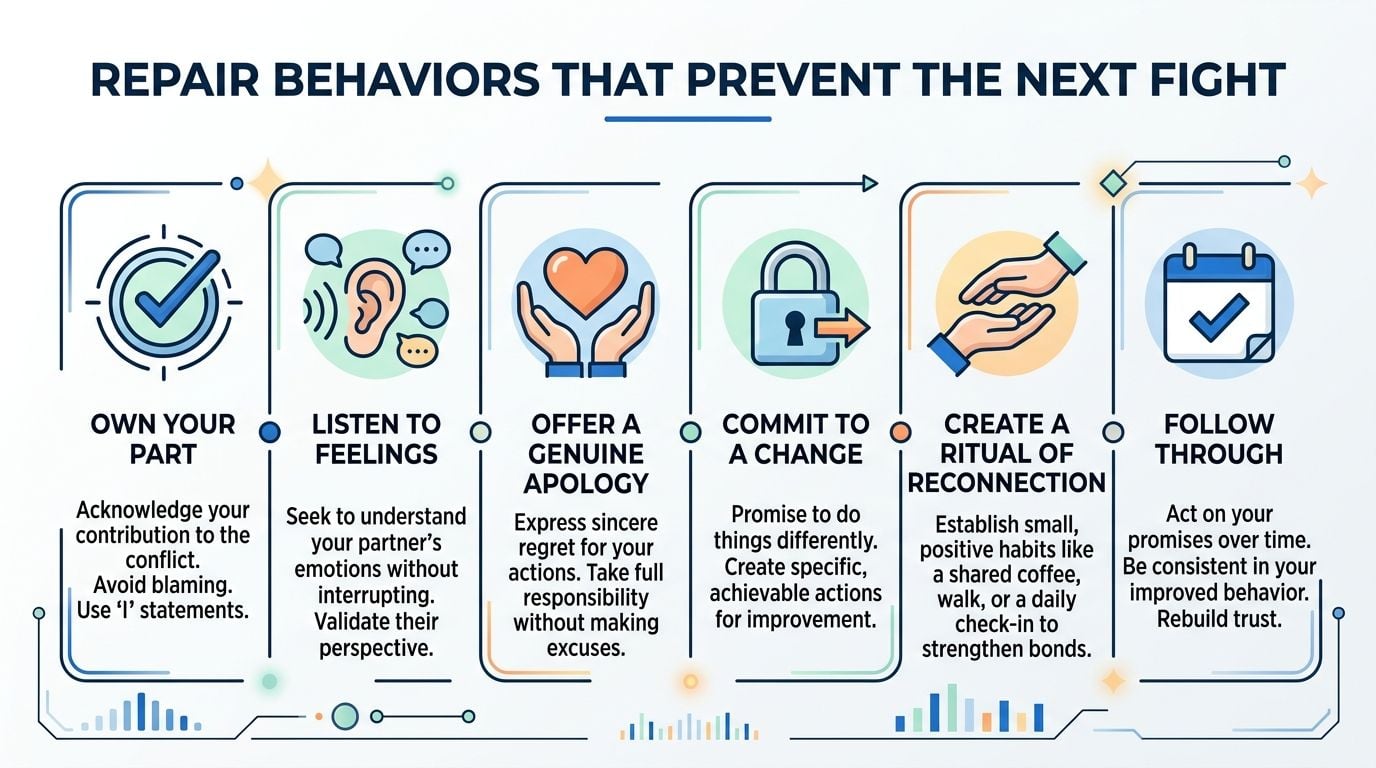
De-escalation stops the bleeding. Repair is what keeps the wound from reopening in the same place. Families don't need perfect harmony, they need a reliable way to clean up after harm so the next disagreement doesn't start with fresh resentment.
Own the harm clearly
A real apology names the specific damage. “I'm sorry you felt that way” shifts the burden back onto the other person. “I interrupted you and dismissed your point, and that was disrespectful” does the opposite. It shows that you understand what landed badly.
Genuine remorse matters, but it can't be used as a doorway to defend yourself for ten more minutes. If the other person is open to hearing a brief explanation, keep it brief. If they aren't, don't force it. Repair only works when the harmed person feels that the impact has been recognized.
Put the fix in writing when it keeps repeating
Some families argue about the same issue because the agreement was too vague to survive memory. Write down who will do what, by when, and what happens if it doesn't happen. That can be a note in a shared phone, a text thread, or a paper list on the fridge.
The point is accountability, not bureaucracy.
Repair works best when it's concrete. A vague promise calms the room for a night. A specific follow-through changes next week.
The same principle shows up in recovery conversations. When a family is dealing with relapse or early sobriety, the question isn't only what went wrong. It's what will happen differently next time, and who will be involved in that decision. A practical primer on what to say when someone relapses can help keep the response focused on safety and next steps instead of shame.
Setting and Enforcing Healthy Boundaries With Family
A boundary is clearer when it describes your action, not the other person's. “Please stop doing that” asks for change. “If that happens, I will end the call” states what you will do if the behavior continues. That difference matters because you cannot control another adult's choices, but you can control access to your time, your space, and your attention.
Say the limit in terms of your own action
Healthy family boundaries can cover conversation topics, financial help, visitors, or the time of day you are available. “I'm not discussing my marriage at dinner” is cleaner than “You need to stop prying.” “I can't lend money anymore” is clearer than a long speech about disappointment. The more direct the boundary, the easier it is to enforce, especially when emotions are already running high.
For families where codependent dynamics have blurred who is responsible for what, a practical overview of codependency in recovery can help explain why limits feel uncomfortable at first. That discomfort does not automatically mean the boundary is wrong. It often means roles are changing, and people are adjusting to a new line that used to be invisible.
Plan for the first crossing and the repeat crossing
In practice, many families test a new boundary once before they settle into it. A few keep pushing. For the first crossing, a short reminder is enough. “I said I'm not talking about that tonight. If it comes up again, I'm ending the call.” If the person crosses again, follow through without a lecture.
Repeated crossings are where contact may need to become more structured or more limited. That does not always mean no contact. It may mean shorter visits, public settings only, or communication in writing. What matters is that the boundary protects the relationship you have, not the ideal version you wish you had.
Boundaries can also bring grief. A parent may feel excluded, an adult child may feel guilty, and siblings may mourn the old family rhythm. That reaction is normal. A boundary changes the system, and systems resist change. The discomfort is part of the adjustment, not proof that you are being unkind.
If the conflict keeps cycling through the same old roles, boundaries may need to be paired with support and a plan for what happens when someone escalates again. In families dealing with substance use, that often includes clarity about safety, who to call, and whether outside help is needed. In some situations, the practical next step is not another argument, but a phone call to a treatment provider or a resource like Bada Bing Bail Bonds fast release when an arrest has put the family under immediate pressure and everyone needs to stabilize the situation before anything else can be addressed.
When Substance Use Is Part of the Conflict
Substance use changes family conflict in ways ordinary communication advice cannot fix. Trust becomes unstable, memory gets unreliable, promises get broken, and the next argument often carries fear people do not say out loud. In those homes, “just talk it through” can sound reasonable and still fail completely.
Active use changes what families can safely expect
When someone is using alcohol or drugs heavily, the family often ends up dealing with inconsistency. One day there is an apology. The next day the same event is denied. That is why one calm conversation rarely solves a drinking or drug pattern. The household needs a response grounded in the reality of the use, with less weight placed on hope that one meaningful talk will change everything.
The first days of sobriety can be rough too. Old patterns come back into view, the family is on edge, and everyone is trying to guess what comes next. Structure matters more than persuasive speeches. Medical support, clear routines, and a team that understands withdrawal, relapse risk, and family dynamics can make the difference between a shaky start and a safer one.
Choose the right level of care
Some situations can be addressed inside the household with boundaries and repair. Others call for outside help right away, especially when safety, detox, or repeated relapse is involved. In Northern California, Addiction Resource Center LLC offers medically supervised detox with medication-assisted treatment, residential rehabilitation through its partner facility, and an Intensive Outpatient Program available in person or by telehealth. Their team includes medical, nursing, counseling, and recovery support roles, which matters when conflict is tangled up with substance use.
That kind of setup gives families more than a meeting. It gives them a framework. A practical guide on how to use family therapy for addiction recovery can help families see why coordinated support beats random advice from relatives. In many cases, the better path is a team approach, with the family, the treatment provider, and the person in recovery working from the same plan instead of everyone improvising at home.
If a loved one is dealing with legal trouble around possession, families sometimes need a fast way to get the person released and into the next step. In that situation, a service like Bada Bing Bail Bonds fast release may be part of the immediate logistics while treatment planning catches up.
Involving Professional Support and Building a Family Plan
When the same conflict keeps returning, the safer next step is often outside help. Family therapy, mediation, and structured recovery support work best when the household has already tried direct repair and still cannot stop repeating the same injury. They also belong in the conversation when substance use, intimidation, or emotional safety is involved.
Bring up help without turning it into an accusation
The cleanest way to suggest support is to talk about the pattern, not the person's failure. “We keep ending up in the same fight, and I don't think we're fixing it on our own” lands better than “You need therapy.” If substance use is part of the picture, the framing can be even simpler. “We need more structure than we have right now.”
If treatment is being discussed, family involvement should be part of the plan, not an afterthought. A practical guide on how to use family therapy for addiction recovery can help families understand why coordinated support beats random advice from relatives. In many cases, better results come from a team approach, with the family, the treatment provider, and the person in recovery working from the same plan instead of everyone improvising at home.
Build a plan people can follow
A serious family plan includes a clear point of contact at the program, agreed responses to high-risk situations, and a standing check-in rhythm with a counselor or therapist. It should also name what happens after a slip, who gets informed, and what the household will do to protect stability. If insurance is part of the decision, most major plans and Tricare are commonly relevant for treatment access, so that question should be raised early with the admissions team.
The plan needs to fit real life, not an ideal version of it. If one person is always on night shift, the check-in time should reflect that. If a parent tends to back down under pressure, the written agreement should spell out who speaks first and who makes the final call when conflict spikes. A family that knows exactly what to do is less likely to improvise in the middle of a crisis.
A good program fit also shows up in the small things. Staff should explain the plan in plain language, not hide behind jargon. The family should leave knowing what comes next, who to call, and what the boundaries are if the same conflict starts rising again at home.
A workable checklist for the next conversation
- Name the pattern. Say what keeps repeating without listing every old grievance.
- Pick the goal. Decide whether you want repair, firmer boundaries, or a safer contact plan.
- Choose the setting. Use calm timing, limited attendees, and a clear agenda.
- Write the agreement. Put the next steps somewhere everyone can see.
- Bring in help when needed. Use therapy, mediation, or treatment when the household cannot stabilize on its own.