A lot of people answer this question too quickly. They say, “That's just what happens when someone drinks too much.” That answer is simple, memorable, and often wrong. If you're asking why do alcoholics have red noses, you may be worried about your own health, wondering about someone you love, or trying to make sense …

A lot of people answer this question too quickly. They say, “That's just what happens when someone drinks too much.” That answer is simple, memorable, and often wrong.
If you're asking why do alcoholics have red noses, you may be worried about your own health, wondering about someone you love, or trying to make sense of a physical change that feels loaded with shame. The most helpful place to start is this: a red nose can happen for several reasons, and the old stereotype about an “alcoholic nose” mixes up a medical skin condition with the effects of alcohol.
That distinction matters. When people assume every red or enlarged nose is proof of alcoholism, they miss what may be going on: temporary flushing, rosacea, long-term skin irritation, or broader health problems that deserve care instead of judgment.
Table of Contents
- The Truth About Alcohol and Facial Redness
- Debunking the Myth of the Alcoholic Nose
- How Alcohol Triggers Facial Redness
- When a Red Nose Signals Deeper Health Issues
- What to Do If You Are Concerned
- Find Compassionate Addiction Help in Northern California
The Truth About Alcohol and Facial Redness
Alcohol can absolutely make the face look red. Many people notice warmth, blotchiness, or a flushed nose soon after drinking. That part is real.
What often gets confused is what kind of redness a person has. A temporary flushed face after alcohol is not the same thing as a permanently red, swollen, or thickened nose. One may come and go within hours. The other may point to a skin condition or another health issue that needs a clinician's attention.
That's where people get tripped up. They see a visible change and jump straight to a moral conclusion. Medicine asks a different question: what process in the body is causing the redness?
A red nose can mean different things
A red nose may reflect:
- Temporary flushing after alcohol, heat, or emotional stress
- Sensitive skin or rosacea, where the face reacts easily and stays red longer
- Visible small blood vessels that become easier to see over time
- Inflammation that makes the skin look irritated or swollen
- General health strain related to heavy drinking, poor nutrition, or other medical problems
Some of these causes are mild and manageable. Some need prompt care.
Practical rule: Don't use the appearance of a nose to diagnose alcoholism. Use it as a reason to ask better medical questions.
The emotional side matters too. A person with facial redness may already feel embarrassed, defensive, or judged. If you're talking to a family member, the most helpful tone is calm and specific: “I've noticed your skin seems redder lately. Have you had that checked?” That goes much farther than labels or accusations.
Debunking the Myth of the Alcoholic Nose
The phrase “alcoholic nose” has been around for a long time, but it isn't a medically accurate diagnosis. The correct medical term is rhinophyma, and modern medical discussion describes it as a severe form of rosacea, not a direct consequence of drinking alcohol, according to the National Rosacea Society review on rhinophyma and alcohol intake.
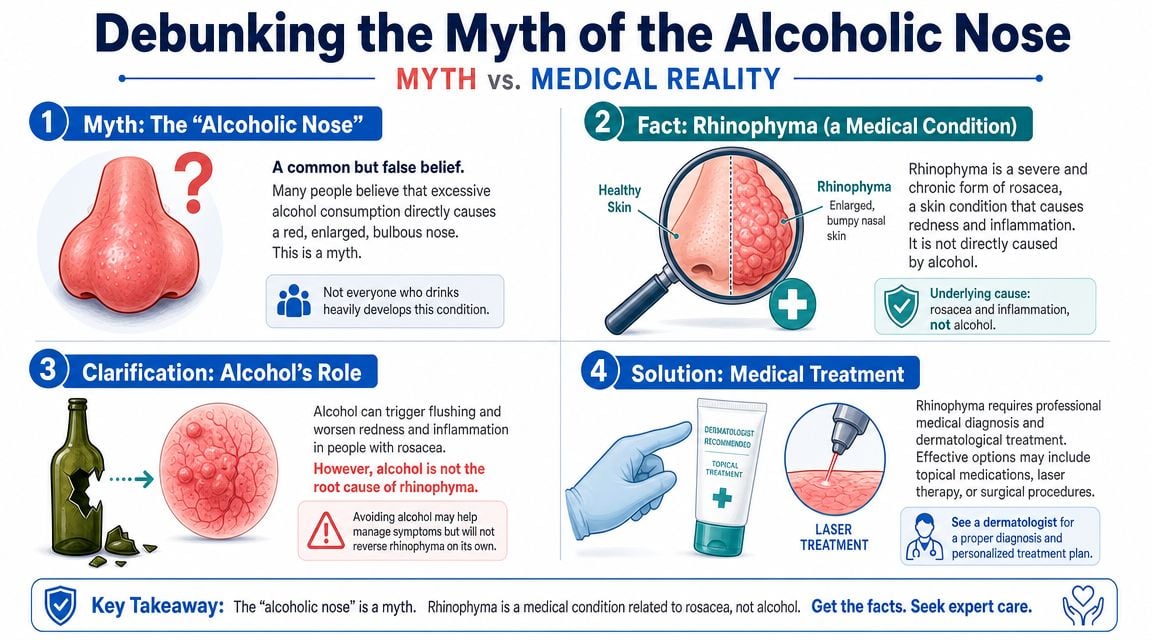
People often assume cause when they're really seeing association. Someone who drinks heavily may flush more often. A person with rosacea may also look redder after alcohol. But that doesn't mean alcohol created rhinophyma in the first place.
What rhinophyma actually is
Rhinophyma is a benign dermatologic condition tied to rosacea. In plain language, it involves skin on the nose becoming thicker, bumpier, and more enlarged over time. That's different from ordinary blushing or the brief redness some people get after a drink.
This is why the old stereotype is so damaging. It takes a medical condition and turns it into a public accusation.
A red, bulbous nose is not reliable proof that someone drinks heavily. It may reflect a skin disease that deserves treatment, privacy, and compassion.
Here's a simple comparison:
| Common belief | Medical reality |
|---|---|
| Alcohol directly causes a bulbous “drinker's nose” | Rhinophyma is linked to rosacea |
| A red nose always signals alcoholism | Redness can have several causes |
| Stopping alcohol alone will reverse severe nose changes | In severe rhinophyma, surgical intervention is the way physical deformity can be reversed, as described in the earlier rosacea review |
For readers who want a short visual explanation, this video gives a helpful overview before a medical visit:
Why this myth sticks around
The myth survives because it fits what people think they're seeing. Alcohol can make the face red in the short term. Rosacea can make redness worse over time. When those two overlap, people draw the wrong conclusion.
The better conclusion is more humane and more accurate. If a nose is persistently red, enlarged, or changing shape, think medical evaluation, not nickname.
How Alcohol Triggers Facial Redness
Alcohol affects the face in ways that are easier to understand when you separate short-term reactions from longer-lasting skin changes. Those are not the same process.
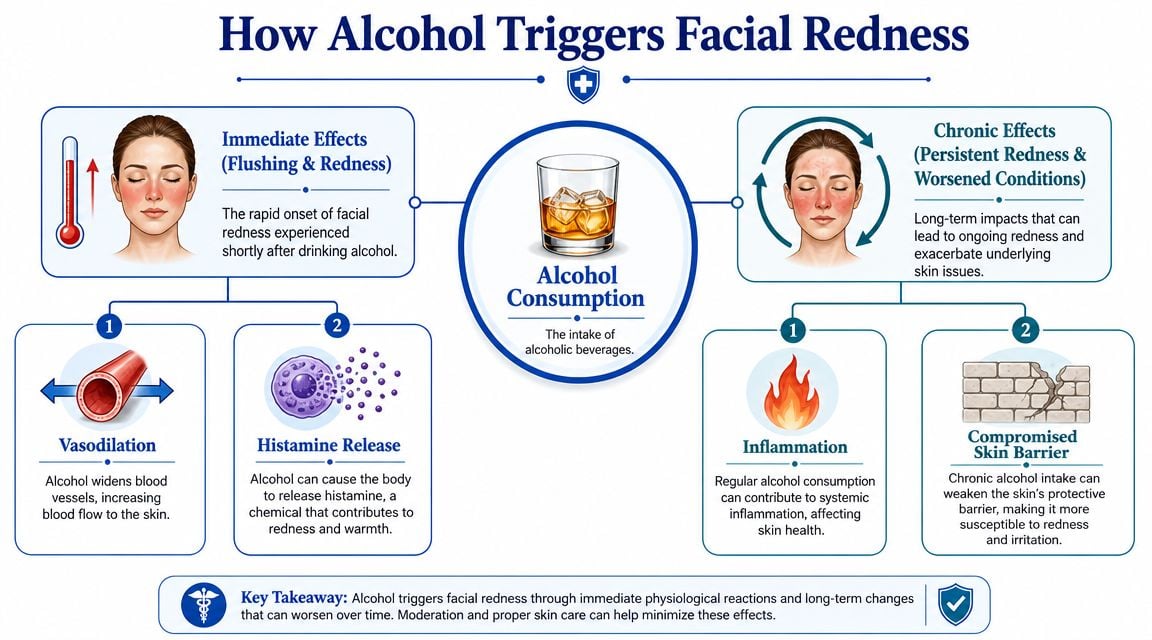
Immediate effects and why flushing happens
The fastest reason alcohol makes the nose and cheeks look red is vasodilation. That means blood vessels widen. When that happens near the skin, more blood moves through the area, and the face looks warmer and redder.
A simple way to picture it is traffic. If a road suddenly opens more lanes, more cars can pass through at once. With alcohol, widened blood vessels let more blood flow near the surface of the skin. The result is visible flushing.
For some people, that redness fades after the alcohol wears off. For others, especially those with sensitive skin, it lasts longer and happens more intensely.
A few features can make this response more noticeable:
- Existing rosacea makes the skin react more strongly
- Heat and spicy food can add to the same flushed look
- Stress can stack on top of alcohol's effects
- Repeated drinking episodes can make redness feel like a recurring pattern
That's one reason family members get confused. They don't just see someone turn red once. They see it happen again and again, and they start to assume the skin change itself proves addiction. It doesn't. It proves the face is reacting.
Longer-term changes in the skin
When flushing happens often, the skin may stop fully returning to baseline. Some people begin to develop more persistent redness, and tiny surface blood vessels may become easier to notice.
This is especially important in people who already deal with rosacea. Alcohol doesn't need to be the root cause to still be a meaningful trigger. If you want a practical overview of day-to-day management, this 2026 rosacea expert plan walks through common ways people try to reduce redness and protect reactive skin.
A few longer-term issues may show up together:
- Ongoing background redness that no longer fades easily
- More frequent flare-ups after drinking
- Skin irritation from repeated inflammation
- Visible small vessels that give the nose or cheeks a consistently red look
The key question isn't “Does alcohol make people red?” It often can. The key question is whether the redness is temporary, part of rosacea, or a sign that the body is under broader stress.
People also often use the same phrase for very different appearances. One person has a brief flushed nose after wine. Another has chronic redness with visible vessels. Another has thickened nasal skin that needs dermatologic care. Those shouldn't all be lumped into one stereotype.
If you're wondering why do alcoholics have red noses, the most accurate answer is usually this: alcohol can trigger flushing and worsen existing redness, but the visible result depends on the person's skin, their underlying conditions, and how long the irritation has been happening.
When a Red Nose Signals Deeper Health Issues
Sometimes the skin is only part of the story. A red nose may be a cosmetic concern, but in some people it can also appear alongside the broader physical effects of chronic heavy drinking.
That doesn't mean every red nose points to organ damage. It means visible facial changes shouldn't distract from a bigger health check, especially if they appear with fatigue, memory problems, poor appetite, easy bruising, shakiness, or major changes in mood and daily functioning.
The skin can reflect whole-body stress
Heavy alcohol use can strain many systems at once. When that happens, the skin often stops looking calm and resilient. People may notice more redness, irritation, dryness, or a generally unhealthy appearance.
A family member's instinct can be useful if it stays compassionate. Instead of focusing only on the nose, pay attention to the whole picture. Is the person sleeping poorly? Eating less? Losing interest in normal routines? Looking physically run down?
Those patterns matter more than any old stereotype.
Nutrition problems can show up on the face
Long-term alcohol misuse can interfere with nutrition. When the body doesn't get or absorb what it needs, the skin may become more reactive and slower to recover. That can make redness and irritation look worse.
Nutritional injury can also affect the brain. If you're concerned that a loved one has serious alcohol-related memory or confusion problems, this explanation of Massachusetts alcohol treatment and wet brain gives a useful overview of why prolonged alcohol misuse can become medically urgent.
A few warning signs deserve prompt medical attention:
- Confusion or severe forgetfulness
- Poor balance or unsteady walking
- Very limited food intake
- Persistent vomiting
- Sudden worsening in appearance or functioning
Don't let a visible symptom become the whole conversation. Sometimes a “red nose” question is really a question about whether someone's health is slipping overall.
If you're worried, start with a doctor, not a debate. A clinician can look at the skin, review alcohol use, check for other medical causes, and help sort out what needs attention first.
What to Do If You Are Concerned
If you're worried about yourself or someone close to you, take a two-track approach. Look at the skin issue and the alcohol issue separately, even if they may be connected.
That helps because people often make one of two mistakes. They either obsess over the nose and ignore the drinking, or they focus only on alcohol and never get the skin properly diagnosed.

Start with a medical evaluation
A primary care doctor or dermatologist can help identify whether the redness looks more like flushing, rosacea, visible vessels, irritation, or another condition. That matters because each problem has a different path forward.
Bring concrete observations to the appointment:
- When it happens after drinking, stress, heat, or certain foods
- How long it lasts
- Whether the skin is changing shape or texture
- What else is happening such as burning, dryness, swelling, or breakouts
That kind of detail is more useful than saying, “It looks like an alcoholic nose.”
Look honestly at alcohol use without shame
If drinking has become frequent, hard to control, or tied to conflict, poor sleep, anxiety, or secrecy, it's worth addressing directly. Seeking help for alcohol use is not an admission of weakness. It's a health decision.
Sometimes the alcohol itself is being used to cope with something deeper. Anxiety, family tension, grief, and relationship stress often travel with problem drinking. For people who need support around those patterns, Therapy for anxiety and relationships can be one example of the kind of counseling support that helps people work on the issues around alcohol, not just the substance itself.
A calm first conversation can sound like this:
- Name what you've noticed. “I've seen more redness in your face, and I'm worried about your health.”
- Stay away from labels. Avoid words that corner the person.
- Ask about support. “Would you be open to seeing a doctor or talking with someone?”
- Focus on care, not blame. That keeps the door open.
“I'm not trying to judge you. I want to help you figure out what's going on.”
That sentence often lowers the temperature of the conversation right away.
Find Compassionate Addiction Help in Northern California
When people ask why do alcoholics have red noses, they're often asking a much bigger question underneath it. They're asking whether a visible change means someone is unwell, whether alcohol is involved, and whether anything can still be done.
The answer is yes. A red nose is not a character flaw. It's a reason to slow down, look carefully, and respond with medical accuracy and respect.

For adults and families in Yuba City and across Northern California, getting help is often easier when one place can guide the next steps. Some people need medically supervised detox with medication-assisted treatment. Others need a structured outpatient program that fits around work or family life. Some need residential care and a calmer setting to stabilize.
The right plan depends on the person, not on a stereotype.
Here's what often helps people take the first step:
- Privacy matters. Many people delay treatment because they fear embarrassment.
- A clear intake process helps. Knowing who to call and what happens next reduces panic.
- Flexible levels of care matter. Not everyone needs the same setting or schedule.
- Support for co-occurring mental health needs matters. Alcohol problems rarely exist in isolation.
If you're in Northern California, it also helps to know the practical details ahead of time. Addiction Resource Center LLC is based at 1002 Live Oak Blvd., Suite A, Yuba City, CA. The program offers a full continuum of care that includes medically supervised detox with MAT, residential rehabilitation through Ona Treatment Center in Browns Valley, and an Intensive Outpatient Program available in person and via telehealth. Care is provided by a multidisciplinary team that includes a medical doctor, registered nurse, CADC counselors, an LMFT, and recovery mentors, with 24/7 wellness monitoring, individualized planning, and support for adults 18+. The center accepts most major insurance plans and welcomes TRICARE beneficiaries. Families can call or text 24/7 at 530-625-7910 to ask questions, schedule a tour, or get guidance.
The most important step is often the simplest one. Stop treating the red nose as the whole story. Start treating the person.
If you or someone you love needs judgment-free help, Addiction Resource Center LLC offers compassionate alcohol and drug treatment in Yuba City, including detox support, MAT, residential referrals, and in-person or telehealth IOP. You can reach their team anytime at 530-625-7910 for private guidance on what to do next.