Genetics account for about 50% of the risk for alcohol or drug dependence, which means addiction can run in families. But the other half of risk comes from environment, stress, trauma, exposure, and choices, so a family history raises risk without deciding your future. That distinction matters. Many families ask, “Does addiction run in the …

Genetics account for about 50% of the risk for alcohol or drug dependence, which means addiction can run in families. But the other half of risk comes from environment, stress, trauma, exposure, and choices, so a family history raises risk without deciding your future.
That distinction matters. Many families ask, “Does addiction run in the family?” and stop at the scary part. They hear that risk is inherited, assume the story is already written, and feel either ashamed or helpless.
A better way to look at it is this: family history is information. It's a warning light, not a sentence. If addiction has shown up in your parents, siblings, grandparents, or close relatives, that history gives you a chance to act earlier, talk more openly, and build stronger protection for yourself or your children.
Most articles explain the genetics, then leave you there. What families usually need is a practical plan. They need help spotting patterns, knowing what to say, understanding what effectively lowers risk, and figuring out what to do if someone is already struggling.
Table of Contents
- Understanding Addiction in Your Family Tree
- The Science of Heredity and Addiction Risk
- Beyond Genes The Power of Your Environment
- How to Recognize Intergenerational Risk Factors
- A Practical Guide for Concerned Loved Ones
- Finding a Path Forward in Northern California
- Your Family History Is Not Your Destiny
Understanding Addiction in Your Family Tree
When people wonder whether addiction runs in the family, they're usually asking two questions at once. First, “Am I at risk?” Second, “Is there anything I can do about it?” The answer to both is yes.
A family history of substance problems matters because it can point to inherited vulnerability, learned coping habits, and repeated exposure in the home. A child may inherit traits that affect reward, stress response, or impulse control. That same child may also grow up watching adults use alcohol or drugs to celebrate, numb pain, manage anger, or avoid hard conversations.
That combination is why this topic feels so personal. It's not just about DNA. It's about the atmosphere a person grows up in, the stories a family tells itself, and the ways stress gets handled from one generation to the next.
Practical rule: Treat family history as a reason to pay attention earlier, not a reason to panic.
Families often get stuck in one of two extremes. They either minimize the problem by saying, “Everyone in our family drinks like this,” or they become so fearful that they avoid the topic completely. Neither response helps.
A steadier response looks like this:
- Name the pattern: Be honest if substance use, secrecy, or untreated mental health issues have shown up across generations.
- Separate risk from fate: A raised risk is real. A guaranteed outcome is not.
- Focus on next steps: Early conversations, clear boundaries, mental health support, and healthy coping skills can change the path.
If you've been carrying quiet worry about your family tree, you're not overreacting. You're noticing something important. That awareness can become one of the strongest protective factors in your home.
The Science of Heredity and Addiction Risk
Addiction doesn't pass down in the simple way people sometimes imagine. There isn't one switch that gets flipped on and guarantees a person will struggle. Heredity works more like a recipe.
Some people inherit a recipe that includes stronger sensitivity to reward, more impulsive decision-making, or a harder time calming stress. That recipe can increase vulnerability. But what gets “cooked” still depends on the ingredients life adds.
What heritable risk actually means
Research summarized by Orlando Recovery notes that genetics account for about 50% of the risk for alcohol or drug dependence, and broader findings commonly place heritability in the 40% to 60% range depending on the substance and study design. The same source reports that first-degree relatives are 4 to 8 times more likely to develop addiction problems, which is why family history matters so much in screening and prevention (family addiction risk statistics).
That can sound overwhelming, so it helps to compare it to another health issue. A family history of heart disease raises concern, but it doesn't guarantee a heart attack. Doctors take the history seriously because it changes how early they screen, what habits they encourage, and how closely they watch for warning signs. Addiction risk works in a similar way.
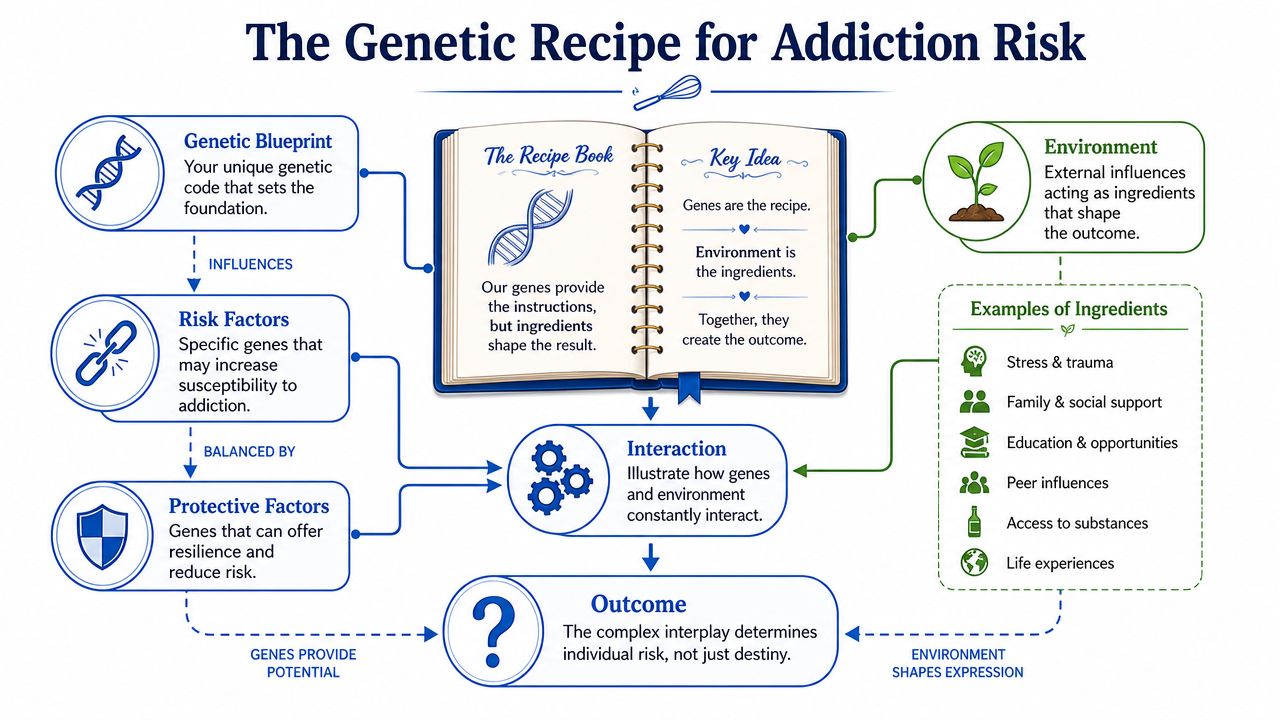
Inherited risk also doesn't mean someone “has the addiction gene.” It's more accurate to think in terms of a mix of inherited traits. One person may be especially reactive to stress. Another may feel pleasure from substances more intensely. Someone else may struggle with self-control during emotional overwhelm.
Why family patterns matter
This is why two siblings from the same home can have different outcomes. They may share family history, but not the exact same traits, experiences, relationships, or stress load.
It also helps explain why families often notice certain repeating themes:
| Family pattern | Why it matters |
|---|---|
| Substance use in multiple generations | It can reflect both inherited vulnerability and learned behavior |
| Early heavy use in relatives | It may signal a family pattern of risk-taking or poor coping |
| Mental health struggles alongside use | Anxiety, depression, and trauma can intensify vulnerability |
| Denial about “normal” drinking or drug use | It lowers the chance of early intervention |
If alcoholism is part of your family story, it can help to read more specific insights on familial alcoholism from Reflections, especially if you're trying to understand why one branch of the family seems repeatedly affected.
Family history is most useful when it changes behavior early. It's less about predicting who will struggle and more about identifying who needs stronger protection.
Beyond Genes The Power of Your Environment
Genes may load the gun, but environment often pulls the trigger. That phrase stays with people because it captures something important. Risk grows in context.
Twin, adoption, and family studies suggest that roughly 40% to 60% of susceptibility to substance use disorders is heritable, while environment, stress, and trauma explain the rest. Orlando Recovery's summary puts it plainly: inherited biology explains about half of the variance, and the surrounding conditions do the rest of the shaping (heredity and environment in substance use disorders).
How home life shapes risk
A home doesn't need obvious chaos to increase risk. Sometimes the pattern is subtle. A child grows up seeing adults pour a drink after every hard day. Nobody talks about feelings directly. Conflict gets buried. Help is viewed as weakness. Medication gets misused privately. Stress is handled by escaping it.
Those lessons stick.
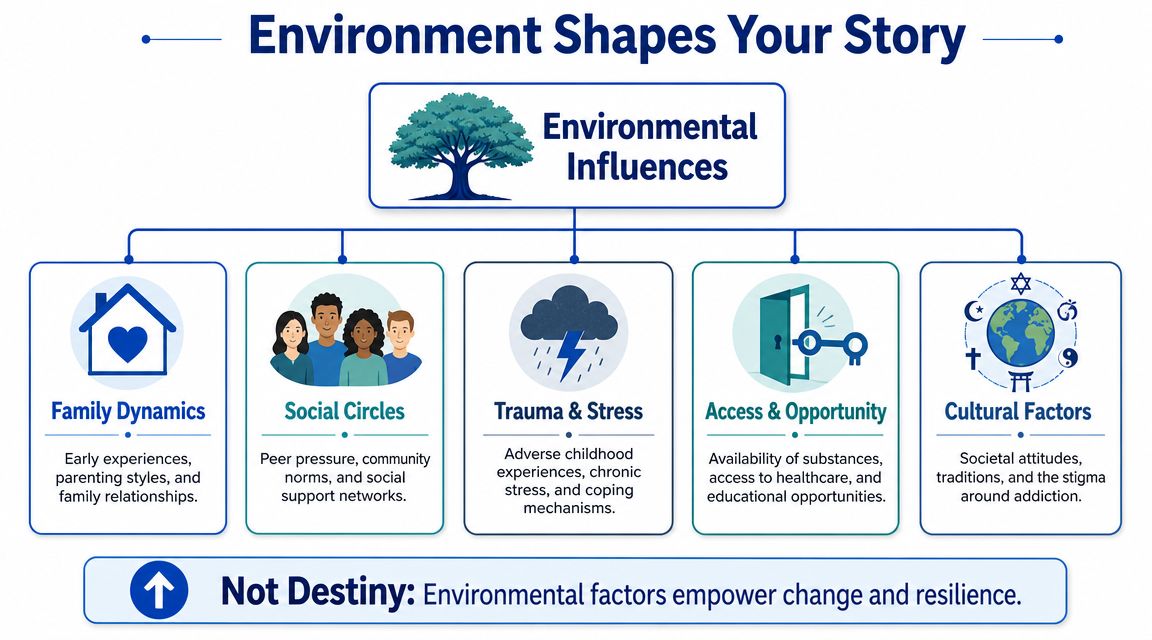
Other environmental factors can increase vulnerability too:
- Trauma and chronic stress: People often reach for substances when they don't have safer ways to regulate pain or fear.
- Easy access: If alcohol, pills, or other substances are readily available, early experimentation becomes more likely.
- Peer and community norms: If heavy use is treated as funny, expected, or harmless, people often miss the line where danger begins.
- Untreated anxiety or depression: Substances can become a fast, unreliable form of self-medication.
Mental health conditions can also run in families and interact with substance risk. If you're trying to understand how inherited biology and brain processes can shape vulnerability in another area, this overview of social phobia genetics and neurobiology offers a useful comparison.
What families can change
You can't rewrite your genes, but families can change the environment around them. That's the hopeful part.
Here are examples of protective shifts:
- Replace silence with direct conversation: Children do better when adults name family risk calmly and openly.
- Teach coping on purpose: Stress management, emotional regulation, sleep, structure, and support matter.
- Make help normal: Therapy, counseling, and support groups should feel available, not shameful.
- Watch substance messages: Notice whether your home treats alcohol or drugs as a reward, a joke, or a rescue.
The home doesn't have to be perfect to become safer. It just has to become more honest.
How to Recognize Intergenerational Risk Factors
Concerns often arise if a parent or sibling is actively misusing drugs or alcohol. The harder part is noticing the quieter family habits that keep risk alive even when nobody talks about addiction directly.
Patterns that often get overlooked
One common pattern is secrecy. A family may hide drinking, minimize pill misuse, or avoid discussing a relative's history. Children learn that certain truths aren't safe to say out loud.
Another pattern is using substances as the family coping style. Every celebration includes heavy drinking. Every grief event does too. Stress, boredom, conflict, and loneliness all point back to the same answer.
A third pattern is enabling wrapped in love. A parent keeps paying rent after repeated relapses. A spouse calls an employer with excuses. A sibling gives cash while insisting it's just temporary help. The intention is care, but the effect can be to protect the addiction from consequences.
You may also see a family history of untreated anxiety, depression, trauma, anger, or emotional shutdown. The substance problem gets the attention, but the pain underneath it keeps moving through the family.
What this can look like in real life
Consider a family where no one says the word “addiction.” Grandpa drank heavily. Mom says he was just “old-school.” Dad uses prescription medication in a way that worries everyone, but the family calls him high-strung and overworked. Their teenager starts vaping, drinking at parties, and joking that addiction “just runs in our blood anyway.”
That family is carrying several risk signals at once:
- Denial has become normal
- Substances are treated as ordinary coping tools
- Mental health isn't addressed directly
- The younger generation has already absorbed a fatalistic story
Here's another version. A woman grows up with a parent in recovery. The home is stable now, but fear still controls everything. Nobody drinks. Nobody talks about why. The children know there's a history, but not what it means. One of them later struggles in college and hides it because asking for help feels dangerous.
Both families need the same thing. Not more shame. More language.
A few questions can reveal a lot:
| Question | What it can uncover |
|---|---|
| How does this family handle stress? | Whether coping is healthy, avoidant, or substance-centered |
| What topics feel forbidden? | Secrecy, fear, denial |
| Who gets rescued repeatedly? | Enabling dynamics |
| How are emotions expressed? | Whether pain gets processed or buried |
If these patterns sound familiar, don't rush to label everyone. Start by observing clearly. Intergenerational risk often shows up in habits before it shows up in diagnoses.
A Practical Guide for Concerned Loved Ones
Knowing that addiction may run in your family is only useful if it changes what you do next. A practical response starts early, stays calm, and avoids both extremes of denial and panic.
Families often need three things most: better prevention, healthier boundaries, and a clear plan for intervention.
Start prevention earlier than feels necessary
Hackensack Meridian Health makes an important point that many resources miss. Family history should be a prompt for earlier conversations about mental health, trauma, and coping skills, not a prediction of inevitable addiction (using family history for prevention).
That means prevention is not just “don't use drugs.” It's broader and more practical.
- Talk plainly: “Addiction has affected people in our family, so we take stress, mental health, and substance use seriously.”
- Teach emotional vocabulary: Children and teens need words for anger, shame, panic, grief, loneliness, and pressure.
- Practice coping before crisis: Breathing skills, exercise, routines, sleep habits, and reaching out for support should be normal parts of family life.
- Name early warning signs: Sudden isolation, secrecy, mood swings, slipping responsibilities, and using substances to cope all deserve attention.
A short, honest conversation is often more effective than one dramatic lecture.
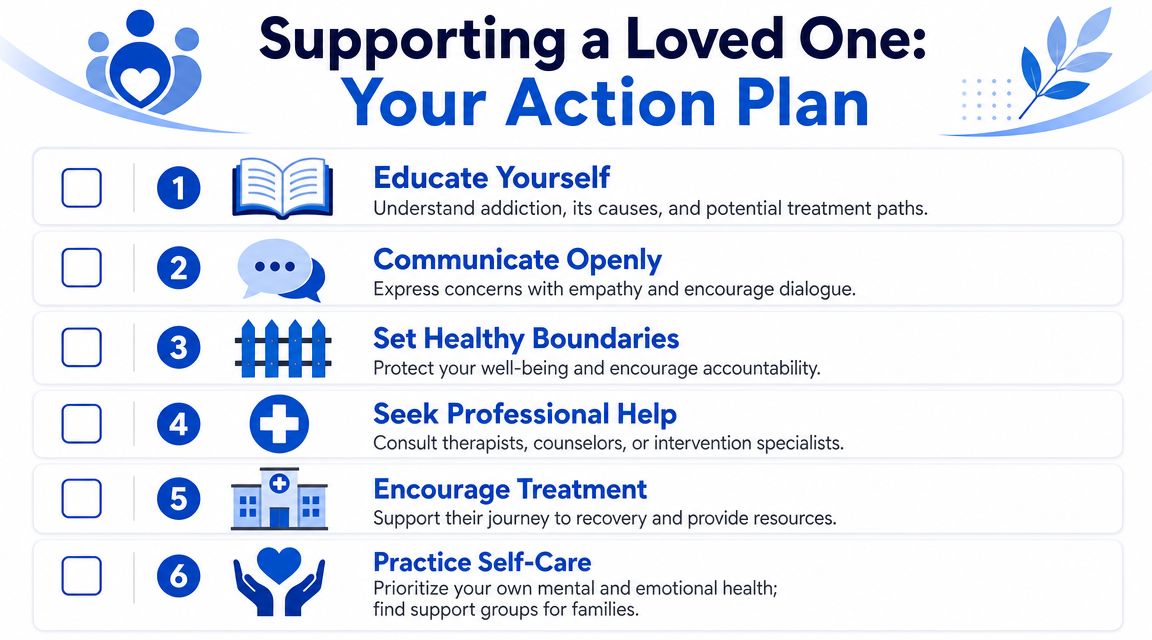
Here's a useful visual checklist for families trying to respond well.
Set boundaries that protect everyone
Boundaries aren't punishments. They're limits that stop one person's addiction from reorganizing the whole family.
“I care about you, and I won't help in ways that make the problem easier to continue.”
That can mean refusing to provide money, declining to lie for someone, or requiring respectful behavior in the home. It can also mean protecting your own sleep, finances, parenting, and mental health.
If your family struggles with conflict, triangling, or mixed messages, this guide to understanding family therapy can help you see how structured support improves communication and reduces blame.
Know when to move from concern to action
Families often wait too long because they want certainty. They want proof that the problem is serious enough. But action doesn't require a perfect label.
Move toward help when you notice patterns like these:
- The person keeps using despite obvious harm.
- Promises to cut back don't hold.
- Mood, work, school, health, or relationships are slipping.
- The family is spending more energy managing the situation than living normal life.
A helpful next step may be a therapist, counselor, physician, addiction professional, or family meeting guided by a clinician. Sometimes the most loving action is a direct one.
A brief educational video can also help families start that conversation from a calmer place.
Finding a Path Forward in Northern California
For families in Yuba City and nearby communities, one of the biggest barriers is not caring enough. It's knowing where to start. People hear terms like detox, MAT, residential treatment, outpatient care, and telehealth, then freeze because the system sounds more complicated than it needs to be.
A good local treatment path should make those options easier to understand, not harder.

What treatment can include
Medically supervised detox helps people withdraw more safely and with support, especially when stopping suddenly could be physically or emotionally intense.
Medication-assisted treatment (MAT) can be part of care when cravings, withdrawal, or relapse risk need structured medical support. For many families, MAT reduces chaos and creates enough stability for therapy and daily functioning to improve.
Residential rehabilitation gives someone a live-in setting away from triggers when home isn't stable enough for early recovery. In this publisher's care model, residential rehab is available through Ona Treatment Center in Browns Valley.
Intensive Outpatient Program (IOP) works for people who need frequent treatment while still living at home. That can be especially useful for adults balancing work, parenting, transportation issues, or privacy concerns. Telehealth options can make care more reachable for people across Northern California.
What families often need from local care
Families usually don't just need a program. They need a continuum. One person may begin with detox, step into residential support, then continue with IOP and aftercare. Another may not need inpatient care but still needs counseling, relapse prevention, accountability, and support for co-occurring mental health needs.
The publisher, Addiction Resource Center LLC, describes a care team that includes medical, counseling, and recovery support roles. That matters because addiction rarely affects only one part of a person's life. People often need help with cravings, routines, relationships, mental health, and long-term planning at the same time.
For many households, a practical treatment option also needs to be private, welcoming, and straightforward to access. Insurance acceptance, telehealth availability, family support, and experience working with TRICARE beneficiaries can make the difference between delaying help and starting it.
Your Family History Is Not Your Destiny
If addiction has touched your family, your concern makes sense. Family history can raise risk, shape coping habits, and influence how people respond to stress. But none of that means the outcome is fixed.
The most important shift is this one: stop treating family history like a verdict and start treating it like a guide. It tells you where to watch closely, where to talk sooner, and where to build stronger support. That knowledge can interrupt patterns that might otherwise stay hidden for years.
People break cycles when they replace secrecy with honesty, chaos with structure, and shame with support. Parents do it. Adult children do it. Couples do it. Entire families do it.
If you're worried about yourself or someone you love, don't wait for the situation to become undeniable before reaching out for guidance.
If you're in Yuba City or anywhere in Northern California and need clear next steps, Addiction Resource Center LLC offers compassionate support for substance use and co-occurring mental health needs, including medically supervised detox with MAT, residential rehab through Ona Treatment Center, and in-person or telehealth IOP. Their team works with adults, families, insured patients, and TRICARE beneficiaries, and they offer a 24/7 phone and text line at 530-625-7910 for confidential, no-obligation help.