You're probably here because someone said, “We need rehab,” and then the search results made everything worse. One listing looks like a hospital for stroke recovery. Another is a nursing facility for older adults after surgery. Another sounds like addiction treatment. They all use the word rehab. That's the problem. In Modesto, one search can …

You're probably here because someone said, “We need rehab,” and then the search results made everything worse.
One listing looks like a hospital for stroke recovery. Another is a nursing facility for older adults after surgery. Another sounds like addiction treatment. They all use the word rehab. That's the problem. In Modesto, one search can pull up three completely different kinds of care, and if you're stressed, tired, or scared, that mix is more than annoying. It can send you in the wrong direction.
Families lose time this way. A spouse searching late at night for alcohol treatment ends up reading about physical therapy. An adult child trying to help a parent after a fall lands on a substance use page that has nothing to do with skilled nursing. A person finally ready to get help for opioids or meth gets overwhelmed and gives up because nothing seems clear.
You need clarity, not more marketing copy. If you searched for rehabilitation center Modesto CA, the first job is figuring out what kind of rehab you need. Once that part is clear, the next step gets much easier.
Table of Contents
- Your Search for Hope in Modesto Starts Here
- Not All Modesto Rehab Centers Are the Same
- Understanding Your Treatment Options for Addiction
- How to Choose the Right Addiction Program for You
- Making the Call The Admission Process Explained
- How Family Support Enhances Recovery
- Your Path to Healing Starts with One Step
Your Search for Hope in Modesto Starts Here
A lot of people searching for a rehabilitation center in Modesto aren't calm and organized. They're searching in the middle of a crisis. Someone relapsed. Someone got discharged from the hospital. Someone finally admitted they need help. Emotions are high, sleep is low, and every website seems to assume you already know the system.
Most families don't.
That's why the phrase rehabilitation center Modesto CA causes so much confusion. It sounds simple, but it isn't. In practice, that search can lead you to addiction treatment, an inpatient rehabilitation hospital for intensive physical recovery, or a skilled nursing facility for longer medical and rehab support. Those are not interchangeable options.
You don't need the “best rehab” in the abstract. You need the right category of care for the problem in front of you.
If the issue is alcohol, opioids, meth, prescription misuse, or co-occurring mental health struggles, you should ignore most of the post-surgical and elder-care listings that dominate local results. If the issue is stroke recovery, mobility after an injury, or recovery after hospitalization, addiction treatment isn't the right lane.
Why people get stuck
Families usually hit one of these roadblocks first:
- The terminology is too broad. “Rehab” can mean addiction care, physical recovery, or skilled nursing.
- The listings are too polished. Many pages look helpful but don't clearly state who they treat.
- The urgency clouds judgment. When you're scared, it's easy to call the first place with a nice website.
The good news is that this confusion is fixable. Once you separate the types of care, the decision gets more practical. You can ask the right questions, stop wasting time, and move toward help that fits.
Not All Modesto Rehab Centers Are the Same
The biggest mistake I see is simple. People assume every “rehab center” does roughly the same thing. That's false. In Modesto, the same search term regularly pulls together facilities that treat completely different needs.
Why the search results feel misleading
A local example makes the problem obvious. Encompass Health's Modesto location is an inpatient rehabilitation hospital with 50 licensed beds, built for intensive therapy after injury. That's a very different setting from facilities like Modesto Post Acute Center, which are skilled nursing centers. Neither of those is the same as substance use treatment.
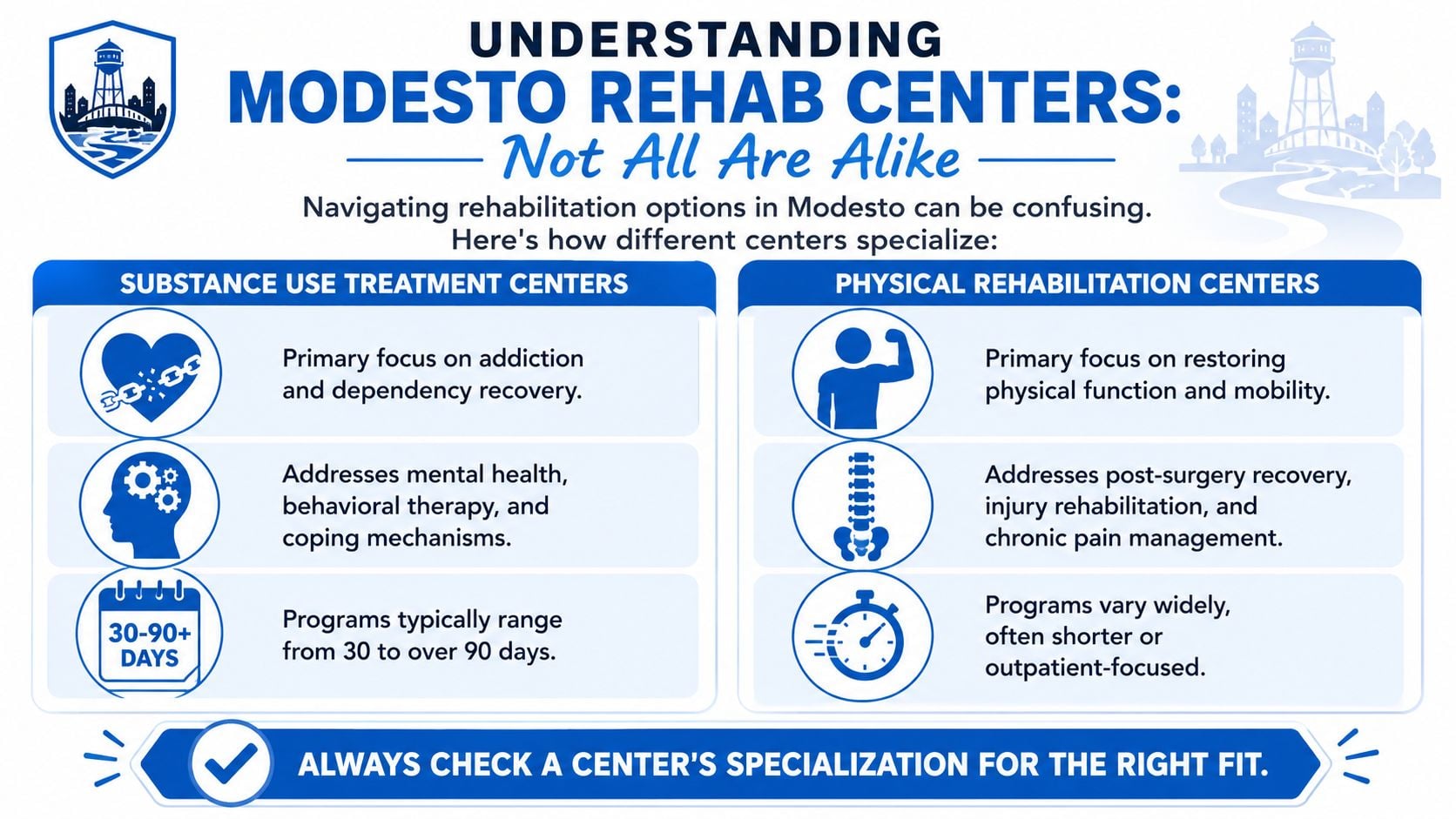
If you remember one thing, remember this. The word rehab describes a goal, not a specialty. The specialty matters more.
The three categories people confuse
Inpatient rehabilitation hospitals
These are for people who need intense physical recovery after a major medical event. Think stroke, serious injury, or major surgery complications. The focus is therapy, mobility, function, and medical oversight.
This is hospital-style rehab. It is not addiction treatment.
Skilled nursing and post-acute rehab facilities
These facilities usually serve people who need ongoing nursing support plus some rehabilitation. They often care for older adults, medically fragile patients, and people who aren't ready to go home safely yet.
In Modesto, these facilities have been part of the local care system for a long time. Modesto Post Acute Center says it has provided skilled care 24 hours a day since 1968 and operates a 99-bed facility at 159 E Orangeburg Ave, while River View Post Acute also identifies itself as a 99-bed skilled nursing and rehabilitation facility in Modesto on the Modesto Post Acute Center site. That tells you this type of rehab isn't niche. It's a long-established part of local healthcare.
Substance use treatment centers
These programs help people stop using drugs or alcohol and build a recovery plan that holds. The focus is detox when needed, counseling, relapse prevention, mental health support, medication options, structure, and aftercare.
This is the category you want if the problem is addiction.
Practical rule: If the website talks mostly about surgery recovery, mobility training, falls, wound care, or nursing support, you're probably not looking at addiction treatment.
There's another clue families miss. Physical rehab and skilled nursing facilities often involve referral rules, medical discharge planning, and different insurance expectations. Addiction programs have their own intake process, clinical screening, and level-of-care decisions. If you call the wrong type of provider, you may get polite answers but no useful path forward.
So be blunt with yourself. What is the actual problem?
- Alcohol or drug use is driving the crisis. Look for addiction treatment.
- The person needs help walking, transferring, or regaining function after illness or injury. Look for physical rehab or skilled nursing.
- You're not sure. Start by asking the provider what they treat every day, not what they mention somewhere on the homepage.
Understanding Your Treatment Options for Addiction
You already did the first hard part. You separated addiction treatment from the Modesto search results that mix in post-surgical rehab hospitals and skilled nursing facilities. Now get specific about the kind of addiction care the person needs today, not the kind that sounds easiest to arrange.
The right level of care depends on five things: how much the person is using, whether withdrawal could be dangerous, whether mental or physical health problems are in the mix, how stable home is, and whether they can follow through outside a structured setting. If a program cannot safely handle those realities, it is the wrong program.
What each level of care actually means
Medical detox
Detox is for people who may have a hard or unsafe withdrawal when they stop drinking or using drugs. The goal is medical monitoring, symptom relief, and stabilization.
Families get tripped up here all the time. Detox gets someone through the first phase. It does not fix the addiction by itself.
MAT
Medication-Assisted Treatment (MAT) uses medication along with counseling and clinical oversight for certain substance use disorders. This can be a strong option for alcohol or opioid addiction when cravings, relapse, or withdrawal keep derailing progress.
Drop the moral debate. If medication helps someone stay alive, stay engaged, and stop cycling through relapse, it is treatment doing its job.
Residential treatment
Residential care gives the person a live-in setting with daily structure, support, and distance from the people, places, and routines tied to use. Choose this level when home is unstable, access to substances is too easy, or repeated attempts at quitting have gone nowhere.
A protected setting helps because willpower is not enough in a chaotic environment.
IOP
An Intensive Outpatient Program gives several treatment sessions each week while the person continues living at home. It fits people who are medically stable and able to show up consistently, but still need much more support than weekly counseling.
This option can work well if the home environment supports recovery. It usually goes badly if the person is surrounded by active use, conflict, or constant triggers.
Telehealth
Telehealth can keep treatment within reach when transportation, work schedules, childcare, or distance would otherwise block care. For the right person, virtual sessions make attendance more realistic and more consistent.
It is a delivery method, not a lower standard of care. It still has to match the person's safety needs and level of stability.
Comparing addiction treatment program levels
| Program Type | Living Situation | Time Commitment | Best For |
|---|---|---|---|
| Medical detox | Supervised setting | Short-term stabilization | People who may face withdrawal and need medical monitoring |
| MAT | Usually at home or in treatment | Ongoing, based on clinical needs | People who may benefit from medication as part of recovery |
| Residential treatment | Live at the facility | Daily, highly structured | People who need separation from triggers and close support |
| IOP | Live at home | Regular scheduled treatment sessions | People who need strong treatment support without living onsite |
| Telehealth IOP or counseling support | Live at home | Remote scheduled participation | People who need flexibility and can participate safely from home |
Pick the level of care the person can complete safely and honestly. Picking the least disruptive option first often wastes time the family does not have.
Two mistakes come up again and again. Families choose outpatient care for someone who clearly needs detox or residential treatment, or they assume residential is always the best care because it sounds more serious. Match the program to the person. That is how treatment starts to work.
How to Choose the Right Addiction Program for You
Families often ask the wrong first question. They ask, “Which place is best?” A better question is, “Which program fits this person's risks, needs, and real-life constraints?”
That shift matters because access problems can derail good intentions fast. Insurance acceptance, referral requirements, and practical logistics affect whether treatment starts at all. As noted by Kaiser Permanente's English Oaks facility page, practical access constraints and objective comparison tools matter because quality can vary and families need more than marketing language.
Ask these questions before you commit
Is the level of care realistic?
If the person is using heavily, blacking out, at risk for withdrawal, or unable to stay sober in the current home environment, basic outpatient counseling may be too light. Don't underbuy care.
On the other hand, if the person is stable, motivated, and has support at home, a structured outpatient path may be the more sustainable choice.
What does the intake team ask?
A serious provider asks detailed questions. Substance use history, current safety concerns, mental health, medications, prior treatment, relapse patterns, and home support should all come up. If the conversation stays vague, that's a bad sign.
How do insurance and referrals work?
This part isn't glamorous, but it decides whether treatment starts smoothly or turns into a mess. Ask exactly what they verify, what they need from you, and whether any referral or prior authorization issues could delay admission.
What kind of support is offered beyond crisis management?
Detox alone is not enough. Ask how the program handles relapse prevention, coping skills, aftercare planning, and ongoing accountability.
What families often miss
Some families choose based on website polish. Others choose based on proximity alone. Both are weak filters.
Use this checklist instead:
- Clinical fit first. Match the program to withdrawal risk, mental health symptoms, and relapse history.
- Access second. Confirm insurance, referral requirements, scheduling, and transportation realities.
- Family role third. Ask how loved ones are included and what boundaries are recommended.
- Aftercare always. Treatment should not end with discharge paperwork and good wishes.
If a provider makes admission sound easy but can't explain how they decide the right level of care, slow down.
One more blunt point. The “right” program should feel structured, not vague. You want specifics. Who will evaluate the person? How is progress monitored? What happens if the first plan isn't enough? Clear answers usually signal a more grounded treatment process.
Making the Call The Admission Process Explained
The first call scares people more than it should. They expect pressure, judgment, or a confusing sales script. A good admissions conversation should feel nothing like that. It should feel calm, private, and practical.

One option for immediate help is Addiction Resource Center, which states that a confidential call is the first step and that its team is available 24/7 by phone or text at 530-625-7910 to answer questions, verify insurance, or schedule an assessment.
What happens on the first call
Most admissions calls cover the same core ground. They'll ask who needs help, what substances are involved, whether the person is safe right now, and whether there are urgent medical or mental health concerns.
They should also ask practical questions. Can the person stop using safely? Are they willing to come in? Is there insurance? Is transportation an issue? Has treatment been tried before?
You do not need to have a perfect summary prepared. You just need enough honesty to describe what's been happening.
A useful way to prepare is to write down:
- Current substance use. What is being used, how recently, and whether stopping has gone badly before.
- Safety concerns. Withdrawal symptoms, overdose history, suicidal talk, or medical complications.
- Mental health concerns. Anxiety, depression, trauma, panic, paranoia, or extreme mood swings.
- Logistics. Insurance card, basic identification, and how quickly the person could start.
What usually happens next
After the initial call, the provider typically decides whether the person needs a fuller clinical assessment, immediate detox screening, outpatient placement, or another referral. That's where the process should become more precise.
Here's a short overview of what a treatment-centered intake often looks like:
Initial screening
A team member gathers the immediate facts and flags safety issues.Clinical review
A clinician or admissions staff member helps determine the likely level of care.Insurance verification
Benefits are checked so the family knows what to expect.Scheduling or admission planning
If the fit is right, next steps are arranged. If it isn't, a responsible provider should say so.
For a quick visual overview of how people move from first contact into treatment, this video gives a helpful framework:
The first call is not a commitment to everything. It's a commitment to getting accurate information instead of guessing.
How Family Support Enhances Recovery
Addiction doesn't isolate itself to one person. It reorganizes the entire household. Routines change, trust erodes, people start covering, monitoring, rescuing, arguing, or withdrawing. That's why family involvement matters. Not as a sentimental add-on, but as part of whether recovery can hold in real life.

Support helps when it is healthy and structured
Family support is useful when it stops feeding the addiction and starts supporting recovery. That may mean learning how to communicate without constant accusation, refusing to provide money that will fund use, or participating in therapy when appropriate.
It also means paying attention to stress. Early recovery can be emotionally volatile for everyone involved. If your household is living in constant tension, practical tools that lower stress responses can help. Some families find value in reading MedEq Fitness wellness journal insights on calming the body and rebuilding steadier routines during high-pressure periods.
What good family involvement looks like
Good support is not surveillance. It is not checking every phone record, forcing confessions every night, or trying to become the person's therapist.
It usually looks more like this:
- Clear boundaries. “We'll help you get treatment, but we won't fund active use.”
- Consistent expectations. House rules and consequences stay stable.
- Participation when invited. Family sessions, education, and recovery planning can help everyone stop repeating the same cycle.
- Care for the caregiver. Loved ones need support too. Burned-out families make desperate decisions.
A family can be loving and still be exhausted. Both can be true.
Recovery gets stronger when the home environment becomes more honest, more predictable, and less chaotic.
If you're the one making the calls, don't disappear from the process once treatment starts. Stay informed. Ask what role you should play. Ask what role you should stop playing too. That second question is often the one that changes everything.
Your Path to Healing Starts with One Step
If you searched for rehabilitation center Modesto CA, you've already done the hard part of admitting that something needs to change. The next hard part is refusing to get lost in the wrong category of care.
This is the main point. In Modesto, “rehab” can mean addiction treatment, a physical rehabilitation hospital, or skilled nursing support. Those are different systems with different purposes. Once you identify the right lane, the path gets clearer fast.
If this is an addiction issue, don't waste another day calling places that treat post-surgical recovery or elder-care rehab. Get a real assessment. Ask direct questions. Verify insurance. Find out what level of care fits the person, not what sounds easiest in the moment.
Help is built one decision at a time. First the call. Then the assessment. Then the plan. That's how chaos starts turning into treatment.
For immediate, confidential guidance or to begin the admission process, Addiction Resource Center's team is available 24/7 by phone or text at 530-625-7910.
If you need clear next steps for drug or alcohol treatment, Addiction Resource Center LLC offers confidential guidance, insurance verification, and admission support any time. Call or text 530-625-7910 to talk through your options and find the right starting point.